


 |
This is a misplaced articles for creation submission. If it is not yet ready for article space, please consider moving it to draft space rather than marking it for deletion.
Note: If you are not an administrator or page mover please tag the redirect left behind after the move for deletion using {{db-r2}}. |
Building in London, England
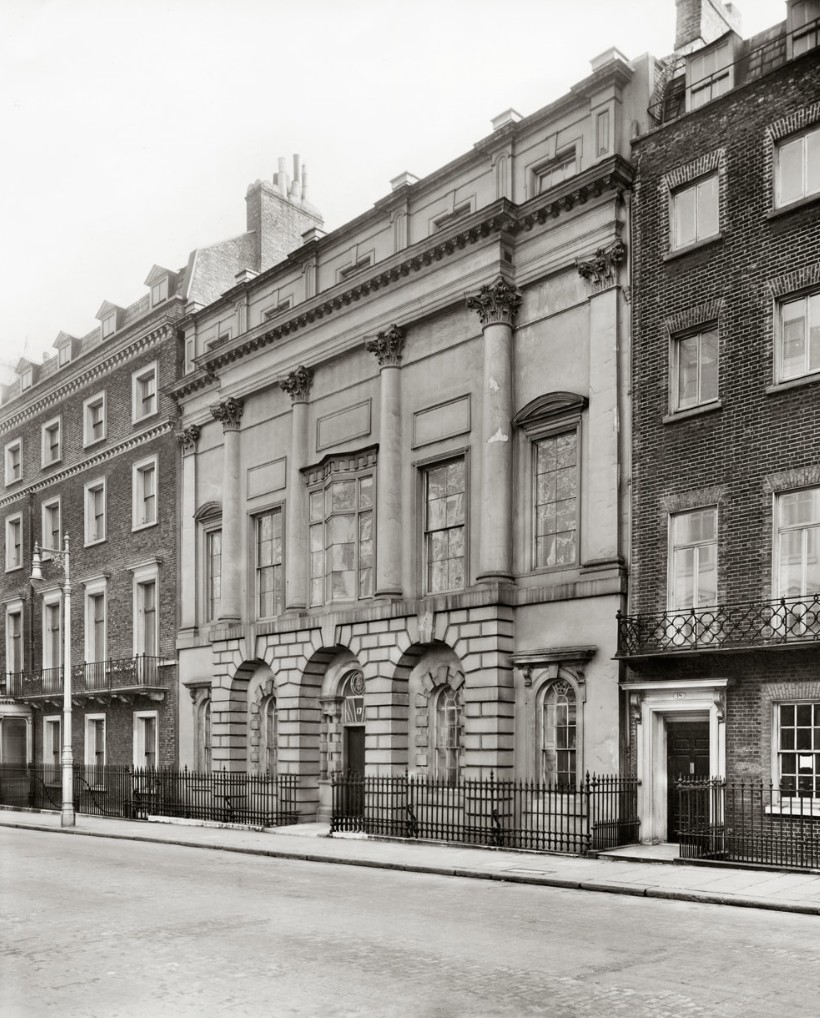
17 Bruton Street was a large, eighteenth-century townhouse located next to Berkeley Square in Mayfair, London. Built in 1742, it was leased by 1920 Claude Bowes-Lyon, 14th Earl of Strathmore and Kinghorne during the 1920s. On 21 April 1926 Lord Strathmore’s daughter Elizabeth, Duchess of York gave birth at the house to Princess Elizabeth of York, who would later become the longest-reigning Sovereign of the United Kingdom.
History and occupants
The house was the town residence of Neil Primrose, 3rd Earl of Rosebery in 1796.[1]
In 1831 the lease, which then had a remaining term of four years, was held by Thomas Berkeley, 6th Earl of Berkeley.[2] In 1832 the house was taken by William Pole-Tylney-Long-Wellesley (who later became 4th Earl of Mornington).
The house was later occupied by Miles Stapleton, 10th Baron Beaumont, who died there on 16 August 1854.[3]
In November 1855 the house was listed as the London residence of Viscount Ebrington.[4]
In March 1860 the House was recorded as being the London residence of John Bligh, 6th Earl of Darnley.[5]
The Morning Post reported that the Countess of Carnarvon (wife of Henry Herbert, 4th Earl of Carnarvon) gave birth to a stillborn son at the house on 21 July 1862.[6]
By December 1869 the House had become the London home of William Campbell, 2nd Baron Stratheden and Campbell.[7] The Campbell family continued to occupy the House until the early 20th century. Following the death of the 2nd Baron Stratheden and Campbell in January 1893, the House become the home of his brother and successor, who loaned the house to Mrs Alban Gibbs for a dance held on 30 May 1893.[8]
In 1905 The Hon. Kenneth Campbell, youngest son of Lord and Lady Stratheden and Campbell married Rosalina Oppenheim; this was reported as something of a novelty in the Daily Mirror due to the fact that the bride’s parents (Mr and Mrs de:Henry Oppenheim) and groom’s parents were neighbours in London, occupying No. 16 and 17 Bruton Street respectively.[9]
During the First World War the Campbell family based an appeal for donations of clothing and money to support Lord Kitchener’s army.[10]
The 3rd Baron Stratheden and Campbell died at 17 Bruton Street on 26 December 1918.[11]
In early 1920 the house was being used as the headquarters of the anti-communist Liberty League.[12] On 11 March 1920 the house was the side of the Breton Fete in aid of the ex-Services Welfare Society, which was opened by Louise, Princess Royal, [13] who was accompanied by her daughter Princess Maud of Fife.[14] The purpose of the society was outlined by Sir Frederick Milner, who was appealing for funds to establish a hostel for the approximately 6,000 ex-servicemen who had “lost their mental balance in the war and are at present in the Poor Law asylums.”[14]
On 15 April 1920 the house was used for the wedding reception of Major Charles Gore, son of Sir Francis Charles Gore, and The Hon. Kathleen Annesley, daughter of former Comptroller of the Royal Household Arthur Annesley, 11th Viscount Valentia.[15]
Lady Blythswood was loaned the house by Lord Stratheden and Campbell for a debutante dance she hosted for her daughter The Hon. Olive Campbell in July 1920; the event was reportedly attended by nearly 300 guests, including Princess Margaret of Denmark.[16]
Later in the same year, it was reported in The Times that an auction of the contents of the house would be held on 8 November due to the sale of the lease of the property.[17]
Bowes-Lyon family
In June 1920 Claude Bowes-Lyon, 14th Earl of Strathmore and Kinghorne and his wife Cecilia Bowes-Lyon, Countess of Strathmore and Kinghorne vacated No. 20 St James’s Square, which had been used as the family’s London townhouse during the 1910s.[18] A temporary lease was taken over a house in Eaton Square, and by April 1921 the lease of No. 17 Bruton Street had been acquired and renovations were underway in preparation for the Bowes-Lyon family’s occupation of the house.[18] The family had moved in to their new Bruton Street residence by March 1922.[19]
In January of 1923 the Strathmores’ youngest daughter Lady Elizabeth Bowes-Lyon had become engaged to Prince Albert, Duke of York.[20] Lady Strathmore arrived at 17 Bruton Street on 9 April in preparation for her daughter’s wedding.[21]
On 26 April 1923 Lady Elizabeth departed from No. 17 Bruton Street for Westminster Abbey where she and Prince Albert were married.[22]
The house was loaned by Lord and Lady Strathmore for a chamber music concert hosted by pianist Mathilde Verne on 14 June 1928.[23]
Lord Strathmore sold the lease of the property in early 1929; the Evening Standard reported on 26 March that the Strathmores would vacate the property in mid-April of that year, and that the reported purchase price of the house was £26,000.[22] On 1 July couturier Norman Hartnell hosted a circus-themed party at the house.[24]
Birthplace of Princess Elizabeth of York
The Duchess of York arrived at the property on 6 April 1926 in preparation for the birth of her first child.[25][24] On the evening of 20 April the-then Home Secretary Sir William Joynson-Hicks was summoned to No. 17 to be present for the birth,[26] and during the morning of 21 April the Duchess gave birth to Princess Elizabeth of York, reportedly in a “quiet room at the back overlooking the garden,”[27] on the first floor of the house.[28] Later on the same day the baby Princess’ paternal grandparents King George V and Queen Mary were driven from Windsor Castle to 17 Bruton Street to see their new granddaughter.[28]
The Duke and Duchess of York and the young Princess left the house on 10 August 1926 to visit the Duchess’ ancestral home Glamis Castle.[29] They continued to use the house as a temporary London residence, and were photographed on the front steps in January 1927 when they departed for their tour of Australia and New Zealand, during which they opened the newly-finished Commonwealth Parliament House in Canberra.[28] Their household had relocated from 17 Bruton Street by the time they returned from the tour in mid-1927.[28]
Commercial use and demolition
By January 1930 the house was available to be leased for commercial use.[30] During the same year it was one of approximately fifteen mansions on Bruton Street (including No. 11-19 and 15-20) purchased by the Canadian Pacific Railway Company,[1] with the intention intent to demolish the houses to conduct a large luxury hotel. These plans were paused in May 1931,[1] and it was later announced in February 1934 that No. 17 Bruton Street would be used as the Company’s headquarters in London.[1]

The house was demolished in March 1937; the The Daily Telegraph reported that it would be replaced by a 145-foot office tower, noting that during the 1930s much of Bruton Street had been commercialised, and that the remaining buildings which “retain the appearance of private houses are in nearly every case dressmarkers’ shops and offices.”[31][32] A plaque outside the existing building commemorates the site as the birthplace of Queen Elizabeth II.[32]
Architecture
Built in 1732, the design of the house was been attributed to Isaac Ware.[32] In 1831 house was described in a newspaper advertisement as a “capital mansion…near Berkeley-square, having a frontage of 54 feet and a depth of 130 feet, with a garden and seven-stall stable behind, opening into Bruton Mews. The mansion contains numerous suites of spacious rooms and all the requisite offices, and is held of the Earl of Berkeley for an unexpired term of four years from 3d of August next, at a ground rent of only £26 6s 6d per annum.”[2]
A description of the house published in 1911 noted that “the façade of this interest front consist of a fine treatment of the Corinthian order placed directly upon a rusticated basement story,”[33] and also noted that the house was “architecturally…somewhat cold; the attic story is a Victorian addition without merit.”[33]
In an article published on 16 February 1934 in The Daily Telegraph described the house as a having a “dignified elevation in the style of the English Renaissance,”[1] and containing “an ample suite of reception-rooms, including a ballrooms measuring 50ft by 21ft.”[1]
Following the house’s demolition in March 1937, The Guardian reported in July of the same year that the house’s exterior featured an “imposing columned plaster front and a humble brick back overlooking a tiny stone-flagged garden with an old stables-still with a horse-box at the end,”[27], whilst the interior included “stately entrance hall with a groined ceiling and relief medallions, probably by Flaxman.”[27]
References
- ^ a b c d e f “Canadian Pacific Railway Company Offices in Mayfair – 17 Bruton Street”. The Daily Telegraph. London, England. 16 February 1934. p. 14. Retrieved 1 November 2025 – via Newspapers.com.
- ^ a b “17 Bruton Street, near Berkeley Square – 4 year lease for sale”. The Morning Post. London, England. 23 May 1831. p. 4. Retrieved 1 November 2025 – via Newspapers.com.
- ^ “Death of Lord Beaumont at 17 Bruton Street, Berkeley Square”. The Standard. London, England. 18 August 1854. p. 2. Retrieved 1 November 2025 – via Newspapers.com.
- ^ “Viscount Ebrington MP of 17 Bruton Street, London”. Daily News. London, England. 20 November 1855. p. 3. Retrieved 1 November 2025 – via Newspapers.com.
- ^ “The Earl and Countess of Darnley have arrived at 17 Bruton Street, London”. The Morning Post. London, England. 2 March 1860. p. 6. Retrieved 1 November 2025 – via Newspapers.com.
- ^ “17 Bruton Street – Countess of Carnarvon gives birth stillborn son”. The Morning Post. London, England. 23 July 1862. p. 7. Retrieved 1 November 2025 – via Newspapers.com.
- ^ “The Education Question”. The Morning Post. London, England. 9 December 1869. p. 6. Retrieved 1 November 2025 – via Newspapers.com.
- ^ “Dance at 17 Bruton Street, Mayfair”. The Morning Post. London, England. 9 May 1893. p. 5. Retrieved 1 November 2025 – via Newspapers.com.
- ^ “Engagement of Lord and Lady Stratheden’s son to daughter of Mr and Mrs Henry Oppenheim”. Daily Mirror. London, England. 18 March 1905. p. 7. Retrieved 1 November 2025 – via Newspapers.com.
- ^ “Appeal for Donations for Lord Kitchener’s Army – 17 Bruton Street, W.” The Times. London, England. 17 February 1915. p. 17. Retrieved 1 November 2025 – via Newspapers.com.
- ^ “Lord Stratheden and Campbell dies at 17 Bruton Street, London”. The Times. London, England. 28 December 1918. p. 9. Retrieved 1 November 2025 – via Newspapers.com.
- ^ “Bolshevism on the Brain”. Daily Herald. London, England. 6 March 1920. p. 3. Retrieved 1 November 2025 – via Newspapers.com.
- ^ “Princess Royal opens fete at 17 Bruton Street, London”. The Times. London, England. 11 March 1920. p. 17. Retrieved 1 November 2025 – via Newspapers.com.
- ^ a b “The Breton Fete”. The Times. London, England. 12 March 1920. p. 19. Retrieved 1 November 2025 – via Newspapers.com.
- ^ “Marriage – Major Charles Gore & The Hon. Kathleen Annesley”. The Times. London, England. 16 April 1920. p. 17. Retrieved 1 November 2025 – via Newspapers.com.
- ^ “Dance – 17 Bruton Street, London”. The Daily Telegraph. London, England. 2 July 1920. p. 13. Retrieved 1 November 2025 – via Newspapers.com.
- ^ “Auction of contents of 17 Bruton Street, W.” The Times. London, England. 5 November 1920. p. 26. Retrieved 1 November 2025 – via Newspapers.com.
- ^ a b Elizabeth, Queen (2013). Counting One’s Blessings: Selected Letters of Queen Elizabeth the Queen Mother. edited by William Shawcross. London: Pan Books. pp. 80–81, 90–91. ISBN 978-0-330-53577-9.
- ^ Elizabeth, Queen (2013). Counting One’s Blessings: Selected Letters of Queen Elizabeth the Queen Mother. edited by William Shawcross. London: Pan Books. p. 98. ISBN 978-0-330-53577-9.
- ^ Longford, Elizabeth (1981). The Queen Mother. London: Weidenfeld & Nicolson. p. 23. ISBN 978-0-580-60560-35.
- ^ “Countess of Strathmore in residence at 17 Bruton Street until wedding of Lady Elizabeth Bowes-Lyon”. The Daily Telegraph. London, England. 10 April 1923. p. 13. Retrieved 1 November 2025 – via Newspapers.com.
- ^ a b “17 Bruton Street Sold”. Evening Standard. London, England. 26 March 1929. p. 12. Retrieved 1 November 2025 – via Newspapers.com.
- ^ “Concert – 17 Bruton Street, London”. The Daily Telegraph. London, England. 9 June 1928. p. 1. Retrieved 1 November 2025 – via Newspapers.com.
- ^ a b Barrow, Andrew (1980). Gossip: A History of High Society from 1920 to 1970. London: Pan Books. pp. 29, 46. ISBN 0-330-26223-8.
- ^ Elizabeth, Queen (2013). Counting One’s Blessings: Selected Letters of Queen Elizabeth the Queen Mother. edited by William Shawcross. London: Pan Books. p. 146. ISBN 978-0-330-53577-9.
- ^ Spencershew, Betty (1947). Royal Wedding. London: MacDonald & Co. p. 28. Retrieved 1 November 2025.
- ^ a b c “The Dismemberment of Berkeley Square – Princess Elizabeth’s Birthplace”. The Guardian. London, England. 19 July 1937. p. 6. Retrieved 1 November 2025 – via Newspapers.com.
- ^ a b c d Montague-Smith, Patrick W. (1981). The Country Life Book of Royal Palaces, Castles & Homes: Including Vanished Palaces and Historic Houses With Royal Connections. London: Country Life Books. pp. 124–126. ISBN 0-600-36808-4.
- ^ “Duke and Duchess of York & Princess Elizabeth leave 17 Bruton St for Glamis Castle”. The Daily Telegraph. London, England. 10 August 1926. p. 11. Retrieved 1 November 2025 – via Newspapers.com.
- ^ “Offices in Berkeley Square – More Mayfair Changes”. The Daily Telegraph. London, England. 24 February 1930. p. 8. Retrieved 1 November 2025 – via Newspapers.com.
- ^ “Making Way for a Skyscraper – 17 Bruton Street, London”. The Daily Telegraph. London, England. 13 August 1937. p. 12. Retrieved 1 November 2025 – via Newspapers.com.
- ^ a b c Montague-Smith, Patrick W. (1981). The Country Life Book of Royal Palaces, Castles & Homes: Including Vanished Palaces and Historic Houses with Royal Connections. with contributions by Hugh Montgomery-Massingberd. London and New York: Country Life Books ; Distributed by Hamlyn. p. 126. ISBN 0-600-36808-4.
- ^ a b Richardson, A. E.; Gill, C. Lovett (1911). London Houses from 1660 to 1820: A Consideration of Their Architecture and Detail. London: Charles Scribner’s Sons. p. 59. Retrieved 1 November 2025.



