


| dissipated = November 7, 2025, 5:40 p.m. ([[UTC−03:00]])
| dissipated = November 7, 2025, 5:40 p.m. ([[UTC−03:00]])
}}{{Infobox weather event/Tornado
}}{{Infobox weather event/Tornado
| gusts = {{convert|250|km/h|mph|round=5|abbr=on}} (estimated)
| gusts = {{convert||km/h|mph|round=5|abbr=on}} (estimated)
| fujita-scale = F3
| fujita-scale = F3
}}{{Infobox weather event/Effects
}}{{Infobox weather event/Effects
F3 tornado in Paraná, Brazil
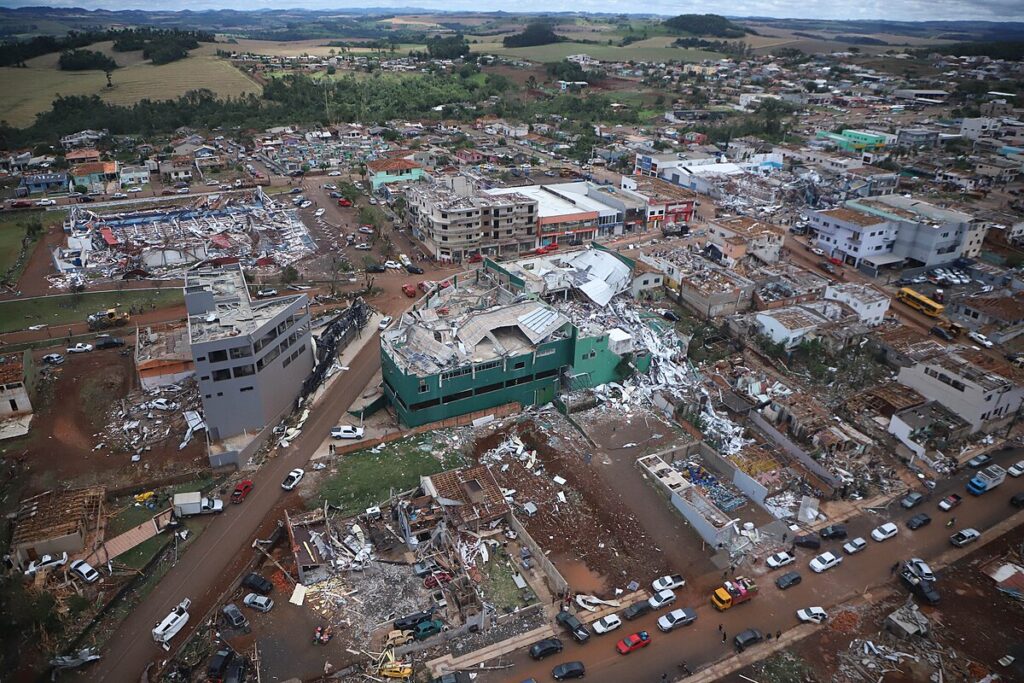
On November 7, 2025, an intense[1] tornado devastated the municipality of Rio Bonito do Iguaçu in Paraná, Brazil, killing six people, injuring over 784 others,[2] and causing widespread damage. The tornado was rated as an F3 on the Fujita scale.[1][3][4][note 1]
Meteorological synopsis
[edit]
According to Simepar and MetSul Meteorologia, the tornado was caused by the interaction between a mass of warm, humid air coming from the north of the country and a strong cold front advancing through the south, driven by an extratropical cyclone. The atmospheric conditions favored the formation of a supercell, a set of clouds characterized by an ascending, rotating air current, which can produce tornadoes, hail, and severe storms under ideal conditions.[6][7]
The warm air that was over southern Brazil, coming from the Amazon rainforest, increased thermodynamic instability, which was also intensified by the sharp drop in temperature, enabling the formation of other storms in the region, including at least three other tornadoes in the neighboring state of Santa Catarina.[6][8] A tornado also struck the nearby city of Guarapuava, killing one person, but authorities could not verify whether this was a separate cell from the one that struck Rio Bonito do Iguaçu.[9]
In addition to the squall line produced by the cyclone, other determining factors for the formation of the tornado were low level jets directed westward across Santa Catarina and Paraná, increasing wind shear and thus favoring tornadogenesis.[6][7]
The tornado caused widespread destruction in the urban and rural areas of the municipality. According to the governor of Paraná, Ratinho Júnior, about 90% of the homes in Rio Bonito do Iguaçu were partially or totally destroyed.[10]
The tornado killed at least six people and injured 750 others. Among the victims was a 14-year-old girl who died from her injuries after the house where she was sheltering with her family collapsed.[11][12] A supermarket also collapsed, trapping multiple people under debris.[13] About 1,000 people were displaced.[14]
The tornado had widespread national and international repercussions, being described by meteorologists as one of the most intense ever recorded in Paraná. MetSul highlighted that the occurrence of an F3 tornado in southern Brazil is a rare event, comparable only to a few documented cases in recent decades.[6]
Teams from Civil Defense, the Paraná Fire Department and the Brazilian Army were deployed to the municipality in the first hours after the disaster. Searches for victims were carried out among the rubble throughout the weekend. The state government sent trucks with food, blankets, and drinking water, as well as equipment to restore electricity.[1]
Temporary shelters were set up in gyms and schools in the region. Nearby hospitals, such as those in Laranjeiras do Sul and Guarapuava, received seriously injured people. Governor Ratinho Júnior declared a state of emergency and announced financial support for the reconstruction of the most affected areas.[10]
Initial estimates pointed to losses in the tens of millions of reais, although the exact amount has not yet been officially released.[11]
Governor of Paraná Ratinho Júnior led an emergency meeting at the Central Fire Department Headquarters in state capital Curitiba regarding response to the disaster,[15] stating “it is a unique catastrophe in the history of Paraná”.[16]
President of Brazil Luiz Inácio Lula da Silva sent his cabinet ministers to aid in the relief efforts.[17]
- ^ a b c “Tornado que devastou cidade no Paraná e deixou seis mortos atingiu índice EF3, com ventos de até 250 km/h” [Tornado that devastated city in Paraná and left 6 dead reached EF3 intensity, with winds of up to 250 km/h] (in Brazilian Portuguese). G1. G1 PR and RPC. 8 November 2025. Archived from the original on 9 November 2025. Retrieved 9 November 2025.
- ^ “Devastada por tornado no Paraná, cidade começa limpeza e vistoria em casas”. O Globo (in Brazilian Portuguese). 2025-11-09. Retrieved 2025-11-09.
- ^ “Tornado no Paraná: veja como é feita classificação de fenômeno climático” [Tornado in Paraná: see how the climatic phenomenon is classified.]. CNN Brasil (in Brazilian Portuguese). Retrieved 2025-11-08.
O fenômeno meteorológico de nível F3 é o terceiro numa escala que mede de zero a cinco a intensidade desse tipo de evento climático. [The F3 level meteorological phenomenon is the third on a scale that measures the intensity of this type of weather event from zero to five.]
- ^ “‘Sem precedentes’: tornado que atingiu cidade no Paraná teve ventos acima de 250km/h, diz Ratinho Jr” [‘Unprecedented’: tornado that hit city in Paraná had winds exceeding 250km/h, says Ratinho Jr.]. O Globo (in Brazilian Portuguese). Retrieved 2025-11-08.
Inicialmente, o Sistema de Tecnologia e Monitoramento Ambiental do Paraná (Simepar) chegou a classificar o tornado como F2, quando os ventos ficam entre 180 km/h e 250 km/h. O órgão, no entanto, mudou a classificação posteriormente para F3, categoria para ventos que ultrapassam os 250 km/h de velocidade. A classificação tem seis níveis, de F0 a F5. [Initially, the Paraná Environmental Technology and Monitoring System (Simepar) classified the tornado as F2, when winds reach speeds between 180 km/h and 250 km/h. However, the agency later changed the classification to F3, a category for winds exceeding 250 km/h. The classification has six levels, from F0 to F5.]
- ^ PREVOTS [@prevots_svr] (2025-11-09). “Pelo menos 8 tornados foram identificados em SC e PR na última sexta-feira. O tornado mais significativo, que atingiu Rio Bonito do Iguaçu, recebeu classificação *preliminar* de F4 no nosso banco de dados com base nos danos na cidade. Vamos atualizar os dados nos próximos dias” [At least eight tornadoes were identified in Santa Catarina and Paraná last Friday. The most significant tornado, which struck Rio Bonito do Iguaçu, received a preliminary F4 rating in our database based on the damage in the city. We will update the data in the coming days.] (Tweet) (in Brazilian Portuguese). Retrieved 2025-11-09 – via Twitter.
- ^ a b c d “Entenda em mapas, imagens de satélite e gráficos o tornado no Paraná” [Understand the tornado in Paraná through maps, satellite images, and graphs.]. MetSul Meteorologia (in Brazilian Portuguese). November 8, 2025. Retrieved November 8, 2025.
- ^ a b Brito, Pablo Olave. “O que é supercélula: a tempestade que gerou o tornado fatal no Paraná” [What is a supercell: the storm that generated the deadly tornado in Paraná.]. NSC Total (in Brazilian Portuguese). Retrieved 2025-11-08.
- ^ Felipe Theodorovitz (8 November 2025). “NOTA METEOROLÓGICA SDC/SC 08/11 – Tempestades severas com tornados confirmados no Oeste catarinense na tarde de sexta-feira (07)” [WEATHER NOTICE SDC/SC 08/11 – Severe storms with confirmed tornadoes on Western Santa Catarina on Friday afternoon (07)]. Secretaria de Estado da Proteção e Defesa Civil de Santa Catarina (in Brazilian Portuguese). Government of Santa Catarina. Archived from the original on 9 November 2025. Retrieved 9 November 2025.
- ^ “Ciclone no Sul teve 4 tornados, deixou 7 mortos e espalhou destruição” [Cyclone in the South had 4 tornadoes, left 7 dead, and spread destruction]. MetSul Meteorologia (in Brazilian Portuguese). 8 November 2025. Archived from the original on 9 November 2025. Retrieved 9 November 2025.
- ^ a b “Rio Bonito do Iguaçu chega a 90% das casas destruídas por tornado, diz governador do PR” [Rio Bonito do Iguaçu has 90% of its houses and buildings destroyed, says the governor of Paraná.]. Terra (in Brazilian Portuguese). November 8, 2025. Retrieved November 8, 2025.
- ^ a b “Tornado no Paraná deixa mortos e dezenas de feridos” [Tornado causes destruction and leaves 6 dead and more than 700 injured in Paraná.]. UOL (in Brazilian Portuguese). November 8, 2025. Retrieved November 8, 2025.
- ^ “Adolescente é uma das vítimas do tornado no Paraná” [A 14-year-old teenager is one of the victims of the tornado in Paraná.]. G1 (in Brazilian Portuguese). November 8, 2025. Retrieved November 8, 2025.
- ^ Tempo, Redação Jornal Novo (2025-11-07). “Jornal Novo Tempo”. Jornal Novo Tempo (in Brazilian Portuguese). Retrieved 2025-11-07.
- ^ “Tornado in Brazil kills 6, injures hundreds”. CBC News. November 8, 2025. Retrieved November 8, 2025.
- ^ Ionova, Ana (November 8, 2025), “Tornado Rips Through Southern Brazil, Killing at Least 5”, The New York Times, retrieved November 8, 2025
- ^ “Tornado: Catástrofe única na história do Paraná, diz Ratinho Jr. à CNN” [Tornado: A unique catastrophe in the history of Paraná, says Ratinho Jr. to CNN]. CNN Brasil (in Brazilian Portuguese). November 8, 2025. Retrieved November 8, 2025.
- ^ Júlia Lopes, Anna (November 8, 2025). “Lula envia ministros para acompanhar ações e vítimas de tornado no Paraná” [Lula sends ministers to monitor relief efforts and assist victims of tornado in Paraná]. CNN Brasil (in Brazilian Portuguese). Retrieved November 8, 2025.



