


 |
|
| Date | October 1, 2025 – present (2025-10-01 – present) (41 days) |
|---|---|
| Cause | Expiration of continuing resolution from Full-Year Continuing Appropriations and Extensions Act, 2025 |
| Employees furloughed | ~900,000 |
On October 1, 2025, the federal government of the United States entered a shutdown at midnight EDT after Congress failed to pass appropriations legislation for the 2026 fiscal year, which began that day. The shutdown has continued for 41 days as Congress has been unable to pass a continuing resolution to fund the government. The House has advanced a continuing resolution, but the Senate has rejected it 14 times. Senate Democrats have opposed the Republican appropriations bill because it does not include an extension of the Affordable Care Act subsidies previously extended by the Inflation Reduction Act.[a]
The shutdown resulted in the furlough of roughly 900,000 federal employees and kept another two million working without pay. Some government programs such as Medicare and Medicaid continue to operate, as do certain agencies such as the Department of Defense and the Transportation Security Administration. Other agencies’ operations have been partially or fully suspended, including the National Institutes of Health, the Centers for Disease Control and Prevention, and the WIC program.
The shutdown is the 11th government shutdown that resulted in federal employees being furloughed and is the longest government shutdown in U.S. history.[7][8]
Background
Government funding procedure and fiscal authority
.jpg)
Article One of the United States Constitution vests the U.S. Congress with the authority to appropriate funds drawn from the Treasury.[9]: 1 Since 1977, the federal budget process has used a fiscal year that runs from October 1 to September 30 of the following year, with 12 individual spending bills that must be passed.[9]: 12 Political polarization has affected this process, often forcing lawmakers to pass continuing resolutions to temporarily fund the government.[10]
The failure of Congress to agree on funding legislation leads to a government shutdown when the previous funding term ends.[9]: 28-29 In a government shutdown, federal agencies continue work categorized as “essential“, but federal employees and contractors are furloughed and not immediately paid. The authority to determine the work that continues is vested in the director of the Office of Management and Budget, although the president has broad authority over this process.[11]
Earlier budget impasse
Ahead of a lapse of government funding expected to occur in March 2025, Democrats in Congress largely objected to funding the government as President Donald Trump moved to assume control of the extent of its operations, including eliminating federal funding and dismissing government workers. Hours before the deadline, Senate minority leader Chuck Schumer announced that he would support a continuing resolution to fund the government through September, arguing that Trump’s efforts were being halted in the courts—which could be impeded by a shutdown; that a shutdown would give greater authority to the Department of Government Efficiency; and that market uncertainty would mount over a shutdown in addition to imminent widespread tariffs, causing ambiguity over the responsibility of economic fear.[12] Schumer’s support incited other Democrats to vote in favor of a temporary continuing resolution proposed by Republicans, allowing the measure to pass and averting a shutdown. Schumer was criticized by several Democrats for his move, including House Democratic Leader Hakeem Jeffries.[13]
Affordable Care Act subsidies
Passed in 2010, the Affordable Care Act (ACA) was a major reform of the U.S. healthcare system that, among other provisions, established income-based tax credits to subsidize the cost of health insurance.[14] For eligible households, subsidies reduced the cost of insurance premiums to between 2.07% and 9.38% of income.[15] Households earning more than 400% of the federal poverty level were ineligible for subsidies, creating a steep welfare cliff.[16]
The American Rescue Plan Act of 2021 increased and expanded the subsidies, though only temporarily for 2021 and 2022. It eliminated the upper income cap for who is eligible for subsidies and further limited the share of income paid, now for all households, to between 0% and 8.5%.[17][15][14] In line with the Build Back Better Plan, Democratic lawmakers proposed bills to make the expanded tax credits permanent.[15][18] As a compromise, the Inflation Reduction Act of 2022 extended the expanded subsidies through 2025.[19]
In 2025, Congress allowed the expanded subsidies to expire and made additional cuts to the medical welfare system under the One Big Beautiful Bill Act.[20] Contention over these changes became a major conflict leading to the government shutdown.[21]
Budget discussions
Initial passages and emerging conflicts
The continuing resolution Republicans passed set a deadline through the remainder of that year’s fiscal budget term, expected to conclude at the end of September. In July, Republicans approved the Trump administration‘s request to rescind US$9 billion allocated for foreign aid and public broadcasting. Washington senator Patty Murray, the ranking member of the Senate Committee on Appropriations, told The New York Times that the “partisan rescissions bill” complicated efforts for Democrats to work with Republicans on a funding bill for the next year’s budget, set to begin in October. That month, senators opened debate on a series of appropriations bills, beginning with military construction projects and veterans programs. Democrats indicated that they would seek to avert a shutdown in budget discussions.[12] In July, Office of Management and Budget Director Russell Vought said, “The appropriations process has to be less bipartisan“, said the White House would not abide by bipartisan spending agreements, and reiterated that he believed the Impoundment Control Act was unconstitutional. The remarks drew condemnation from Democrats and pushback from Senate Majority Leader John Thune.[22]
By August, Senators approved an initial set of spending bills, including US$433 billion for veterans programs, US$19.8 billion for military construction and family housing projects, US$27.1 billion for agricultural programs, and US$7.1 billion to continue the operations of Congress and legislative agencies.[23] Although the bills passed before an anticipated recess that month for the first time since 2018, the objections mounted, indicating further resistance ahead of the deadline. Louisiana senator John Kennedy unsuccessfully sought a two percent reduction in the agriculture bill. Kennedy later called for a separate vote on the legislative branch funding bill to state his opposition to the funding level. A fourth bill that would have funded the Department of Commerce, the Department of Justice, and science agencies faltered after opposition from Maryland senator Chris Van Hollen. The legislative branch funding bill largely kept the Government Accountability Office‘s funding levels consistent, despite the agency’s conflict with the Trump administration; the House of Representatives‘s bill halved the office’s budget.[23] In September, House Speaker Mike Johnson and House Minority Leader Hakeem Jeffries discussed extending government funding into November or December.[24] A continuing resolution emerged as a likely possibility to resolve the impasse, though the cession of Congress’s authority to determine spending concerned several Democrats.[25]
Impasse and deadlock
The Trump administration, along with several fiscal hawks, advocated for funding the government through January. Conversely, Democrats and some Republicans sought a deal through November to ensure additional time for a compromise. The administration’s move to cancel almost US$5 billion in foreign aid through a pocket rescission intensified the impasse. House and Senate appropriators suggested a bill to fund the Department of Agriculture, the Department of Veterans Affairs, and congressional operations for a year with a short-term extension for other agencies.[26] Representative Andy Harris, the chair of the Freedom Caucus, expressed reluctant support for a temporary bill proposed by Representative Tom Cole, the chair of the House Committee on Appropriations, so long as Cole had the votes.[27] The discussions collided with the Trump administration’s request to bolster security for Supreme Court justices and increase funding for the Marshals Service after the assassination of Charlie Kirk.[28] Lower-court judges also sought security of their own.[29]
Democrats sought to force Republicans to extend healthcare insurance subsidies, set to expire at the end of the year.[30] Trump publicly told Republicans not to “bother dealing with them”[31] and to support Cole’s “clean” continuing resolution;[32] additional funding for lawmakers after Charlie Kirk‘s death delayed the bill’s release.[27] On September 16, Johnson released the spending bill without insurance subsidies, expecting Democrats to balk and cause a shutdown or to support a bill that retained the status quo, increasing health insurance premiums for Affordable Care Act recipients.[33] Representatives Thomas Massie and Victoria Spartz and Senator Rand Paul, all fiscally conservative Republicans, opposed the bill over its spending additions and a narrow timeline for a larger appropriations bill.[34]
Senator Lisa Murkowski, a moderate Republican, also initially opposed the bill because she believed it could not pass the Senate.[35] Democrats opposed the bill[36] and proposed a stiff counteroffer to increase health spending by US$1 trillion.[37] The Republican plan passed the House on September 19 but failed in the Senate, with 44 voting in favor to 48 against. John Fetterman was the only Senate Democrat to vote for the plan, while two Republicans voted against it. The same day, the Democratic plan failed in the Senate on party lines, with a vote of 47 to 45.[38]
Schumer and Jeffries requested a meeting with Trump after the votes failed.[39] Trump abruptly canceled the meeting, calling their demands “unserious”,[40] but met with the Democrats, joined by Johnson and Thune, in the Oval Office one day before the deadline;[41] the meeting was Jeffries’s first with Trump and Trump’s first invitation of Democrats to the White House in his second term.[41] The meeting failed to yield an agreement.
At 7:31 p.m. EDT, hours after the meeting, Trump posted an AI-generated video on Truth Social[42] of Chuck Schumer (in a faux speech voice-over) denigrating immigrants and calling the Democrats “woke pieces of shit” to mock[43] the Democratic base,[44] with Jeffries at his side wearing a cartoonish sombrero and a handlebar mustache while the Mexican hat dance played in the background.[b] The Republican messaging also included JD Vance averring that he believed a shutdown was imminent, with the Democrats to blame.[50]
On September 30, 2025, hours before the shutdown began, the Senate voted again on the Democratic and Republican plans. The Democratic plan again failed on party lines (47 in favor, 53 against).[51] All Republicans except Rand Paul, along with Democrats Catherine Cortez Masto and John Fetterman, as well as Angus King, an independent who caucuses with Democrats, voted for the plan, which thus failed 51–47. Despite receiving a majority of votes in the Senate, the Republican plan failed to pass because it could not overcome a 60-vote filibuster. After the votes, the Office of Management and Budget directed agencies to execute their shutdown plans.[52]
Presidential use of rescissions
The president of the United States historically had the power to not spend funds that had been appropriated by Congress, a process known as impoundment of appropriated funds.[53][54] In 1974, in response to president Richard Nixon‘s impoundment of tens of billions of dollars, Congress passed the Congressional Budget and Impoundment Control Act of 1974, which eliminated this unilateral authority.[55][56] In its place, the Impoundment Control Act allows the president to propose impoundments as a rescission bill to Congress, which must approve the rescission within 45 days.[57][58]
Use of rescissions had been dormant since Bill Clinton‘s presidency,[59] but in early 2025 Trump’s Department of Government Efficiency made large cuts to appropriated parts of the federal government, including reducing foreign aid and public broadcasting.[60] The Trump administration revived rescissions as a way to permanently codify DOGE’s cuts, proposing a rescissions bill to Congress[61] that became law on July 24 as the Rescissions Act of 2025.[62]
Trump’s use of rescissions became a major hurdle in budget negotiations: Chuck Schumer expressed a fear that anything the Democratic Party negotiated to include in a budget would be undone by rescission.[63][64][65]
Further negotiations
After the shutdown began, Republicans began attempting to reach a deal. On November 9, a bipartisan agreement was negotiated by several senators.[66]
Timeline of the shutdown
This is the 21st funding gap and 11th government shutdown in modern U.S. history, the third to occur during a Trump presidency, and the first to occur since the shutdown that lasted from December 2018 to January 2019 during the first Trump administration.[10] Congressional activity centered on dueling Democratic and Republican proposals to end the shutdown. Until October 13, the Senate held continuous votes on the Democratic-led continuing resolution. It failed on party-line votes.[67]
Since the government shutdown, the Senate has continuously held votes on the House-passed continuing resolution. The votes have failed mostly along party lines. Democratic Senators John Fetterman, Catherine Cortez Masto, and Angus King broke from their party to vote for the resolution. Republican Senator Rand Paul broke from his party to vote against the resolution.[68][69][70]
The Republican-led House has stayed in recess during the entirety of the shutdown and has not held any votes.[71] On October 20, Speaker Mike Johnson said the House was on 24-hour notice to return, if needed.[72]
| Date | Events |
|---|---|
| Wednesday, October 1 |
|
| Thursday, October 2 |
|
| Monday, October 6 |
|
| Wednesday, October 8 |
|
| Tuesday, October 14 |
|
| Tuesday, October 21 |
|
| Wednesday, October 22 |
|
| Thursday, October 23 |
|
| Saturday, October 25 |
|
| Monday, October 27 |
|
| Tuesday, October 28 |
|
| Thursday, October 30 |
|
| Friday, October 31 |
|
| Sunday, November 2 |
|
| Tuesday, November 4 |
|
| Wednesday, November 5 |
|
| Friday, November 7 |
|
| Saturday, November 8 |
|
| Sunday, November 9 |
|
Effects
On employees


Furloughed workers
 |
This section needs to be updated. The reason given is: Depending on the passage of an agreement this evening, the data listed here will need to be finalized. (November 2025) |

An estimated 900,000 federal workers are expected to be furloughed, and an additional 700,000 may work without pay, according to the Partnership for Public Service.[111] The Department of Agriculture intends to lay off workers.[112] On October 8, the Internal Revenue Service announced furloughs for 34,000 employees, about 50% of its staff.[79][113]


Pay status
Members of Congress are guaranteed pay during government shutdowns due to a permanent appropriation passed in 1983, allowing their pay to not be renewed annually compared to other departments. The average member is paid an annual salary of US$174,000, with the Speaker of the House earning US$223,500 and both party leaders in each chambers and the president pro tempore of the Senate earning US$193,400. Previous shutdowns required Congress to approve back pay for employees, but a 2019 law made it mandatory, except for contractors not included in the law.[117]
According to a Bipartisan Policy Center review of the shutdown, about 830,000 federal workers have been continuously paid during the shutdown, while over 1 million are going unpaid. Senate staffers were told on October 17 that they would not receive a paycheck on October 20 or for the rest of the shutdown. The judicial branch also announced that they had run out of funding to cover full operations.[118]
During an October 7 meeting with reporters, Speaker Johnson said he supported back pay for government workers. A draft memo from the Office of Management and Budget reported by Axios floated the idea of not back paying workers after the shutdown ended.[119] An updated version of the memo suggested that either the Government Employee Fair Treatment Act had been misinterpreted or the language is deficient. The memo indicates that Congress is responsible for providing the back pay by including it in any bill passed to fund the government.[120][121]
About two weeks into the shutdown, Business Insider reported that many federal workers and members of the military were already dipping into savings and concerned about covering basic needs and medical costs.[122] Civilian employees of the Department of Defense grew frustrated about pay status and treatment compared to military members by early November 2025, as nearly half of the civilian employees at the Pentagon were veterans as of 2021. Some veteran civilian employees indicated that they felt disrespected and were looking to leave federal work after working years or decades at the Defense Department. Others note concerns with US national security as personal debt and financial concerns are key questions in the security-clearance process.[123]
Elected officials
Adelita Grijalva was elected to represent Arizona’s 7th congressional district in a special election on September 23, after the death of the previous representative, her father Raúl Grijalva. As of November 3, Grijalva has not been sworn in to the House of Representatives. Speaker Mike Johnson has blamed the delay on the government shutdown, saying that it was “standard practice” to “schedule a swearing in for the Representative-elect when the House returns to session.”[124] But Johnson, who has canceled 14 scheduled legislative sessions since Grijalva’s election, has sworn in other lawmakers out of session, including two Republican special election winners, Jimmy Patronis and Randy Fine, both of Florida. Johnson has been accused by both sides of the aisle of trying to avoid a vote to compel the release of files from the Justice Department’s investigation into convicted sex offender Jeffrey Epstein.[125]
On military
Military personnel are still on active duty despite the shutdown but they will not receive orders from their commanders except in an emergency. Veterans’ benefits and military operations are also funded, but not military and civilian workers.[126]
Due to the Government Employee Fair Treatment Act of 2019, which was passed after the 2018–2019 government shutdown, federal employees and military Armed Forces are ensured back pay after the shutdown ends.[111] While speaking with reporters on October 8, Speaker Johnson said he was not open to moving forward a bill to pay troops if the shutdown continued into the next week. Without the passing of such a bill, military service members would miss a paycheck, something that has not happened during modern times.[127]
On October 11, Trump directed Secretary of Defense Pete Hegseth to pay service members using funds previously earmarked for other projects. A Department of Defense official later said that $8 billion of unobligated research and development funds would be used to pay military personnel. The Director of Budget and Entitlement Policy at the Cato Institute has raised concerns about the broad reach and legality of the directive.[128]
In mid-October, Vice President JD Vance told US Marines that Trump would do “everything he can” to ensure that military personnel continue to receive their salaries despite the shutdown.[129] On October 24, the Pentagon announced it would accept a private US$130 million donation to help pay military personnel.[130][84] Ethics concerns were raised about the decision to accept the gift, with many saying the donation may violate the Antideficiency Act, which bars federal agencies from spending funds not appropriated by Congress. The New York Times also reported on October 26 that the private donor was Timothy Mellon, a longtime Trump donor who gave US$50 million to Trump’s super PAC during his 2024 election campaign.[85]
On October 22, the German Finance Ministry announced that they would take over the payment of some 11,000 local employees stationed at US military bases in Germany and was anticipating being reimbursed by the United States government.[131] The Fort Leavenworth Installation Warrior Restaurant closed due to the shutdown per a notice from base officials Facebook post, the restaurant is the only dining facility or DFAC on the base where most junior enlisted soldiers are able to eat if they cannot leave the base.[132]
Use of food banks
A little over a week into the shutdown, Time reported an increase in military members and families relying on food pantries, as service members’ spouses are usually either unemployed due to frequent relocation or also employed by the federal government. A military-based food pantry in Kansas saw a 300% increase in traffic, while the Armed Service YMCA, a military nonprofit, saw a 30% increase in food requests across all locations and a 34% increase at its location in Killeen, Texas.[133]
In early November 2025, directives posted to the U.S. Army Garrison Bavaria website were swiftly taken down after being reported on. The directives stated that the team would continue to provide services for those working and living in the community while also providing a running list of German support organizations such as Essen für Alle (Food for All), Foodsharin e.V., Tafel Deutschland and Too Good To Go.[134]
On Native Americans
The federal shutdown has varied effects on Native Americans and the tribal nations. Those with casinos, oil and gas leases, or other forms of independent revenue report that they believe they can operate for several months, while others more dependent on government funding and assistance were more concerned. Others raised concerns that the Trump administration would act on earlier calls by Trump and Elon Musk for the General Services Administration to terminate leases held by the Bureau of Indian Affairs and other offices or terminate employees.[135]
Shortly after the shutdown was announced, the Navajo Nation announced that it would continue to offer essential services to members.[136] During an October 29 meeting of the Senate Indian Affairs Committee, tribal representatives reported the difficulties of covering the costs of necessities such as heating, food, and education. National Indian Education Association president Kerry Bird said most of her staff had been furloughed and spoke of her concerns about the freeze on Education Department grants.[137]
Economics
The Department of Labor and the Department of Commerce were to suspend economic data releases for the Bureau of Labor Statistics and the Census Bureau.[138] The Office of the Trade Representative remained open.[139] Ahead of the shutdown, the United States dollar and Treasury securities fell.[140]
Concern was voiced about the shutdown and its effects on the Federal Reserve‘s October 29 decision about the next interest rate, as key reports were not being generated. Additional concern was raised about the potential reduction of the annualized real gross domestic product growth for the fourth quarter, as it was projected at 0.1%,[141] though much of that could be recouped, as has happened after previous shutdowns. But if Trump dismisses workers, rather than temporarily putting them on furlough—or does not pay many of them—the impact could be more substantial.[142] On October 6, National Economic Council Director Kevin Hassett told reporters that each week of the shutdown could cost the U.S. economy about $15 billion.[143]
Education
A contingency plan was created for the Department of Education after 95% of its staff was furloughed, apart from the Federal Student Aid Office. Services such as student aid disbursements, funding for Title 1 schools, and the Individuals with Disabilities Education Act continue during the shutdown. Schools receiving Impact Aid, such as those on military bases or Native American reservations, are affected as they are primarily funded by the federal government, not state or local taxes.[144] On October 11, it was reported that the Department of Education had dismissed nearly everyone in the Office of Special Education and Rehabilitative Services in a wave of mass layoffs during the shutdown.[145]
The shutdown confused college students and their families, who were unsure if they could complete the FAFSA and receive federal aid. Federal aid and the FAFSA are not affected by the shutdown and many colleges and universities issued statements to that effect.[146][147] Some higher education institutions and research associations issued guidance about the shutdown’s impact. The National Institutes of Health said that while many researchers can still draw from its funds, there are some restrictive terms and conditions.[148] Some universities paused tuition payments for students affected by the shutdown, such as the more than 75,000 college and trade school students who are dependents and survivors of former military members.[149][150]
The government shutdown affected the Head Start program, an early education program that serves children under six. The Department of Health and Human Services said that more than 58,600 children in 134 Head Start centers in 41 states and Puerto Rico would not receive grants on November 1 if the shutdown continued. The program’s funding had already been affected, as the Trump administration mistakenly froze grants in January 2025.[151]
Food

Food and Drug Administration commissioner Marty Makary told employees that the agency was exempt from shutdown cuts.[153]
As of early November, Special Supplemental Nutrition Program for Women, Infants and Children (WIC) program was distributing benefits normally, as a US$450 million funding source had been found.[154] Before the shutdown began, WIC funding had been expected to run out after two weeks, but a week into the shutdown, the USDA distributed money from the 2024 fiscal year to cover some access in some states.[155][111] WIC served about 6.7 million people monthly during the 2024 fiscal year, including about 41% of all infants in the country.[156]
_(cropped).jpg)
Payments from the Supplemental Nutrition Assistance Program (SNAP) were delayed[157] and halved.[158] In October, states began to notify SNAP recipients that benefits would pause,[159][160] and on October 27, the USDA announced that no benefits would be issued on November 1, also blaming the shutdown on the Democratic Party.[86] On November 3, after lawsuits against the administration, the USDA said it would send SNAP recipients half the funds it would have otherwise sent them for November.[158] According to the Center on Budgets and Policy Priorities, the USDA has about US$5 billion in SNAP contingency funding, or about 60% of a month in benefits. More than 41 million people participate in the program. Most recipients in 2023 were aged 18 to 59; children were about 39%. The average monthly assistance per person in 2025 was $190.59, with a household averaging $356.41.[156][161][162]

The decision left the program’s funding uncertain for approximately 43 million Americans who receive SNAP benefits. Several states, including California and New York, announced temporary funding measures to maintain payments during the shutdown.[163][164]
During the shutdown, food bank nonprofit organizations in Washington, D.C., and nationwide, such as Stronghold Food Pantry, Feeding America, and Capital Area Food Bank, reported extended queues at food banks in the D.C. area, Virginia, and Maryland, where many federal workers live.[165][166] After many states announced that SNAP and WIC benefits would not be issued for November, many food banks began to prepare for an influx of people set to lose the benefits.[167][11][13] Virginia Governor Glenn Youngkin announced the Virginia Emergency Nutrition Assistance (VENA) initiative to offset the loss of federal funding for SNAP.[168] Maryland Governor Wes Moore announced the release of $62 million in funding to offset the loss of November federal funding for SNAP.[169]
The National School Lunch Program (NSLP), which provides low-cost or free school lunches to children, provided more then 4.8 billion lunches in 2024.[156] This program is not expected to be affected by the shutdown,[170] but Diane Pratt-Heavner of the School Nutrition Association said that some state agencies have reported that they lack the funds to reimburse schools for providing the lunches. The USDA reportedly released funding for the program in October 2025, but in early October some states reported that they had yet to receive the funds.[171]
Resulting lawsuits
On October 28, over two dozen states sued the Trump administration in Massachusetts v. USDA after the USDA announced that no SNAP benefits would be disbursed to recipients on November 1. The states requested that the presiding judge force the administration to maintain the benefits.[91][172]
| Massachusetts v. USDA | |
|---|---|
 |
|
| Court | District of Massachusetts |
| Full case name | Massachusetts, California, Arizona, Minnesota, Connecticut, Colorado, Delaware, District of Columbia, Hawai’i, Illinois, Governor Laura Kelly, Office of Governor Andy Beshear, Maine, Maryland, Michigan, Nevada, New Jersey, New Mexico, State of New York, North Carolina, Oregon, Governor Josh Shapiro, Rhode Island, Vermont, State of Washington, Wisconsin v. United States Department of Agriculture, Secretary Brooke Rollins, Director Russell Vought[173] |
| Started | October 28, 2025 |
| Docket nos. | 1:25-cv-13165[174] |
| Ongoing | |
| Judge sitting | Indira Talwani |
On October 31, it was reported that Rhode Island federal judge John J. McConnell Jr. had ruled in Rhode Island State Council of Churches v. Rollins that the USDA must distribute SNAP benefits to recipients as soon as possible. McConnell referenced the US$6 billion in contingency funds.[94] Federal judge Indira Talwani gave the Trump administration a November 3 deadline to respond to her about authorizing at least partial SNAP benefits for November.[175][172]
Trump said his administration’s lawyers are unsure the administration has the authority to pay for SNAP during the shutdown.[178] On October 31, Trump posted, “If we are given the appropriate legal direction by the Court, it will BE MY HONOR to provide the funding, just like I did with Military and Law Enforcement Pay.” In the post he also blamed the Democratic Party for the shutdown.[178][179] On CNN’s State of the Union, Treasury Secretary Scott Bessent said the administration would follow the ruling and suggested that the benefits could restart by November 5.[175]
Legal challenges arose following the USDA’s announcement to suspend full Supplemental Nutrition Assistance Program (SNAP) benefits for November. A federal district court initially ordered the Trump administration to continue full benefit payments; however, this order was temporarily stayed by Justic Jackson after the government filed an appeal.[180]
Health care and insurance
The shutdown will not affect Medicare and Medicaid, though certain services, such as Medicare card procurement, may shut down.[162] The health insurance marketplace and Food and Drug Administration drug approvals will also continue.[181] The Department of Health and Human Services, the Centers for Disease Control and Prevention, and the Centers for Medicare and Medicaid Services intend to furlough much of their staff, with some retention at the FDA;[181] the National Institutes of Health will retain only a quarter of its staff, preventing it from issuing grant peer reviews, conducting advisory council meetings, and performing basic research. The Centers for Disease Control and Prevention‘s communications operations will be affected.[181]
On October 23, it was reported that many people who obtain health insurance under the ACA had begun to see premium prices rise after open enrollment began on October 15 without any of the federal subsidies that formerly lowered consumer costs.[182][183]
Judiciary and law enforcement
Speaking with reporters the Supreme Court public information officer Patricia McCabe, stated that the Supreme Court expected to run out of funding by October 18. McCabe indicated that the Supreme Court would be closed to the public, but the court would continue to operate on official business such as hearing oral arguments, issuing orders, and other ventures. The Administrative Office of the US Courts stated a similar timeline with funding expected to dry up by October 20, for federal courts.[184] Several federal district courts announced that they would begin operating on modified schedules such as limiting employees who work specific days or closing entirely for others to handle the changes to their budgets.[185]
NASA
According to a September 29 shutdown plan released by NASA, 15,094 NASA civil servants have been furloughed, while 3,124 have been classified as exempted and continue working. The exempted workers include those needed for the operations of the International Space Station, those operating active satellite missions, and those working on the Artemis program. The shutdown will not affect preparations for the Artemis II crewed mission around the Moon, currently scheduled for February 2026.[186][187]
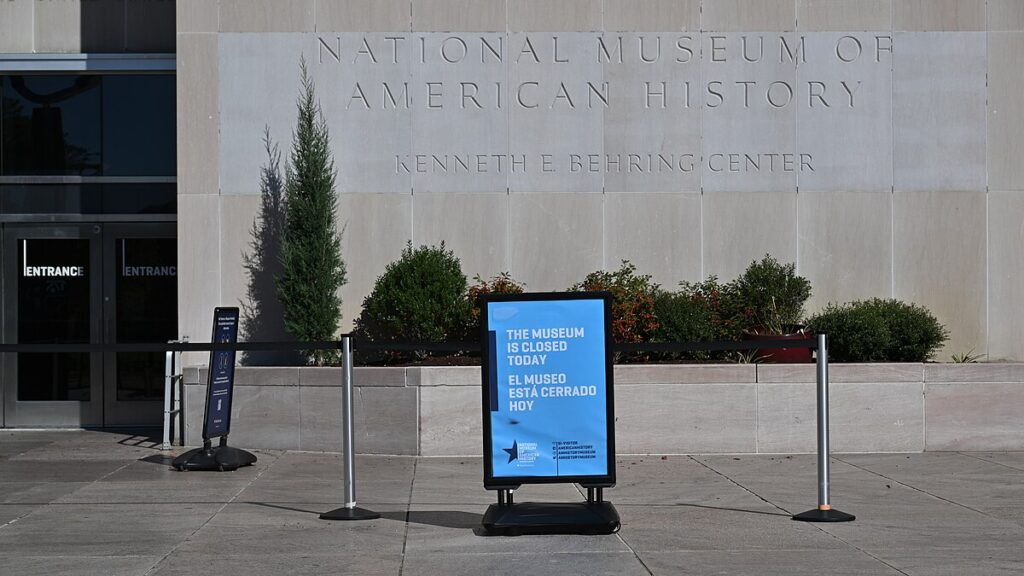
National parks and capital museums

According to a September 30 contingency plan by the Department of Interior, all national parks were to be left partially open during the shutdown, but any buildings that required staffing, such as visitor centers or sites such as the Washington Monument, would be closed to the public, with only restrooms open and trash collected as normal. Park roads, lookouts, trails and open-air memorials are expected to stay open with limited emergency services available to visitors. The plan is similar to the one adopted during the 2018–2019 government shutdown.[188][189]
Some states, such as West Virginia, have used state funding to keep their national parks open during the shutdown.[190] In some areas, guide services are seeing an influx of business as visitors are using the service as a stand-in for park rangers and workers. Additionally, private museums are seeing a boost in visitors because national parks and museums are closed, with the Mount Vernon estate reporting a 50% increase in visitors during the first two weeks of October.[191]
Conservationists, the National Parks Conservation Association, and the National Park Service have all issued warnings to the public to use caution or not to visit national parks during the shutdown due to concern about skeleton staffing making it difficult to assist in an emergency. Additional concern was raised about the mass layoffs shortly after Trump took office, which made many parks already short-staffed before the shutdown.[192] Locals, furloughed workers, and local organizations have worked together during the shutdown to keep national parks clean and well kept.[191]
Technology
Suspension of non-essential functions of the Federal Communications Commission caused product delays for devices that emit radio frequencies, affecting the release of new cameras, speakers, and controllers.[193]
Travel
The Transportation Security Administration, Amtrak, ships, and cruises continue to function despite the shutdown.[194][195] 95% of TSA employees are required to work during the shutdown.[196]
Air travel still functions, but air traffic controller hiring, field training of air traffic controllers, facility security inspections and law enforcement assistance support are stopped.[126] Beginning on October 6, staffing shortages led to flight delays at various airports.[197] On October 7, it was reported that cities such as Nashville, Dallas, Chicago, and Newark were seeing high levels of delays due to the air traffic controller shortage. The Hollywood Burbank Airport control tower was unstaffed for nearly six hours and then remotely managed due to shortages.[198] By October 8, airport staffing shortages led to delays reported at Boston, Burbank, Chicago, Denver, Houston, Las Vegas, Nashville, Newark, Orlando, Philadelphia, Phoenix, and Washington.[197]

On October 15, it was reported that multiple airports were rejecting the use of a video provided by Homeland Security Secretary Kristi Noem that blames Democrats for the shutdown and the resulting impact on TSA operations. Many airports reject the use of the video on the grounds that it violates their policies and regulations prohibiting political messaging at the airport, with some experts raising concerns about violations of the Hatch Act.[196][199]
On November 4, Transportation Secretary Sean Duffy said that the DOT and the Federal Aviation Administration (FAA) would begin to reduce flights at dozens of major airports and closing sections of airspace due to staffing shortages beginning Friday, November 7, if the shutdown does not end.[100][200] The next day, November 5, Duffy announced that forty different airports, included in the “Core 30″ high traffic airports, would cut airspace capacity 10% starting November 7.[201] Prior to Duffy’s announcement, staffing shortages over the weekend of November 1-2 had lead to major delays and concerns about potential widespread travel chaos as the shutdown continues. Reporters from NPR spoke with some air traffic controllers during the week of November 3-7, who stated that morale was low even prior to the shutdown, with resentment at mandatory overtime and stagnating wages due to longstanding staffing issues.[202] By November 9, more than 2,500 flights had been cancelled nationwide after the FAA’s flight reduction order.[203] On November 7, the Federal Aviation Administration announced that air traffic controllers have implemented measures to decrease air traffic by 10 percent in 40 “high-volume” markets as a result of the government shutdown. The FAA oversees more than 44,000 flights daily, which encompass commercial passenger flights, cargo aircraft, and private jets. Since the shutdown commenced on October 1, air traffic controllers have been performing their duties without compensation, in addition to fulfilling mandatory overtime requirements.[204]
Mass layoffs
On September 24, the Office of Management and Budget instructed federal agency heads to prepare reduction-in-force plans to be executed if the government were to shut down, reducing the government workforce permanently instead of temporarily furloughing staff.[205] If conducted, such layoffs could have drastic and far-reaching consequences, especially in land management and environmental agencies.[206] Democratic Congressional leaders Chuck Schumer and Hakeem Jeffries called it “intimidation“.[207] One former OMB official and Congressman, James Walkinshaw, questioned whether preparing or conducting a reduction in force during a shutdown would be legal, but as the practice is unprecedented, an executive at the Partnership for Public Service could not predict how it would play out.[208]
On September 30, Trump told reporters that he was in favor of mass layoffs, saying, “We’d be laying off a lot of people that are going to be very affected, they’re going to be Democrats” and “We can get rid of a lot of things that we didn’t want.”[209]
Impacted
On October 1, the Trump administration dismissed all but four members of the National Council on the Humanities.[210] Layoff notices were issued that day for 126 workers at the U.S. Patent and Trademark Office.[211][212]
On October 10, over 4,100 federal workers were notified that they would be laid off. The Department of the Treasury had the most layoffs, with 1,446.[212][213] Layoffs at the Department of Homeland Security included ones at the Cybersecurity and Infrastructure Security Agency.[214] Other departments affected were Commerce, Education, Energy, and Housing and Urban Development, as well as the Environmental Protection Agency.[212][213][214]
The Department of Health and Human Services (HHS) had the second-most layoffs, about 1,100. Nearly all of these were at the Centers for Disease Control and Prevention, including many in infectious disease programs, which had been largely spared in the April 2025 HHS layoffs. Other affected programs included the Laboratory Leadership Service and CDC Library, as well as leadership from several CDC components.[d] The Washington Office was reported to be completely closed.[217] Some layoff notices were reversed the next day after reportedly having been in error, including the entire staff of Morbidity and Mortality Weekly Report,[216] recent cohorts of the Epidemic Intelligence Service, Ebola response personnel, and Global Health Center leadership.[218] About 700 employees were reinstated to their positions on October 11.[219]
Lawsuit
| AFGE v. OMB | |
|---|---|
 |
|
| Court | Northern District of California |
| Full case name | American Federation of Government Employees v. U.S. Office of Management and Budget |
| Started | September 30, 2025 |
| Docket nos. | 3:25-cv-08302 |
| Prior action | Motion for temporary restraining order granted[220] |
| Ongoing | |
| Judge sitting | Susan Yvonne Illston |
On September 30, the American Federation of Government Employees and the American Federation of State, County and Municipal Employees sued in the federal District Court for the Northern District of California, seeking to prevent these mass layoffs. The labor unions alleged that any mass layoffs during the shutdown would be illegal, because the staff that would carry out the dismissals would be prevented from working due to the Antideficiency Act.[221]
On October 15, U.S. District Judge Susan Illston issued a restraining order against the Trump administration after siding with the two unions. The order is to be used to stop the government from issuing any reduction-in-force notices and her decision included instructions not to enforce any notices already sent to any of the agencies that have employees the unions represent.[222]
On October 17, it was reported that the Trump administration had paused work on only a small number of those who were laid off to comply with Illston’s order. The pause affected 465 Education Department employees, 102 Census Bureau employees, and more than 400 Department of Housing and Urban Development employees.[223]
Responses

Republicans
Several Republican officials and organizations, including President Donald Trump, Vice President JD Vance, the Senate Republican Conference, and Speaker of the House Mike Johnson, falsely accused Democrats of demanding free health care for undocumented immigrants, to whom the Affordable Care Act does not apply. This is based on Republican claims that there has been widespread fraud in Affordable Care Act enrollment.[224] Independent reporters, analysts, and oversight bodies have disputed those claims or not substantiated them at their reported scale.[e]
Most House representatives have left the Capitol, at the direction of Mike Johnson. Representative Kevin Kiley of California has continued to work at the Capitol in an effort to end the shutdown. Kiley told reporters that he was looking for “any and all constructive conversations” to end the shutdown, saying, “Clearly, it’s not working…Sometimes you have to work with people who have a different position in order to find common ground.”[231]
Trump administration
After the unsuccessful back-to-back votes, Trump told reporters that Democrats in the Senate “want to shut down the country”, except John Fetterman, who voted for the Republican spending bill.[232] After his meeting with Senate Minority Leader Chuck Schumer and House Minority Leader Hakeem Jeffries, Trump posted a controversial deepfake, AI-generated video of Schumer and Jeffries with fabricated audio of Schumer saying that Democrats “have no voters anymore, because of our woke, trans bullshit” and “if we give all these illegal aliens health care, we might be able to get them on our side so they can vote for us.”[49] In an interview with Politico‘s Dasha Burns, Trump called Democrats “deranged”.[233]
Before and during the shutdown, government websites and emails blamed Democrats or “the radical left” for it; actions ethics experts said were likely illegal.[234][209] Hours before the shutdown was set to begin, the Department of Housing and Urban Development‘s website warned, in a pop-up and a red banner, that the “radical left” would hurt the United States,[235][236] and Department of Health and Human Services encouraged its employees to set out-of-office email messages blaming the Democratic Party for the shutdown;[237] this elicited concerns that both websites were violating the Hatch Act.[235][236][237] In a statement, the department said: “Employees were instructed to use out-of-office messages that reflect the truth: Democrats have shut the government down.”[238] At the Department of Education, employees’ out-of-office messages were forcibly changed to political ones and they were unable to remove the partisan messaging:[239]
Thank you for contacting me. On September 19, 2025, the House of Representatives passed HR 5371, a clean continuing resolution. Unfortunately, Democrat Senators are blocking passage of HR 5371 in the Senate which has led to a lapse in appropriations. Due to the lapse in appropriations I am currently in furlough status. I will respond to emails once government functions resume.
Watchdog group Public Citizen filed a Hatch Act complaint against Small Business Administration (SBA) administrator Kelly Loeffler and Department of Housing and Urban Development (HUD) head Scott Turner, alleging the messages constituted electioneering while on duty.[240][238]
Trump posted that the shutdown was an “unprecedented opportunity” and that he would meet “with Russ Vought, he of Project 2025 Fame, to determine which of the many Democrat Agencies, most of which are a political SCAM, he recommends to be cut”.[241][242] During the shutdown, the administration halted billions in approved funding largely going to states that had voted for Kamala Harris in the 2024 presidential election, including $20 billion for public transport in New York City and Chicago.[f]
The United States Department of Agriculture (USDA)’s notice later included claims that the shutdown was being perpetuated by Senate Democrats that “[continued] to hold out for healthcare for illegal aliens and gender mutilation procedures”, the latter stemming from the ongoing scapegoating of transgender rights in the United States by the administration.[248][249]
Democrats
Democrats proposed a constant livestream to discuss the shutdown.[250] The night before the shutdown, many politicians, including Representative Sarah McBride and Senator Andy Kim, posted on social media and told the media that their Republican counterparts were not in the Capitol to vote on the budget.[251][252] Representative Robert Garcia said the messages placed on government agency websites blaming Democrats for the shutdown violated the Hatch Act.[238] Senator Bernie Sanders and Representative Alexandria Ocasio-Cortez held a town hall on CNN to discuss the shutdown.[253][254]
Former government officials
In a letter to Secretary of the Interior Doug Burgum, over 35 former park superintendents urged the parks managed by the National Park Service to close to avoid damage by unsupervised visitors.[255]
Public opinion

Pre-shutdown
A poll conducted by Data for Progress from September 5 to 7 asked likely voters whom they would blame for a potential shutdown at the end of the month. 27% of respondents thought Republicans in Congress would be responsible, 32% expected to blame Trump personally, and 34% placed the blame on Democrats in Congress.[257] Two days before the shutdown, a poll by Morning Consult indicated 45% of voters said they would blame Republicans and 32% said they would blame Democrats.[258]
In a September 22 to 27 poll by The New York Times and Siena University, 26% of respondents blamed the Trump and Republican Party for the shutdown, compared to 19% who blamed the Democratic Party and 33% who blamed both parties.[259] Another question asked whether Democrats should shut down the government if their demands were not met; 27% of respondents said yes and 65% no.[260]
In a September 30 poll by NPR, 38% of respondents blamed the Republican Party for the shutdown, compared to 27% who blamed the Democratic Party, 31% who blamed both parties, and 1% who blamed neither. Another NPR poll conducted days earlier, which controlled for political affiliation, indicated that while Democrats and Republicans were more likely to blame each other for a hypothetical shutdown, independent voters were most likely to blame both.[261]
In a poll conducted by KFF from September 23 to 29, 78% of respondents supported extending Affordable Care Act tax credits and 61% of respondents had heard little or nothing about the expiring subsidies.[262][263]
During the shutdown
An October 1 poll from The Washington Post indicated that 47% of respondents believed that Trump and Republicans in Congress were mainly responsible for the shutdown, compared to the 30% who blamed Democrats in Congress. This was consistent with polls regarding past shutdowns in the last 30 years, including the month-long shutdown during the first Trump presidency: according to polls, public opinion blamed Republicans more than Democrats with a difference of +10% or higher for every shutdown since 1995.[264]
An October 1–2 Harvard CAPS/Harris poll showed 65% of respondents felt the Democrats should accept a continuing resolution at current spending levels, but the same poll showed 53% of respondents blamed Republicans.[265]
An October 1–3 CBS News poll via YouGov asked a multitude of questions. 39% of respondents blamed Trump and Republicans for the shutdown, compared to the 30% who blamed Democrats and 31% who blamed both parties equally. Respondents felt that Trump, Republicans, and Democrats were handling the shutdown poorly at 52%, 52%, and 49%, respectively.[266]
An October 2–7 Reuters/IPSOS poll found that 67% of respondents said that Republicans deserved a fair amount of the blame for the shutdown, compared to 63% who blamed Democrats. About 63% of respondents said that Trump deserved a fair amount of blame.[267]
An October 9–13 AP–NORC poll found that nine in ten adults felt the federal shutdown was at least a “minor” problem. Democrats were more concerned, with 69% saying the shutdown was a major problem compared to 37% of Republicans. Over half the respondents, 58%, blamed the shutdown on both Trump and the Republicans, with Congressional Democrats blamed by 54%.[268]
An October 24–28 Washington Post–ABC News-IPSOS poll found that more than 4 in 10 U.S. adults, about 45%, hold Trump and Republicans primarily responsible for the shutdown. Blame for the Democrats has grown from 30% when the shutdown began to 33% in the most recent poll. Three out of four of U.S. adults said they were “very” or “somewhat” concerned about the shutdown; the figure was 87% among self-described liberals and 62% among self-described conservatives.[269]
A November 7 YouGov poll found similar shares of Americans blaming both parties, with 32% blaming Democrats in Congress, 35% blaming Republicans, and 28% blaming both parties equally.[270]
Operational criticism
When the Trump administration rolled out spending freezes across the entire federal government, fiscal and monetary analyst Nathan Tankus commented that the freeze was “the most dramatic event ever” in the annals of constitutional law on fiscal policy in the U.S., arguing that the Oval Office’s pertinent executive orders essentially give the president “far greater control” over Congress’s authority to spend.[271]
Tankus delineated the “extremely unique” legal architecture of the U.S. government. In countries with a parliamentary system, the government can “fall apart” or even lose its mandate to govern if its parliament cannot pass a budget.[272] In the U.S., tax revenue typically goes into the general fund,[273] an accounting fact that does not mean the government spends any additional money. Tankus concludes that, while the Trump administration has been “circumspect and legalistic” about spending without appropriations, it has also been “brazen” in ignoring congressional orders to spend.[272]
Political impact
The political impact of the shutdown have benefited the Democrats with polling showing a majority blaming Republicans for the shutdown and supporting an extension of the ACA.[274] The effects include landslide victories in the 2025 Virginia House of Delegates election and the 2025 Virginia gubernatorial election the largest Democratic victory since 1961,[275] as well as the 2025 New Jersey gubernatorial election, as well as local electoral victories in Pennsylvania, Mississippi, and Georgia.[276][277]
Notes
References
- ^ Blair, Elizabeth (October 12, 2025). “Smithsonian closes as government shut down continues”. NPR. Retrieved November 7, 2025.
- ^ Tait, Robert (November 4, 2025). “US Senate rejects funding package for 14th time with shutdown in 35th day”. The Guardian. ISSN 0261-3077. Retrieved November 5, 2025.
- ^ Digital, Kaia Hubbard Politics Reporter Kaia Hubbard is a politics reporter for CBS News; Washington, based in; Hubbard, D. C. Read Full Bio Kaia (November 4, 2025). “Government shutdown becomes longest in U.S. history after failed Senate vote”. CBS News. Retrieved November 5, 2025.
- ^ Weaver, Al (November 4, 2025). “Senate spurns GOP spending bill for 14th time amid bipartisan talks to end shutdown”. The Hill. Retrieved November 4, 2025.
- ^ “Some senators predict the government shutdown, now the longest in history, could end this week”. NBC News. November 4, 2025. Retrieved November 5, 2025.
- ^ Fulton, Aris Folley and Jacob (November 5, 2025). “Democrats tight-lipped on shutdown off-ramp as pressure grows”. Roll Call. Retrieved November 5, 2025.
- ^ a b Mascaro, Lisa; Jalonick, Mary Clare (November 5, 2025). “Government shutdown becomes the longest on record as fallout spreads nationwide”. AP News. Retrieved November 5, 2025.
- ^ “Why has the US government shut down and what does it mean?”. BBC. November 7, 2025. Retrieved November 7, 2025.
- ^ a b c Saturno, James V. (2023). Introduction to the Federal Budget Process (Report). Congressional Research Service. R46240. Archived from the original on March 17, 2025.
- ^ a b Gamio, Lazaro (September 30, 2025). “From Crisis to Crisis: How Congress Struggles to Fund the Government”. The New York Times. Archived from the original on September 30, 2025. Retrieved September 30, 2025.
- ^ a b Gold, Michael (March 14, 2025). “The Democratic Divide: Would a Shutdown Have Helped or Hurt Trump?”. The New York Times. Archived from the original on September 25, 2025. Retrieved September 29, 2025.
- ^ a b Hulse, Carl; Edmondson, Catie (March 13, 2025). “Schumer Will Clear the Way for G.O.P. Spending Bill, Breaking With His Party”. The New York Times. Retrieved September 29, 2025.
- ^ a b Karni, Annie (March 14, 2025). “Schumer, Facing Backlash for Not Forcing a Shutdown, Says He’ll Take ‘the Bullets’“. The New York Times. Archived from the original on September 25, 2025. Retrieved September 29, 2025.
- ^ a b “The health insurance subsidies behind the government shutdown”. hks.harvard.edu. October 20, 2025. Retrieved October 30, 2025.
- ^ a b c O’Brien, Sarah (April 28, 2021). “Biden’s $1.8 trillion plan to help families would retain enhanced Obamacare premium subsidies”. CNBC. Retrieved October 30, 2025.
- ^ “A Steep Subsidy Cliff Looms for Older Middle-Income Enrollees if ACA Enhanced Tax Credits Expire”. KFF. Retrieved October 30, 2025.
- ^ kffcarenec (March 15, 2021). “Impact of Key Provisions of the American Rescue Plan Act of 2021 COVID-19 Relief on Marketplace Premiums”. KFF. Retrieved November 9, 2025.
The American Rescue Plan Act of 2021 (COVID-19 relief) law passed in March 2021 expands Marketplace subsidies above 400% of poverty and also increases subsidies for those making between 100% and 400% of the poverty level, for two years (2021 and 2022), consistent with what President Biden proposed during his campaign.
- ^ kffjaredo (November 23, 2021). “Potential Costs and Impact of Health Provisions in the Build Back Better Act”. KFF. Retrieved October 30, 2025.
- ^ Iacurci, Greg (October 17, 2025). “ACA enhanced subsidy lapse could hit early retirees hardest amid shutdown fight”. CNBC. Retrieved October 30, 2025.
- ^ kffcarenec (June 18, 2025). “How Will the One Big Beautiful Bill Act Affect the ACA, Medicaid, and the Uninsured Rate?”. KFF. Retrieved October 30, 2025.
- ^ Luhby, Tami; Choi, Annette (October 9, 2025). “Obamacare premiums could more than double. Here’s why it matters in the shutdown battle | CNN Politics”. CNN. Retrieved October 30, 2025.
- ^ Tully-McManus, Katherine (July 17, 2025). “Russ Vought: Appropriations process ‘has to be less bipartisan’“. Politico. Archived from the original on September 26, 2025. Retrieved October 2, 2025.
- ^ a b Gold, Michael (August 1, 2025). “Senate Passes Its First Spending Bills, but Battles Lie Ahead”. The New York Times. Archived from the original on September 19, 2025. Retrieved September 29, 2025.
- ^ Lee Hill, Meredith; Scholtes, Jennifer; Tully-McManus, Katherine (September 15, 2025). “House GOP zeroes in on lawmaker security plan in government shutdown patch”. Politico. Archived from the original on September 18, 2025. Retrieved September 29, 2025.
- ^ Edmondson, Catie (September 4, 2025). “Members of Congress Grasp for a Stopgap Deal to Avert a Shutdown”. The New York Times. Archived from the original on September 24, 2025. Retrieved September 29, 2025.
- ^ Scholtes, Jennifer; Carney, Jordain; Tully-McManus, Katherine (September 8, 2025). “Congress splinters into unlikely factions over looming government shutdown”. Politico. Archived from the original on September 15, 2025. Retrieved September 29, 2025.
- ^ a b Lee Hill, Meredith; Carney, Jordain (September 8, 2025). “Key House GOP hard-liner doesn’t rule out short-term shutdown punt”. Politico. Archived from the original on September 16, 2025. Retrieved September 29, 2025.
- ^ Jimison, Robert (September 14, 2025). “White House Seeks More Supreme Court Security Funding After Kirk Killing”. The New York Times. Archived from the original on September 25, 2025. Retrieved September 29, 2025.
- ^ Schwartz, Mattathias (September 16, 2025). “Federal Courts Want More Money From Congress for Security”. The New York Times. Archived from the original on September 25, 2025. Retrieved September 29, 2025.
- ^ Wu, Nicholas; Scholtes, Jennifer; Carney, Jordain (September 11, 2025). “Democrats coalesce around insurance subsidies as shutdown demand, Neal says”. Politico. Archived from the original on September 22, 2025. Retrieved September 29, 2025.
- ^ Lee Hill, Meredith (September 12, 2025). “‘Don’t even bother dealing with them,’ Trump says of Democrats’ shutdown demands”. Politico. Archived from the original on September 15, 2025. Retrieved September 29, 2025.
- ^ Razor, Calen (September 15, 2025). “Trump to GOP: Vote yes on the ‘clean’ CR”. Politico. Archived from the original on September 19, 2025. Retrieved September 29, 2025.
- ^ Edmondson, Catie (September 16, 2025). “Johnson Releases Spending Bill, Daring Democrats to Oppose It”. The New York Times. Archived from the original on September 25, 2025. Retrieved September 29, 2025.
- ^ Lee Hill, Meredith (September 15, 2025). “2 House Republicans oppose Johnson’s spending plan amid conservative grumbling”. Politico. Archived from the original on September 23, 2025. Retrieved September 29, 2025.
- ^ Carney, Jordain (September 19, 2025). “Shutdown standoff hits fever pitch”. Politico. Retrieved September 19, 2025.
- ^ Edmondson, Catie (September 16, 2025). “Democrats Oppose Stopgap Bill, Raising Odds of a Shutdown”. The New York Times. Archived from the original on September 25, 2025. Retrieved September 29, 2025.
- ^ Edmondson, Catie (September 17, 2025). “Democrats Outline Spending Demands as Shutdown Looms”. The New York Times. Archived from the original on September 25, 2025. Retrieved September 29, 2025.
- ^ Edmondson, Catie (September 19, 2025). “Democrats Block G.O.P. Spending Extension as Shutdown Looms”. The New York Times. Archived from the original on September 26, 2025. Retrieved September 29, 2025.
- ^ Karni, Annie (September 20, 2025). “Top Democratic Leaders Ask Trump for Meeting to Avert a Shutdown”. The New York Times. Archived from the original on September 24, 2025. Retrieved September 29, 2025.
- ^ Edmondson, Catie (September 23, 2025). “Trump Cancels Meeting With Democrats as Shutdown Nears”. The New York Times. Archived from the original on September 26, 2025. Retrieved September 29, 2025.
- ^ a b Gold, Michael (September 29, 2025). “Trump to Meet With Congressional Leaders as Shutdown Looms”. The New York Times. Archived from the original on September 29, 2025. Retrieved September 29, 2025.
- ^ “Donald J. Trump (@realDonaldTrump)”. Truth Social. Archived from the original on September 30, 2025. Retrieved October 1, 2025.
- ^ Ferek, Katy Stech; Leary, Alex; Wise, Lindsay (September 30, 2025). “Government Heads for Shutdown as Rival Votes Fail in Senate”. The Wall Street Journal. Archived from the original on September 30, 2025. Retrieved October 1, 2025.
- ^ “‘National Embarrassment’: Critics Rip Trump Over ‘Disgusting’ New Attack On Democrats”. HuffPost. September 30, 2025.
- ^ “Trump Posts Racist AI Video of Democrats as Shutdown Talks Hang in Balance”. MeidasTouch News. September 29, 2025. Archived from the original on October 2, 2025. Retrieved October 1, 2025.
- ^ “No deal at White House shutdown summit, but Trump broaches health care talks”. Politico. September 29, 2025. Archived from the original on September 29, 2025. Retrieved October 1, 2025.
- ^ “US shutdown looms as Trump and Democrats end meeting without a deal”. BBC. September 30, 2025. Archived from the original on September 30, 2025. Retrieved October 1, 2025.
- ^ Shamim, Sarah. “Why is the US government on the brink of a shutdown? What will it mean?”. Al Jazeera. Archived from the original on September 30, 2025. Retrieved October 1, 2025.
- ^ a b “Trump posts vulgar deepfake slam of Democratic leaders after White House meeting”. Politico. September 30, 2025.
- ^ Wasson, Erik; Dlouhy, Jennifer; Dennis, Steven; Birnbaum, Emily (September 29, 2025). “Vance Says US Headed for Shutdown After Talks With Democrats”. Bloomberg News. Retrieved September 30, 2025.
- ^ Parkinson, John; Pellet, Lauren; Pecorin, Allison (October 1, 2025). “Federal government shuts down after Senate fails to pass funding measures”. ABC News.
- ^ Gold, Michael (September 30, 2025). “U.S. Begins Shutdown That Could Lead to Mass Layoffs and Service Cuts”. The New York Times. Retrieved September 30, 2025.
Shortly after the Senate failed to pass a measure to fund the federal government, the White House’s Office of Management and Budget issued a memo directing executive branch agencies to “execute their plans for an orderly shutdown.”
- ^ Stanton, Nile (1974). “History and practice of executive impoundment of appropriated funds”. Nebraska Law Review. 53 (1): 1–30.
- ^ Boggs, Hale (1972). “Executive impoundment of Congressionally appropriated funds”. University of Florida Law Review. 24 (2): 221–229.
- ^ Kosar, Kevin (October 21, 2015). “So… this is Nixon’s fault?”. The Agenda. Politico. Archived from the original on October 22, 2015.
- ^ Fisher, Louis (2014). The Law of the Executive Branch: Presidential Power. The Oxford Commentaries on American Law. Oxford University Press. ISBN 978-0-19-985621-3. OCLC 843785547. OL 20346393W.
- ^ Zeidenstein, Harvey G. (1978). “The reassertion of Congressional power: New curbs on the President”. Political Science Quarterly. 93 (3): 393–409. doi:10.2307/2149531. JSTOR 2149531.
- ^ Fisher, Louis (1982). “Congress and the President in the administrative process: The uneasy alliance”. In Heclo, Hugh; Salamon, Lester M. (eds.). The Illusion of Presidential Government. Routledge. pp. 21–43. doi:10.4324/9780429311727-3. ISBN 978-1-00-030234-9. OCLC 1289836623. OL 17855378W.
- ^ Hubbard, Kaia; Watson, Kathryn (May 9, 2025). “What is rescission, the process Congress will use to make Trump’s DOGE cuts?”. CBS News. Archived from the original on May 9, 2025.
- ^ Walker, Amy Schoenfeld; Khurana, Malika; Zhang, Christine (June 22, 2025). “What remains of U.S.A.I.D.?”. The New York Times. Archived from the original on June 22, 2025.
- ^ Boak, Josh (June 3, 2025). “Trump formally asks Congress to claw back approved spending targeted by DOGE”. Associated Press News. Archived from the original on June 3, 2025.
- ^ The White House (July 24, 2025). “H.R. 4 and H.R. 517 Signed into Law S. 1582” (Press release). Archived from the original on July 25, 2025.
- ^ Hubbard, Kaia (September 29, 2025). “Lessons of March funding fight color Democrats’ shutdown approach”. CBS News. Archived from the original on September 29, 2025.
The GOP also approved a rescissions package that clawed back congressionally approved funding for foreign aid and public broadcasting, which Democrats say has increased distrust that funding agreements will be honored.
- ^ Watson, Kathryn (September 29, 2025). “Schumer after meeting with Trump: ‘Still large differences between us’“. CBS News. Archived from the original on September 29, 2025.
Schumer said Democrats and the White House have ‘very large differences’ on health care and concerns that Republicans and the White House would undo approved government funding through rescissions.
- ^ Watson, Kathryn (September 29, 2025). “Schumer says there was a ‘possible division’ between GOP leaders and Trump in their conversation”. CBS News. Archived from the original on September 29, 2025.
Schumer said he and Jeffries particularly raised the need to extend the Affordable Care Act’s enhanced health insurance tax credits and the concern that the threat of rescissions and impoundments—two controversial strategies for the Trump administration to avoid spending money appropriated by Congress—make negotiations impossible.
- ^ Carney, Jordain; Wu, Nicholas (November 9, 2025). “Senate reaches deal on ending the shutdown”. Politico. Retrieved November 9, 2025.
- ^ Carney, Jordain; Wu, Nicholas; Hill, Meredith Lee (October 13, 2025). “Democrats are in a GOP shutdown vise”. Politico. Retrieved October 14, 2025.
- ^ Hubbard, Kaia; Watson, Kathryn; Yilek, Caitlin (October 8, 2025). “Government shutdown live updates as Senate votes fail for 6th time”. CBS News. Retrieved October 8, 2025.
- ^ Hubbard, Kaia; Watson, Kathryn (October 10, 2025). “Government shutdown will extend into next week as Senate adjourns without breaking stalemate”. CBS News. Retrieved October 10, 2025.
- ^ “Government shutdown updates: Senate again fails to pass funding bills”. ABC News. October 6, 2025. Retrieved October 6, 2025.
- ^ “House Recess Extended to Oct. 19 As Government Shutdown Continues | Video | C-SPAN.org”. www.c-span.org. Retrieved October 10, 2025.
- ^ “Inside Mike Johnson’s shutdown strategy of keeping House Republicans away from Washington”. MSNBC. October 21, 2025. Retrieved October 21, 2025.
- ^ Beggin, Riley; Natanson, Hannah; Meyer, Theodoric; Sotomayor, Marianna; Bogage, Jacob (September 30, 2025). “Government set to shut down overnight after Senate blocks funding extension”. The Washington Post. Archived from the original on September 30, 2025. Retrieved September 30, 2025.
- ^ “U.S. government shuts down as Trump and Congress fail to reach a funding deal”. NBC News. October 1, 2025. Archived from the original on October 1, 2025. Retrieved October 1, 2025.
- ^ kpage_drupal. “Senate fails to pass CR, government shutdown begins while health programs expire | AHA News”. www.aha.org. Retrieved October 9, 2025.
- ^ Carney, Jordain; Lee Hill, Meredith; McCarthy, Mia (October 1, 2025). “Senators hunt for possible path out of shutdown”. Politico. Retrieved October 1, 2025.
- ^ Korecki, Natasha; Terkel, Amanda; Alba, Monica; Dixon, Matt (October 2, 2025). “Education Department Employees Surprised to Find Their Email Automatically Changed to Blame Democrats for Shutdown”. NBC News.
- ^ “Schumer rejects Trump’s claim that bipartisan government shutdown negotiations are under way – as it happened”. The Guardian. October 6, 2025. Retrieved October 7, 2025.
- ^ a b Garrison, Joey; Anderson, Zac; Jansen, Bart. “Government shutdown reaches Day 9; Trump vows military will be paid: live updates”. USA Today. Retrieved October 9, 2025.
- ^ Hubbard, Kaia (October 15, 2025). “Senate fails to advance GOP funding bill for 8th time as shutdown drags on”. CBS News. Retrieved November 4, 2025.
- ^ a b Wasson, Erik (October 22, 2025). “US Government Shutdown Is Now Second Longest in History”. Bloomberg L.P. Retrieved October 22, 2025.
- ^ Pecorin, Allison (October 23, 2025). “Senate voting on paying essential federal workers as shutdown continues”. ABC News. Retrieved October 23, 2025.
- ^ Mackey, Robert; Popat, Shrai; Ambrose, Tom (October 23, 2025). “Senate fails to pass bill to keep essential federal workers and troops paid throughout government shutdown”. The Guardian. ISSN 0261-3077. Retrieved October 23, 2025.
- ^ a b Matza, Max (October 26, 2025). “Mystery Trump supporter gives $130m to US military for paying troops during shutdown”. BBC. Retrieved October 27, 2025.
- ^ a b Nova, Annie; Mangan, Dan (October 25, 2025). “Timothy Mellon is Trump’s $130 million mystery military donor: NYT”. CNBC. Retrieved October 27, 2025.
- ^ a b Khan, Melina (October 27, 2025). “SNAP benefits won’t go out Nov. 1. ‘The well has run dry,’ USDA says”. USA Today. Retrieved October 27, 2025.
- ^ “It’s Past Time to End This Shutdown”. afge.org. October 27, 2025. Retrieved October 27, 2025.
- ^ Alba, Monica (October 27, 2025). “Largest federal workers union calls for an end to the shutdown, putting pressure on Democrats”. NBC News. Retrieved October 28, 2025.
- ^ Kim, Ellis; Raju, Manu; Main, Alison (October 27, 2025). “Johnson defends keeping House out of session as shutdown continues”. CNN. Retrieved October 27, 2025.
- ^ McCarthy, Mia; Carney, Jordain (October 28, 2025). “Troops will get their paychecks this week, Vance says”. Politico. Retrieved October 29, 2025.
- ^ a b Romm, Tony; Cochrane, Emily (October 28, 2025). “Dozens of States Sue Trump Administration Over SNAP Funding During Shutdown”. The New York Times. Retrieved October 29, 2025.
- ^ Hubbard, Kaia (October 29, 2025). “Government shutdown continues as senators express cautious optimism about talks”. CBS News. Retrieved November 4, 2025.
- ^ Faguy, Ana (October 31, 2025). “Trump calls on Republicans to scrap filibuster rule in shutdown standoff”. BBC. Retrieved October 31, 2025.
- ^ a b Grumbach, Gary; Marquez, Alexandra; Burke, Minyvonne (October 31, 2025). “Federal judge orders Trump administration to pay SNAP benefits out of contingency fund”. NBC News. Retrieved October 31, 2025.
- ^ Davenport, Carli (October 31, 2025). “Agriculture Secretary Brooke Rollins: “We have failed you.” – Oklahoma Farm Report”. Retrieved November 3, 2025.
- ^ “Watch live: Johnson, Rollins give remarks amid shutdown, SNAP funding lapse”. The Hill. October 31, 2025. Retrieved November 3, 2025.
- ^ Jalonick, Mary Clare (November 3, 2025). “Trump says he ‘won’t be extorted’ as the shutdown is about to become the longest ever—and millions could soon lose food aid”. Fortune. Retrieved November 3, 2025.
- ^ Erickson, Bo (November 4, 2025). “US government shutdown ties record, as congressional inaction takes toll”. Reuters. Retrieved November 4, 2025.
- ^ Breuninger, Kevin (November 4, 2025). “Government shutdown set to become longest ever after latest Senate vote fails”. CNBC. Retrieved November 4, 2025.
- ^ a b Skores, Alexandra (November 4, 2025). “DOT may close certain parts of the airspace due to air traffic controller shortages”. CNN. Retrieved November 4, 2025.
- ^ Yee, Curtis; Mcghee, Bernard. “Live updates: Hundreds of flights canceled nationwide due to government shutdown”. AP News. Retrieved November 7, 2025.
- ^ Faulders, Katherine; Charalambous, Peter (November 7, 2025). “Trump administration asks appeals court to immediately halt ruling on SNAP funding”. ABC News. Retrieved November 7, 2025.
- ^ a b “Supreme Court justice temporarily pauses order requiring Trump administration to fully fund SNAP by end of Friday”. ABC News. November 7, 2025.
- ^ Wilkins, Dan Mangan,Kevin Breuninger,Emily (November 7, 2025). “Senate Republicans reject Democrat deal to reopen government”. CNBC.
{{cite web}}: CS1 maint: multiple names: authors list (link) - ^ Karanth, Sanjana; HuffPost (November 9, 2025). “USDA Orders States To Stop Giving Full Food Stamps To Hungry Families”. HuffPost. Retrieved November 9, 2025.
- ^ a b “Senate reaches deal on ending the shutdown”. POLITICO. November 9, 2025. Retrieved November 10, 2025.
- ^ Raju, Manu; Barrett, Ted; Main, Allison (November 9, 2025). “Senators near deal to reopen government as key Democrats signal willingness to back plan”. CNN. Retrieved November 9, 2025.
- ^ “Trump Administration Live Updates – Update from Catie Edmondson”. The New York Times. November 9, 2025. Archived from the original on November 10, 2025. Retrieved November 10, 2025.
- ^ Edmonson, Catie (November 9, 2025). “Trump Administration Live Updates – Update from Catie Edmondson”. The New York Times. Archived from the original on November 10, 2025. Retrieved November 10, 2025.
- ^ “Thune Says Deal to Reopen Government Is ‘Coming Together’“. November 9, 2025. Retrieved November 10, 2025.
- ^ a b c Bhutani, Anvee (September 29, 2025). “How a U.S. Government Shutdown Would Affect You”. The Wall Street Journal. Archived from the original on September 30, 2025. Retrieved September 29, 2025.
- ^ Yarrow, Grace (September 29, 2025). “USDA eyes more layoffs if government shuts down”. E&E News. Archived from the original on September 30, 2025. Retrieved September 29, 2025.
- ^ “IRS furloughs nearly half its workforce, shuttering most operations”. POLITICO. October 8, 2025. Retrieved November 9, 2025.
- ^ Shao, Elena (September 30, 2025). “What we know so far about who will be furloughed”. The New York Times. Archived from the original on September 30, 2025. Retrieved September 30, 2025.
- ^ Heckman, Jory (October 3, 2025). “Furloughs hit federal employees exempt from shutdown, laid-off staff told to keep working”. Federal News Network. Retrieved October 16, 2025.
- ^ Shao, Elena; Gamio, Lazaro; Wu, Ashley (September 30, 2025). “How the Shutdown Is Affecting Federal Services and Workers”. The New York Times. ISSN 0362-4331. Retrieved November 9, 2025.
- ^ Yilek, Caitlin; Becket, Stefan (October 20, 2025). “Does Congress get paid during a government shutdown? – CBS News”. CBS News. Retrieved October 20, 2025.
- ^ Luhby, Tami (October 22, 2025). “Here’s who gets paid — and who doesn’t — during a federal government shutdown | CNN Politics”. CNN. Retrieved October 22, 2025.
- ^ Caputo, Marc (October 7, 2025). “Scoop: White House memo says furloughed federal workers aren’t entitled to back pay”. Axios. Archived from the original on October 8, 2025.
- ^ Jaramillo, Alejandra; Luhby, Tami; Ferris, Sarah (October 7, 2025). “Trump questions back pay for federal workers furloughed as part of government shutdown | CNN Politics”. CNN. Retrieved October 8, 2025.
- ^ Mascaro, Lisa (October 7, 2025). “Trump administration threatens no back pay for federal workers in shutdown”. AP News. Retrieved October 8, 2025.
- ^ Kelly, Allie; Sheffey, Ayelet; Kaplan, Juliana (October 19, 2025). “They were living paycheck to paycheck. Then the checks stopped coming”. Business Insider. Retrieved October 20, 2025.
- ^ Britzky, Haley (November 5, 2025). “Civilians at the Pentagon continue missing paychecks while working alongside troops getting paid | CNN Politics”. CNN. Retrieved November 6, 2025.
- ^ Legum, Judd. “Speaker Johnson’s unprecedented, democracy-thwarting effort to keep the Epstein files secret”. popular.info. Retrieved November 7, 2025.
- ^ Grisales, Claudia (October 16, 2025). “Adelita Grijalva can force a vote on the Epstein files, but she’s still not sworn in”. NPR. Retrieved November 7, 2025.
- ^ a b Uribe, Raquel Coronell; Lebowitz, Megan (September 30, 2025). “What happens when the government shuts down?”. NBC News. Archived from the original on October 1, 2025. Retrieved October 1, 2025.
- ^ Brooks, Emily (October 8, 2025). “Johnson, in shift, signals no vote during shutdown for military pay”. The Hill. Retrieved October 8, 2025.
- ^ Timotija, Filip (October 13, 2025). “Can Trump pay troops without Congress? Some Democrats don’t think so”. The Hill. Retrieved October 15, 2025.
- ^ Shelter, Thomas (October 19, 2025). “J.D. Vance Reassures Marines at Camp Pendleton Over Salary Payments Despite Government Shutdown”. CONGRESS.NET. Retrieved October 19, 2025.
- ^ Kube, Courtney; Gains, Mosheh; Coronell Uribe, Raquel (October 24, 2025). “Pentagon accepts anonymous $130 million donation to help pay troops during government shutdown”. NBC News. Retrieved October 27, 2025.
- ^ Inayatullah, Saim Dušan (October 23, 2025). “Germany to pay US military base employees amid shutdown – DW – 10/23/2025”. Deutsche Welle. Retrieved November 6, 2025.
- ^ Nieberg, Patty (November 5, 2025). “Army closes only dining facility on Kansas base due to government shutdown”. Task & Purpose. Retrieved November 6, 2025.
- ^ Schneid, Rebecca (October 12, 2025). “Shutdown Causes Spike in Military Families Using Food Pantries”. Time. Retrieved October 15, 2025.
- ^ Hallam, Mark (November 5, 2025). “US troops given German food bank advice amid shutdown – DW – 11/05/2025”. Deutsche Welle. Retrieved November 6, 2025.
- ^ Lee Brewer, Graham (October 3, 2025). “Federal shutdown hurts services for Native Americans and they worry worse is coming”. AP News. Retrieved October 20, 2025.
- ^ Reagan, Kevin (October 1, 2025). “Essential services on Navajo Nation expected to continue under government shutdown”. 12news.com. Retrieved October 20, 2025.
- ^ Huiskes, Helen (October 30, 2025). “Tribal nations are struggling to cover food and education costs during the shutdown”. The Salt Lake Tribune. Retrieved October 31, 2025.
- ^ Mutikani, Lucia (September 29, 2025). “US government shutdown would halt September jobs report, other data”. Reuters. Retrieved September 29, 2025.
- ^ Eavis, Peter (September 30, 2025). “The United States’ top trade negotiator said on Tuesday that his agency would stay open during a government shutdown”. The New York Times. Retrieved September 30, 2025.
- ^ Osipovich, Alexander; Lang, Hannah (September 29, 2025). “Stocks Rise as Government Shutdown Looms”. The Wall Street Journal. Archived from the original on October 1, 2025. Retrieved September 29, 2025.
- ^ Zahn, Max (October 6, 2025). “Government shutdown halts data, stokes risk as economy wobbles, experts say”. ABC News. Retrieved October 9, 2025.
- ^ Kinnard, Meg (October 9, 2025). “AP reader question: How might the federal shutdown affect the economy?”. AP News. Retrieved October 13, 2025.
- ^ Fortinsky, Sarah (October 6, 2025). “Shutdown costing US economy about $15B a week: Hassett”. The Hill. Retrieved October 9, 2025.
- ^ Cochran, Lexi Lonas (October 1, 2025). “The longer the shutdown, the worse for schools, education experts say”. The Hill. Retrieved October 31, 2025.
- ^ Schermele, Zachary (October 11, 2025). “Education Department wipes out special ed office in shutdown layoffs, union says”. USA Today. Retrieved October 31, 2025.
- ^ Valdez, Ana (October 28, 2025). “Government shutdown leads to confusion concerning FAFSA funding”. KWCH 12 News. Retrieved October 31, 2025.
- ^ Scharf, Nadia (October 7, 2025). “UW leaders don’t expect FAFSA delays under government shutdown”. Green Bay Press-Gazette. Retrieved October 31, 2025.
- ^ Quinn, Ryan (October 14, 2025). “Already Battered by Cuts, Researchers and Colleges Face Federal Shutdown Impacts”. Inside Higher Ed. Retrieved October 31, 2025.
- ^ “More than 75,000 student veterans’ benefits impacted by government shutdown”. The American Legion. October 30, 2025. Retrieved October 31, 2025.
- ^ Powers, Kelly (October 21, 2025). “This Delaware university will defer payments for students impacted by government shutdown”. The News Journal. Retrieved October 31, 2025.
- ^ Wilkes, Mackenzie (October 28, 2025). “Shutdown imperils key education program for young children”. Politico. Retrieved October 31, 2025.
- ^ “Governor Moore Visits Prince George’s County Food Pantry Serving Federal Workers During Federal Government Shutdown – Press Releases – News – Office of Governor Wes Moore”. governor.maryland.gov.
- ^ Phengsitthy, Nyah (September 29, 2025). “FDA Chief Says Agency Exempt From Government Shutdown Cuts”. Bloomberg Law. Retrieved September 29, 2025.
- ^ Bragg, Meghan (November 4, 2025). “WIC remains funded amid shutdown but SNAP halted”. wcnc.com. Retrieved November 5, 2025.
- ^ Balingit, Moriah (October 10, 2025). “WIC food program receives $300M to keep running during government shutdown”. AP News. Retrieved October 31, 2025.
- ^ a b c Khan, Melina (October 28, 2025). “Who will be impacted by food stamps running out? SNAP recipients by the numbers”. USA Today. Retrieved October 31, 2025.
- ^ Luhby, Tami; Cole, Devan (October 31, 2025). “Will SNAP benefits be paid in November? Here’s what we know about the judges’ ruling”. CNN. Retrieved November 1, 2025.
- ^ a b Chowdhury, Maureen; Hammond, Elise (November 3, 2025). “Trump administration will provide partial November food stamp benefits”. CNN. Retrieved November 3, 2025.
- ^ Dickler, Jessica (October 23, 2025). “Millions of families at risk as government shutdown impacts SNAP funding”. CNBC. Retrieved October 23, 2025.
- ^ Yarrow, Grace (October 23, 2025). “At least 25 states plan to cut off food aid benefits in November”. Politico. Retrieved October 23, 2025.
- ^ Douglas, Leah (October 23, 2025). “US mayors urge USDA to fund November food benefits amid shutdown”. Reuters. Retrieved October 23, 2025.
- ^ a b Ngo, Madeleine (September 29, 2025). “Which Federal Benefits and Services Continue During a Government Shutdown?”. The New York Times. Archived from the original on September 29, 2025. Retrieved September 29, 2025.
- ^ “Government shutdown impasse stretches on as Senate Republicans reject Democrats’ health care offer”. CBS News. November 7, 2025. Retrieved November 8, 2025.
- ^ “Deep red and swing states making election flip to Democrats indicate Trump’s plunging popularity”. The Guardian. November 7, 2025. Retrieved November 8, 2025.
- ^ Erickson and Douglas, Bo and Leah (October 2, 2025). “US government shutdown threatens food-aid program for low-income Americans”. reuters.
- ^ Bogage and Natanson, Jacob and Hannah (October 12, 2025). “The pain from the government shutdown is about to hit the public”. The Washington Post.
- ^ Nobles, Ryan (October 21, 2025). “Food banks and community groups brace for spike in demand as shutdown continues”. NBC News. Retrieved October 23, 2025.
- ^ Shields, Billy (October 28, 2025). “Youngkin unveils state-run emergency nutrition assistance program”. VPM. Retrieved October 31, 2025.
- ^ Yorgey, Tori (November 4, 2025). “Moore authorizes funds for Marylanders’ SNAP benefits in November”. WBAL. Retrieved November 4, 2025.
- ^ Musgrave, Beth (October 30, 2025). “Will government shutdown affect free and reduced lunch at KY schools? What we know”. Lexington Herald Leader. Retrieved October 31, 2025.
- ^ “The federal government is still shut down. Here’s what that means across the country”. NPR. October 21, 2025. Retrieved October 31, 2025.
- ^ a b Becket, Stefan; Quinn, Melissa (November 1, 2025). “Judges say Trump administration must continue paying SNAP food stamp benefits during shutdown”. CBS News.
- ^ “Complaint”. mass.gov.
- ^ “Case: Commonwealth of Massachusetts v. United States Department of Agriculture”. Civil Rights Litigation Clearinghouse.
- ^ a b Han, Lisa Kailai; Mangan, Dan (November 2, 2025). “Treasury Secretary Bessent says SNAP food benefits could restart by Wednesday”. CNBC. Retrieved November 3, 2025.
- ^ “Complaint – #1 in Rhode Island State Council of Churches v. Rollins (D.R.I., 1:25-cv-00569) – CourtListener.com”. CourtListener.
- ^ “Case: Rhode Island State Council of Churches v. Rollins”. Civil Rights Litigation Clearinghouse.
- ^ a b “Trump says he has asked court to ‘clarify’ SNAP ruling with funding set to lapse”. ABC News. October 31, 2025.
- ^ @realDonaldTrump (October 31, 2025). “Truth Details”. Truth Social. Archived from the original on October 31, 2025.
Our Government lawyers do not think we have the legal authority to pay SNAP with certain monies we have available, and now two Courts have issued conflicting opinions on what we can and cannot do. I do NOT want Americans to go hungry just because the Radical Democrats refuse to do the right thing and REOPEN THE GOVERNMENT. Therefore, I have instructed our lawyers to ask the Court to clarify how we can legally fund SNAP as soon as possible. It is already delayed enough due to the Democrats keeping the Government closed through the monthly payment date and, even if we get immediate guidance, it will unfortunately be delayed while States get the money out. If we are given the appropriate legal direction by the Court, it will BE MY HONOR to provide the funding, just like I did with Military and Law Enforcement Pay. The Democrats should quit this charade where they hurt people for their own political reasons, and immediately REOPEN THE GOVERNMENT. If you use SNAP benefits, call the Senate Democrats, and tell them to reopen the Government, NOW! Here is Cryin’ Chuck Schumer’s Office Number: (202) 224-6542
- ^ “Supreme Court justice temporarily pauses order requiring Trump administration to fully fund SNAP”. ABC News. November 8, 2025. Retrieved November 8, 2025.
- ^ a b c Aboulenein, Ahmed (September 29, 2025). “US government shutdown to furlough 41% of health agency workers”. Reuters. Retrieved September 29, 2025.
- ^ Choi, Joseph (October 23, 2025). “ObamaCare price jump hits Idaho first as shutdown deal remains elusive”. The Hill. Retrieved October 23, 2025.
- ^ “Health insurance sticker shock begins as shutdown battle over subsidies rages”. The Washington Post. October 22, 2025. ISSN 0190-8286. Retrieved October 23, 2025.
- ^ Mancini, Ryan (October 17, 2025). “Supreme Court to run out of funding due to shutdown”. The Hill. Retrieved November 6, 2025.
- ^ Raymond, Nate (October 23, 2025). “Some US courts to limit operations on Fridays due to government shutdown”. Reuters. Retrieved November 6, 2025.
- ^ Dinner, Josh (October 1, 2025). “NASA closes doors to 15,000 employees as US government shutdown begins”. Space.com. Retrieved October 2, 2025.
- ^ Shinn, Steve (September 29, 2025). “NASA Continuity of Appropriations Plan” (PDF). NASA. Retrieved October 2, 2025.
- ^ Alba, Monica; Coronell Uribe, Raquel (October 1, 2025). “National parks to remain partially open during government shutdown”. NBC News. Retrieved October 16, 2025.
- ^ Richards, Heather (September 30, 2025). “National parks will remain mostly open in shutdown”. Politico. Retrieved October 16, 2025.
- ^ Coyne, Caity (October 3, 2025). “WV spending $100K to keep national parks open during federal government shutdown • West Virginia Watch”. West Virginia Watch. Retrieved October 16, 2025.
- ^ a b Hudspeth Blackburn, Piper; Iyer, Kaanita (October 20, 2025). “As tourists continue to visit national parks and DC, advocates and local businesses warn about long-term impact of shutdown | CNN Politics”. CNN. Retrieved October 23, 2025.
- ^ Walsh, Aoife (October 2, 2025). “Stay out of national parks during US shutdown, conservationists warn”. BBC. Retrieved October 16, 2025.
- ^ Faulkner, Cameron (October 28, 2025). “The government shutdown is delaying new gadgets”. The Verge. Retrieved October 28, 2025.
- ^ Cerullo, Megan (September 29, 2025). “How would a government shutdown affect travel around the U.S.?”. CBS News. Retrieved October 1, 2025.
- ^ Chen, Eve (October 1, 2025). “How the government shutdown could impact flights, trains, and cruises”. USA Today. Retrieved October 2, 2025.
- ^ a b “Major airports refuse to play Kristi Noem’s video blaming Democrats for the shutdown”. NBC News. October 15, 2025. Retrieved October 15, 2025.
- ^ a b “Delays reported at airports for third day as government shutdown drags on”. NBC News. October 8, 2025.
- ^ Yousif, Nadine (October 8, 2025). “Major US airports experience delays as government shutdown hits air travel”. BBC. Retrieved October 8, 2025.
- ^ Varley, Len (October 16, 2025). “Major U.S. Airports Refuse Kristi Noem’s Shutdown Blame Video”. AeroAvian News. Retrieved October 17, 2025.
- ^ Skores, Alexandra; Muntean, Pete (November 5, 2025). “Trump administration will reduce traffic at 40 airports across the US starting Friday if shutdown continues”. CNN. Retrieved November 6, 2025.
- ^ Yan, Holly (November 6, 2025). “US flights could soon get slashed if the shutdown continues. Here’s what to know if you’re about to fly”. CNN. Retrieved November 6, 2025.
- ^ Rose, Joel (November 5, 2025). “Air traffic controllers warn of ‘tipping point’ as U.S. government shutdown drags on”. NPR. Retrieved November 6, 2025.
- ^ Seewer, John (November 8, 2025). “US airlines cancel more than 2,500 weekend flights largely due to government shutdown”. AP News. Retrieved November 9, 2025.
- ^ “FAA reducing air traffic by 10% across 40 ‘high-volume’ markets during government shutdown”. abcnews.
- ^ Cai, Sophia (September 24, 2025). “White House to agencies: Prepare mass firing plans for a potential shutdown”. Politico. Archived from the original on September 25, 2025. Retrieved October 2, 2025.
- ^ Northey, Hannah; Picon, Andres; Yachnin, Jennifer; Bogardus, Kevin (September 25, 2025). “Federal workforce girds for mass firings amid shutdown threat”. E&E News. Archived from the original on September 26, 2025.
- ^ Carney, Jordain; Wu, Nicholas (September 25, 2025). “Democrats dig in on shutdown after White House layoff threat”. Politico. Archived from the original on September 26, 2025.
- ^ Friedman, Drew (September 25, 2025). “Feasibility of RIFs around a government shutdown called into question”. Federal News Network. WFED. Archived from the original on September 26, 2025.
- ^ a b Heckman, Jory (September 30, 2025). “Mass email tells federal employees not to blame Trump for government shutdown”. Archived from the original on October 2, 2025. Retrieved October 2, 2025.
- ^ Kingsberry, Janay; Ables, Kelsey; Andrews, Travis M. (October 1, 2025). “White House fires much of the National Council on the Humanities”. The Washington Post. ISSN 0190-8286. Archived from the original on October 2, 2025. Retrieved October 1, 2025.
- ^ Friedman, Drew (October 1, 2025). “Government shutdown layoffs to occur ‘very soon,’ White House warns”. Archived from the original on October 2, 2025. Retrieved October 1, 2025.
- ^ a b c Schonfeld, Zach (October 10, 2025). “Trump administration fires at least 4.1K federal workers in shutdown layoffs”. The Hill. Retrieved October 11, 2025.
- ^ a b Luhby, Tami; Grayer, Annie; Treene, Alayna (October 10, 2025). “Trump administration lays off thousands of federal workers during government shutdown”. CNN. Retrieved October 11, 2025.
- ^ a b Walker, Josephine (October 10, 2025). “These are the agencies Trump is purging during the shutdown”. Axios. Retrieved October 11, 2025.
- ^ Stolberg, Sheryl Gay (October 11, 2025). “Trump Administration Lays Off Dozens of C.D.C. Officials”. The New York Times. Retrieved October 11, 2025.
- ^ a b Mandavilli, Apoorva (October 11, 2025). “Trump Administration Will Rehire Measles Experts Fired in Error”. The New York Times. Retrieved October 11, 2025.
- ^ a b Gardner, Sophie; Brensel, Lauren (October 11, 2025). “Mass firings hit CDC”. Politico. Retrieved October 11, 2025.
- ^ a b “More than 1,000 CDC staff receive layoff notices during government shutdown”. The Washington Post. October 11, 2025. ISSN 0190-8286. Retrieved October 11, 2025.
- ^ Goodman, Brenda; Tirrell, Meg (October 12, 2025). “More than half of CDC staffers recently fired by Trump administration have been reinstated”. CNN. Retrieved October 13, 2025.
- ^ Mangan, Dan (October 15, 2025). “Judge blocks Trump from firing federal workers during government shutdown for now”. CNBC.
- ^ Wardwell, Faith (October 1, 2025). “Labor unions sue OMB, OPM for ‘unlawful’ threats of mass layoffs ahead of shutdown”. Politico. Archived from the original on October 1, 2025. Retrieved October 1, 2025.
- ^ Wilson, Mallory; Dinan, Stephen (October 15, 2025). “Judge temporarily blocks Trump administration’s federal layoffs during shutdown”. The Washington Times. Retrieved October 16, 2025.
- ^ Hsu, Andrea (October 17, 2025). “Trump administration says most federal layoffs aren’t blocked by court order”. NPR. Retrieved October 20, 2025.
- ^ “Chairmen Guthrie, Smith, and Arrington Issue Joint Statement on CBO Confirmation of Democrat-led Cover-up of Widespread Fraud and Abuse in Federal Health Programs”. United States House Committee on Energy and Commerce. September 2, 2025. Archived from the original on September 18, 2025. Retrieved September 30, 2025.
- ^ Luhby, Tami (September 30, 2025). “Fact check: Trump falsely claims Democrats want to give free health care to ‘illegal aliens’ in government shutdown battle”. CNN. Archived from the original on October 2, 2025. Retrieved October 2, 2025.
- ^ Goldin, Melissa (October 1, 2025). “FACT FOCUS: Democrats did not shut down the government to give health care to ‘illegal immigrants’“. AP News. Archived from the original on October 1, 2025. Retrieved October 2, 2025.
CLAIM: Democrats shut down the government because they want to give free health care to immigrants who entered the U.S. illegally. THE FACTS: This is false.
- ^ Qiu, Linda (September 29, 2025). “Explaining the G.O.P.’s Misleading Talking Point on the Looming Shutdown”. The New York Times. Archived from the original on October 1, 2025. Retrieved September 29, 2025.
- ^ Farrow, Fritz (September 30, 2025). “Republicans falsely claiming Democrats want to give free health care to those without legal status”. ABC News. Retrieved October 2, 2025.
- ^ “As GOP eyes ACA cuts, a conservative group highlights rampant fraud”. The Washington Post. June 17, 2025. ISSN 0190-8286. Retrieved October 1, 2025.
- ^ kffraynaw (June 30, 2025). “Fraud in Marketplace Enrollment and Eligibility: Five Things to Know”. KFF. Archived from the original on August 23, 2025. Retrieved October 1, 2025.
- ^ Al-Waheidi, Majd (October 27, 2025). “Why this Republican lawmaker is still showing up to work during the shutdown”. NPR. Retrieved October 27, 2025.
- ^ Sentner, Irie (September 19, 2025). “Trump accuses Dems of wanting a shutdown after failed Senate vote”. Politico. Archived from the original on September 25, 2025. Retrieved September 29, 2025.
- ^ Burns, Dasha (September 30, 2025). “What Trump told POLITICO about the impending government shutdown”. Politico. Archived from the original on September 30, 2025. Retrieved September 30, 2025.
- ^ Alba, Monica; Strickler, Laura; Gregorian, Dareh; Terkel, Amanda (October 1, 2025). “Trump administration uses government websites and email messages to pin the shutdown on Democrats”. NBC News. Archived from the original on October 2, 2025. Retrieved September 30, 2025.
- ^ a b Wardwell, Faith (October 1, 2025). “Government agencies are blaming the shutdown on Democrats. Ethics experts say it could be against the law”. Politico. Archived from the original on October 1, 2025.
- ^ a b Siegel, Rachel; Natanson, Hannah (September 30, 2025). “HUD website says ‘radical left’ will hurt America in shutdown, raising ethics concerns”. The New York Times. Archived from the original on September 30, 2025.
- ^ a b Jamieson, Dave (October 1, 2025). “Trump admin tells furloughed workers to set OOO message blaming Democrats for shutdown”. HuffPost. Archived from the original on October 2, 2025.
- ^ a b c Anderson, Nate (October 2, 2025). “Trump admin defiles even the “out of office” email auto-reply”. Ars Technica. Retrieved October 4, 2025.
- ^ Feiger, Leah; Elliott, Vittoria (October 2, 2025). “Government workers say their out-of-office replies were forcibly changed to blame Democrats for shutdown”. Wired. Archived from the original on October 2, 2025.
- ^ Beitsch, Rebecca (October 2, 2025). “Watchdog group files Hatch Act complaint over federal agencies blaming Democrats for shutdown”. The Hill. Retrieved October 3, 2025.
- ^ @realDonaldTrump (October 2, 2025). “Truth Details”. Truth Social. Archived from the original on October 2, 2025.
I have a meeting today with Russ Vought, he of PROJECT 2025 Fame, to determine which of the many Democrat Agencies, most of which are a political SCAM, he recommends to be cut, and whether or not those cuts will be temporary or permanent. I can’t believe the Radical Left Democrats gave me this unprecedented opportunity. They are not stupid people, so maybe this is their way of wanting to, quietly and quickly, MAKE AMERICA GREAT AGAIN! President DJT
- ^ Romm, Tony (October 2, 2025). “Trump Calls Shutdown an ‘Unprecedented Opportunity,’ and Eyes Deep Cuts”. The New York Times. Archived from the original on October 2, 2025.
- ^ Romm, Tony (October 4, 2025). “Trump Seizes On Shutdown to Punish Political Foes”. The New York Times. Archived from the original on October 4, 2025.
- ^ Mason, Melanie; Reisman, Nick (October 3, 2025). “Trump turns shutdown into weapon against blue America”. Politico.
- ^ Mangan, Dan (October 3, 2025). “Trump admin freezes $2.1 billion for Chicago projects, blames Democrats for shutdown holdup”. CNBC.
- ^ “U.S. Department of Transportation Statement on Review of New York’s Discriminatory, Unconstitutional Contracting Processes | US Department of Transportation”. United States Department of Transportation (Press release). October 1, 2025. Archived from the original on October 1, 2025.
WASHINGTON, D.C. – The U.S. Department of Transportation issued the following statement: USDOT issued an interim final rule (IFR) barring race- and sex-based contracting requirements from federal grants. Secretary Duffy’s position on the DBE program is clear – subsidizing infrastructure contracts with taxpayer dollars based on discriminatory principles is unconstitutional, counter to civil rights laws, and a waste of taxpayer resources. USDOT issued letters to New York to inform them that their two mega projects – the 2nd Avenue Subway and Hudson Tunnel – are under administrative review to determine whether any unconstitutional practices are occurring. The Department is focusing on these projects because they are arguably the largest infrastructure initiatives in the Western Hemisphere, and the American people want to see them completed quickly and efficiently. Until USDOT’s quick administrative review is complete, project reimbursements cannot be processed, including a $300 million disbursement for the 2nd Avenue Subway. The remaining federal funding for these projects totals nearly $18 billion. Thanks to the Chuck Schumer and Hakeem Jeffries shutdown, however, USDOT’s review of New York’s unconstitutional practices will take more time. Without a budget, the Department has been forced to furlough the civil rights staff responsible for conducting this review. This is another unfortunate casualty of radical Democrats’ reckless decision to hold the federal government hostage to give illegal immigrants benefits.
- ^ “U.S. Department of Transportation Statement on Review of Chicago’s Discriminatory, Unconstitutional Processes | US Department of Transportation”. United States Department of Transportation (Press release). October 3, 2025. Archived from the original on October 3, 2025.
- ^ “USDA blames Democrats for potential SNAP benefits lapse in new message: ‘The well has run dry’“. NBC News. October 26, 2025. Retrieved November 8, 2025.
- ^ “USDA scapegoats transgender people, immigrants for SNAP loss”. Advocate. Retrieved November 8, 2025.
- ^ Karni, Annie (September 30, 2025). “House Democratic leaders are trying to organize their caucus to participate in a 24-hour livestream to discuss the government shutdown that will go into effect at 12:01 a.m. if there is no breakthrough in talks with Republicans”. The New York Times. Retrieved September 30, 2025.
- ^ Moreno-Lizarazo, Camila (September 29, 2025). Dem Sen. Kim on shutdown: Republicans aren’t even showing up to work | CNN Politics. CNN. Retrieved October 1, 2025.
- ^ Sprayregen, Molly (October 1, 2025). “Sarah McBride brutally mocks GOP absence at the Capitol as shutdown loomed”. LGBTQ Nation. Retrieved October 1, 2025.
- ^ Rimmer, Morgan; Hammond, Elise; Stracqualursi, Veronica; Powell, Tori B.; Grayer, Annie; Sangal, Aditi; Wright, David (October 15, 2025). “As it happened: CNN town hall with AOC and Bernie Sanders | CNN Politics”. CNN. Retrieved October 19, 2025.
- ^ “AOC directly asked if she plans to primary Chuck Schumer”. Newsweek. October 15, 2025. Retrieved October 19, 2025.
- ^ Sullivan, Eileen (September 26, 2025). “Close National Parks if Government Shuts Down, Former Superintendents Plead”. The New York Times. Retrieved September 29, 2025.
- ^ Washington Post staff (October 2, 2025). “We asked 1,000 Americans who they blame for the shutdown”. The Washington Post. Archived from the original on October 3, 2025.
- ^
- ^ Yokley, Eli (September 29, 2025). “More voters say they’d blame Republicans than Democrats for a shutdown”. Morning Consult. Archived from the original on September 29, 2025.
- ^ “Cross-Tabs: September 2025 Times/Siena National Poll of Registered Voters”. The New York Times. October 2, 2025. Archived from the original on October 2, 2025. Retrieved October 4, 2025.
- ^ “After Volatile Summer, Trump’s Approval Remains Low but Stable, Poll Finds”. The New York Times. September 30, 2025. Archived from the original on October 2, 2025. Retrieved October 4, 2025.
- ^ Montanaro, Domenico (September 30, 2025). “Poll: Republicans get more of the blame than Democrats for a potential shutdown”. NPR. Archived from the original on October 1, 2025. Retrieved October 1, 2025.
- ^ Mole, Beth (October 3, 2025). “Nearly 80% of Americans want Congress to extend ACA tax credits, poll finds”. Ars Technica. Retrieved October 4, 2025.
- ^ “KFF Health Tracking Poll: Public Weighs Political Consequences of Health Policy Legislation”. KFF. October 3, 2025. Retrieved October 4, 2025.
- ^ Suter, Tara (October 2, 2025). “More Americans blame Trump, Republicans for shutdown than Democrats: Survey”. The Hill. Retrieved October 2, 2025.
- ^ “Press Release: September 2025 – Harvard CAPS / Harris Poll”. Retrieved October 8, 2025.
- ^ Salvanto, Anthony; De Pinto, Jennifer; Backus, Fred; Khanna, Kabir (October 5, 2025). “CBS News poll finds few feel shutdown is worth it, low marks for Republicans, Democrats and Trump’s handling – CBS News”. CBS News. Retrieved October 6, 2025.
- ^ Lange, Jason (October 9, 2025). “Who’s to blame for the shutdown? All of the above, Reuters/Ipsos poll finds”. Reuters. Retrieved October 9, 2025.
- ^ “Most see the federal shutdown as a problem and think there is plenty of blame to go around”. Associated Press. October 16, 2025. Retrieved October 23, 2025.
- ^ Bogage, Jacob; Beggin, Riley; Clement, Scott (October 30, 2025). “Americans blame Trump and GOP more than Democrats for shutdown, poll finds”. The Washington Post. ISSN 0190-8286. Retrieved October 31, 2025.
- ^ “Are people changing their minds about the shutdown? | YouGov”. today.yougov.com. Retrieved November 8, 2025.
- ^ Tankus, Nathan (January 31, 2025). “Everything About the Trump Administration’s Impoundment Putsch You Were Too Afraid to Ask”. Notes on the Crises. Retrieved October 22, 2025.
- ^ a b Tankus, Nathan (October 15, 2025). “What the Hell is a Government Shutdown Anyway? The Accounting Gimmicks at the Heart of the Federal Budget”. Notes on the Crises. Retrieved October 22, 2025.
- ^ “Parts of the General Fund”. United States Department of the Treasury. March 9, 2021. Retrieved October 21, 2025.
- ^ Today, Taylor Vance, Michael Goldberg, Geoff Pender, Mississippi (November 5, 2025). “Democrats appear to gain three seats in Mississippi Legislature”.
{{cite web}}: CS1 maint: multiple names: authors list (link) - ^ “Can Alabama Democrats replicate Tuesday’s Southern wins in 2026?”. al. November 7, 2025.
- ^ https://thehill.com/homenews/senate/5592094-democrats-shutdown-strategy-election/
- ^ Kondik, Kyle (November 5, 2025). “Dem Wave Hits Virginia, New Jersey, and Elsewhere; a Dozen House Ratings Shift in California Following Approval of New Dem Map”.
External links



