


From Wikipedia, the free encyclopedia
Content deleted Content added
|
|
|||
| Line 96: | Line 96: | ||
|
[[Category:Bipyridines]] |
[[Category:Bipyridines]] |
||
|
[[Category:2-Pyridyl compounds]] |
[[Category:2-Pyridyl compounds]] |
||
|
[[Category:Symmetrical biaryls]] |
|||
Latest revision as of 03:25, 17 November 2025
 |
|
 |
|
 |
|
 |
|
| Names | |
|---|---|
| Preferred IUPAC name | |
| Other names
Bipyridyl |
|
| Identifiers | |
| 113089 | |
| ChEBI | |
| ChEMBL | |
| ChemSpider | |
| ECHA InfoCard | 100.006.069 |
| EC Number | |
| 3720 936807 | |
| RTECS number | |
| UNII | |
|
|
| Properties | |
| (C5H4N)2 | |
| Molar mass | 156.18 |
| Appearance | Colorless solid |
| Melting point | 70 to 73 °C (158 to 163 °F; 343 to 346 K) |
| Boiling point | 273 °C (523 °F; 546 K) |
| Structure | |
| 0 D | |
| Hazards | |
| Occupational safety and health (OHS/OSH): | |
|
Main hazards |
toxic |
| GHS labelling: | |
  |
|
| Danger | |
| H301, H302, H311, H312, H319, H412 | |
| P264, P270, P273, P280, P301+P310, P301+P312, P302+P352, P305+P351+P338, P312, P321, P322, P330, P337+P313, P361, P363, P405, P501 | |
| Lethal dose or concentration (LD, LC): | |
| 15-78 mg/kg (oral, rat); 20-140 mg/kg (oral, mouse) | |
| Related compounds | |
|
Related compounds |
4,4′-Bipyridine Pyridine Phenanthroline 3-Pyridylnicotinamide Terpyridine Biphenyl |
|
Except where otherwise noted, data are given for materials in their standard state (at 25 °C [77 °F], 100 kPa).
|
|


Chemical compound
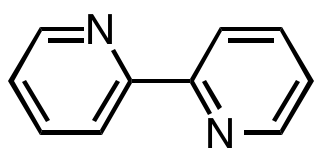
2,2′-Bipyridine (bipy or bpy, pronounced )[citation needed] is an organic compound with the formula (C5H4N)2. This colorless solid is an important isomer of the bipyridine family. It is a bidentate chelating ligand, forming complexes with many transition metals. Ruthenium and platinum complexes of bipy exhibit intense luminescence.[1]
Preparation, structure, and general properties
[edit]
2,2′-Bipyridine was first prepared by decarboxylation of divalent metal derivatives of pyridine-2-carboxylate:[2]
2C5H4NCOO− → (C5H4N)2 + 2CO2 + 2e−
It is prepared by the dehydrogenation of pyridine using Raney nickel:[3]
2C5H5N → (C5H4N)2 + H2
Substituted 2,2′-bipyridines
[edit]
Unsymmetrically substituted 2,2′-bipyridines can be prepared by cross coupling reaction of 2-pyridyl and substituted pyridyl reagents.[4]
Although bipyridine is often drawn with its nitrogen atoms in cis conformation, the lowest energy conformation both in solid state and in solution is in fact coplanar, with nitrogen atoms in trans position.[5] Monoprotonated bipyridine adopts a cis conformation.[6]

2,2′-bipyridine produces multiple coordination complexes. It binds metals as a ligand for chelation, forming a 5-membered chelate ring.
- ^ Broomhead J. A.; Young C. G. (1990). “Tris(2,2″-Bipyridine)Ruthenium(II) Dichloride Hexahydrate”. Inorganic Syntheses. Vol. 28. pp. 338–340. doi:10.1002/9780470132593.ch86. ISBN 978-0-470-13259-3.
- ^ Constable; Housecroft (2019). “The Early Years of 2,2′-Bipyridine—A Ligand in its Own Lifetime”. Molecules. 24 (21): 3951. doi:10.3390/molecules24213951. PMC 6864536. PMID 31683694.
- ^ Sasse, W. H. F. (1966). “2,2′-Bipyridine”. Organic Syntheses. 46: 5. doi:10.15227/orgsyn.046.0005.
- ^ Liu, Tiandong; Fraser, Cassandra L. (2012). “Discussion Addendum for: Synthesis of 4-, 5-, and 6-Methyl-2,2′-bipyridine by a Negishi Cross-Coupling Strategy: 5-Methyl-2,2′-bipyridine”. Organic Syntheses. 89: 76. doi:10.15227/orgsyn.089.0076.
- ^ Merritt, L. L.; Schroeder, E. (1956). “The Crystal Structure of 2,2′-Bipyridine”. Acta Crystallographica. 9 (10): 801–804. doi:10.1107/S0365110X56002175.
- ^ Göller, A.; Grummt, U.-W. (2000). “Torsional barriers in biphenyl, 2,2′-bipyridine and 2-phenylpyridine”. Chemical Physics Letters. 321 (5–6): 399–405. Bibcode:2000CPL…321..399G. doi:10.1016/S0009-2614(00)00352-3.




