


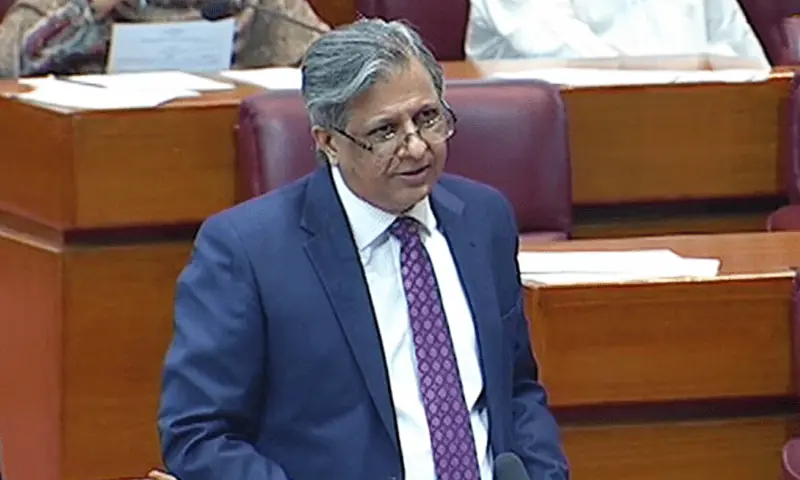
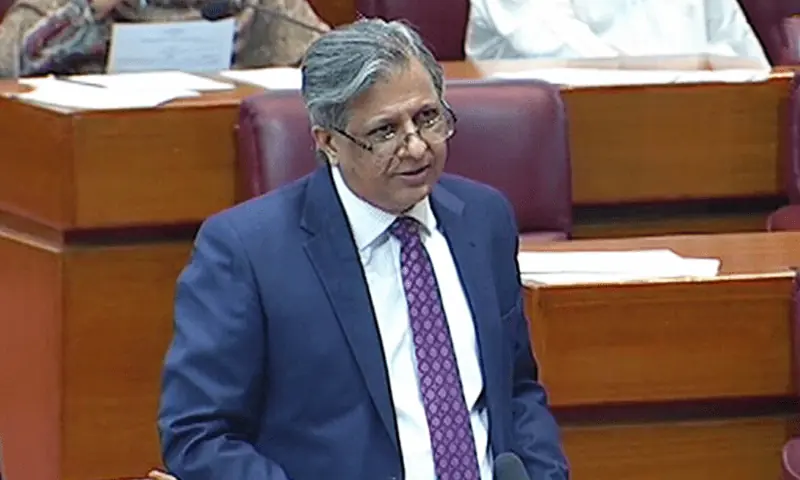
The federal cabinet on Saturday approved a draft for the 27th Constitutional Amendment, with Law Minister Azam Nazeer Tarar saying that the proposed legislation would be tabled in the upper house of Parliament today.
Prime Minister Shehbaz Sharif chaired the cabinet meeting via video link from Azerbaijan, state-run PTV News reported. “The federal cabinet approved the draft for the 27th Constitutional Amendment and warmly welcomed it,” it added.
After the meeting in Islamabad, Tarar briefed the media on some of the key features of the draft, and said the bill for the Amendment would be presented in the Senate today.
“This bill will be presented in the Senate of Pakistan, and then the desire to refer it to a joint committee was expressed so that members of the Senate and National Assembly law and justice committees … so that a satisfactory conversation can be held on the bill’s provisions,” he said.
The minister said that in recent days, Prime Minister Shehbaz Sharif had held meetings with the government’s allies.
“After detailed consultation, the points on which consensus has been reached concern the old promise in the Charter of Democracy regarding the formation of a constitutional court,” he said.
“Now, the suggestion of a separate federal constitutional court will be referred to Parliament in the form of a bill, and Parliament will decide on it after a debate,” he said.
The minister also noted that there had been much debate about the transfer of judges. “It has been proposed in the bill that the transfer of judges be handled by the Judicial Commission of Pakistan … It has been added in the bill that the chief justices of high courts from where a judge is posted and where he wishes to transfer to will be included in the consultations.”
He further said that in the past, the Senate election process in Khyber Pakhtunkhwa had been affected due to court proceedings and certain decisions made by the provincial assembly.
He noted that the term for the upper house of Parliament was six years, adding that it could not be dissolved, as compared to the National Assembly.
“After every three years, there is a constitutional need for the election of the Senate chairman, deputy chairman. To solve this issue, there is a need to make appropriate amendments in that specific article to clarify that members of the Senate elected this time or who will be elected in the future — whose six-year term has somehow been wasted — they will be considered as being members so that elections can be held across the country at one time.”
He said that smaller provinces, such as KP and Balochistan, had demanded that their provincial cabinet threshold of 11 per cent be increased so that their departments were not left “incomplete”.
The Constitution allows the provinces to have cabinets not exceeding 15 ministers or 11pc of the total membership of their respective provincial assembly, whichever of the two is higher.
“So on their suggestion, it has been proposed to make it 13pc from 11pc,” he said. He further said that provinces were only allowed five advisers, but it had been suggested to change it to seven advisers.
Talking about Article 243, which provides that the federal government “shall have control and command of the armed forces”, the minister said that there had always been a great debate on strategic and defence subjects in this region.
“The recent Pak-India war has also taught us a lot of lessons, and we have found out that the contours of war have changed.”
“So regarding this, appointments and their processes, which were in the Army Act but could not be discussed at the time of the 1973 Constitution, one of which is the role of the field marshal … it has been deemed necessary to discuss this,” he said.
“And it has been suggested that the awards you give to national heroes, this is also a ceremonial title alongside being a rank, so it has been suggested that this should remain with them for a lifetime.
“As far as their command is concerned, it will continue to be regulated as per the law, and the appropriate amendments on this will be presented before Parliament,” he said.
In his media talk, the law minister highlighted that constitutional amendments could only be passed if they were accepted by a two-thirds majority.
He further said that at the time of the 26th Constitutional Amendment, the Muttahida Qaumi Movement-Pakistan (MQM-P) had contacted the prime minister and the PML-N seeking changes to Article 140A, which provides that the provinces will establish local governments (LGs).
“They had introduced a bill in the Senate, which was referred to a committee and on the directives of the premier, I, as the law minister, also gave a note in its support,” Tarar said.
“As that bill is already pending, the cabinet has also directed me today that when today’s bill is referred to the committee after being presented in the senate, the committee should also mull over [the one tabled by the MQM-P],” he said.
He said that the government would try to convince its allied partners to develop a consensus on this bill so that it could be passed, adding that a recent resolution by the Punjab Assembly regarding LGs would also be discussed.
He further said that leaders of the Balochistan Awami Party (BAP), in their Thursday meeting with PM Shehbaz, had directed his attention to a bill pertaining to an increase in the seats for the Balochistan Assembly.
“So both these bills, which are already pending before the law and justice standing committee, will be debated,” he said.
The proposed constitutional tweaks have been heavily criticised by lawyers and politicians, who termed them an attempt to revoke provincial rights granted in the 18th Amendment.
The federal cabinet meeting was originally scheduled for Friday, but was postponed due to PM Shehbaz’s commitments in Azerbaijan, sources in the PM Office said. However, some were of the opinion that the meeting was put off due to a lack of consensus between the ruling PML-N and the PPP over the Amendment.
PM Shehbaz had held consultations with multiple ruling allies on Thursday, meeting with the top leadership of the PML-Q, the Istehkam-i-Pakistan Party (IPP), the MQM-P, the BAP, the Awami National Party (ANP) and PML-Zia president Ijazul Haq.
The PPP has said it would support amendments to Article 243, which defines the powers of the armed forces, but has rejected proposals related to provinces’ shares under the National Finance Commission (NFC) award and any rollback of the 18th Amendment.
The PPP’s Central Executive Committee (CEC) yesterday decided that it “agrees in principle with the idea that constitutional courts should be formed” — a proposal also mulled during the 26th Amendment discussions last year.
The MQM-P presented its own version of additions to the 27th Amendment, calling for strong and autonomous LGs across the country. The Jamiat Ulema-i-Islam–Fazl (JUI-F), which met with an MQM-P delegation on Thursday, has opposed any amendment that would reduce the powers granted to the provinces under the 18th Amendment.
The opposition PTI has criticised most of the tweaks, terming the proposed amendment an “attack“ on the Parliament. PTI Chairman Barrister Gohar Ali Khan said earlier this week that it would be inappropriate to claw back population and education from the provinces.
On the other hand, Parliamentary Affairs Minister Dr Tariq Fazal Chaudhry on Wednesday assured the National Assembly that the 18th Amendment would not be rolled back through the 27th Amendment.
On November 3, PPP Chairman Bilawal Bhutto-Zardari revealed that the government’s proposed amendments included “setting up [of] constitutional court, executive magistrates, transfer of judges, removal of protection of provincial share in NFC, amending article 243, return of education and population planning to the federation and breaking [the] deadlock on appointment of ECP”.
More to follow



