


== History ==
== History ==
[[File:Tournaisis carte 1.png|thumb|right|Map of the [[Tournaisis]] region in [[Belgium]] showing the location of [[Tournai]], where the 5th Group CIS was based]]
===Formation and role===
===Formation and role===
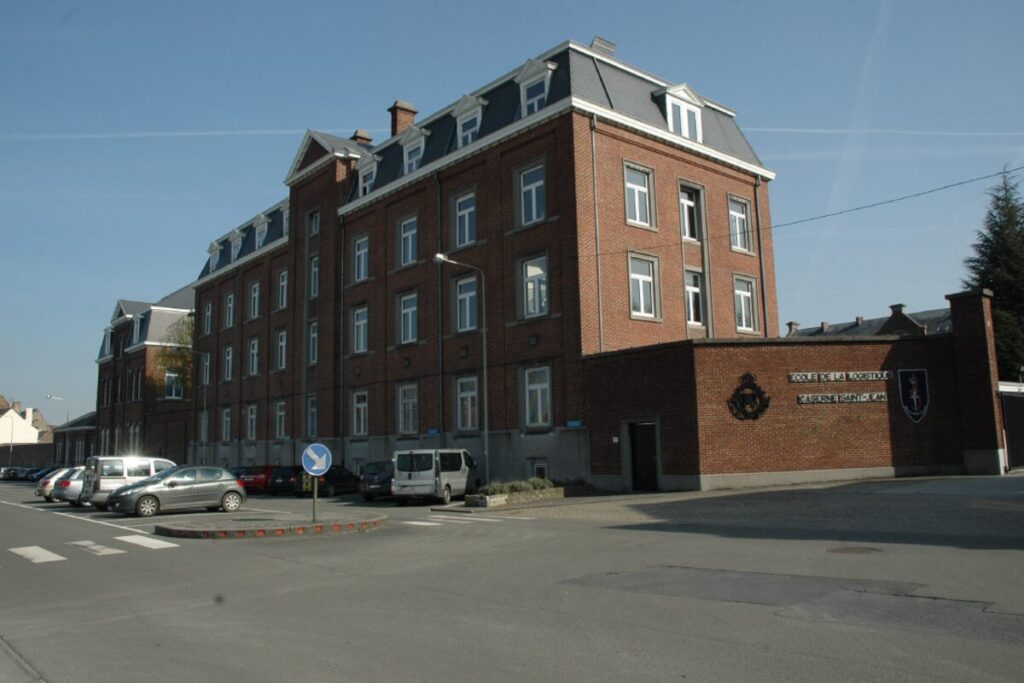
The 5 Gp CIS was created in 2003 as part of the ongoing modernisation of the Land Component, the land-based branch of the [[Belgian Armed Forces]] responsible for ground operations, that began in the 1990s.{{sfn|”La Libre.be”|2010}} Its role was to provide secure communication and information systems for both domestic and overseas missions.{{sfn|”lavenir.net”|2011}} It was based at the Saint-Jean barracks in [[Tournai]], a site with a long military tradition. The location had previously hosted the 11th Artillery Regiment during the interwar period and later the Belgian Army’s logistics schools before the arrival of the 5 Gp CIS in 2003.{{sfn|”Les Amis de la Citadelle de Tournai”|2021}}
The 5 Gp CIS was created in 2003 as part of the ongoing modernisation of the Land Component, the land-based branch of the [[Belgian Armed Forces]] responsible for ground operations, that began in the 1990s.{{sfn|”La Libre.be”|2010}} Its role was to provide secure communication and information systems for both domestic and overseas missions.{{sfn|”lavenir.net”|2011}} It was based at the Saint-Jean barracks in [[Tournai]], a site with a long military tradition. The location had previously hosted the 11th Artillery Regiment during the interwar period and later the Belgian Army’s logistics schools before the arrival of the 5 Gp CIS in 2003.{{sfn|”Les Amis de la Citadelle de Tournai”|2021}}
Belgian Army communications unit (2003–2011)
| 5th Group Communication and Information Systems | |
|---|---|
 Saint-Jean barracks in Tournai, headquarters of the 5 Gp CIS
|
|
| Active | 5 May 2003 – 24 March 2011 |
| Disbanded | 24 March 2011 |
| Country |  |
| Allegiance | Belgian Armed Forces |
| Branch | Land Component |
| Type | Signals |
| Role | Communications and information systems support |
| Size | ≈230 personnel |
| Part of | Land Component, Belgian Armed Forces |
| Headquarters | Tournai |
| Nickname | 5 Gp CIS |
| Mottos | Partout et toujours (“Everywhere and always”) |
| Equipment | Mobile and fixed communications systems |
| Operations | Afghanistan, Côte d’Ivoire, Cape Verde, Lebanon, Kosovo, Chad |

Military unit
The 5th Group Communication and Information Systems (’‘5e Groupe des Systèmes de Communication et d’Information’’, ‘‘5 Gp CIS’’) was a military communications unit of the Land Component of the Belgian Armed Forces. Established on 5 May 2003 and based in Tournai, it was the only Land Component formation located in the province of Hainaut.
The unit provided secure communications and information systems support for both national operations and international deployments, participating in more than thirty missions across Africa, Asia and Europe. Known for its motto, Partout et toujours (“Everywhere and always”), the 5 Gp CIS was disbanded in 2011 under the Belgian Army’s Transformation Plan.
The origins of Belgium’s military communications units date back to the First World War. In 1913, the fortified positions of Liège and Namur each received a telegraph company, marking the beginning of organised army signalling. At mobilisation in August 1914, a telegraph company was created for the fortified position of Antwerp, and eight telegraph sections were established for the Grand Quartier Général, (General Headquarter) the cavalry division and each of the six army divisions. These sections were reorganised as platoons in January 1915 and became full companies by 1917.
A wireless service (service TSF, for télégraphie sans fil) was founded in February 1917, and every major formation received its own radio section. By the end of the war, Belgian communications troops included 1,962 telegraphists, 1,500 radio operators, 600 transmitters, 4,900 telephones, 5,340 kilometres of telephone wire and thousands of signal flags and lamps, illustrating the rapid expansion of military communications during the conflict.

The 5 Gp CIS was created in 2003 as part of the ongoing modernisation of the Land Component, the land-based branch of the Belgian Armed Forces responsible for ground operations, that began in the 1990s. Its role was to provide secure communication and information systems for both domestic and overseas missions. It was based at the Saint-Jean barracks in Tournai, a site with a long military tradition. The location had previously hosted the 11th Artillery Regiment during the interwar period and later the Belgian Army’s logistics schools before the arrival of the 5 Gp CIS in 2003.
The 5 Gp CIS specialised in providing communications and information systems support for operational deployments and domestic missions. From its creation in 2003 until its disbandment, the unit took part in thirty-six overseas missions across Africa, Asia and Europe, with a total of 234 Belgian personnel deployed. The unit comprised around 200 personnel and provided communications support for the Land Component across Belgium and abroad. It was deployed on numerous missions, including in Afghanistan, Côte d’Ivoire, Cape Verde, Lebanon, Kosovo and Chad.
Its commanding officer, Major Jeff Vandromme, stated that the unit’s motto, partout et toujours (“Everywhere and always”), reflected both its operational flexibility and its service to the local population, assisting during crises and supporting regional activities and charitable causes.
In December 2010, the Ministry of Defence confirmed a major restructuring under the finalisation de la transformation plan presented by Defence Minister Pieter De Crem. The reform reorganised the army into two principal brigades and reduced personnel numbers. Among the affected formations in Hainaut were the 5 Gp CIS in Tournai and the 2nd Medical Intervention Element (EMI 2) in Ghlin, together involving around 300 of the province’s 1,150 active military personnel. The dissolution of the 5 Gp CIS was scheduled for 15 January 2011 as part of this broader consolidation of logistics and communications units.
As part of the Belgian Army Transformation Plan and the creation of the Medium Brigade, the 5 Gp CIS was formally disbanded in 2011. A farewell ceremony took place on 24 March 2011 in the Grand-Place of Tournai, attended by around 150 Belgian and French soldiers, including personnel from the 41st Signals Regiment of Douai. The event was presided over by Lieutenant-General Marc Compernol, Aide-de-camp to the King and Commander of the Land Component.



