
Content deleted Content added
| Line 15: | Line 15: | ||
|
| rite = |
| rite = |
||
|
| festival = <!– or |festivals= –> |
| festival = <!– or |festivals= –> |
||
|
| organisational_status = |
| organisational_status = |
||
|
| ownership = |
| ownership = |
||
|
| governing_body = |
| governing_body = |
||
| Line 37: | Line 37: | ||
|
| heritage_designation = |
| heritage_designation = |
||
|
| architect = |
| architect = |
||
|
| architecture_type = {{ |
| architecture_type = {{|[[]]}} |
||
|
| architecture_style = [[Moorish architecture|Moorish]] |
| architecture_style = [[Moorish architecture|Moorish]] |
||
|
| founded_by = [[Abu al-Hasan Ali ibn Othman|Abu al-Hasan]] |
| founded_by = [[Abu al-Hasan Ali ibn Othman|Abu al-Hasan]] |
||
Revision as of 15:27, 22 September 2025
Mosque in Tlemcen, Algeria
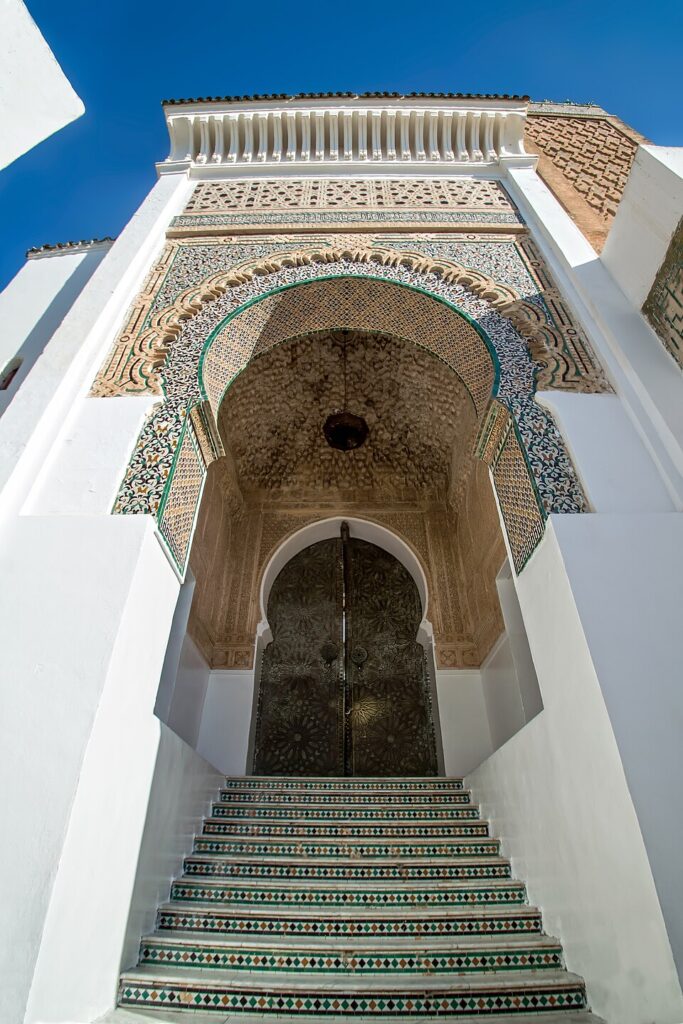
The Sidi Boumediene Mosque (Arabic: مسجد شعيب أبو مدين) or the Worshipper’s Mosque (Arabic: مسجد العباد) is a Sunni mosque and associated religious complex located in Tlemcen, Algeria. The complex comprises a mosque, madrasa and mausoleum dedicated to the influential Sufi saint Abu Madyan. Abu Madyan was hailed from Seville and contributed greatly to the spread of tasawwuf in the Maghreb region.
The mosque was added to the list of cultural heritage items in Algeria.[citation needed]
History
The mosque was founded by the Marinid rulers in 1339 CE. The madrasa was founded eight years after the mosque, where Ibn Khaldun had taught once.[1] The Dar al-Sultan palace was established as well in the lower point of the complex, where the sultans stayed during their visit to the mosque.[2] The Sidi al-Haloui Mosque, built in 1353, was closely modelled on it.[3][4]
Architecture
The complex contains several religious buildings including the mosque, mausoleum, madrasa and the hamam. The mosque has the main entrance resembling that of the several other Moorish architectures from Córdoba to Kairouan. The entrance leads to the gallery of plaster paintings. On top of the dome exists muqarnas. It continues to the stairs which resemble that of the Puerta del Sol, Toledo. The wooden doors are decorated with bronze, and they lead to the sahn with the fountain in the middle and surrounded by corridors and prayer hall.
Gallery
See also
References
- ^ “Madrasa Sidi Abu Madyan”. ArchNet. n.d. Archived from the original on January 7, 2018. Retrieved January 7, 2018.
- ^ “Dar al-Sultan”. ArchNet. n.d. Archived from the original on December 27, 2020. Retrieved January 9, 2018.
- ^ Lafer, Ali. “Sidi al-Haloui Mosque”. Discover Islamic Art, Museum With No Frontiers. Archived from the original on June 24, 2021. Retrieved June 19, 2021.
- ^ Marçais, Georges (1954). L’architecture musulmane d’Occident (in French). Paris: Arts et Métiers Graphiques. p. 278.
Further reading
- Marçais, Georges (2003). du Tell, Blida (ed.). Les villes d’art célèbres. Tlemcen (in French). Paris: rééd. de l’ouvrage paru en 1950 à la Librairie Renouard.
External links
 Media related to Sidi Boumediene Mosque at Wikimedia Commons

