
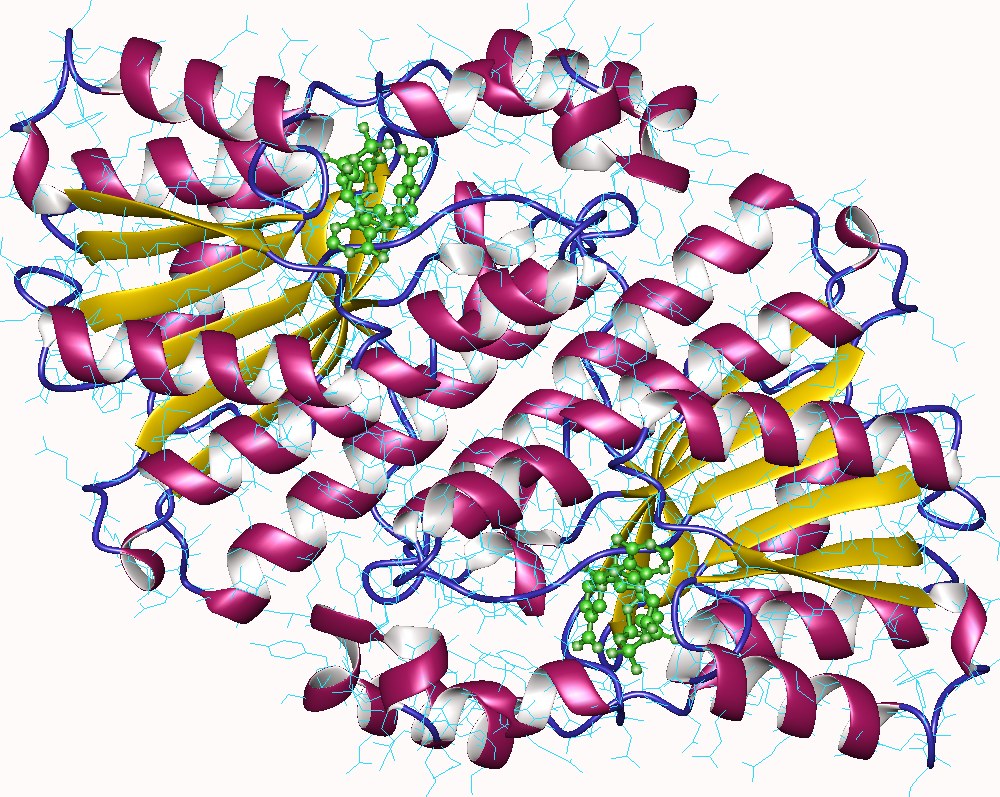
* [[ML148]] <ref>Niesen FH, Schultz L, Jadhav A, Bhatia C, Guo K, Maloney DJ, Pilka ES, Wang M, Oppermann U, Heightman TD, Simeonov A. High-affinity inhibitors of human NAD-dependent 15-hydroxyprostaglandin dehydrogenase: mechanisms of inhibition and structure-activity relationships. ”PLoS One”. 2010 Nov 2;5(11):e13719. {{doi|10.1371/journal.pone.0013719}} {{pmid|21072165}}</ref>
* [[ML148]] <ref>Niesen FH, Schultz L, Jadhav A, Bhatia C, Guo K, Maloney DJ, Pilka ES, Wang M, Oppermann U, Heightman TD, Simeonov A. High-affinity inhibitors of human NAD-dependent 15-hydroxyprostaglandin dehydrogenase: mechanisms of inhibition and structure-activity relationships. ”PLoS One”. 2010 Nov 2;5(11):e13719. {{doi|10.1371/journal.pone.0013719}} {{pmid|21072165}}</ref>
* 15-PGDH-IN-4 <ref>Dodda LS, Campos S, Ciccone D, Carreiro S, Leit S, Brennan D, Zephyr J, Jacques-O’Hagan S, Kumar S, Kuo FS, Shaik MM, Price DJ, Loh C, Edmondson SD, Tummino P, Kaila N. Knowledge and Structure-Based Drug Design of 15-PGDH Inhibitors. ”J Med Chem”. 2025 Sep 11;68(17):18436-18462. {{doi|10.1021/acs.jmedchem.5c01231}} {{pmid|40864846}}</ref>
* 15-PGDH-IN-4 <ref>Dodda LS, Campos S, Ciccone D, Carreiro S, Leit S, Brennan D, Zephyr J, Jacques-O’Hagan S, Kumar S, Kuo FS, Shaik MM, Price DJ, Loh C, Edmondson SD, Tummino P, Kaila N. Knowledge and Structure-Based Drug Design of 15-PGDH Inhibitors. ”J Med Chem”. 2025 Sep 11;68(17):18436-18462. {{doi|10.1021/acs.jmedchem.5c01231}} {{pmid|40864846}}</ref>
* [[HW201877]] <ref>Li Q, Zang Y, An D, Yin S, Wu H, Wang M, Li C, Zhou Y, Liu L, Zhang X. Discovery of HW201877: A Highly Potent and Orally Bioavailable Inhibitor of 15-Prostaglandin Dehydrogenase to Potentiate Tissue Repair and Regeneration. ”J Med Chem”. 2025 Jul 10;68(13):14099-14113. {{doi|10.1021/acs.jmedchem.5c01361}} {{pmid|40568827}}</ref>
== Substrates ==
== Substrates ==
Class of enzymes
Hydroxyprostaglandin dehydrogenase 15-(NAD) (the HUGO-approved symbol = HPGD; HGNC ID, HGNC:5154), also called 15-hydroxyprostaglandin dehydrogenase (NAD+), (EC 1.1.1.141), is an enzyme produced by the HPGD gene.
It catalyzes the It catalyzes the NAD⁺-dependent oxidation of the 15-hydroxyl group of prostaglandins (primarily prostaglandin E₂ or PGE2, but also others like PGD₂ and PGF₂α) and related eicosanoids (such as lipoxins), converting them to inactive 15-keto metabolites. This is the rate-limiting step in prostaglandin degradation, reducing their biological activity and regulating processes such as inflammation, cell proliferation, and tissue homeostasis.:[1][2]
- Downregulation in cancer — Can be reduced in tumors (e.g., colorectal, lung, breast), leading to elevated PGE2 levels that promote tumorigenesis; it acts as a tumor suppressor.[3]
- Aging and regeneration — Levels increase with age, contributing to tissue decline (e.g., muscle atrophy, cartilage loss). Inhibiting 15-PGDH elevates PGE2 and promotes regeneration in muscle, bone, cartilage, liver, colon, and hematopoietic tissues.[4][5]
- Inflammation and immunity — Degrades pro-inflammatory prostaglandins; inhibition can enhance resolution of inflammation or protect barriers like the blood-brain barrier in conditions such as Alzheimer’s or traumatic brain injury.[6]
- Other roles — It is involved in wound healing, obesity-related inflammation, and pregnancy maintenance.
Therapeutic interest
[edit]
Small-molecule inhibitors of 15-PGDH are under investigation for promoting tissue repair, countering sarcopenia, treating osteoarthritis, and supporting recovery after injury or transplantation. Mutations in HPGD can cause rare disorders like primary hypertrophic osteoarthropathy (digital clubbing, bone overgrowth).[7]
- Inhibitors
The two substrates of this enzyme are prostaglandin E2 and oxidised nicotinamide adenine dinucleotide (NAD+). Its products are 15-ketoprostaglandin E2, reduced NADH, and a proton.[13][14][15][16]
This enzyme belongs to the family of oxidoreductases, specifically those acting on the CH-OH group of donor with NAD+ or NADP+ as acceptor.
The systematic name of this enzyme class is (5Z,13E)-(15S)-11alpha,15-dihydroxy-9-oxoprost-13-enoate:NAD+ 15-oxidoreductase. Other names in common use include NAD+-dependent 15-hydroxyprostaglandin dehydrogenase (type I), PGDH, 11alpha,15-dihydroxy-9-oxoprost-13-enoate:NAD+ 15-oxidoreductase, 15-OH-PGDH, 15-hydroxyprostaglandin dehydrogenase, 15-hydroxyprostanoic dehydrogenase, NAD+-specific 15-hydroxyprostaglandin dehydrogenase, prostaglandin dehydrogenase, 15-hydroxyprostaglandin dehydrogenase (NAD+), and 15-PGDH.
As of late 2007, only one structure has been solved for this class of enzymes, with the PDB accession code 2GDZ.
- ^ Enzyme 1.1.1.141 at KEGG Pathway Database.
- ^ Huang, Wei; Li, Hongyun; Kiselar, Janna; Fink, Stephen P.; Regmi, Sagar; Day, Alexander; Yuan, Yiyuan; Chance, Mark; Ready, Joseph M.; Markowitz, Sanford D.; Taylor, Derek J. (2023-02-11). “Small molecule inhibitors of 15-PGDH exploit a physiologic induced-fit closing system”. Nature Communications. 14 (1): 784. Bibcode:2023NatCo..14..784H. doi:10.1038/s41467-023-36463-7. ISSN 2041-1723. PMID 36774348.
- ^ Tai, Hsin-Hsiung; Tong, Min; Ding, Yunfei (May 2007). “15-hydroxyprostaglandin dehydrogenase (15-PGDH) and lung cancer”. Prostaglandins & Other Lipid Mediators. 83 (3): 203–208. doi:10.1016/j.prostaglandins.2007.01.007. ISSN 1098-8823. PMC 1963423. PMID 17481556.
- ^ Conger, Krista (2025-11-27). “Inhibiting a master regulator of aging regenerates joint cartilage in mice”. News Center. Retrieved 2026-01-05.
- ^ Desai, Amar (2023-11-02). “15-Pgdh Inhibition Alternatively Activates Macrophages to Promote Hematopoietic Function during Aging”. Blood. 142 (Supplement 1): 5610. doi:10.1182/blood-2023-174704. ISSN 0006-4971. Archived from the original on 2024-04-07.
- ^ Koh, Yeojung; Vázquez-Rosa, Edwin; Gao, Farrah; Li, Hongyun; Chakraborty, Suwarna; Tripathi, Sunil Jamuna; Barker, Sarah; Bud, Zea; Bangalore, Anusha; Kandjoze, Uapingena P.; León-Alvarado, Rose A; Sridharan, Preethy S.; Cordova, Brittany A.; Yu, Youngmin; Hyung, Jiwon (2025-05-27). “Inhibiting 15-PGDH blocks blood–brain barrier deterioration and protects mice from Alzheimer’s disease and traumatic brain injury”. Proceedings of the National Academy of Sciences. 122 (21) e2417224122. Bibcode:2025PNAS..12217224K. doi:10.1073/pnas.2417224122. PMC 12130856. PMID 40397680.
- ^ “What are 15-PGDH inhibitors and how do they work?”. synapse.patsnap.com. Retrieved 2026-01-05.
- ^ Zhang Y, Desai A, Yang SY, Bae KB, Antczak MI, Fink SP, Tiwari S, Willis JE, Williams NS, Dawson DM, Wald D, Chen WD, Wang Z, Kasturi L, Larusch GA, He L, Cominelli F, Di Martino L, Djuric Z, Milne GL, Chance M, Sanabria J, Dealwis C, Mikkola D, Naidoo J, Wei S, Tai HH, Gerson SL, Ready JM, Posner B, Willson JK, Markowitz SD. TISSUE REGENERATION. Inhibition of the prostaglandin-degrading enzyme 15-PGDH potentiates tissue regeneration. Science. 2015 Jun 12;348(6240):aaa2340. doi:10.1126/science.aaa2340 PMID 26068857
- ^ Singla M, Wang YX, Monti E, Bedi Y, Agarwal P, Su S, Ancel S, Hermsmeier M, Devisetti N, Pandey A, Bakooshli MA, Palla AR, Goodman S, Blau HM, Bhutani N. Inhibition of 15-hydroxy prostaglandin dehydrogenase promotes cartilage regeneration. Science. 2025 Nov 27:eadx6649. doi:10.1126/science.adx6649 PMID 41308124
- ^ Niesen FH, Schultz L, Jadhav A, Bhatia C, Guo K, Maloney DJ, Pilka ES, Wang M, Oppermann U, Heightman TD, Simeonov A. High-affinity inhibitors of human NAD-dependent 15-hydroxyprostaglandin dehydrogenase: mechanisms of inhibition and structure-activity relationships. PLoS One. 2010 Nov 2;5(11):e13719. doi:10.1371/journal.pone.0013719
{{doi}}: unflagged free DOI (link) PMID 21072165 - ^ Dodda LS, Campos S, Ciccone D, Carreiro S, Leit S, Brennan D, Zephyr J, Jacques-O’Hagan S, Kumar S, Kuo FS, Shaik MM, Price DJ, Loh C, Edmondson SD, Tummino P, Kaila N. Knowledge and Structure-Based Drug Design of 15-PGDH Inhibitors. J Med Chem. 2025 Sep 11;68(17):18436-18462. doi:10.1021/acs.jmedchem.5c01231 PMID 40864846
- ^ Li Q, Zang Y, An D, Yin S, Wu H, Wang M, Li C, Zhou Y, Liu L, Zhang X. Discovery of HW201877: A Highly Potent and Orally Bioavailable Inhibitor of 15-Prostaglandin Dehydrogenase to Potentiate Tissue Repair and Regeneration. J Med Chem. 2025 Jul 10;68(13):14099-14113. doi:10.1021/acs.jmedchem.5c01361 PMID 40568827
- ^ Anggaard E, Samuelsson B (1966). “Purification and properties of a 15-hydroxyprostaglandin dehydrogenase from swine lung”. Prostaglandins. 25: 293–300.
- ^ Braithwaite SS, Jarabak J (1975). “Studies on a 15-hydroxyprostaglandin dehydrogenase from human placenta. Purification and partial characterization”. J. Biol. Chem. 250 (6): 2315–8. doi:10.1016/S0021-9258(19)41718-3. PMID 1117007.
- ^ Lee SC, Levine L (1975). “Prostaglandin metabolism. II. Identification of two 15-hydroxyprostaglandin dehydrogenase types”. J. Biol. Chem. 250 (2): 548–52. doi:10.1016/S0021-9258(19)41931-5. PMID 234431.
- ^ Lee SC, Pong SS, Katzen D, Wu KY, Levine L (1975). “Distribution of prostaglandin E 9-ketoreductase and types I and II 15-hydroxyprostaglandin dehydrogenase in swine kidney medulla and cortex”. Biochemistry. 14 (1): 142–5. doi:10.1021/bi00672a024. PMID 803247.

