

The architecture of the Song dynasty (960–1279) was noted for its towering Buddhist pagodas, enormous stone and wooden bridges, lavish tombs, and extravagant palaces. Although literary works on Chinese architecture existed beforehand, architectural writing blossomed during the Song dynasty, maturing into a more professional form that described dimensions and working materials in a concise, organized manner. In addition to ruins and structures still standing intact, depictions in Song artwork, architectural drawings, and illustrations in published books all aid modern historians in understanding the architecture of the period.
The professions of architect, master craftsman, carpenter, and structural engineer did not have the high status of the Confucian scholar-officials during China’s dynastic era. Architectural knowledge had been passed down orally for thousands of years, usually from craftsman fathers to their sons. There were also government agencies and schools for construction, building, and engineering. The Song dynasty’s building manuals aided not only the various private workshops, but also the craftsmen employed by the central government.
City and palace

While some Chinese architecture built during the Song dynasty remains intact or in ruins, many of the buildings and much of the construction materials from this era have disappeared or eroded over time. Chinese pavilions, restaurants, and wine shops built in urban areas during the Song period no longer exist, and can only be studied with the aid of primary sources such as government edicts, literature, and artworks. For instance, Zhang Zeduan‘s large painting Along the River During the Qingming Festival, which depicts various buildings, bridges, vehicles, and people in Kaifeng, serves as one of the major sources for understanding Song architecture before the Jurchen Jin siege and occupation of the capital city in 1127. Various texts from the 12th and 13th centuries also describe the layout of Kaifeng.[a]
Buddhist pagodas


Following the reign of the Han dynasty, (202 BC – 220 AD), the idea of the Buddhist stupa entered Chinese culture as a means to house and protect scriptural sutras. During the Southern and Northern Dynasties period, the distinctive Chinese pagoda was developed, its predecessors being the tall watch towers and towering residential apartments of the Han dynasty (as inferred from models in Han-era tombs). During the Sui (581–618) and Tang (618–907) periods, Chinese pagodas were developed from purely wooden structures to use articulated stone and brick, which could more easily survive fires caused by lightning or arson and were less susceptible to decay. The earliest brick pagoda that remains extant is the Songyue Pagoda, built in 523, and a typical example of a Tang-era stone pagoda is the Giant Wild Goose Pagoda, constructed in 652. Although Buddhist influences on China waned after the late Tang period, numerous Buddhist pagoda towers were built during the Song dynasty. Tall Chinese pagodas were often built in the countryside rather than within a city’s walls, largely to avoid competition with the cosmic-imperial authority embodied in the cities’ drum- and gate-towers.
The Song period featured true cast-iron pagodas, such as the Iron Pagoda of Yuquan Temple (Jade Springs Temple), Dangyang, Hubei Province. Built in 1061, it incorporates 53,848 kg (118,715 lb) of cast iron and stands 21.28 m (69.8 ft) tall.
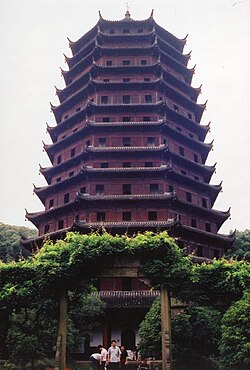
The Liuhe Pagoda, or Six Harmonies Pagoda, is another example of Song-era pagoda architecture. It is located in the Southern Song capital of Hangzhou, in Zhejiang Province, at the foot of Yuelun Hill facing the Qiantang River. Although the original was destroyed in 1121, the current tower was erected in 1156 and fully restored by 1165. It stands 59.89 m (196.5 ft) tall, and was constructed from a red brick frame with 13 stages of wooden eaves. Because of its size, the pagoda served as a permanent lighthouse to aid sailors at night.
-
 Lingxiao Pagoda in Zhengding, Hebei Province, is a 42-meter (138 ft) tall wood-and-brick hybrid pagoda. It was built in 1045.
 -

-
 The wooden dougong-constructed Pagoda of Fogong Temple, located in Shanxi, 67 m (220 ft) in height, built in 1056 during the Liao dynasty
 -
 Although rebuilt during the Ming dynasty, the Beisi Pagoda‘s frame was designed between 1131 and 1162 during the Song period; it stands 76 m (249 ft) tall.
 -
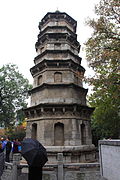 Wuying Pagoda (Shadowless Pagoda) in Wuhan, built in 1270 during the Mongol Invasion of the Southern Song


Temples


It was not uncommon for wealthy or powerful families to facilitate the construction of large temple complexes, usually by donating a portion of their family estate to a Buddhist sect. Often the land already contained buildings that could be re-purposed for religions use. The Fei (費) family of the town of Jinze, located just west of Shanghai, converted a mansion on their property into a Buddhist sutra recitation hall, and later built several other religious buildings around the hall. This spurred a boom in temple construction in the area, causing Jinze to become a major center of the White Lotus sect of Buddhism, which in turn spurred the construction of more temples and lead the town to become a significant location within the Song. The nearby town of Nanxiang gained prominence shortly after the fall of the Song in large part to the construction of temples and other religious buildings, which spanned the entire Song empire.
The Hall of the Saintly Mother (圣母殿) and the Hall of Sacrifice at Jin Temple, located in a southeastern suburb of Taiyuan City, Shanxi province, are extant examples of early Song architecture.
Bridges


The construction of bridges over waterways has been recorded in China since the ancient Zhou dynasty. During the Song dynasty, large trestle bridges were constructed, such as the one built by Zhang Zhongyan in 1158. There were also large bridges made entirely of stone, like the Bazi Bridge of Shaoxing, built in 1256 and still standing today.
In 1221, the Taoist traveler Qiu Changchun visited Genghis Khan in Samarkand, describing various Chinese bridges encountered on the way there through the Tian Shan Mountains, east of Yining. The historian Joseph Needham quotes Qiu as saying:
[The road had] “no less than 48 timber bridges of such width that two carts can drive over them side by side”. It had been built by Chang Jung [Zhang Rong] and the other engineers of the Chagatai some years before. The wooden trestles of Chinese bridges from the −3rd century [BC] onwards were no doubt similar to those supposed to have been employed in Julius Caesar‘s bridge of −55 [BC] across the Rhine, or drawn by Leonardo, or found in use in Africa. But where in +13th century [AD] Europe could a two-lane highway like Chang Jung’s have been found?
In Fujian Province, enormous beam bridges were built during the Song dynasty. Some of these were as long as 1,220 m (4,000 ft), with individual spans of up to 22 m (72 ft) in length; their construction necessitated moving massive stones of 203 t (203,000 kg). No names of the engineers were recorded or appear in the inscriptions on the bridges, which give only the names of local officials who sponsored them and oversaw their construction and repair. However, there might have been an engineering school in Fujian, headed by a prominent engineer known as Cai Xiang (1012–1067), who had risen to the position of governmental prefect in Fujian. Between 1053 and 1059, he planned and supervised the construction of the large Wanan Bridge (once called the Luoyang Bridge) near Quanzhou (on the border of the present-day Luojiang District and Huai’an County.
Tombs of Northern Song emperors


Located southwest of Gongyi city in Henan province, the large tombs of the Northern Song number about one thousand, including individual tombs for Song emperors, empresses, princes, princesses, consorts, and members of the extended family. The complex extends approximately 7 km (4.3 mi) from east to west and 8 km (5.0 mi) from north to south. The construction of the complex began in 963 AD, during the reign of the first Song ruler, Emperor Taizu of Song, whose father is also buried at the site. The only Northern Song emperors not buried there are Emperor Huizong of Song and Emperor Qinzong of Song, who died in captivity after the Jin–Song Wars in 1127. Lining the spirit ways of the tomb complex are hundreds of Song sculptures and statues of tigers, rams, lions, horses with grooms, horned beasts and mythical creatures, government officials, military generals, foreign ambassadors, and others featured in an enormous display of Song-era artwork.
The layout and style of the Song tombs resemble those found in the contemporary Tangut kingdom of the Western Xia, which also had an auxiliary burial site associated with each tomb. At the center of each burial site is a truncated pyramidal tomb. Each of these tombs was once guarded by a four-walled enclosure containing four centered gates and four corner towers. About 100 km (62 mi) from Gongxian is the Baisha Tomb, which according to historian Nancy S. Steinhardt contains “elaborate facsimiles in brick of Chinese timber frame construction, from door lintels to pillars and pedestals to bracket sets, that adorn interior walls”. The Baisha Tomb has two large separate chambers with conical domed ceilings; a large staircase leads down to the entrance doors of the subterranean tomb.
Contemporary literature

Overview
During the Song dynasty, written works on architecture were brought to more sophisticated levels of description, including tomes such as the influential Yili Shigong written in 1193 AD. However, one of the most definitive works was the Mu Jing (“Timberwork Manual”), ascribed to Yu Hao and written sometime between 965 and 995. Yu Hao was responsible for the construction of a wooden pagoda tower in Kaifeng, which was destroyed by lightning and rebuilt with brick in 1049 as the so-called Iron Pagoda. In his day, books on architecture were still considered a low scholarly achievement due to the social status of craftsmen, so Mu Jing was not even recorded in the official court bibliography. Although the book itself was lost to history, the scientist and statesman Shen Kuo wrote of Yu’s work extensively in his Dream Pool Essays of 1088, praising it as a work of architectural genius and that no one in his own time could reproduce it. Shen Kuo singled out passages in which Yu Hao gives advice to another artisan-architect about slanting struts in order to brace a pagoda against the wind; another where Yu Hao describes the three sections of a building, the area above the crossbeams, the area above ground, and the foundation; and another where he provides proportional ratios and construction techniques for each section.

Yingzao Fashi
The Yingzao Fashi (‘Treatise on Architectural Methods’), a technical treatise on architecture and craftsmanship written at the Directorate of Buildings and Construction, was completed in 1100 and presented to Emperor Zhezong of Song in the last year of his reign. Although similar books came before it, such as the Yingshan Ling (‘National Building Law’) of the early Tang dynasty, this is the earliest manual on Chinese architecture to have survived in full. Zhezong’s successor, Emperor Huizong of Song, had the treatise officially published three years later, in 1103, for the benefit of foremen, architects, and literate craftsmen. The book was intended to provide standard regulations, to not only the engineering agencies of the central government, but also the many workshops and artisan families throughout China who could benefit from using a well-written government manual on building practices.
The Yingzao Fashi includes building codes and regulations, accounting information, descriptions of construction materials, and classification of crafts. In its 34 chapters, the book outlined units of measurement, and the construction of moats, fortifications, stonework, and woodwork. For the latter, it included specifications for making bracketing units with inclined arms and joints for [columns and beams. It also provided specifications for wood carving, drilling, sawing, bamboo construction, tiling, wall building, and decoration. The book also contained recipes for decorative paints, glazes, and coatings. It listed proportions for mixing mortars used in masonry, brickwork, and manufacture of glazed tiles. It illustrated these practices and standards with detailed drawings accompanying the text.
The Yingzao Fashi also outlined structural carpentry in great detail, providing standard dimensional measurements for all components used. Li Jie developed a standard eight-grade system for sizing timber elements, known as the cai-fen system of units, which could be universally applied in wooden buildings. Roughly 8% of the book was derived from officially published works on architecture; the vast majority of it documented the inherited oral traditions and preexisting written materials of craftsmen and architects. The Yingzao Fashi provided a full glossary of technical terms that included mathematical formulae, building proportions, and construction techniques, and discussed the implications of the local topography for construction at a particular site. In his book, Li Jie also estimated the rough daily monetary costs for hiring various laborers and craftsmen possessing different skill levels, and the price of the materials they would need, adjusting these figures for different season of the year.
Dongjing Meng Hua Lu
The Dongjing Meng Hua Lu, a memoir and city chronicle published by Meng Yuanlao in 1147, recounts his experiences in Kaifeng during the 1120s and offers vital information about the layout of the capital city and Song cityscapes more broadly. It includes intricate details about city walls, bridges, palaces, government offices, streets, lanes, markets, eateries, pavilions, and shops.
See also
Notes
- ^ According to the Dongjing Meng Hua Lu by Meng Yuanlao, the city of Dongjing (Bianjing, later Kaifeng) had three enclosures during the Song period: the outer city wall, the inner city wall, and the palace at the center. The inner city was rectangular, with three doors on each side. The palace enclosure was also rectangular, with a watch tower on each of the four corners. It had four main gates: Xihua Gate to the west, Donghua Gate to the east, Gongchen Gate to the north, and Xuande Gate, also known as Duan Gate or Xuandelou, at the south. Xuande Gate had five-paneled doors, painted red and decorated with gold tacks; its walls were lavishly decorated with dragon, phoenix and floating-cloud patterns to match the carved beams, painted rafters and glazed-tile roof.
Running southward from Xuande Gate was the Imperial Boulevard, about two hundred paces wide, with the Imperial Corridors on either side. Merchants opened shops in the Corridors until 1112, when they were banned. Two rows of black fencing were placed at the center of the boulevard as a barrier to pedestrians and carriages. Along the inner sides of the fences ran the brick-lined Imperial Water Furrows, filled with lotus. About 400 m (1,300 ft) south from Xuande Gate, the Bian River intercepted the Imperial Boulevard, which crossed it over the stone Zhou Bridge, balustraded and flat-decked. This design of a boulevard with a stone bridge crossing a river was later imitated in the Forbidden City. During spring and summer, mingled peach, plum, pear and apricot trees adorned the banks of the Bian with a variety of flowers.
References
Sources
- Guo, Qinghua (1998). “Yingzao Fashi: Twelfth-Century Chinese Building Manual”. Architectural History. 41: 1–13. doi:10.2307/1568644. JSTOR 1568644. S2CID 192365949.
- Liang, Sicheng (1984). A Pictorial History of Chinese Architecture: A study of the Development of its Structural System and the Evolution of its Types. MIT Press. ISBN 978-0-262-12103-3.
- Needham, Joseph (1971). Science and civilisation in China, Vol. 4: Physics and Physical Technology, Part 3: Civil Engineering and Nautics (1978 Caves Books, Ltd. Reprint ed.). Cambridge: Cambridge University Press. ISBN 0-521-07060-0.
- Meng, Yuan Lao (2007) [1126-1147]. Yi Yongwen (ed.). Dongjin Meng Hua Lu (A Reminiscence of the Glory of Bianjin), Vol. 1: The Outer City of East Capital (in Chinese). Beijing: 中華書局 (Zhonghua Book Company). ISBN 978-7-101-04779-0.
- Steinhardt, Nancy Shatzman (1993). “The Tangut Royal Tombs near Yinchuan”. Muqarnas. 10: 369–381. JSTOR 1523201.
- von Glahn, Richard (2003). “Towns and Temples: Urban Growth and Decline in the Yangzi Delta, 1100-1400”. In Smith, Paul Jakov; von Glahn, Richard (eds.). The Song-Yuan-Ming Transition in Chinese History. Cambridge, Mass.: Harvard University Asia Center, Harvard University Press. pp. 176–211. ISBN 978-0-674-01096-3.
- Yang, Wantian (2025). “The shaping of cityscape and imagination: Song Dynasty urban pavilions along the streets”. Journal of Asian Architecture and Building Engineering. 24 (6): 4771–4786. doi:10.1080/13467581.2024.2421239. ISSN 1346-7581. OCLC 11008275216.
External links
Yang, Wantian (2025). “The shaping of cityscape and imagination: Song Dynasty urban pavilions along the streets“. Journal of Asian Architecture and Building Engineering, 24 (6), 4771–4786. https://doi.org/10.1080/13467581.2024.2421239
- Page 4771: The cities of the Song Dynasty have long been the subject of intense scrutiny in the realms of Chinese architectural history and urban studies. The widely recognized “medieval revolution” theory suggests a shift in urban structure from the wards’ system to a network of streets during the Song Dynasty.1 This era experienced significant economic and cultural growth, leading to important societal changes that were also reflected in the development of urban architecture (Kato 1959). One notable record related to the Northern Song capital, Kaifeng,2 is the esteemed city chronicle Dongjing Menghua Lu (A Dream of Splendors Past in the Eastern Capital 東京夢華錄), which vividly…
- Page 4772: …describes a vibrant scene of prosperity, with many wine pavilions decorating the cityscape.3
- Page 4772: Katō Shigeru examines the urban changes from the Tang to the Song Dynasty. He considers wine pavilions important structures in the capital and thinks that their growing number indicates urban development (Kato 1959). Yang (2003) views the establishment of new markets based around wine pavilions and tea houses during the Song dynasty as an illustration of the structural changes in the capital city. Kiang Heng Chye argues that the widespread presence of entertainment establishments, such as wine pavilions, along the streets of Song dynasty cities, shaped a unique urban landscape for centuries (Chye Kiang 1999). Tian Yinsheng emphasizes that different market elements, like wine pavilions, played a major role in enhancing urban consumption and economic functions during the Song dynasty (Tian 2011). Some studies on the urban history of the Song Dynasty have delved into the distinct urban culture of that era by focusing on urban literature. The research have highlighted the Song literati’s inclination towards portraying commercial streetscapes (De Pee 2022). This depiction of commercial streetscapes often focuses on wine pavilions as the main subject. Although this research attempts to distinguish between the city as a textual construct and the city itself, it cannot determine whether wine pavilions were indeed prevalent in reality (2022).
- Page 4772: Furthermore, recent urban studies have focused on the long-term continuity and changes in Chinese cities from the late Tang Dynasty to the Qing Dynasty. Some studies argue that the growth of urban commercial wealth after the Song Dynasty promoted the rise of the gentry class and the dissemination of local institutions (Chen 2017). This also implies that the Song Dynasty, as an important period within this framework, requires more in-depth research into urban history, including urban spaces.
- Page 4772: Since the 1960s, a paradigm innovation called “Spatial Turn” took place in the humanities and social sciences, has carried critical spatial thinking and writing into a wider range of disciplinary practices than at any time in the past. Lefebvre distinguishes between the “city,” a fact of building materials and practices, and the “urban,” a social reality composed of relation-ships. According to De Certeau, a city is shaped by the interplay between planned space and how residents utilize that space (De Certeau 1984). Soja’s “Third space” theory offers a different perspective to contemplate the meaning and significance of space, including concepts like place, location, positionality, and cityscape, which are aimed at opening up and expanding the scope and critical sensibility of our already established spatial or geographical imaginations (Soja 1996). In many ways, the academic genealogy of the field reflects its object of study: there is no single narrative of urban reality (Gulliver and Tóth2014).
- Page 4772: Although the above urban theories originated from the study of Western cities, their focus on the significance of “space” is equally applicable to ancient Chinese cities. The widespread presence of wine pavilions in Song dynasty history should not be explained only by an inevitable result of urban economic development. Buildings that are part of urban spaces and used by residents should be understood within a specific historical context. What were the locations and architectural characteristics of wine pavilions in Song dynasty cities? How did the founders and residents of the city understand and perceive the wine pavilions behind the spatial forms? More importantly, How did the abundance of wine pavilions along the streets impact the cityscape?
- Page 4772: In fact, in the Chinese context, the wine pavilion has a specialized term: Jiu lou酒樓, where Jiu represents liquor and lou implies a type of building with two or more stories. In ancient China, lou樓or ge阁were easily distinguishable architectural forms, as most commoner buildings were single-story structures. This also led to the term “Jiu lou” being a description of both function and architectural form. So far, there has been much uncertainty surrounding the translation of “Lou”, with terms such as “tower” and “pavilion” being used interchangeably. In the Song Dynasty, the “Jiu lou” found in marketplaces were often translated as “wine shops” or “restaurants”. Taking the “Jiu lou” as an example, the classification of ancient Chinese buildings is woven from different dimensions, and describing them solely based on function is inadequate (Xu2000).4 Therefore, this article not only focuses on the use of wine shops but also focuses on the architectural form, so pavilions will be collectively referred to in the following article.
- Page 4772: To explore the urban significance of wine pavilions during the Song Dynasty, this article first contextualizes pavilions within the urban development of the Song era through literary research. It involves the official regulation and oversight of building pavilions. The edicts from the Tang and Song Dynasties are important…
- Page 4773: historical documents, and the article will also take into account the relevant economic history of the Song Dynasty.
- Page 4773: Furthermore, the absence of physical remains and archaeological materials associated with Song Dynasty pavilion architecture is unavoidable. However, the important urban text, Dongjing Menghua Lu provides a basis for exploring the urban details of the Song Dynasty. This memoir not only records various buildings in the city of Kaifeng during the Song Dynasty but also the daily urban life. More importantly, the expression in the Dongjing MenghuaLu reveals an alternate perception of space, one that is generated through operative and continuous movement. This perspective contrasts with the “mapview,” which reflects how the author, as an urban wanderer, observed and understood the city through. This text can be considered a representative work of Song Dynasty urban cityscapes, making a historical close reading of the text essential.
- Page 4773: This article will focus on analyzing the author’s intentional structuring of chapters narrative strategies, and the perspective of multiple visits to wine pavilions while roaming the city. In addition, other works depicting the city during the Southern Song Dynasty, “The Splendid Scenery of the Capital (Ducheng jisheng, 1235)”and “A Dream of Sorghum (Mengliang lu, 1274)”, which also describe the urban cityscape, will also be used for textual analysis. This article’s specific analysis draws up ideas from Michel de Certeau, who points out that although the everyday living space of users is controlled by institutions, it can be partially circumvented through daily practices (1984). It inspires the research perspective on transforming wine pavilions from controlled buildings within a city into spaces utilized by residents, high-lighting their potential as creative environments for utilizing available resources in everyday life.
- Page 4773: The other important source is the painting ”Along the River During the Qingming Festival (Qingming shanghe tu)”, which most scholars agree was created shortly before the fall of Kaifeng. In this painting, the artist meticulously depicts the buildings, bridges, vehicles, and figures, objectively portraying the physical world, akin to a scientist. Previous analyses of the image have primarily concentrated on the shapes of individual buildings. However, this article specifically examines wine pavilions as essential components of urban spaces, highlighting their connection with the streets. Combining text analysis with image analysis, this article discusses how pavilions, as urban spaces, were understood in the city and the architectural characteristics of pavilion buildings.
- Page 4773: The significance of wine pavilions beyond their physical space also needs to be considered. As Lefebvre’s position in “The Production of Space”: space is generated, not a priori given, and that it constitutes an essential aspect of human interaction and the history of societies. Lefebvre’s understanding of the production of space, which emerges from the interplay and conflicts between perceived space, conceived space, and lived space, providing an effective theoretical model for the analysis in this article (1991). In the context of Song Dynasty cities, pavilions also exist within the interrelations of these three spatial dimensions. Overall, through textual and image analysis of significant descriptions of Song Dynasty cities, this article will discuss wine pavilions from various angles: as managed urban spaces (conceived spaces), as physically perceived spaces, and as symbolic spaces.
- Page 4773: To explore why numerous pavilions appeared in the Song Dynasty, it is first necessary to discuss when the construction of Lou ge (樓閣) a long the streets began to rise in ancient Chinese cities. In ancient China, there were various types of Lou ge, including city gates for military installations, drum and bell towers, and book storage buildings, among others. These lou ge were either located on top of the city walls or belonged to a specific group of buildings that were not directly related to the urban environment of the market or the marketplace. The pavilions in the markets, such as the “flag pavilions(旗亭)” or “market towers(市樓)” were official buildings used by the government to regulate commerce. They were also not open to the general urban population and were there-fore not part of the discussion.
- Page 4773: In the Tang Dynasty, the city layout was based on the ward system. Residential areas, known as “fang(坊)” were separated from the commercial areas, known as “shi(市),” and the wards were divided by walls. Regarding the official regulations to restrict the manufacture of buildings, the Tang Hui Yao (唐會要) royal edict issued in 779 AD regarding construction in the wards.
- Page 4773: “All shops, residences, and buildings in various districts are prohibited from building lou ge that overlook other people’s homes in the residential and market area.”
- Page 4773: This indicates that the state explicitly prohibited the construction of high platforms to prevent people from…
- Page 4774: …observing other people’s homes from the pavilions. However, only three months after the promulgation of the edict, there was a provision stating “Do not demolish the existing buildings” (Wang 2006, 1220),indicating that there were already many buildings in place, making it difficult to strictly enforce the decree.
- Page 4774: According to the documentation of the Sui dynasty, there was no policy to limit the manufacture of buildings in the capital city. As described in Dai ye za ji (大業雜記), the market called Fengdu (豐都) in the Sui Dynasty: “The market had over four hundred shops along its four walls, with multi-story buildings and extended pavilions. This setup attracted merchants and travelers, leading to the accumulation of a wealth of rare and precious goods.”6
- Page 4774: This indicates that there were already many pavilions in the market used for commercial activities. At that time, perhaps due to limited land area, the market had to increase architecture density by adding more pavilions to meet the spatial needs of commercial transactions.
- Page 4774: In a tale from the Tang novel Qiu Ranke zhuan (虬髯客傳), the main characters Li Jing (李靖) and Qiu Ranke (虯髯客) met precisely at a wine pavilion in the horse market of the Sui Dynasty city (Gao 1997). During that era, horses served as the primary mode of transportation, leading to a thriving horse market. The wine pavilion served as a marketplace for merchants to conduct vital transactions, including examining merchandise, bargaining, and exchanging goods. Simultaneously, these establishments evolved into meeting places for merchants and locals to interact and converse. Many stories in Tang Chuanqi novel stake place in such pavilions. Notably, the pavilions in the horse market did not have specific building names and were simply common structures within a specific industry. Furthermore, these establishments were located within the market enclosed by a wall, and were accessible only to the people within that specific market, somewhat limiting their accessibility.
- Page 4774: The construction of the capital city in the Later Zhou(後周) Dynasty is believed to have laid the foundation for the capital city structure of the Northern Song Dynasty, and to have been an important stage in the “medieval revolution”. According to the records, in the second year of the Xiande era (955), Zhou Shizon (周世宗) ordered a restructuring of the city’s construction, allowing the construction of multi-story pavilions in residential areas, thus formally breaking the court’s restriction on the construction of such buildings (Wang and Ouyang 1990, 114). Subsequently, General Zhou Jingwei (周景威) responded actively to the policy call and constructed a thirteen-room Lou along the river-banks for use as a residence and a shop (Wen 2012, 80).This establishment provided storage for goods for merchants and travelers and also marked the beginning of the elite profiting from the construction of such buildings. On the one hand, the construction of the thirteen-room Lou met the practical needs of merchants for storing a significant quantity of goods. Onthe other hand, the building’s large size emphasized its urban magnificence, creating a grand image.
- Page 4774: The management of the city in the Northern Song Dynasty inherited the practices of the Later Zhou Dynasty. During this period, the government of the Northern Song Dynasty allowed people to build pavilions along the streets. Song Renzong once issued an edict(A.D.1036):“The houses of the common people, if they are not located by the street market as shops or pavilions, are not permitted to use advanced construction methods such as four-pitched brackets and caisson creation.”
- Page 4774: This edict indicates that the country was still supervising the construction of civilian buildings. It restricts the use of advanced construction practices for such structures, but there may be exceptions allowed for certain buildings located in marketplaces. In the early Song dynasty painting “Zhakou Panche Tu (閘口盤車圖),” there is a pavilion that uses the construction method of four-pitched brackets, serving as evidence for the authenticity of this edict. It can be inferred that the pavilion-style buildings in the marketplace, with their architectural aesthetics influencing the market’s appearance, have received lenient treatment in terms of construction standards (Figure 1).
- Page 4774: From this, it can be observed that the official attitude towards private construction of buildings in the market-place has transformed. Initially, there were clear restrictions, evolving from strict limitations to allowing construction, and then further relaxing the control over architectural forms. On one hand, this change is driven by the demand for commercial activities, leading to a relaxation of control over the development of urban spatial structures. On the other hand, the emergence of open markets means that commercial buildings are no longer constrained by precinct walls and can be directly along the street.
- Page 4774: Therefore, while the authorities permit spontaneous construction by the residents, they also allow a certain degree of variation in the appearance of such pavilions. In this context, the pavilions gradually became a part of the marketplace’s image description.
- Page 4775: … [mostly info about wine pavilions and liquor taxes, illustrations]
- Page 4776: … [mostly info about wine pavilions and liquor taxes, illustrations]
- Page 4777: The important source for retracing the urban scenes of the Northern Song capital, Dongjing Menghua Lu, was written in 1147 by Meng Yuanlao. Little is known about the author’s life, but according to the preface, the book narrates events that took place in Kaifeng, the former capital, twenty years prior. Comprising ten volumes, this nostalgic city chronicle covers various aspects of urban landscapes, including city walls, bridges, palaces, government offices, streets, lanes, and shops. Despite the detailed recounting of events, accurately representing urban space still depends on the author’s deliberate selection and extraction of city elements. Itis necessary to conduct a more detailed examination of the pavilion that the author extensively focuses on, as well as the urban space it formed.
- Page 4777: The first three volumes of Dongjing Menghua Lu depict numerous streets and lanes in the city, with the second volume focusing on various commercial street market sin Kaifeng. These include entries such as “Imperial Street, in front of Xuande Lou in the provincial government palace, streets, and lanes outside Zhuque Gate…
- Page 4778: …night markets at Zhou Bridge, streets and lanes near Dongjiao Lou, streets and lanes near Pan Lou, Pavilion and eateries and fruit shops”.9 The narrative typically starts from important streets, city gates, or landmark buildings, unfolding the urban details along these streets and lanes. This narrative style allows readers to feel as if they are wandering, experiencing the city’s scenes as if onsite. The pavilions continue to be…
- Page 4779: …present in major street markets, displaying unique and recognizable features.
- Page 4779: The significance of pavilions is evident in the streets named after them, showing a strong connection between the buildings and the streets. The second volume of Dongjing Menghua Lu describes a street called “Pan Lou Street (潘樓街)” and devotes a section to “Pan Lou East Streets and Lanes (潘樓東街巷)” (Meng2007, 176). The unique feature of Pan Lou is its advantageous location, with two busy streets intersecting to the east, both bustling with commercial activities. When wandering through streets and lanes, pavilions are easily recognizable landmarks. For instance, near the northern part of the crossroads, there are streets named “Yang Lou Street (楊樓街),” and to the east, there are Zhuang Lou (莊樓) and Rendian (任店), clearly and concisely marking the area of the street with the pavilions., (Meng 2007, 144). The western side of Pan Lou Street and the lanes near Dongjiao Lou 東角樓 were described as places where “mats were spread, and business was bustling” (Meng 2007, 144). The text also mentions, “Street, the night market of the capital, is extremely prosperous with pavilions.” The close link between the pavilion and the horse market is high-lighted, and the horse market was a major trading industry in the Song Dynasty. The ground floor of Zhuang Lou was precisely the horse market, suggesting that Zhuang Lou functioned similarly to the pavilion in the horse market structure of the Tang Dynasty. Another famous Pavilion, Baifan Lou, was located near the grain market on Horse Street. The grain market was an area where many artisans lived at that time, indicating that pavilions were established near areas with artisanal activities to meet essential urban needs. The descriptions all revolve around pavilions located near city transportation nodes. These traffic hubs usually attract large populations and encourage commercial activities. The prevalence of numerous pavilions establishments signifies their essential role as facilities in commercial zones, firmly rooted in urban spatial nodes distinguished by unique characteristics (Figure 5).
- Page 4779: In the text “Mengliang Lu (夢梁錄)” which describes Lin’an in the Southern Song Dynasty, we can also observe the characteristics of the pavilions as spatial coordinates. The east of the Imperial Pavilion is said to be the Collapsed Square Bridge, and the north is said to be the Xiao Mei Jia Bridge (Wu 1984, 53). The alley opposite the South Wide Liquor Storehouse is said to be the Qing Shui Zha Bridge, describing the relationship between the pavilion and the commercial activities, such as “in front of the Shang lou, the immortal nuns sell food and medicine,” etc. (Wu 1984, 199).” There area lso descriptions of the relationship between commercial activities, such as “the nuns selling medicine in front of the new pavilion.” In the description of Mengliang Lu, the city of Lin’an in the Southern Song Dynasty, the Pavilion along Royal Street is more prominent. The famous pavilion in Lin’an of the Southern Song Dynasty was concentrated on both sides of Imperial Street, especially on the section of Imperial Street out-side the Chaotian Gate, and the nearby industries were mostly tile markets and meat markets. If the most prosperous business area in the Northern Song Dynasty was the Horse Market at the center of Horse Street, then Lin’an in the Southern Song Dynasty undoubtedly formed a comprehensive commercial street centered on Imperial Street. The commerce in this area near Chaotian Gate was more diverse and highly concentrated in well-known commercial stores (Shiba 2001).
- Page 4779: From a temporal point of view, the pavilion also became the place where some festivals and folk activities took place. During the Mid-Autumn Festival, the pavilion would offer new wines and adorn the colorful buildings, while people would compete for pavilion seats to enjoy the moon. On summer moonlight nights, the Liangfeng pavilion is the most suitable place for people to enjoy the cool breeze. In the Song Dynasty, there is a poem that describes: “remembering the joyful things of the youth, going up to Fan Lou in the late night lights”, which indicates that it was common for kings and noble guests to feast and have fun in the pavilion.
- Page 4779: Generally speaking, Dongjing Menghua Lu depicts various city fragments through a roaming narration, and the pavilion is indeed one of the urban market-places depicted by the author. This reflects the author’s awareness of the unique characteristics of markets and urban spaces. On the one hand, pavilions are located in well-known streets and lanes or transportation nodes, and they have become the locating points of the urban map, on the other hand, they have been integrated into urban life and have become the necessary com-ponents of commercial activities. Pavilions can be considered part of the market in both urban space and urban life in terms of their spatial coordinates. The reason why the Pavilion becomes a special building that can be used to name the street, the characteristics of the architectural image should not be ignored as well.

