
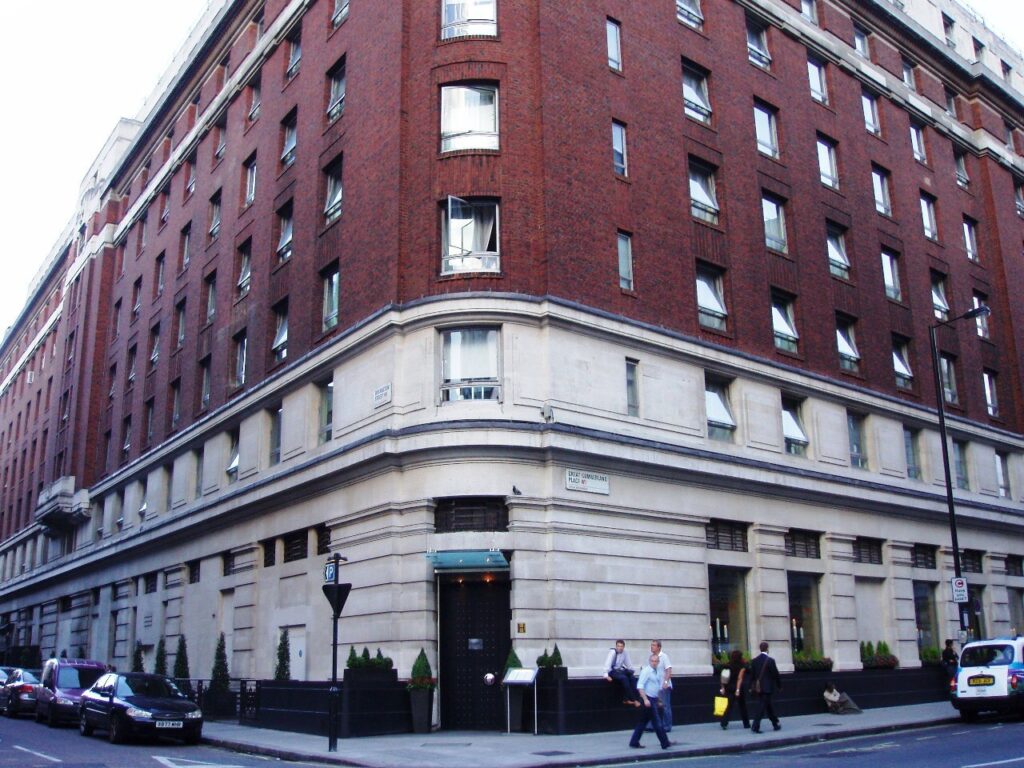
The way in to [[Marble Arch tube station]] is in the middle of the hotel’s front onto Oxford Street.
The way in to [[Marble Arch tube station]] is in the middle of the hotel’s front onto Oxford Street.
In 2024, the Cumberland was given a face-lift, which was described as “awash in bright lights and gold fixtures, brash and blingy, but nevertheless spectacular”.<ref>Anthea Gerrie, [https://www.tripreporter.co.uk/the-cumberland/ “The Cumberland, discover Marble Arch’a transformed grande dame”], Trip Reporter, 14/03/2024, accessed 27 January 2026</ref>
==Site==
==Site==

.jpg)
The Cumberland Hotel, also known as the Cumberland, is a historic four-star hotel on Oxford Street in Westminster, Central London.
When opened in December 1933, with its 1,000 rooms the hotel claimed to be the largest in Europe,[1] and also “the most modern and elaborate in the world”.[2]
The hotel is named for Great Cumberland Place, one of the four streets it fronts onto, where it has its main entrance.[3]
The way in to Marble Arch tube station is in the middle of the hotel’s front onto Oxford Street.
In 2024, the Cumberland was given a face-lift, which was described as “awash in bright lights and gold fixtures, brash and blingy, but nevertheless spectacular”.[4]
From at least the late 18th century, in the middle of the Oxford Street front of the future hotel site there was an inn or coffee house called the General Wolfe, with livery stables in the yard behind it. By 1818, this had become the Hyde Park Hotel, and the street in front of it was called Hyde Park Place. In 1889, this was renamed as Marble Arch.[5]
Before the redevelopment of the 1930s, the site contained about thirty houses, fronting onto four streets, a public house, and the office of the Marble Arch Electric Railway Station.[6]

The building of the Cumberland Hotel, by Holloway Brothers of London, began early in 1932, at the western end of Oxford Street, on a site facing Marble Arch and Hyde Park.[7]
The new Cumberland Hotel took almost two years to build.[7]
The main elevations are in Portland stone on Oxford Street, in brick and Portland stone elsewhere. As built, the hotel has eight storeys above ground level and another seven below it.[8][9]
The Western Mail noted on completion that “The night scene at the Marble Arch, London, has been considerably changed by the addition of the Cumberland Hotel with its floodlights.”[10]
Oliver Percy Bernard designed many of the interiors.[11] There were a thousand bathrooms, all lined with tiles from Jackfield.[12] The hotel boasted a lift which was “the first of a kind which travels at a rate of 500 feet a minute”[13]
It was reported on 4 December 1933 that new carpets from Yorkshire had been bought at a cost of £40,000 (equivalent to £3,586,932 in 2023), and that Wm. Rhodes. Ltd was supplying pillows for the one thousand bedrooms.[14] On 7 December came reports that forty-five tons of Sheffield cutlery had arrived in London for the hotel,[15] and it had received more than 900 “super box spring mattresses” and three thousand down pillows.[7] With the nation still suffering from the Great Depression, the press also noted that there had been “a rush for jobs” at the hotel.[16]
It was announced on 7 December 1933 that the opening of the new hotel was imminent, and that this would be marked on 11 December by Sir Isidore Salmon, chairman of J. Lyons and Co., the company behind the hotel, who would preside at a luncheon for a large number of invited guests.[17]
On the morning of 11 December, Salmon gave King George V and his wife Queen Mary a private tour of the hotel, lasting an hour.[18] A history of the hotel’s site was published, by William Walcot, with a foreword by John Drinkwater.[19] This noted that “the hotel windows would have commanded an excellent view of the executions of Perkin Warbeck, Jack Sheppard, and others on Tyburn gallows.[20]
At the luncheon, a number of toasts were proposed. In one to “the Press”,[21] Salmon said that no one understood better than Lyons the value of press advertising;[22] Lord Camrose, owner of many newspapers, replied and called for a review of the licensing laws, noting that “If Messrs Lyons had built this hotel on the south side of Oxford Street, I could have had a drink until eleven o’clock at night.”[23][24]
On 12 December 1933, the day the hotel opened for business, the Daily Express reported that “the majestic Cumberland Hotel… opens its doors to its first guests to-day” and was already famous.[25] The Western Daily Press stated that a staff of some two thousand had been employed to look after guests and that the new hotel “has shown the world that British brains, enterprise and skill have yet to find their match”.[26]
A further house-warming took place on the opening day, with Salmon welcoming “a large and influential party of guests”.[27] The Leeds Mercury commented drily on the day that “London people will regard the new Cumberland Hotel at the Marble Arch as an acquisition to be proud of, but the clientele will come mainly from the Provinces and overseas.”[28] However, the paper reported the next day that more than a thousand people had had lunch at the hotel on its first day, and within half an hour of the doors opening six women were visiting the hairdressing rooms to have work done on their hair.[29]
In May 1940, during the Second World War, Tyler Kent, a clerk at the Embassy of the United States in London who was stealing secret papers, used the hotel for meetings with an agent of German intelligence.[30]
Alma Cogan was a resident singer at the hotel for two years. In 1949, she was talent-spotted there by Walter Ridley.[31]
On 11 September 1970, Jimi Hendrix gave his last interview in his suite at the Cumberland Hotel. He visited his suite on the day of his death, a week later.[32]
Gary Rhodes opened his restaurant Rhodes W1 within the hotel in May 2007.[33]
- ^ “Largest Hotel in Europe”, Liverpool Daily Post, Tuesday 12 December 1933, p. 7
- ^ “PLANT”, Skegness News, Wednesday 13 December 1933, p. 6
- ^ “POETS CORNER TO THE YOUTH OF TO-DAY”, Buckinghamshire Advertiser, Friday 15 December 1933, p. 14
- ^ Anthea Gerrie, “The Cumberland, discover Marble Arch’a transformed grande dame”, Trip Reporter, 14/03/2024, accessed 27 January 2026
- ^ Andrew Saint, Oxford Street, The Survey of London, vol. 53 (London: Paul Mellon Centre, 2020), p. 297
- ^ a b Ordnance Survey 25-inch series, Sheet Westminster V. 13, 1914/1916 National Library of Scotland online collections, accessed 27 January 2026
- ^ a b c “Cumberland Hotel, Marble Arch, W.1”, Nottingham Journal, Tuesday 12 December 1933, p. 7
- ^ “The Cumberland Hotel, Marble Arch”, Building: Incorporating the British Builder, Vol. 9 (1934), pp. 5–7
- ^ “A DERBY MAN’S DIARY”, Derby Daily Telegraph, Wednesday 13 December 1933, p. 6
- ^ “THE NIGHT SCENE”, Western Mail (Glamorgan, Wales), p. 12
- ^ A. Powers, “Bernard, Oliver Percy (1881–1939)”, Oxford Dictionary of National Biography, online edition by Oxford University Press, accessed 22 January 2026 (subscription, Wikipedia Library access or UK public library membership required)
- ^ “SHROPSHIRE TILES IN LONDON Used in Palatial New Hotel MADE IN SEVERN VALLEY WORKS”, Shrewsbury Chronicle, Friday 15 December 1933, p. 13
- ^ “THE KING AND QUEEN AT HOTEL”, Liverpool Daily Post, Monday 11 December 1933, p. 8
- ^ “NEW LONDON HOTEL”, Yorkshire Post, Monday 4 December 1933, p. 7
- ^ “This News Makes Work”, Daily Express, Thursday 7 December 1933, p. 13
- ^ “LONDON’S NEW HOTEL”, Daily Record, Thursday 7 December 1933, p. 14: “There has been a rush for jobs at London’s newest hotel the Cumberland Hotel Marble Arch which is to be opened by Major Isadore Salmon MP the chairman of Lyons on Monday…”
- ^ “OUR LONDON LETTER: MAMMOTH HOTEL”, Northern Whig (Antrim, Northern Ireland, Thursday 7 December 1933, p. 6
- ^ “KING AND QUEEN SEE NEW HOTEL”, Western Daily Press, Monday 11 December 1933, p. 8
- ^ Calcutta Review (University of Calcutta, June 1934), p. 229: “Cumberland Hotel, by William Walcot, R.E., John Drinkwater, and Philip Page. This is an illustrated souvenir issued by the authorities of the Cumberland Hotel, Marble Arch.”
- ^ “Cumberland Hotel”, The People, Sunday 10 December 1933, p. 11
- ^ The Electrician Volume 111 (1933), p. 749: “Sir Isidore Salmon, C.B.E., M.P., who presided, proposing the toast of “The Press”…”
- ^ “IT ALWAYS PAYS TO ADVERTISE: London’s Luxury Hotel — Tribute to the Press”, Daily Mirror, Tuesday 12 December 1933, p. 9
- ^ Daily Record, Tuesday 12 December 1933, p. 3
- ^ “CHAOTIC LICENSING LAWS”, Aberdeen Press and Journal, Tuesday 12 December 1933, p. 8
- ^ “FAMOUS BEFORE ITS DOORS ARE OPENED”, Daily Express, Tuesday 12 December 1933, p. 18
- ^ “LYONS’S GREAT HOTEL, THE CUMBERLAND”, Western Daily Press, Tuesday 12 December 1933, p. 4
- ^ “LONDON LETTER”, Western Morning News (Devon), Tuesday 12 December 1933, p. 6
- ^
“LONDON’S PRIDE IN ITS LATEST”, Leeds Mercury, Tuesday 12 December 1933, p. 3 - ^ “THE CUMBERLAND HOTEL MORE THAN 1,000 TAKE LUNCH ON OPENING DAY: From Our London Staff”, Leeds Mercury, Wednesday 13 December 1933, p. 7
- ^ Richard Griffiths, Patriotism Perverted: Captain Ramsay, the Right Club and English Anti-semitism, 1939-40 (London: Constable, 1998), p. 259
- ^ Peter Noble, “Alma Cogan in her own show”, Radio Times, 19 April 1957, p. 6
- ^ Tony Brown, Jimi Hendrix: The Final Days (Omnibus Press, 1997), p. 81
- ^ “An interview with Gary Rhodes”, Caterer Search, 18 April 2007, archived at archive.org

