
Design: corr typo
| ← Previous revision | Revision as of 09:01, 28 January 2026 | ||
| Line 78: | Line 78: | ||
|
== Design ==
|
== Design ==
|
||
|
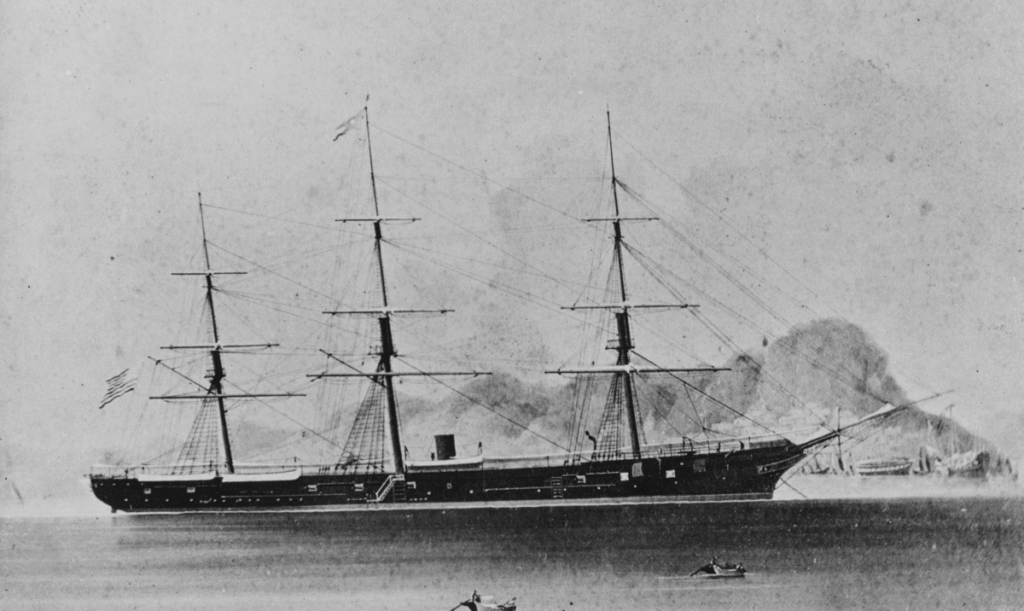
The ”Contoocook”-class was envisioned as “[[clipper]] screw sloops,”<ref name=”The Old2″ />{{Rp|page=127}} and featured [[Hull (watercraft)|hulls]] that were long, narrow, and shallow in an attempt to achieve high speeds.<ref name=”archive2″ />{{Rp|page=125}} The hulls were designed by [[John Lenthall (shipbuilder)|John Lenthall]] and featured a shape similar to the earlier sloops [[USS Swatara (1865)|USS ”Swatara”]] and ”[[USS Quinnebaug (1866)|Quinnebaug]].” The ships had a length of {{Convert|290|ft|m}}, [[Beam (nautical)|beam]] of {{Convert|41|ft|m}}, [[Draft (hull)|draft]] of {{Convert|18|ft|m}}, and a [[Displacement (ship)|displacement]] of {{Convert|3,100|short ton|long ton}}.<ref name=”The Old2″>{{Cite book |last=Canney |first=Donald L. |title=The Old Steam Navy Volume 1: Frigates, Sloops and Gunboats, 1815–1885 |date=January 1, 1990 |publisher=[[Naval Institute Press]] |isbn=978-0870210044}}</ref>{{Rp|page=127-128}} The design also featured either one or two funnels and a
|
The ”Contoocook”-class was envisioned as “[[clipper]] screw sloops,”<ref name=”The Old2″ />{{Rp|page=127}} and featured [[Hull (watercraft)|hulls]] that were long, narrow, and shallow in an attempt to achieve high speeds.<ref name=”archive2″ />{{Rp|page=125}} The hulls were designed by [[John Lenthall (shipbuilder)|John Lenthall]] and featured a shape similar to the earlier sloops [[USS Swatara (1865)|USS ”Swatara”]] and ”[[USS Quinnebaug (1866)|Quinnebaug]].” The ships had a length of {{Convert|290|ft|m}}, [[Beam (nautical)|beam]] of {{Convert|41|ft|m}}, [[Draft (hull)|draft]] of {{Convert|18|ft|m}}, and a [[Displacement (ship)|displacement]] of {{Convert|3,100|short ton|long ton}}.<ref name=”The Old2″>{{Cite book |last=Canney |first=Donald L. |title=The Old Steam Navy Volume 1: Frigates, Sloops and Gunboats, 1815–1885 |date=January 1, 1990 |publisher=[[Naval Institute Press]] |isbn=978-0870210044}}</ref>{{Rp|page=127-128}} The design also featured either one or two funnels and a of 350.<ref name=”The Old2″ />{{Rp|page=128}}<ref name=”archive2″ />{{Rp|page=125}}
|
||
|
The initial design included a cast-metal ram mounted on the stem, although the feature was removed at the end of the Civil War. The main armament initially comprised a [[Broadside (naval)|broadside]] of eight {{Convert|9|in|cm|abbr=on}} [[Dahlgren gun|Dahlgren cannons]] and a {{Convert|60|lbs|kg}} [[Parrott rifle|Parrott rifled]] [[muzzle-loading]] gun mounted on the foredeck. The engines was designed by [[Benjamin F. Isherwood|Benjamin Isherwood]]; the power plants featured four main boilers and two superheating boilers that provided steam to two [[Horizontal steam engine|horizontal back action steam]] {{Convert|36|in|cm|abbr=on}} [[Stroke ratio|stroke]] engines, which turned a single propeller. While initially planned to be rigged as barques, the rigging plans on the ships were later altered.<ref name=”The Old2″ />{{Rp|page=128}} The engines alone could produce {{convert|12.5|kn|lk=in}},<ref name=”archive2″ />{{Rp|page=125}} and speeds up to {{convert|14|kn|lk=in}} could be reached with ideal circumstances under both steam and sail. ”Contoocook”<nowiki/>’s sea trials was a success, and she was praised for stability and handling.<ref name=”The Old2″ />{{Rp|page=129}} In 1875, [[David Dixon Porter|David Porter]] described the ships as, “The most efficient kind of ships we have had in the navy, and the model of which for steaming and sailing cannot be surpassed.”<ref name=”The Old2” />{{Rp|page=127}}
|
The initial design included a cast-metal ram mounted on the stem, although the feature was removed at the end of the Civil War. The main armament initially comprised a [[Broadside (naval)|broadside]] of eight {{Convert|9|in|cm|abbr=on}} [[Dahlgren gun|Dahlgren cannons]] and a {{Convert|60|lbs|kg}} [[Parrott rifle|Parrott rifled]] [[muzzle-loading]] gun mounted on the foredeck. The engines was designed by [[Benjamin F. Isherwood|Benjamin Isherwood]]; the power plants featured four main boilers and two superheating boilers that provided steam to two [[Horizontal steam engine|horizontal back action steam]] {{Convert|36|in|cm|abbr=on}} [[Stroke ratio|stroke]] engines, which turned a single propeller. While initially planned to be rigged as barques, the rigging plans on the ships were later altered.<ref name=”The Old2″ />{{Rp|page=128}} The engines alone could produce {{convert|12.5|kn|lk=in}},<ref name=”archive2″ />{{Rp|page=125}} and speeds up to {{convert|14|kn|lk=in}} could be reached with ideal circumstances under both steam and sail. ”Contoocook”<nowiki/>’s sea trials was a success, and she was praised for stability and handling.<ref name=”The Old2″ />{{Rp|page=129}} In 1875, [[David Dixon Porter|David Porter]] described the ships as, “The most efficient kind of ships we have had in the navy, and the model of which for steaming and sailing cannot be surpassed.”<ref name=”The Old2” />{{Rp|page=127}}
|
||
|
== Service history ==
|
== Service history ==
|
||

