
{{Speciesbox
{{Speciesbox
| image = Protanguilla palau.jpg
| image = Protanguilla palau.jpg
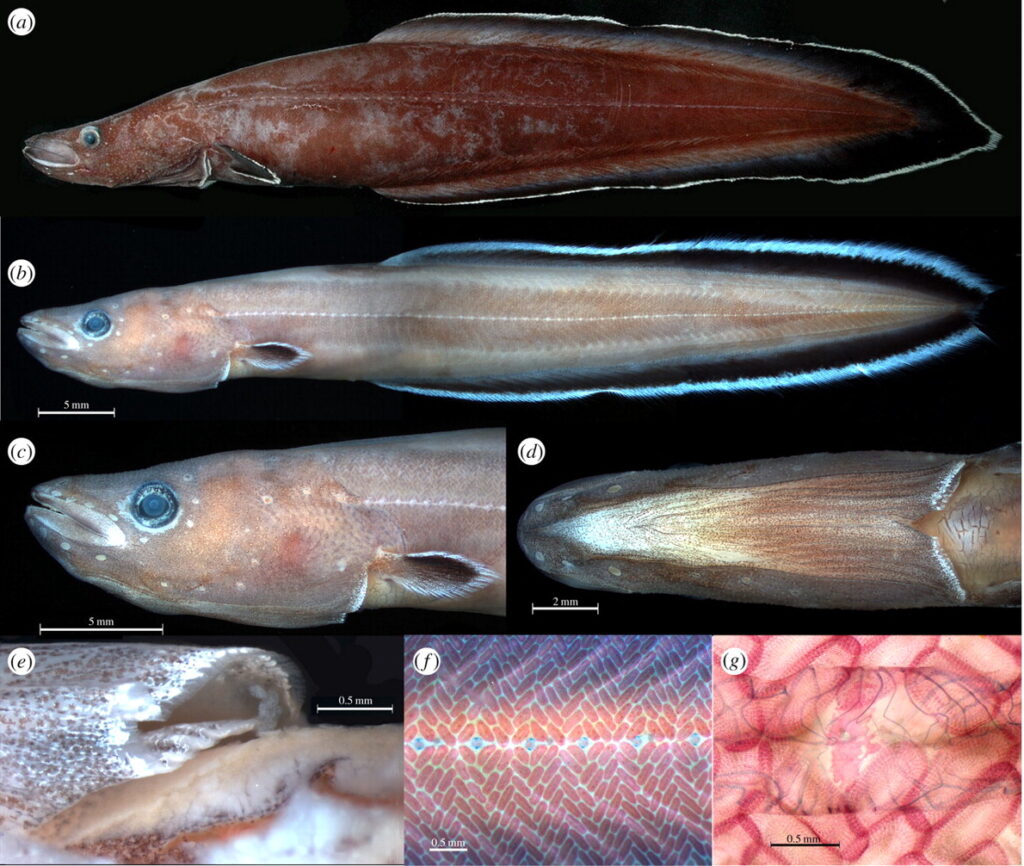
| image_caption = (a) [[Holotype]], female, 176 mm [[Fish measurement#Overall length|SL]].<br /> (b–g) [[Paratype]], juvenile, 65 mm SL;<br />(c,d) head in lateral and ventral view; <br />(e) gill opening; <br />(f,g) stained body scales.<ref name=r1>{{cite journal |last=Johnson |first=G. D. |author2=Ida H. |author3=Sakaue J. |author4=Sado T. |author5=Asahida T. |author6=Miya M. |year=2012 |title=A ‘living fossil’ eel (Anguilliformes: Protanguillidae, fam nov) from an undersea cave in Palau |journal=[[Proceedings of the Royal Society]] |volume=(in press) |issue=1730 |doi=10.1098/rspb.2011.1289 |pmc=3259923 |pmid=21849321 |pages=934–943}}{{Open access}}</ref>
| image_caption = (a) [[Holotype]], female.<br /> (b–g) [[Paratype]], juvenile, 65mm SL;<br />(c,d) head in lateral and ventral view; <br />(e) gill opening; <br />(f,g) stained body scales.<ref name=r1>{{cite journal |last=Johnson |first=G. D. |author2=Ida H. |author3=Sakaue J. |author4=Sado T. |author5=Asahida T. |author6=Miya M. |year=2012 |title=A ‘living fossil’ eel (Anguilliformes: Protanguillidae, fam nov) from an undersea cave in Palau |journal=[[Proceedings of the Royal Society]] |volume=(in press) |issue=1730 |doi=10.1098/rspb.2011.1289 |pmc=3259923 |pmid=21849321 |pages=934–943}}{{Open access}}</ref>
| status = DD
| status = DD
| status_system = IUCN3.1
| status_system = IUCN3.1
}}
}}
””’Protanguilla palau””’ is a [[species]] of [[eel]], the [[monotypic taxon|only species]] in the [[genus]] ””’Protanguilla””’ (first eel), which is in turn the only genus in its [[family (biology)|family]], ”’Protanguillidae”’. Its common name is ”’Palauan primitive cave eel”’. Individuals were found swimming in March 2010 in a deep underwater cave in a [[fringing reef]] off the coast of [[Palau]].<ref name=r1/>
””’Protanguilla palau””’ is a [[species]] of [[eel]], the [[monotypic taxon|only species]] in the [[genus]] ””’Protanguilla””’ (first eel), which is in turn the only genus in its [[family (biology)|family]], ”’Protanguillidae”’. Its common name is ”’Palauan primitive cave eel”’. Individuals were found swimming in March 2010 in a deep underwater cave in a [[fringing reef]] off the coast of [[Palau]].<ref name=r1/>
Protanguillidae is a sister group to all other eels.<ref name=springer>Springer, V. G. (2015). The Gill-Arch Musculature of Protanguilla, the Morphologically Most Primitive Eel (Teleostei: Anguilliformes), Compared with That of Other Putatively Primitive Extant Eels and Other Elopomorphs, 103(2), 595–620. doi: 10.1643/CI-14-152</ref> They are monophyletic, yet also strongly synapomorphic with all other eel species. Molecular analysis shows that all other eels are also monophyletic, showing that they may have broken off directly from the Protanguillidae. Being a significantly aged cave species, ”Protanguilla palau” has also been given the name “Palauan primitive cave eel”.<ref name= “Smithsonian National Museum of Natural History”>{{cite web |url=https://ocean.si.edu/ocean-life/fish/palauan-primitive-cave-eel-protanguilla-palau-living-fossil |title=Palauan primitive cave eel (Protanguilla palau), a ‘living fossil’ |website=ocean.si.edu |access-date=2024-11-06}}</ref> For this reason it is known as a “[[living fossil]]”.<ref name=”BBC” />
Protanguillidae is a sister group to all other eels.<ref name=springer>Springer, V. G. (2015). The Gill-Arch Musculature of Protanguilla, the Morphologically Most Primitive Eel (Teleostei: Anguilliformes), Compared with That of Other Putatively Primitive Extant Eels and Other Elopomorphs, 103(2), 595–620. doi: 10.1643/CI-14-152</ref> They are synapomorphic with all other eel species monophyletic .<ref name= “Smithsonian National Museum of Natural History”>{{cite web |url=https://ocean.si.edu/ocean-life/fish/palauan-primitive-cave-eel-protanguilla-palau-living-fossil |title=Palauan primitive cave eel (Protanguilla palau), a ‘living fossil’ |website=ocean.si.edu |access-date=2024-11-06}}</ref>
==Characteristics==
==Characteristics==
[[File:Protanguilla palau.webm|285px|right]]
[[File:Protanguilla palau.webm|285px|right]]
The body is very small and slender, about 18 cm long.<ref>[https://web.archive.org/web/20140130145215/http://www.google.com/hostednews/afp/article/ALeqM5jpgfZ7kYnRBImcgjv-7eY1jtCEVg?docId=CNG.7aa66f1c981d06b848662459607dc717.51 ‘Fossil eel’ squirms into the record books], [[Agence France-Presse]], 16 August 2011.</ref><ref name=”BBC”>{{cite news |url=https://www.bbc.co.uk/news/science-environment-14547942 |author=Rincon, Paul |title=New Pacific eel is a ‘living fossil’, scientists say |publisher=[[BBC News]] |access-date=17 August 2011 |date=17 August 2011}}</ref> The eel has a second [[premaxilla]] and under 90 [[vertebrae]], features previously found only in fossilised eels. Its full set of [[gill raker]]s in its [[branchial arch]]es has never previously been found in an eel, but is common in [[Osteichthyes|bony fish]].<ref name=”eurekalert”>{{cite web |url= http://www.eurekalert.org/pub_releases/2011-08/s-sdt081711.php |title=Scientists discover the most primitive living eel |work=eurekalert.org |year=2011 |access-date=17 August 2011}}</ref> It is very different from all other living eels, and scientists estimate it must have diverged from the others around 200 million years ago, during the [[Mesozoic era]]. It thus has not only its own species, but also its own genus and [[family (biology)|family]], as well, and has been referred to by scientists as a “[[living fossil]]”.<ref name=”BBC”/>
The body is very small and slender, .<ref>[https://web.archive.org/web/20140130145215/http://www.google.com/hostednews/afp/article/ALeqM5jpgfZ7kYnRBImcgjv-7eY1jtCEVg?docId=CNG.7aa66f1c981d06b848662459607dc717.51 ‘Fossil eel’ squirms into the record books], [[Agence France-Presse]], 16 August 2011.</ref><ref name=”BBC”>{{cite news |url=https://www.bbc.co.uk/news/science-environment-14547942 |author=Rincon, Paul |title=New Pacific eel is a ‘living fossil’, scientists say |publisher=[[BBC News]] |access-date=17 August 2011 |date=17 August 2011}}</ref> The eel has a second [[premaxilla]] and under 90 [[vertebrae]], features previously found only in fossilised eels. Its full set of [[gill raker]]s in its [[branchial arch]]es has never been found in , but is common [[Osteichthyes|bony fish]].<ref name=”eurekalert”>{{cite web |url= http://www.eurekalert.org/pub_releases/2011-08/s-sdt081711.php |title=Scientists discover the most primitive living eel |work=eurekalert.org |year=2011 |access-date=17 August 2011}}</ref>
It is very different from all other living eels, and scientists estimate it must have diverged from the others around 200 million years ago, during the [[Mesozoic era]]. It thus has not only its own species, but also its own genus and [[family (biology)|family]] as well, and has been referred to by scientists as a “[[living fossil]]”.<ref name=”BBC”/>
==References==
==References==
{{Reflist}}
{{Reflist}}
==External links==
==External links==
[[Category:Monotypic fish genera]]
[[Category:Monotypic fish genera]]
[[Category:Fish described in 2012]]
[[Category:Fish described in 2012]]
{{Anguilliformes-stub}}
{{Anguilliformes-stub}}
Genus of fishes
| Protanguilla | |
|---|---|

|
|
| (a) Holotype, female. (b–g) Paratype, juvenile, 65 mm (2.6 in) SL; (c,d) head in lateral and ventral view; (e) gill opening; (f,g) stained body scales.[1] |
|
Scientific classification 
|
|
| Kingdom: | Animalia |
| Phylum: | Chordata |
| Class: | Actinopterygii |
| Order: | Anguilliformes |
| Suborder: | Synaphobranchoidei |
| Family: | Protanguillidae G.D. Johnson, H. Ida & Miya, 2012 |
| Genus: | Protanguilla G.D. Johnson, H. Ida & Miya, 2012 |
| Species: |
P. palau |
| Binomial name | |
| Protanguilla palau
G. D. Johnson, H. Ida & Sakaue, 2012 |
|
Protanguilla palau is a species of eel, the only species in the genus Protanguilla (first eel), which is in turn the only genus in its family, Protanguillidae. Its common name is Palauan primitive cave eel. Individuals were found swimming in March 2010 in a deep underwater cave in a fringing reef off the coast of Palau.[1] {{convert|
Protanguillidae is considered a “living fossil“,[3] being the sister group to all other eels.[4] They are synapomorphic with all other eel species, which were confirmed to be monophyletic through molecular analysis.[5]
Characteristics
The eel’s body is very small and slender, being 176 mm (6.9 in) SL for the holotype female.[6][3] The eel has a second premaxilla and under 90 vertebrae, features previously found only in fossilised eels. Its full set of gill rakers in its branchial arches has never been found in true eels, but is a common trait of other bony fish families.[7]
It is very different from all other living eels, and scientists estimate it must have diverged from the others around 200 million years ago, during the Mesozoic era. It thus has not only its own species, but also its own genus and family as well, and has been referred to by scientists as a “living fossil“.[3]
References
- ^ a b Johnson, G. D.; Ida H.; Sakaue J.; Sado T.; Asahida T.; Miya M. (2012). “A ‘living fossil’ eel (Anguilliformes: Protanguillidae, fam nov) from an undersea cave in Palau”. Proceedings of the Royal Society. (in press) (1730): 934–943. doi:10.1098/rspb.2011.1289. PMC 3259923. PMID 21849321.

- ^ McCosker, J.; Tighe, K.; Smith, D. G. (2022). “Protanguilla palau“. IUCN Red List of Threatened Species. 2022 e.T103707334A103708468. doi:10.2305/IUCN.UK.2022-2.RLTS.T103707334A103708468.en. Retrieved 20 February 2024.
- ^ a b c Rincon, Paul (17 August 2011). “New Pacific eel is a ‘living fossil’, scientists say”. BBC News. Retrieved 17 August 2011.
- ^ Springer, V. G. (2015). The Gill-Arch Musculature of Protanguilla, the Morphologically Most Primitive Eel (Teleostei: Anguilliformes), Compared with That of Other Putatively Primitive Extant Eels and Other Elopomorphs, 103(2), 595–620. doi: 10.1643/CI-14-152
- ^ “Palauan primitive cave eel (Protanguilla palau), a ‘living fossil’“. ocean.si.edu. Retrieved 2024-11-06.
- ^ ‘Fossil eel’ squirms into the record books, Agence France-Presse, 16 August 2011.
- ^ “Scientists discover the most primitive living eel”. eurekalert.org. 2011. Retrieved 17 August 2011.

