
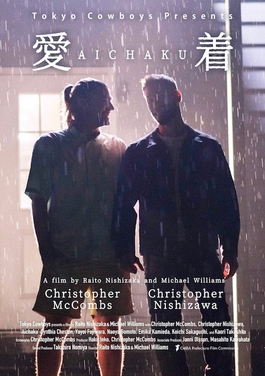
2025 film by Raito Nishizaka and Michael Williams
Aichaku (Japanese: 愛着; lit.. “Affection”) is a 2025 Japanese film directed by Raito Nishizaka and Michael Williams that premiered on Amazon Prime Video in April 2025. The film stars Christopher McCombs and Christopher Nishizawa as two men living in a remote area of Chiba, Japan who fall in love over the course of the three-day story.
Aichaku is additionally available in fourteen languages via Taiwan-based worldwide subscription video on demand service GagaOOLala.[1]
Plot
Lucas, an American expat, works as an English teacher at a struggling small language school in a rural town of Chiba Prefecture, Japan. He lives modestly and dreams of buying an abandoned roadside café that he often passes, but with his meager salary, it’s out of reach.
Meanwhile, Ken, a half‑Japanese man raised by his uncle after his father’s suicide and his mother’s return to the United States, has worked since age fifteen at his uncle Nobu’s construction business. Ken quietly yearns to learn English so someday he can reconnect with his mother in America.
Over the span of three days, the two meet and their lives subtly intertwine. Initially reserved and uncertain, Ken gradually warms to Lucas, and an unlikely friendship forms. They share intimate conversations that reveal their vulnerabilities and past hurts, and eventually become physically intimate. For Lucas, the connection feels transformative. Ken, on the other hand, grapples with uncertainty about his own sexuality and emotional readiness.
When Lucas unexpectedly loses his teaching job, he faces possible expulsion from Japan due to visa restrictions. To stay longer, he reluctantly agrees to a marriage of convenience with his landlady’s daughter Marie—who, unbeknownst to him at first, is lesbian. This ruse allows him to maintain his residency temporarily while navigating complex emotional terrain.
Meanwhile, Ken slowly overcomes his fears and gains clarity about who he is and what he wants. Learning to accept himself enables him to take definitive action. At the climax, Ken and Lucas confess their love for one another. Empowered by their attachment—to each other and to their shared dreams—they purchase the café Lucas had long coveted. The film concludes a year later at a festive grand opening of that café, with family and friends gathered, signaling new beginnings and emotional fulfillment for both men.[2]
Cast
Production
Development
Production company Tokyo Cowboys was heading into its tenth year and wanted to make something special to commemorate the anniversary. After making several streaming shows, the production company decided to return to the movie format that they had begun with.[3]
Raito Nishizaka and Michael Williams had previously worked together on several of production company Tokyo Cowboy’s projects including comedy series The Benza, Benza English, and the travel documentary show Getting Dirty in Japan. It was decided with Lucas being a foreigner and Ken being Japanese that it was important for Aichaku to have two directors with each director aligning with one of the character’s perspectives.[4]
Screenplay writer Christopher McCombs partially based the story of Aichaku off of his personal experiences living in Japan for fifteen years and partially on a series of interviews held in Chiba, Japan in 2023. Though initially Aichaku began as a short film script, McCombs realized that they weren’t going to be able to tell the kind of story that he wanted to in that format.[3] McCombs wrote the part of Ken specifically for Nishizawa after a four-hour meeting in 2022 where they discussed different project ideas they could potentially work on together.[5][6]
Casting
Casting began with video auditions followed by an in-person callback.[3] Callbacks were held for Aichaku in 2023 with Emika Kamieda and Yayoi Fujiwara in attendance. Kamieda and Fujiwara were both cast partially because they had experienced what it was like living overseas and could relate to Lucas’ character. Kaori Takeshita was also in attendance, and was cast in part for her resemblance to Fujiwara.[7][6]
Several actors who had appeared in previous Tokyo Cowboys projects returned for Aichaku, including Haku Inko, Masahito Kawahata, and Kosuke Imai in smaller roles. Cynthia Cheston, who had previously portrayed McCombs’s mother in earlier works, was directly offered the role of Lucas’s mother, Cathy. She accepted the part without reading the script, citing her positive experiences working with McCombs.[6]
Filming
Rehearsals for Aichaku began in April 2023.
Filming for Aichaku took place during the summer months of 2023 and was shot entirely on location in Chiba, Japan and Ibaraki, Japan.[8][9] Several of the shooting locations were found while shooting the travel documentary series Getting Dirty in Japan the year before.[10] Both Chiba Prefecture Film Commission and Ibaraki Prefecture Film Commission officially supported production and provided shooting location support.[11]
Postproduction
A crowd funding campaign was hosted by Executive Producer Max Emerson to help raise funds to support Aichaku’s postproduction via Kickstarter.[12] The campaign was successfully completed with over three hundred backers.
A test screening was held at Nakano Zero in Nakano-Ku of Tokyo, Japan on May 4, 2024, that was attended by the main cast as well as both directors.[13]
Postproduction was completed on Aichaku in October 2024.[14]
Release
Aichaku was released in April 2025 on Amazon Prime Video in Japan and Spain.[15] It was released on Amazon Prime Video France in May of the same year followed by Belgium, Italy, Mexico, Canada, Great Britain, Germany, and USA.[16] Following its release in Japan, Aichaku reached number nine on Prime Video’s best seller chart.[17]
On September 22, 2025, Aichaku was released worldwide via streaming platform GagaOOLala with subtitles in fourteen languages including Vietnamese, Thai, Korean, and Hindi.[18][19][20]
Reception
Aichaku received generally positive reviews from critics, who praised its emotional depth, performances, and thematic exploration, while offering minor criticisms regarding pacing and romantic development.
Critics highlighted the film’s portrayal of cultural differences and expatriate life. Reviewers from BL Watcher and BL Bliss noted that the story captures the challenges of living abroad with humor and sensitivity, particularly through the experiences of the main characters, Lucas and Ken.[21][22] French reviewers from L’Éternelle Romantique emphasized the film’s exploration of identity and chosen family, describing its treatment of these themes as delicate and sincere.[23] BL News (Chil-Chil) added that the film extends beyond romance to explore friendship, family love, and the rediscovery of belonging, while addressing LGBTQ issues in Japan without creating an oppressive tone.[4]
The performances of the lead actors, Christopher McCombs and Christopher Nishizawa, were widely praised. Multiple reviews, including those from BL Xpress, G-Lad XX, and Taxi Drivers, noted their chemistry and sincerity.[24][25][26] Supporting characters, such as Marie, Yoshiko, Cathy, and Nobu, were also recognized for adding warmth and depth to the story.
The film’s cinematography and setting received praise across reviews. Abendzeitung Nürnberg highlighted the intimate and quiet moments between the protagonists,[27] while G-Lad XX and Taxi Drivers appreciated the depiction of rural Japan, emphasizing how the visuals enhanced the emotional atmosphere.[25][26] The Brazilian site Cinematografia Queer praised the film’s cinematography for its naturalistic use of rural landscapes to subtly reinforce the emotional core of the story.[28]
Critics also remarked on the film’s music, describing the soundtrack as subtle and atmospheric. Reviews noted that the score complemented the understated tone of the narrative, particularly in scenes exploring loneliness, belonging, and connection.[6] The restrained use of music was seen as reinforcing the film’s naturalistic style while still heightening emotional resonance.[24][28] Silverscreen Pallet offered a positive assessment of the film, highlighting its quiet tone, emotional intimacy, and depiction of cultural connection through understated storytelling.[29]
Several critics commented on the film’s pacing and narrative structure. BL Watcher and BL Bliss observed that the romantic arc between Lucas and Ken develops quickly, which may feel rushed, while L’Éternelle Romantique suggested that the relationship could have benefited from additional tension or conflict.[23] Cinematogrfia Queer commented that the narrative occasionally feels limited to the development of a romantic comedy.[28] G-Lad XX also noted that certain moments, such as language use and character behaviors, might not resonate with all audiences.[25] A review from Gay Films Review offered a more mixed assessment, praising the film’s intimate tone and cross-cultural premise while noting that the pacing may feel uneven for some viewers, and expressing reservations about certain performance choices while acknowledging the film’s sincerity and emotional intent.[30]
In addition to critical reviews, Aichaku has been featured in curated viewing round-ups by international outlets.[31] The Spanish magazine Shangay recommended the film as a noteworthy LGTBIQ+ title on Prime Video, highlighting its rural setting and tender approach to queer romance.[32] The Argentine magazine GENTE Online listed the film among “five dramatic films with happy endings” to stream, describing it as a feel-good romantic drama.[33] In Japan, BL News included Aichaku in a list of seven international LGBT films recommended for long holiday viewing, noting its emphasis on romantic, familial, and human connection.[34] The film was also included as an honorable mention in the American magazine RAGE Monthly’s list of notable films of 2025.[35]
A column from the Japanese marriage-consulting site Nanahoshi Marriage also responded positively to the film, describing it as a “quiet shock” for its depiction of diverse forms of love. The writer praised the film’s focus on emotional connection, attachment styles, and “quiet intimacy,” noting that Aichaku illustrates how relationships can develop through empathy and shared silence rather than dramatic events. The column recommended the film even to viewers unfamiliar with same-sex romance, highlighting its relevance to contemporary conversations about how people form partnerships in Japan.[36]
Overall, critics agreed that Aichaku succeeds in portraying the nuances of personal attachment and cultural displacement, capturing both the ordinary and meaningful moments that define human connection.
Themes
Aichaku (literally “attachment” in Japanese) explores emotional bonds—how people develop deep attachments to places, objects, relationships, and personal identity. The film’s title captures this central motif, illustrating how emotional “attachment” defines our sense of belonging and self-worth.[37]
One major theme is belonging versus displacement. Lucas, an American living and working as an English teacher in rural Chiba, struggles to make ends meet and dreams of owning a café. Ken, a half‑Japanese man working in a construction business, yearns to learn English so he can reconnect with his absent American mother. Both characters feel disconnected from their roots and search for stability and home through personal attachment.
The film also explores cultural and sexual identity, portraying how being a foreigner, a mixed‑race individual, or a gay person can complicate one’s experience of attachment. These identities sometimes become barriers to emotional connection and fulfillment, but ultimately bring growth and self‑acceptance as the characters learn to value their attachments authentically. Actress Yayoi Fujiwara, who plays Marie, noted the importance of portraying characters across the spectrum of sexual orientations with empathy and respect, emphasizing a goal to bring honesty and realism to the role.[38]
Another theme is mutual healing through connection. Over three days, Lucas and Ken’s meeting allows each of them to reflect on the things they hold dear and confront their fears. Through their fledgling relationship, they help each other reclaim their dreams and sense of belonging, turning emotional attachment into an empowering force rather than a limiting burden.[39]
Finally, Aichaku underscores the significance of community and support. Drawing from real experiences, McCombs shares an anecdote of a gay man in rural Japan who described loneliness as “like hunger,” underscoring the emotional isolation that Aichaku seeks to humanize. Supporting characters—such as Ken’s uncle Nobu, Lucas’s landlady and her daughter Marie, and Lucas’s mother—provide emotional anchors, challenging and aiding the protagonists in accepting their identities and attachments. The transformations in these relationships mirror the film’s central idea: attachments, when nurtured, foster growth and understanding.[40][41]
Soundtrack
The Aichaku soundtrack features fourteen original songs performed in a 1950s style. According to McCombs, the decision emerged during location scouting, as the retro sound complemented both the aging architecture and the weathered aesthetic of the film’s settings[3] He also explained that the familiarity of 1950s-style music could help viewers who might not immediately connect with the film’s themes feel more welcome and at ease while watching.[6]
The soundtrack was released in part on May 20, 2025, with a six track album entitled “Holding on to You (Songs from the Film Aichaku) by Ananda Jacobs as well as a two track EP release from Fossilize entitled “A Feeling I Get (Songs from the Film Aichaku).”[42] On May 21, 2025, Klassix Jones released both “Dream Lover” and “Tricky Lil Thang” as singles.[43]
“A Feeling I Get” charted in at number four on the Japanese iTunes soundtrack chart upon its release and additionally charted in Norway, Sweden, and Italy.[44] “Holding on to You (Songs from the Film Aichaku)” peaked at number six as an album on the Japanese iTunes soundtrack chart as well as reaching number seven in Italy.[45][46]
An official lyric video was released via YouTube on May 16, 2025, from Fossilize for “A Feeling I Get” that features footage from the film Aichaku.
Potential sequel
Though both writer McCombs and director Nishizaka have indicated that a sequel to Aichaku would be difficult, they have both mentioned in separate interviews that the story of Aichaku 2 would follow Marie to America and would explore her life living in a small town. Ken and Lucas would appear as a more established couple and the relationship between Ken and his mother would be further explored testing the couple.[41][47]
Actress Yayoi Fujiwara (Marie) has expressed personal interest in the sequel stating in an interview, “I’d love to see Marie discover more of herself in Aichaku 2— including her romantic desires, her self-expression, and her outlook on life in general.”[6]
References
- ^ “日本発インディペンデント映画『Aichaku/愛着』、世界240の国と地域で配信決定”.
- ^ “Aichaku | Tokyo Cowboys”.
- ^ a b c d “5 Questions with Christopher McCombs”. hamishdownie.wordpress.com. Retrieved 2025-05-03.
- ^ a b “【試写会レポ】日本の片田舎で紡がれる愛しいラブ…長編ゲイ映画『Aichaku 愛着』”.
- ^ “Japanese BL ‘Aichaku’ to Hold Special Screening with Fans on May 4 – BLTai”. 杰德BLTai. 29 April 2024.
- ^ a b c d e f “Aichaku, when love for Japan is seen from the eyes of a LGBTQ+ foreigner: interview”. AnimeClick. Retrieved 2025-09-27.
- ^ “元NMB48で女優の上枝恵美加が、国際色豊かな映画「愛着(Aichaku)」とWeb番組「ゲッティング・ダーティ・イン・ジャパン」シーズン2に同時出演!”.
- ^ @BLUPDATE2022 (2024-04-27). “Japanese BL “Aichaku” Invites Fans to Their Special Test Screening on May 4″. X (formerly Twitter). Archived from the original on 2025-05-27. Retrieved 2025-07-22.
{{cite web}}: CS1 maint: numeric names: authors list (link) - ^ “Amazonプライムビデオ「Aichaku~愛着~」の撮影で大子町立滝倉集会所が使用されました | 大子町公式ホームページ”.
- ^ “映画「Aichaku」(愛着) – いばらきフィルムコミッション”.
- ^ “映画「Aichaku」(愛着)|支援作品紹介 |千葉県フィルムコミッション”.
- ^ “Max Emerson is Releasing a New Book & Queer Indie Film—Here’s How to Help”.
- ^ “Tokyo Cowboys to Hold Test Screening for “Aichaku” on 4th May”. May 2024.
- ^ “元NMB48上枝恵美加、映画とWeb番組に同時出演!魅力全開の新作を楽しもう”.
- ^ “上枝恵美加が多国籍映画とWeb番組で魅せる新たな才能”.
- ^ “Aichaku”.
- ^ “日本で製作されたインディペンデント映画『Aichaku/愛着』が世界配信決定”. Retrieved 2025-10-02.
- ^ “日本発のゲイ・ロマンス映画『Aichaku/愛着』が世界配信へ”.
- ^ “Aichaku”.
- ^ “16 Gay Romance Movies with Sweet, Happy Endings”. GagaOOLala. 2026-01-13. Retrieved 2026-02-08.
- ^ “Aichaku Movie Review”. BL Watcher. Retrieved 2025-09-28.
- ^ “Aichaku (2025) United States-Japan”. BL Bliss. Retrieved 2025-09-28.
- ^ a b “Aichaku Film Review”. L’Éternelle Romantique. Retrieved 2025-09-28.
- ^ a b “Aichaku Movie Review”. The BL Xpress. Retrieved 2025-09-28.
- ^ a b c “Aichaku Movie Review”. G-Lad XX. Retrieved 2025-09-28.
- ^ a b “Aichaku Omosessualità in Giappone”. Taxi Drivers. Retrieved 2025-09-28.
- ^ “Aichaku”. Abendzeitung Nürnberg. Retrieved 2025-09-28.
- ^ a b c Eduardo de Assumpção (May 28, 2025). “Aichaku (Japão, 2024)”. Cinematografia Queer. Retrieved 2025-10-01.
- ^ “Aichaku/愛着レビュー|異文化と恋愛が織りなす新感覚ラブストーリー”. Silver Screen Palette (in Japanese). Retrieved 2025-12-27.
- ^ “Aichaku (Japanese/English)”. Gay Films Review. 2025-06. Retrieved 2026-02-08.
- ^ “Rekomendasi Film Jepang Romantis 2025 yang Bikin Baper Maksimal”. Tuwaga (in Indonesian). Retrieved 2026-02-07.
- ^ “‘Aichaku’, una tierna película LGTBIQ+ japonesa”. Shangay. 8 May 2025. Retrieved 2025-10-01.
- ^ “Cinco películas dramáticas con final feliz para maratonear en Prime Video – GENTE”. GENTE Online. 10 August 2025. Retrieved 2025-10-01.
- ^ “長期休みに観たい!男たちの愛と苦悩を描く傑作LGBT洋画7選”. BL News (Chil-Chil). 11 August 2020. Retrieved 2025-10-01.
- ^ “Top Films, Bottom Flops: Movie Memories of 2025 (January 2026 issue)” (PDF). RAGE Monthly. Rage Magazine, Inc. January 2026. Retrieved 2025-12-27.
Honorable mentions, in alphabetical order: Aichaku… (p.19)
- ^ “「Aichaku/愛着」から考える、”多様な愛”が婚活を変える時代”. Nanahoshi Marriage. 26 November 2025. Retrieved 2025-11-28.
- ^ “Aichaku (Japanese/English)”.
- ^ “Interview with Yayoi Fujiwara on playing Marie in Aichaku”. Retrieved 2025-07-21.
- ^ “Aichaku Movie Review”.
- ^ “日本の片田舎を舞台にしたゲイ・ロマンス長編映画「愛着(Aichaku)」配信開始”.
- ^ a b “Rencontre avec Christopher McCombs – acteur, scénariste, producteur… et peut-être votre futur coup de cœur」”.
- ^ “Ananda Jacobs、「Holding On To You (Music from the Film Aichaku)」を配信開始”.
- ^ “DREAM LOVER (MUSIC FROM THE FILM AICHAKU) – Single”.
- ^ {{cite web|title=A Feeling I Get (Music from the Film Aichaku)|url=https://linkco.re/THTv44ST?lang=en%7Cwebsite=LinkCo%7Caccess-date=2026-02-08%7Clanguage=en}
- ^ “インディペンデント映画『Aichaku/愛着』、全世界配信決定!”.
- ^ {{cite web|title=Holding On To You (Music from the Film Aichaku)|url=https://linkco.re/YgtmAPpY?lang=en%7Cwebsite=LinkCo%7Caccess-date=2026-02-08%7Clanguage=en}
- ^ “Aichaku The Movie: An Affinity Towards Dreams And Love”.

