
{{Stock characters}}
{{Stock characters}}
[[Category:14th-century neologisms]]
[[Category:14th-century neologisms]]
[[Category:Stock characters]]
[[Category: ]]
[[Category:Fictional adventurers]]
[[Category:Fictional adventurers]]
[[Category:Romance (genre)]]
[[Category:Romance (genre)]]
[[Category:Damsels in distress]]
[[Category: ]]
Chivalric literature stock character

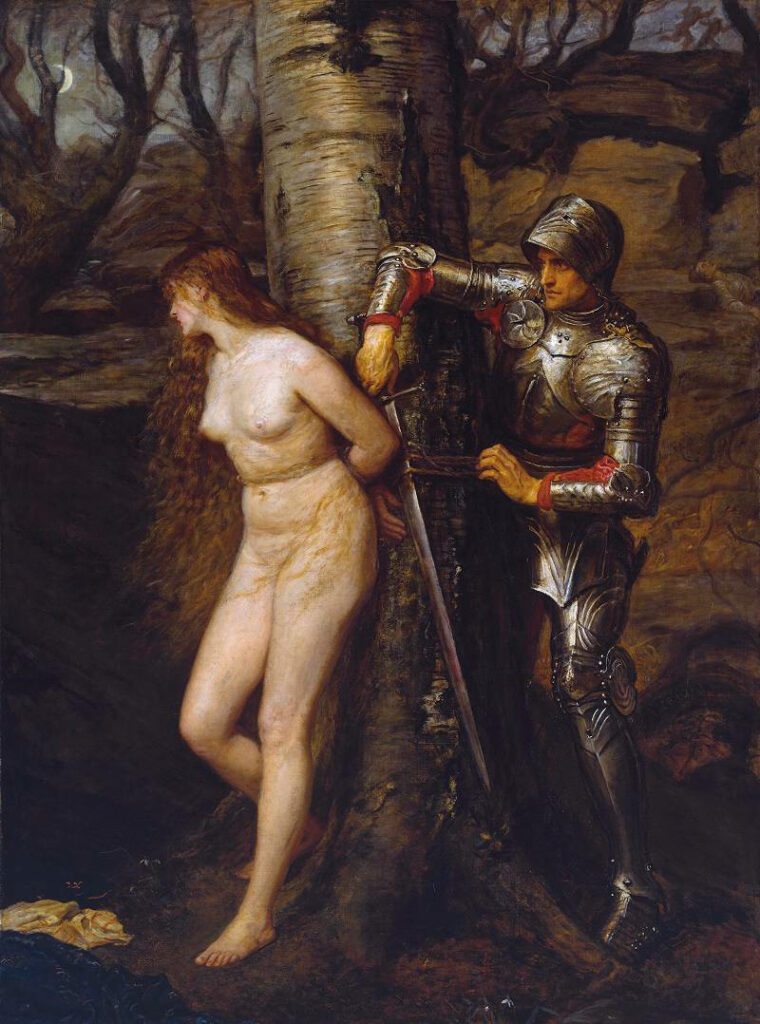
A knight-errant[1] (or knight errant[2]) is a figure of medieval chivalric romance literature. The adjective errant (meaning “wandering, roving”) indicates how the knight-errant would wander the land in search of adventures to prove his chivalric virtues, either in knightly duels (pas d’armes) or in some other pursuit of courtly love.
Description
The knight-errant is a character who has broken away from the world of his origin, in order to go off on his own to right wrongs or to test and assert his own chivalric ideals.[3][4] He is motivated by idealism and often illusory goals.[5]
In medieval Europe, knight-errantry existed in literature, though fictional works from this time often were presented as non-fiction.[6][7] The character of the wandering knight existed in romantic literature as it developed during the late 12th century. However, the term “knight-errant” was to come later; its first extant usage occurs in the 14th-century poem Sir Gawain and the Green Knight.[8]
Chivalric romance
A knight-errant typically performed all his deeds in the name of a lady, and invoked her name before performing an exploit.[9] Their adventures often include mythical enemies such as giants, enchantresses, or dragons.
The models of the knight-errant are the heroes of the Round Table of Arthurian legend such as Gawain, Lancelot, or Perceval. Their greatest quest is that of Holy Grail, originating from Perceval, the Story of the Grail written by Chrétien de Troyes in the 12th century.[10] Some knights may be motivated by pure moralistic idealism rather than romantic inspiration (as in the case of Galahad).
Analogues
East Slavic folklore
The byliny (epic poems) feature bogatyrs, knights-errant who served as protectors of their homeland, and occasionally as adventurers.[11] Some of them are might have been historical figures; others are fictional, perhaps from the Slavic mythology.
East Asian folklore
Xiake (Chinese: 俠客) or xia (俠), sometimes translated as the “Chinese knight-errant” or “Chinese gallant”, is a type vigilante folk hero in Ancient China who often wanders around the countryside (known as jianghu) solo or with a small group of like-minded companions upholding their own standards of justice. Such individuals are typically martial artists whose combat prowess, social support and connections (guanxi) allows them to defy oppressive local authorities such as officials, aristocrats, gentries, and bandits through acts of chivalry. Unlike their European counterpart, Chinese xia are not confined to any particular social caste and can be anything from free-spirited noblepeople, policemen or warriors, to travelling scholars, poets or physicians, and to peasant militiamen, skilled hunters, or simply trained vagrants. A popular literary tradition arose during the Tang dynasty which centered on warriors with superhuman physical capabilities who saved kidnapped damsels in distress and protected underdogs from injustice and bullying, or gifted slaves who proved their worth and loyalty by retrieving treasures or lovers for their feudal lords (e.g. Kunlun Nu).[12][13] The famous Tang poet Li Bai, a skilled swordsman himself, wrote a yuefu poem Ode to Gallantry (俠客行) to praise the chivalrous romance of such heroes. Tales of xia who excels in martial prowess have inspired an entire genre of Chinese literature called wuxia (武俠, lit. “martial hero”), while tales of those who mastered magical skills or have cultivated supernatural abilities are called xianxia (仙俠, lit. “immortal/saintly hero”).
In Japan, musha shugyō is a similar concept featuring a quest or pilgrimage in which a samurai wanting to test his abilities in real conditions, leaves to travel across the country in a kind of initiatory journey and engages in duels along the way.
Modern literature
- The protagonist of Cormac McCarthy‘s novel All the Pretty Horses, John Grady Cole, is said to be based specifically on Gawain of Sir Gawain and the Green Knight. Both characters share a number of aspects and traits; both are rooted in the myths of a past that no longer exists, and both live by codes of conduct from a previous era.[14]
- The protagonist of Lee Child‘s novels, Jack Reacher, is intended by the author as a modern-day reflection of classic lone heroes.[16]
See also
References
- ^ As plural, knights-errant is most common, although the form knights-errants is also seen, e.g. in the article Graal in James O. Halliwell, Dictionary of Archaic and Provincial Words (1847).
- ^ “Knight errant.” The Canadian Oxford Dictionary. Ed. Barber, Katherine: Oxford University Press, 2004.
- ^ Menard, Philippe (1976), “Le chevalier errant dans la littérature arthurienne. Recherches sur les raisons du départ et de l’errance”, Voyage, quête, pèlerinage dans la littérature et la civilisation médiévales, Senefiance (in French), Aix-en-Provence: Presses universitaires de Provence, pp. 289–311, ISBN 978-2-8218-3683-9, retrieved 2026-02-11
{{citation}}: CS1 maint: work parameter with ISBN (link) - ^ Amy de la Bretèque, François (1995). “La figure du chevalier errant dans l’imaginaire cinématographique”. Cahiers de l’AIEF. 47 (1): 49–78. doi:10.3406/caief.1995.1863.
- ^ Monk, Nicholas (2012-05-22). Intertextual and Interdisciplinary Approaches to Cormac McCarthy: Borders and Crossings. Routledge. ISBN 978-1-136-63606-6.
- ^ Daniel Eisenberg, “The Pseudo-Historicity of the Romances of Chivalry”, Quaderni Ibero-Americani, 45–46, 1974–75, pp. 253–259.
- ^ Jean Charles Léonard de Sismondi; Thomas Roscoe (1846). “Historical View of the Literatures of the South of Europe” (4 ed.). London. pp. 76–79.
- ^ Sir Gawain arrives at the castle of Sir Bercilak de Haudesert after long journeys, and Sir Bercilak goes to welcome the “knygt erraunt.” The Maven’s Word of the Day: Knight Errant
- ^ Lacy, Norris J. (1996). The New Arthurian Encyclopedia. Garland Publishing.
- ^ Lacy, Norris J. (1980). The Craft of Chrétien de Troyes: An Essay on Narrative Art. Brill Archive. ISBN 978-90-04-06191-0.
- ^ Kononenko, Natalie (11 April 2025). “Byliny: Russian Folk Epic”. In Beissinger, Margaret H. (ed.). The Oxford Handbook of Slavic and East European Folklore. Oxford University Press. pp. 502–503. ISBN 978-0-19-008077-8.
- ^ Liu, James J.Y. The Chinese Knight Errant. London: Routledge and Kegan Paul, 1967 ISBN 0-226-48688-5
- ^ .Snow, Philip. The Star Raft: China’s Encounter With Africa. Cornell Univ. Press, 1989 ISBN 0-8014-9583-0
- ^ McGilchrist, Megan Riley (2012). “The Ties that Bind: Intertextual Links between All the Pretty Horses and Sir Gawain and the Green Knight”. In Monk, Nicholas (ed.). Intertextual and Interdisciplinary Approaches to Cormac McCarthy: Borders and Crossings. Routledge. p. 24. ISBN 978-1-136-63606-6. ISBN 9781136636066
- ^ Jean Giraudoux Four Plays. Hill and Wang. 1958. p. 175
- ^ ““I wanted to write a suburban Reacher”: Richard Osman talks to Lee Child about class, success, and the secret to great writing”. The Guardian. 14 September 2024.
- ^ Martin, George R. R. (1998). “The Hedge Knight“. Legends. Macmillan + ORM. pp. 452–536. ISBN 978-1-429-96657-3.

