
[[Category:Films set in Budapest]]
[[Category:Films set in Budapest]]
[[Category:Films set in 1919]]
[[Category:Films set in 1919]]
[[Category:Films about domestic workers]]
1958 film
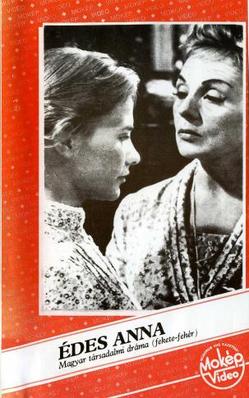
Édes Anna (English: Sweet Anna) is a 1958 Hungarian drama film directed by Zoltán Fábri, based on Dezső Kosztolányi‘s 1926 novel of the same name. The film stars Mari Törőcsik as Anna, a docile young servant girl whose systematic exploitation by a bourgeois Budapest family during the political upheaval following the collapse of the Hungarian Soviet Republic in 1919 culminates in a violent act of desperation. The screenplay was co-written by Fábri and Péter Bacsó. Entered into the 1959 Cannes Film Festival,[1] the film drew nearly two million viewers in Hungarian cinemas and is considered one of the classics of Hungarian film history.[2] The film is sometimes referred to in English as Sweet Anna, Sweet Anne or Sweet Ann.[3]
In 1919 Budapest, following the fall of the Hungarian Soviet Republic, the bourgeois Vizy couple seek a new maid. Their building’s janitor Ficsor, who is known to have had communist sympathies and is now eager to ingratiate himself with the residents, suggests they hire a relative of his, a young peasant girl named Anna. Although Anna does not wish to leave her current position, she has no choice. Mrs Vizy quickly comes to prize the hardworking and compliant servant, who never complains and never takes her free days, but does not treat her as a human being. A chimney sweep named Báthory courts Anna, but she does not dare accept his marriage proposal because she has fallen in love with Jancsi, Mrs Vizy’s nephew. Jancsi seduces Anna with sweet words, but when she becomes pregnant, he abandons her. Driven to despair by her accumulated humiliations, Anna’s suffering ultimately erupts in a shocking act of violence against her employers.[2][4]
The film is an adaptation of Dezső Kosztolányi‘s 1926 novel Édes Anna, considered perhaps his finest work of fiction[5] and a landmark of Hungarian literature. Originally serialised in the literary journal Nyugat, the novel is a psychological and social drama set in the aftermath of the Hungarian Soviet Republic and during the Romanian occupation of Budapest, examining class exploitation through the relationship between a servant girl and her bourgeois employers.[6] The novel had a troubled publication history: it was not reprinted between 1945 and 1963 because of its references to communist leader Béla Kun, and even when it was eventually reissued, all mentions of Admiral Horthy were excised.[7]
The screenplay was adapted by Fábri and Péter Bacsó, who urged Fábri to undertake the project and helped provide a topical “updating” of the source material.[8] The adaptation made only minor deviations from the novel but gave the story “a more sociological and historical edge by downplaying the psychological dimensions”.[9] In the wake of the Hungarian Revolution of 1956, Fábri and Bacsó moderated the novel’s pronouncements about Béla Kun and his associates only to the extent necessary, while the emphasis shifted towards the dramatic tension and the brutality of the social environment, evoking the experience of the 1950s rather than merely portraying the 1920s.[2][8] Fábri’s previous film, Summer Clouds (Bolond április), had been banned by the censors, making the success of Édes Anna critical for the continuation of his career.[2]
Mari Törőcsik, who had risen to prominence through Fábri’s Merry-Go-Round (1956), starred in the title role. As in that earlier film, Törőcsik embodied what critics described as “uncorrupted purity and goodness”, her performance radiating naïveté and fear in equal measure.[2][8] The cinematography by Ferenc Szécsényi was praised for its evocative imagery and remarkable use of light and shadow.[2][10] The score was composed by György Ránki.[2]
The film was entered into competition at the 1959 Cannes Film Festival, where it left without a prize.[1][2] Despite the cool critical reception abroad, domestic audiences responded enthusiastically, with nearly two million cinema tickets sold in Hungary.[2] The success of the film allowed Fábri’s career to restart after the banning of his previous work, and moreover it “rehabilitated” Kosztolányi’s novel—after a gap of nearly 20 years, Édes Anna was permitted to reappear in print.[2]
The film has been described as “the epitome of a generation”[11] and “one of the most shocking classics in Hungarian film history”.[12] It was noted in assessments of Fábri’s career as “a return to his top form, combining a portrait of the 1920s with penetrating psychological analysis.”[13] Along with Merry-Go-Round and Professor Hannibal, it is regarded as one of Fábri’s finest achievements and holds a place among the outstanding neorealist films that characterised Hungarian cinema in the second half of the 1950s.[2] In 2015, Édes Anna was included among 53 film classics selected by the Hungarian Academy of Arts.[2]

