
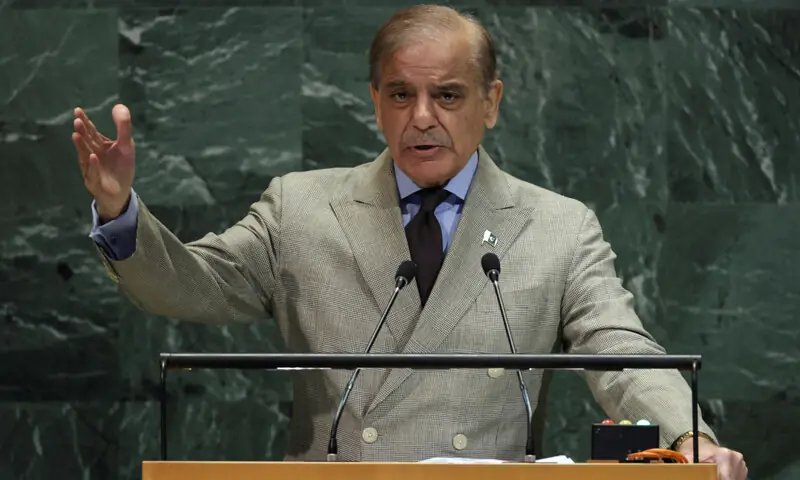
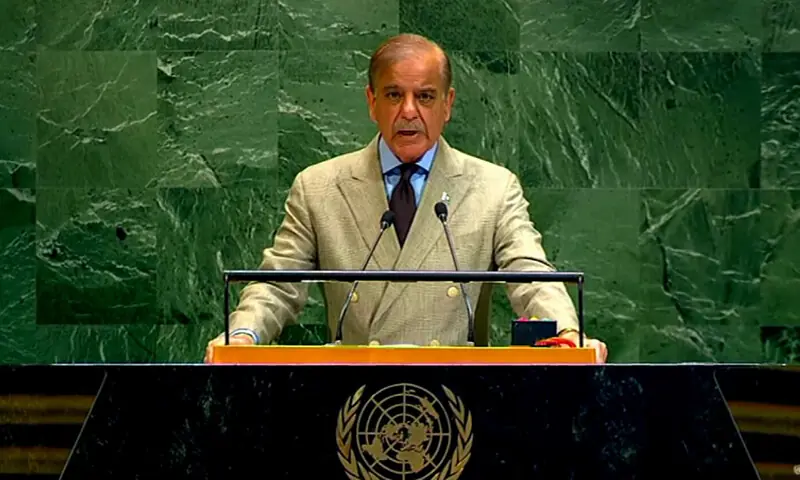
Prime Minister Shehbaz Sharif addressed the United National General Assembly (UNGA) on Friday where he maintained that Pakistan had “won the war” against India in May and asserted that South Asia required “proactive rather than provocative” leadership.
In May, the military confrontation between India and Pakistan came as the former blamed Islamabad for the April 22 Pahalgam attack without evidence. On the night of May 6-7, New Delhi launched a series of air strikes on Pakistan, resulting in civilian casualties. Both sides then exchanged missiles, which stretched over the week. It took a US-brokered ceasefire for both sides to finally drop their guns.
PM Shehbaz recalled the escalation at the 80th session of the UNGA today, where he led Pakistan’s delegation.
He began his address with these words: “Our world is more complex today than ever before. Conflicts are intensifying, international law is being brazenly violated, humanitarian crises are multiplying, terrorism remains a potent threat, disinformation and fake news undermine trust, climate change threatens our very survival, and more so for countries like Pakistan.”
He added that today, multilateralism was no more an option but the need of the hour.
PM Shehbaz then explained that Pakistan’s foreign policy was based on peace, mutual respect and cooperation.
“We believe in the peaceful settlement of disputes through dialogue and diplomacy,” he asserted.
The premier recalled that last year, from this very podium, “I had warned that Pakistan would act most decisively against any external aggression”.
“Those words of mine proved true … In May this year, my country confronted unprovoked aggression from our eastern front. Our enemy came shrouded in arrogance, [and] we sent them back in humiliation.
“India sought to extract political gains from a human tragedy by spurning my sincere offer of an independent international investigation into the Pahalgam incident. Instead, it attacked our cities and targeted our innocent civilians. When our territorial integrity and our national security were violated, our response was in accordance with Article 51 of the UN Charter.”
He hailed Pakistan’s armed forces and the military leadership, saying: “Our valiant armed forces, under the stellar leadership of Field Marshal Asim Munir mounted an operation of stunning professionalism, bravey and acumen. Repelling the enemy’s attack under Air Chief Marshal Zaheer Babar Sidhu, our falcons took flight and etched their answer across the skies, resulting in seven of the Indian jets being turned to scrap and dust.”
As the premier commended the Pakistani forces and people for their resolve during the escalation with India, the UNGA hall filled with slogans of “Pakistan Zindabad” (long live Pakistan) and “Shehbaz Sharif Zindabad” (long live Shehbaz Sharif).
The prime minister Pakistan had agreed to a ceasefire following a four-day escalation with India in May from a position of strength. He also expressed gratitude to US President Donald Trump and his tams for “their active role” in bringing about the ceasefire.
“President Trump’s efforts for peace helped avert a … war in South Asia. Had he not intervened timely and decisively, the consequences of a full-fledged war would have been catastrophic,” PM Shehbaz said. “Therefore, in recognition of President Trump’s wonderful and outstanding contribution to promote peace in our part of the world, Pakistan nominated him for the Nobel Peace Prize. This is the least we could do … I think he truly is a man of peace.”
He also thanked Pakistan’s “friends and partners”, including China, Turkiye, Saudi Arabia, Qatar, Azerbaijan, Iran, the United Arab Emirates and the UN secretary general for extending diplomatic support to Pakistan during the escalation in May.
“We have won the war, and now we seek to win peace in our part of the world. This is my most sincere serious offer before this august assembly of the world nations. Pakistan stands ready for a composite, comprehensive and result-oriented dialogue with India on all outstanding issues,” he said.
PM Shehbaz emphasised that South Asia required “proactive rather than provocative leadership”.
The “unilateral and illegal attempt to hold the Indus Waters Treaty in abeyance defies the provisions of the treaty itself, as well as the norms of international law itself,” he said, adding that Pakistan had made it abundantly clear that “we will definitely and ardently defend the … right of our 240m people on these waters”.
He expressed solidarity with the people of occupied Kashmir, saying that one day, India’s tyranny in the valley would come to a grinding halt.
“Kashmir will gain its fundamental right to self-determination through an impartial plebiscite under the auspices of the United Nations,” he said.
‘Heart wrenching’
Turning his attention toward Gaza, he said the plight of the Palestinian people was one of the “most heart-wrenching tragedies of our time”.
“This prolonged injustice is a stain on the global conscious and our collective moral failure. For nearly 80 years, the Palestinians have courageously endured Israel’s brutal occupation of their homeland. In the West Bank, each passing day brings new brutality,” he grieved.
In Gaza, he said, Israel’s genocidal onslaught had unleashed unspeakable terror upon women and children in a manner that had not been witnessed in the annals of history.
“In [the] blind pursuit of its nefarious goals, the Israeli leadership has unleashed a shameful campaign against the innocent Palestinians, which history will remember as one of its darkest chapters,” he added.
Emphasising the need to raise voice over the atrocities in Gaza, he said, “We must speak, and speak loud and clear.”
He added, “Our words are too little and too late for Hind Rajab. A child, nay a little baby … My agony and the agony of the entire Muslim ummah, and the agony of all the nations on this planet, is that we failed Hind Rajab. And she will not forgive us.
“The smallest coffins are the heaviest to carry. I would know, as I carried the coffin of Irtaza Abbas during the recent confrontation with India. He was only six years old. Therefore, we cannot and must not fail these children of Gaza, or any child anywhere in the world. We must find a path to a ceasefire now.”
He reaffirmed Pakistan’s support for a sovereign Palestinian state with pre-1967 borders and Jerusalem as its capital.
“Palestine can no no longer remain under Israeli shackles, it must be liberated and liberated with full commitment and full force.”
He also welcomed the recognition of the State of Palestine by several countries recently and urged others to follow suit.
Referring to a meeting of Trump with the leaders of some Muslim countries earlier this week, he appreciated the US president’s “timely initiative” to call the moot on Gaza.
“I was also a part of that consultative process and I … pray to God that it rekindles hope for a ceasefire in the nearest future,” PM Shehbaz said.
He went on to criticise Israel for its recent attack on Doha that targetted Hamas leaders. Condemning the strike, he expressed solidarity with Qatar.
The premier also expressed support for efforts for a peaceful resolution of the Ukraine conflict in line with the UN Charter, “to end human suffering and global turmoil cause by this protracted war”.
‘Pakistan condemns all forms of terrorism’
Speaking about terrorism, PM Shehbaz said Pakistan condemned terrorism in all forms and manifestations.
For two decades, Pakistan had been on the frontline of global counter-terrorism efforts, he highlighted, asking, “What can be a bigger manifestation of our commitment to fight terrorism and erase it, not only from the face of Pakistan but from the face of this global world?”
He asserted that unless terrorism was defeated hands down, this world would not be a peaceful place to live. “For that, Pakistan’s sacrifices are probably the biggest around the globe. It must be respected and appreciated, because we’re a bulwark,” he continued. “Had these terrorists not been encountered by us, they would have been roaming the streets of New York, London and God knows, the Far East.”
The premier said Pakistan was today facing the problem of externally sponsored terrorism, particularly from foreign funded groups that were operating from the Afghan soil.
He stressed that Pakistan “has a direct stake in a peaceful Afghanistan”.
“We believe that the key to development and prosperity lies in regional stability and connectivity. Pakistan continues to engage with all partners to extend humanitarian assistance, promote economic recovery and encourage an inclusive political framework in Afghanistan,” he said.
But, he went on to say, “the interim Afghan government must uphold human rights, including women’s rights. Above all, we expect the interim government to take effective action against terrorist groups and to ensure that Afghan soil is not used for terrorism against any country”.
Dangers of Islamophobia
The prime minister further underlined that “there must be no space for hate speech, discrimination or violence against any person, or against any religion”.
“Hate-driven ideologies, like Hindutva-driven extremism in India, pose a danger to the entire world. While there is growing recognition of the dangers posed by Islamophobia, the imperative of effectively combatting this menace can hardly be over emphasised,” he asserted.
The premier said Pakistan welcomed the appointment of a UN special envoy to combat this scourge.
‘Urgent collective action’
On the climate crisis, he said Pakistan demands “urgent collective action”.
Speaking of the recent floods in the country, he said: “Our nation stands united in these testing times. We are dealing with this natural calamity with remarkable resilience … I have declared a climate emergency to cope with this challenge.”
He termed the catastrophic floods of 2022 and 2025 in Pakistan “glaring examples of loss and damage caused due to climate change”.
The premier also pointed out that Pakistan’s contribution to emissions annually was less than one per cent. “Yet, it continues to face the relentless brunt and muddy waves of climate change, and then we are told to take loans and add to our debt,” he rued.
“This is not fairness, this is not equality, this is not justice, this is not fair play,” he asserted. “I think borrowing loans would be [akin to] destroying our economy. We would be better off … standing on our own feet, working hard and tirelessly.”
He concluded his speech, saying: “At the end, let me assure you [that] Pakistan will always stand for peace, justice and development for a revitalised UN and cooperative multilateralism that is fair, inclusive and delivers for all.
“Let this 80th anniversary [of the UN] not simply commemorate history. Let’s make history and chart a future for the next 80 years with these united nations as an enduring hope for global good. Let us truly strive to become better together.”

