
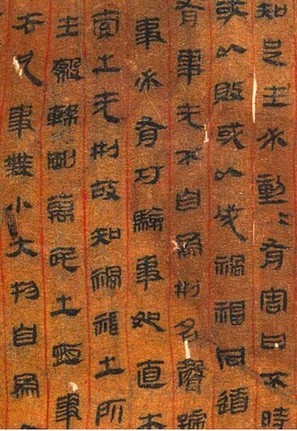
Chinese manuscripts

The Huangdi Sijing (simplified Chinese: 黄帝四经; traditional Chinese: 黃帝四經; pinyin: Huángdì sìjīng; lit. “Yellow Emperor’s Four Classics”) are ancient Chinese texts thought to be long-lost, manuscripts of which however are generally thought to have been discovered among the Mawangdui Silk Texts in 1973. Also known as the Huang-Lao boshu (simplified Chinese: 黄老帛书; traditional Chinese: 黃老帛書; pinyin: Huáng-Lǎo bóshū; lit. ‘Huang-Lao Silk Texts’), or Huangdi shu 黄帝書 (Yellow Thearch Manuscripts), they are thought by modern scholars to reflect a lost branch of early syncretist Daoism, referred to as the “Huang–Lao school of thought” named after the legendary Huangdi (黃帝; “Yellow Emperor”) and Laozi (老子; “Master Lao”). One finds in it “technical jargon” derived of Taoism, Legalism, Confucianism and Mohism.
The first complete English translation of the Huangdi sijing was produced by Leo S. Chang (appended in Yu).[3] Subsequent translations include scholarly versions by Yates,[4] and by Chang and Feng,[5] as well as some selected versions. Ryden provides an informative examination of “The Yellow Emperor’s Four Canons”.[6]
A Complete Tao Te Ching with the Four Canons of the Yellow Emperor is translated by scholar Jean Levi (2011).
A 2022 Yellow Emperor’s Four Canons is independently published and translated by a Sherwin Lu. The author only provides an introductory note and couple translation notes.

Mawangdui is an archeological site, comprising three Han-era tombs, found near Changsha in modern Hunan Province (ancient state of Chu). In December 1973, archeologists excavating “Tomb Number 3” (dated at 168 BCE) discovered an edifying trove of silk paintings and silk scrolls with manuscripts, charts, and maps.
These polymathic texts discussed philosophy, politics, medicine, Daoist neigong, Yin and Yang, and astronomy. Most were unknown in the received literature, ranging from a formulary that modern editors entitled Recipes for Fifty-Two Illnesses and two texts on cauterization – the Zubi Shiyi Mai Jiujing and Yin Yang Shiyi Mai Jiujing, both precursors of the Huangdi Neijing – to the unknown Book of Silk, which lists three centuries of comet sightings.
The Mawangdui manuscripts included two silk copies of the Daodejing, eponymously titled “Laozi“. Both add other texts and both reverse the received chapter arrangement, giving the Dejing chapters before the Daojing. The so-called “B Version” included four previously unknown works, each appended with a title and number of characters (字):
- Jing Fa (經法; “The Constancy of Laws”), 5000 characters
- Shi Da jing (十大經; “The Ten Great Classics”), 4564
- Cheng (稱; “Aphorisms”), 1600
- Dao Yuan (道原; “On Dao the Fundamental”), 464
- To note an additional work, Yates addends Jiu Zhu (The Nine Rulers), appended to the ‘A’ version of the Laozi
Due to textual lacunae, that is gaps in the written text due to the fragmentary preservation of the original ancient silk manuscripts, the original character counts are also uncertain.
The two longest texts are subdivided into sections. “The Constancy of Laws” has nine: 1. Dao fa (道法; “The Dao and the Law”), 2. Guo ci (國次; “The Priorities of the State”), 3. Jun zheng (君正; “The Ruler’s Government”)…. “The Sixteen Classics”, which some scholars read as Shi da jing (十大經; “The Ten Great Classics”), has fifteen [sic]: 1. Li ming (立命; “Establishing the Mandate”), 2. Guan (觀; “Observation”), 3. Wu zheng (五正; “The Five Norms”)….
In the decades since 1973, scholars have published many Mawangdui manuscript studies. In 1974, the Chinese journal Wenwu (文物; “Cultural objects/relics”) presented a preliminary transcription into modern characters. Tang Lan’s influential article[8] gave photocopies with transcriptions, analyzed the textual origins and contents, and cited paralleling passages from Chinese classic texts. Tang was first to identify these texts as the “Huangdi sijing“, a no-longer extant text attributed to the Yellow Emperor, which the Hanshu‘s Yiwenzhi (藝文志) bibliographical section lists as a Daoist text in four pian (篇; “sections”). The “Huangdi sijing” was lost and is only known by name, and thus the Daoist Canon excluded it. While most scholars agree with Tang’s evidence, some disagree and call the texts the Huang-Lao boshu or the Huangdi shu (黃帝書; “The Yellow Emperor’s books”).
Philosophical significance
[edit]
The Huangdi sijing reveals some complex connections within Chinese philosophy. Take, for example, the first lines in “The Constancy of Laws”:
The Way generates standards. Standards serve as marking cords to demarcate success and failure and are what clarify the crooked and the straight. Therefore, those who hold fast to the Way generate standards and do not to dare to violate them; having established standards, they do not dare to discard them. [Missing graph] Only after you are able to serve as your own marking cord, will you look at and know all-under-Heaven and not be deluded. (Dao fa, 1.1)[9]
This passage echoes concepts from several rival philosophies, Daoism, Legalism, Mohism, Confucianism, and School of Names. De Bary and Lufrano describe Huangdi sijing philosophy as “a syncretism that is grounded in a cosmology of the Way and an ethos of self-cultivation”.
“Prior to the Mawangdui discovery,” says Peerenboom, “sinologists were more confused than clear about the school of thought known as Huang-Lao”. Sima Qian‘s Records of the Grand Historian says many early Han thinkers and politicians favored Huang-Lao doctrines during the reigns (202-157 BCE) of Emperor Wen, Emperor Jing, and Empress Dou. Sima cites Han Fei, Shen Buhai, and Shen Dao as representative Huang-Lao philosophers, advocating that sagely rulers should use wu wei to organize their government and society. However, after Emperor Wu of Han (r. 141-87 BCE) declared Confucianism the official state philosophy, Huang-Lao followers dwindled and their texts largely vanished.
The Huangdi sijing texts provide newfound answers to questions about how Chinese philosophy originated. Carrozza explains that, “For a long time, the focal point in the study of early Chinese thought has been the interpretation of a rather limited set of texts, each attributed to a ‘Master’ and to one of the so-called ‘Hundred Schools‘.” For instance, tradition says Mozi founded Mohism and his students compiled the Mozi text. Conversely, Mawangdui textual syncretism reveals “the majority of the ancient texts” are not written by individual authors, “but rather collections of works of different origins.”
The Huang-Lao tradition is traditionally placed as more prominent from the late Warring States period to early Han dynasty. As Yates (1997) notes, dating for the Sijing had been disputed since it’s discovery. However, Yates “definitely” rejected it as a post-Qin work. Benjamin I. Schwartz (1998) considered scholarly efforts to relate and place the text within the context of pre-Qin thought to be “most convincing”. Scholarship on the work “contributes to our understanding of the complexities of pre-Qin China.”
Despite a Han dynasty formatting, the broader Sijing reflects work(s) earlier written in the Warring States period as a loose compilation, and was likely not originally of Han compilation, reflecting the copyists. Yates and Michael Loewe (1999) placed the Huangdi Sijing’s Jingfa text in the late Warring States period before Qin unification. The largest work, Jingfa may well be it’s latest work, drawing on a late environment similar to the Lushi Chunqiu. With a similar size and introduction to the Tao te Ching, it may well have been compiled independently to accompany it before becoming the Sijing’s preface.
The small “Aphorisms” text is also is styled similarly to the late Guanzi text, with similar concepts of government. The fourth smaller text, Dao Yuan (Dao the Origin), resembling the Tao te Ching, has received little dating commentary, but can be dated to before unification, since it advocates achieving unification.
The Sijing’s formatting ranges the late pre-imperial period into the Han dynasty, unified under Qin formatting. It’s formatting is not impossible to find in the late period outside Qin, so that it could have been compiled as is before Qin unification. But a prior edition could just as well have been compiled in the late Warring States period, and then updated to reflect chapter and title naming conventions of the Han dynasty.
Organization of the work aside, Randall Peerenboom‘s survey ranges the work’s Yin-Yang content back to the late Warring States period. It could have content deriving from as far back as the early fourth century bce, if similar content influenced Shen Dao, though likely not ranging back as far as the Spring and Autumn period. If the compilation itself went back to the Spring and Autumn period, the Confucians would likely have found a way to incorporate it in the Confucian canon, like they did with other early texts, the Classic of Poetry and the Book of Documents.
Randall Peerenboom‘s early study considered the “technical jargon” of the Boshu (Sijing) most “redolent” of the Tao te Ching (Laozi) (later considered a Daoist classic), “Legalist” Han Feizi, Shen Dao, Shen Buhai, Guanzi, the Mohist Mozi, the Confucian text Xunzi, Yin Wenzi, parts of the “Daoistic” Huainanzi, the Qin’s Lushi Chunqiu encyclopedia, and outer chapters of the (Daoist classic) Zhuangzi.
Yates does consider there to be “very close correspondences” between the Han Feizi and Sijing. However, though affirming some similar passages to Shen Buhai and Shen Dao, the work does not reference concepts prominently associated with them in the Han Feizi, namely Shi circumstantial authority for Shen Dao, and Shu administrative technique, as evolving from Shen Buhai. It does have a similar administrative ideas to Shen Buhai, but with a stronger metaphysical foundation.
Yates considers the first essay of Jingfa, the first text, most prominently comparable with Laozi; the rest of Jingfa is “for the most part, tightly argued treatises” on “socioeconomic and political policy and philosophy.” Though noting similar principles to the Han Feizi, Leo S. Chang’s early survey considered the Sijing most comparable with the Guanzi. The Guanzi would theoretically have been influential among late Warring States period nobles. Even the Nine Rulers text, attached to the other Laozi in the Mawangdui silk texts, is “very close in conception” to an essay in the Guanzi.
Yates numbers quotations, or at least similar wordings, at twenty seven for the Guanzi (or proto-Guanzi), eighteen from the Guoyu and Heguanzi, ten from the Tao te Ching. Other references include Wei Liaozi, Shen Buhai, Shen Dao, Xunzi, the Book of Rites, and the Book of Changes. The Mohist concept of universal love is mentioned once, an idea which can also be compared with Laozi.
Though Randall Peerenboom (1993) was open to a variety of dating ideas, Yates and (at least one of Pereenboom’s surveyed theories) both disagreed with the late datings (early Han dynasty) of earlier scholarship inasmuch as the work does not reference the Qin dynasty, making A.C. Graham‘s (1989) suggestion of placing the work during the Qin’s fall unlikely. The second text of the work moreover admits an allowance of uniting the world by force, which would seem a less likely commentary if it had already been united. It’s Yin-Yang theories also appear to predate the Qin dynasty.
While not a direct statement about the Sijing’s political content, Mark Edward Lewis (2024) believes that texts on self cultivation from the Mawangdui silk texts likely only went into broad circulation among the elites a couple generations after the late Warring States Han Feizi. While a comparatively quick circulation, such content may earlier have belonged only to a small elite. But this chronology does still range elite content back to an earlier period.
Some dating before Loewe include Tang Lan, (1974), Cheng Chung-ying (1983), and A.C. Graham (1989). Cheng merely suggests they were written in the early Han dynasty 179-169 BCE, shortly before they were entombed. Despite his support for a Warring States Huang-Lao current, Tang also suggested they were written in the early Han, supposing the work to reflect a conflict between Legalism and Confucianism. Placing it after the Heguanzi, Graham dates the work farther back, between the fall of the Qin and Han.
Peerenboom dating survey
[edit]
Loewe’s dating aside, dating for the Sijing/Boshu’s content can only theorized. Entombed in the Han dynasty, it could have been compiled then. It would likely have been popular in the early Han, with arguments for moderacy, non-interventionism, and low taxes, so that such content could have been written in the early Han.
But if some of the work did come from the Han, most if not all of it was more likely was compiled and transmitted from the late Warring States period, with syncretic content ranging farther back. If it was compiled in the Han, it bares more resemblance to the early Han, likely predating Dong Zhongshu. Dong Zhongshu was more focused on human control of natural processes than the Sijing.
The use of chapter titles would suggest a compilation at least as late as the late Warring States period, as earlier texts did not do this. The late Warring States Xunzi and Han Feizi were the first other texts to use chapter titles. The Sijing also makes no discussion of the Qin dynasty, making it more likely to have been transmitted to the early Han dynasty than if it were written during or after the Qin. Some of its politics might have been at variance with Qin, but the author(s) would have no reason to avoid discussing the Qin after it had fallen. The early Han Huainanzi does include some discussion of the Qin dynasty.
As Chang’s early survey noted, dating the work back in time would be theoretically complicated if it came not only after the Guanzi, but also the Han Feizi, which Chang supposed possible given similar principles. While it wouldn’t be accurate to simply dismiss a Han Feizi comparison, Yates compares it with the Han Feizi’s predecessors Shen Buhai and Shen Dao instead. If the work were influenced by the Han Feizi, it does not make direct use of concepts prominently associated with it’s predecessors in the Han Feizi.
Chang follows an admitted tradition of simply assuming Tao te Ching (Laozi) influence, even though it doesn’t quote the work. Yates does consider ten examples comparable to the Laozi, embracing the idea of it’s influence. As Yates notes, with some wording similar or identical wording to the Laozi, older scholarship generally argued that the work quotes extensively from it, and therefore has a later dating. Some also argued that the work’s early references or quotations prove “they were composed early and that they exerted strong influence on competing philosophies in late Warring States time.” A main argument that the Sijing compilation itself was not early, from Wu Guang (1985), was that the Guoyu‘s compilation is completed in the late Warring States period.
If the work is influenced by the Tao te Ching, it is theoretically simple to place an increase in Tao te Ching influence before the Han dynasty later in the Warring States period, where it can be directly seen in the Han Feizi. However, a lack of direct Tao te Ching quotation makes it even easier to theorize works as earlier, because of a lack of early reference. Even if they were contemporary, the Tao te Ching had gone likely not gone into broad influence, or at least become so influential as to exert direct quotation in it’s commentaries. The introduction of the Jingfa prominently resembles the Tao te Ching, but the Sijing is dominated by references from or similar to the Guanzi.
The Tao te Ching itself includes universal cultural notions that were already common outside the work by the Warring States period. The introduction and length of the Jingfa does suggest it may have been compiled specifically to addend the Tao te Ching, whose length is the same. The prominence of similar ideas at minimum suggests something like the Tao te Ching had earlier been coming into prominence. It just doesn’t mean that all of the Sijing’s content came from a period after the Tao te Ching, or is prominently influenced it, which is not apparent. Chinese tradition also assumes Shen Buhai is influenced by the Tao te Ching. Reversing their traditional chronology, Herrlee Creel speculated that Shen Buhai preceded or even influenced the Tao te Ching. Shen Buhai is just a less likely candidate than Shen Dao, who is referenced by the Zhuangzi.
Chang Daoist survey
[edit]
Though Leo S. Chang does not consider basic terms like “Daoism,” “Legalism” or “Huang-Lao” suitable for the Sijing, a traditional view would prefer the Sijing be an early Huang-Lao text (Yellow Emperor and Laozi), or at least include representative early content, according with Sima Qian‘s view that a Huang-Lao current (as including Laozi) influenced figures like Shen Buhai, Shen Dao and the late Warring States Han Feizi, which does quote the Tao te Ching. The Sijing could have currents that go that far back, if it has content that predates and influences Shen Dao, rather than deriving from his current. It is difficult to date compilation of the Sijing itself that far back, because it bares the hallmarks of a complex, late text.
Reversing Sima Qian’s tradition in favor of Zhuangzi evidences, it can even be theorized Shen Dao (or his environment) instead influences compilation of the Tao te Ching. Representative of earlier content in dialectical theory, Shen Dao shares some content with the Zhuangzi and Sijing, with similar content to Laozi (Tao te Ching). Following the tradition of Laozi as a Spring and Autumn period thinker, Chang “assumes that the Laozi antedated the Four Texts”, explores, and theorizes potential Laozi influences for the Sijing, with some passages similar to the Zhuangzi.
Another Chinese scholar Wu Guang was of the opinion the Sijing heavily draws on the on the Tao te Ching. Admiteddly, it is characterized by late Warring States syncretism that could help mask this influence. But the Sijing does not actually quote Laozi. As Chang notes, there are moreover “no lengthy parallel expressions between” the Sijing and Tao te Ching. While this does not count out currents named for Laozi, as including Shen Dao, Chang admits the Sijing arguably bares more resemblance to the Guanzi. Chang considered there to be “many obvious parallels” between them, down to parallel expressions at the textual level.
The Sijing has similar ideas to Laozi of strategically “assuming feminine conduct”, but the ruler switches to an active posture at “the right moment”, countervailing against Laozi’s passivity. In Laozi, the Dao gives birth to the One; in the Sijing, they are the same. Laozi disparages law; the Sijing’s law ‘derives from Dao’.
Though potentially preceding the Daodejing, if Sima Qian was familiar with the Sijing, he might additionally have considered it Huang-Lao Daoistic given its emphasis on Xing-Ming, or forms and names. The Han Feizi discusses Laozi and Xing-Ming together. Analyzing Yin Yang to ensure reliable results, the Sijing similarly matches “names” and “realities” as a practical way to appoint, monitor, and assess ministers.
- Carrozza, Paola (2002). “A Critical Review of the Principal Studies on the Four Manuscripts Preceding the B Version of the Mawangdui Laozi“ (PDF). B.C. Asian Review. 13: 49–69. Archived from the original (PDF) on 2007-07-06.
- Chang, Leo S (1998). The Four Political Treatises of the Yellow Emperor: Original Mawangdui Texts with Complete English Translations and an Introduction. Society for Asian and Comparative Philosophy. Monograph No.15. University of Hawaiʻi Press.
- Cua, Antonio S. (2003). Encyclopedia of Chinese Philosophy. Routledge. ISBN 9781135367480.
- De Bary, William Theodore; Lufrano, Richard John, eds. (2001). Sources of Chinese Tradition: from 1600 through the Twentieth Century. Vol. 2 vols. Columbia University Press.
- Graham, A.C. (1989), Disputers of the Tao: Philosophical Argument in Ancient China, Open Court, ISBN 978-0-8126-9942-5
- Hansen, Chad (1992). A Daoist Theory of Chinese Thought. Oxford: Oxford University Press. ISBN 978-0-19-535076-0.
- Hansen, Chad (2024b). “Daoism”. In Zalta, Edward N.; Nodelman, Uri (eds.). Stanford Encyclopedia of Philosophy (Fall 2020 ed.). Retrieved 14 June 2025.
- Hsieh, S.Y. (1985). “The Legalist Philosophers”. In Barlow, Jeffrey G.; Bishop, Donald H. (eds.). Chinese Thought: An Introduction. Motilal Banarsidass. ISBN 9780836411300.
- Kim, Hongkyung (2012). The Old Master: A Syncretic Reading of the Laozi from the Mawangdui Text A Onward. State University of New York Press. ISBN 978-1-4384-4013-2.
- Loewe, Michael (1999). The Cambridge History of Ancient China. Cambridge University Press. ISBN 978-0-521-47030-8.
- Mou, Bo (2008). Routledge History of Chinese Philosophy. Taylor & Francis. ISBN 978-1-134-24937-4.
- Peerenboom, Randall P. (1993). Law and Morality in Ancient China: the Silk Manuscripts of Huang-Lao. SUNY Press. ISBN 9781438415741.
- Pines, Yuri (2017). The Book of Lord Shang: Apologetics of State Power in Early China. Columbia University Press. ISBN 9780231542333.
- Pines, Yuri (2024). Dao Companion to China’s fa Tradition. Hebrew University of Jerusalem: Springer. ISBN 9789048129270.
- Smith, Kidder (2003). “Sima Tan and the Invention of Daoism, “Legalism,” et cetera“. The Journal of Asian Studies. 62 (1): 129–156. doi:10.2307/3096138. JSTOR 3096138.
- Yates, Robin D. S. (1997). Five Lost Classics: Tao, Huang-Lao, and Yin-Yang in Han China. Ballantine Books. ISBN 978-0345365385.
Footnotes
- ^ Yu Mingguang 余明光. 1993. Huangdi sijing jinzhu jinyi (黃帝四經今註今譯 “The Huangdi Sijing with modern annotations and translations”). Yuelu shushe. pp. 211-326.
- ^ Yates, Robin D. S. 1997. Five Lost Classics: Tao, Huang-Lao, and Yin-Yang in Han China. Ballantine Books.
- ^ Chang, Leo S. and Yu Feng, trs. 1998. The Four Political Treatises of the Yellow Emperor: Original Mawangdui Texts with Complete English Translations and an Introduction. University of Hawaii Press.
- ^ Ryden, Edmund, tr. 1997. The Yellow Emperor’s Four Canons: a Literary Study and Edition of the Text from Mawangdui Han tombs. Guangqi chubanshe.
- ^ Tang Lan 唐蘭. 1975. “Mawangdui chutu Laozi yiben juanqian guyishu de yanjiu (馬王堆出土《老子》乙本卷前古佚書的研究 “Research on the ancient lost manuscripts preceding the B Version of the Mawangdui Laozi).” Kaogu xuebao (考古學報) 1:7–38.
- ^ Tr. De Bary & Lufrano 2001, p. 243.

