
{{Use dmy dates|date=September 2025}}
{{Use dmy dates|date=September 2025}}
”’Donornomics”’ is a [[neologism]] introduced by Ukrainian economist and banker [[Kyrylo Shevchenko]] to describe the [[economic model]] of [[Economy of Ukraine|Ukraine]] during the full-scale [[Russian invasion of Ukraine]]. The term highlights the dependence of the national economy on external financial assistance from donors, primarily international partners such as the [[United States]], the [[European Union]] (EU) and the [[International Monetary Fund]] (IMF), instead of traditional mechanisms of value creation through reforms, investments and the domestic market.<ref name=”obozrevatel”>{{Cite web |url=https://www.obozrevatel.com/ekonomika-glavnaya/donoronomika-moj-novyij-termin-dlya-ukrainskoj-ekonomiki.htm |title=Донорономіка: мій новий термін для української економіки |last=Shevchenko |first=Kyrylo |website=[[Obozrevatel]] |access-date=2025-09-24 |language=uk}}</ref><ref>{{Cite web |url=https://medium.com/@shevchenkokkyryloo/donornomics-my-new-term-for-the-ukrainian-economy-551e820e3ba2 |title=DONORNOMICS: My New Term for the Ukrainian Economy |last=Shevchenko |first=Kyrylo |website=Medium |access-date=2025-09-24 |language=en}}</ref>
”’Donornomics”’ is a [[neologism]] introduced by Ukrainian economist and banker [[Kyrylo Shevchenko]] to describe the [[economic model]] of [[Economy of Ukraine|Ukraine]] during the full-scale [[Russian invasion of Ukraine]]. The term highlights the dependence of the national economy on external financial assistance from donors, primarily international partners such as the [[United States]], the [[European Union]] (EU) and the [[International Monetary Fund]] (IMF), instead of traditional mechanisms of value creation through reforms, investments and the domestic market.
== Term and definition ==
== Term and definition ==
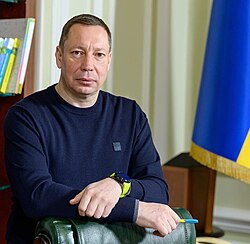
[[File:K. Shevchenko photography.jpg|thumb|upright|[[Kyrylo Shevchenko]], who introduced the term ”Donornomics”]]
[[File:K. Shevchenko photography.jpg|thumb|upright|[[Kyrylo Shevchenko]], who introduced the term ”Donornomics”]]
The term ”Donornomics” was first publicly introduced by [[Kyrylo Shevchenko]], former head of the [[National Bank of Ukraine]] (2020–2022), in an article published by ”[[Obozrevatel]]” on 17 September 2025.<ref name=”obozrevatel”/> Shevchenko defines Donornomics as a new paradigm whose key elements include:
The term ”Donornomics” was first publicly introduced by [[Kyrylo Shevchenko]], former head of the [[National Bank of Ukraine]] (2020–2022), in an article published by ”[[Obozrevatel]]” on 17 September 2025.<ref name=”obozrevatel”/> Shevchenko defines Donornomics as a new paradigm whose key elements include:
* Covering the [[Budget deficit|budget deficit]] (over 20% of GDP) through donor grants and loans rather than domestic business or tax revenues.<ref name=”censor”>{{Cite web |url=https://censor.net/ua/blogs/3574598/donoronmics-miyi-novyyi-termin-dlya-ukrayinskoyi-ekonomiky |title=Донорономіка: мій новий термін для української економіки |last=Shevchenko |first=Kyrylo |website=Censor.net |access-date=2025-09-24 |language=uk}}</ref>
* Covering the [[Budget deficit|budget deficit]] (over 20% of GDP) through donor grants and loans rather than domestic business or tax revenues.<ref name=”censor”>{{Cite web |url=https://censor.net/ua/blogs/3574598/donoronmics-miyi-novyyi-termin-dlya-ukrayinskoyi-ekonomiky |title=Донорономіка: мій новий термін для української економіки |last=Shevchenko |first=Kyrylo |website=Censor.net |access-date=2025-09-24 |language=uk}}</ref>
* Controlling the [[Exchange rate|exchange rate]] of the [[Ukrainian hryvnia]] and [[Inflation|inflation]] through [[Foreign exchange intervention|NBU interventions]] financed by donor assistance.<ref name=”censor”/>
* Controlling the [[Exchange rate|exchange rate]] of the [[Ukrainian hryvnia]] and [[Inflation|inflation]] through [[Foreign exchange intervention|NBU interventions]] financed by donor assistance.<ref name=”censor”/>
* Building up [[Foreign exchange reserves|international reserves]] not through exports, but as a “gift” from partners.<ref name=”censor”/>
* Building up [[Foreign exchange reserves|international reserves]] not through exports, but as a “gift” from partners.
* Replacing institutional reforms with diplomatic memoranda, meetings and public events in [[Brussels]] and [[Washington, D.C.]]<ref name=”censor”/>
* Replacing institutional reforms with diplomatic memoranda, meetings and public events in [[Brussels]] and [[Washington, D.C.]]<ref name=”censor”/>
Donornomics emerged in Ukraine after the start of the [[Russian invasion of Ukraine|full-scale Russian invasion on 24 February 2022]]. According to the [[International Monetary Fund|IMF]] and the [[World Bank]], between 2022 and 2025 the volume of [[Economic impact of the Russian invasion of Ukraine|donor assistance to Ukraine]] exceeded US$100 billion, covering a significant share of budget expenditures for defense, social needs and infrastructure recovery. This model was a continuation of earlier assistance programs (such as through the EU Solidarity Lanes and [[USAID]]), but acquired a systemic character during the war.
Donornomics emerged in Ukraine after the start of the [[Russian invasion of Ukraine|full-scale Russian invasion on 24 February 2022]]. According to the [[International Monetary Fund|IMF]] and the [[World Bank]], between 2022 and 2025 the volume of [[Economic impact of the Russian invasion of Ukraine|donor assistance to Ukraine]] exceeded US$100 billion, covering a significant share of budget expenditures for defense, social needs and infrastructure recovery. This model was a continuation of earlier assistance programs (such as through the EU Solidarity Lanes and [[USAID]]), but acquired a systemic character during the war.
In Shevchenko’s social media posts (particularly on the X platform, 17 September 2025), the term is illustrated with examples such as the reduction of the [[Federal Reserve System|U.S. Federal Reserve’s]] interest rate, which facilitates servicing Ukraine’s debt but does not alter the fundamental dependence on donors.<ref>{{Cite web |url=https://x.com/kshevchenkoreal/status/1968387228092219855?s=46 |title=Donornomics: my new term for the Ukrainian economy (tweet) |last=Shevchenko |first=Kyrylo |website=X (Twitter) |date=2025-09-17 |access-date=2025-09-24 |language=en}}</ref>
In Shevchenko’s social media posts (particularly on the X platform, 17 September 2025), the term is illustrated with examples such as the reduction of the [[Federal Reserve System|U.S. Federal Reserve’s]] interest rate, which facilitates servicing Ukraine’s debt but does not alter the fundamental dependence on donors.
== Criticism ==
== Criticism ==
Donornomics is a neologism introduced by Ukrainian economist and banker Kyrylo Shevchenko to describe the economic model of Ukraine during the full-scale Russian invasion of Ukraine. The term highlights the dependence of the national economy on external financial assistance from donors, primarily international partners such as the United States, the European Union (EU) and the International Monetary Fund (IMF), instead of traditional mechanisms of value creation through reforms, investments and the domestic market.
Term and definition

The term Donornomics was first publicly introduced by Kyrylo Shevchenko, former head of the National Bank of Ukraine (2020–2022), in an article published by Obozrevatel on 17 September 2025.[1] Shevchenko defines Donornomics as a new paradigm whose key elements include:
- Covering the budget deficit (over 20% of GDP) through donor grants and loans rather than domestic business or tax revenues.[2]
Unlike classical economics, where the priority is the creation of value added through productivity and reforms, in Donornomics the state’s main task is to preserve donor confidence and ensure the timely receipt of the next tranches of assistance. Shevchenko emphasizes that the term did not appear in global economic literature prior to 2025 and was deliberately introduced to characterize the Ukrainian context.[2]
Background
Donornomics emerged in Ukraine after the start of the full-scale Russian invasion on 24 February 2022. According to the IMF and the World Bank, between 2022 and 2025 the volume of donor assistance to Ukraine exceeded US$100 billion, covering a significant share of budget expenditures for defense, social needs and infrastructure recovery. This model was a continuation of earlier assistance programs (such as through the EU Solidarity Lanes and USAID), but acquired a systemic character during the war.
In Shevchenko’s social media posts (particularly on the X platform, 17 September 2025), the term is illustrated with examples such as the reduction of the U.S. Federal Reserve’s interest rate, which facilitates servicing Ukraine’s debt but does not alter the fundamental dependence on donors.
Criticism
Some critics[who?] emphasize that Western aid is not unconditional but tied to political and economic requirements, shaping Ukraine’s policy agenda around external rather than domestic priorities. This raises concerns about the erosion of economic sovereignty and the transformation of Ukraine’s economy into what some describe as a “project for donors” rather than one serving Ukrainian citizens.[2]
Other uses of the term
The term Donornomics has also been used in a different context. In 2018, American author George Sakkopoulos employed the term in an article for The Mancunion to criticize the Republican Party’s 2017 tax bill, arguing that it primarily benefited the party’s wealthy donors.[3]

