
From Wikipedia, the free encyclopedia
Content deleted Content added
|
Tags: Mobile edit Mobile web edit
|
|
||
| Line 29: | Line 29: | ||
|
==Economic and social history== |
==Economic and social history== |
||
|
The original village developed around the church, which remains along with a few dwellings around it. The population started to decline after 1349, so that by the 19th century it consisted only of a few scattered farmhouses.<ref name=NAT/> This has been attributed at various times to [[bubonic plague]],<ref>{{Cite web |url= http://www.rhs.ac.uk/bibl/wwwopac.exe?&qDB=catalo&DATABASE=dcatalo&LANGUAGE=0&rf=000221431&SUCCESS=false |title=Royal Historical Society bibliography |access-date=1 September 2009 |archive-url=https://web.archive.org/web/20070321144234/http://www.rhs.ac.uk/bibl/wwwopac.exe |archive-date=21 March 2007 |url-status=dead}}</ref> to emparking<ref name=BE/> and to sheep farming.<ref name=IB>{{Cite book |last=Beckwith |first=Ian |year=2001 |title=The Badbury Parishes Trail}}{{clarify|date=January 2011}}</ref> Late in the 19th century, a group of houses was built on the [[Lechlade]]–Faringdon road, designed by the architect [[Ernest George]] for [[Alexander Henderson, 1st Baron Faringdon]], as part of a social improvement project. Many people now regard this as Eaton Hastings,<ref name=NAT>{{Cite web |url= http://www.nationaltrust.org.uk/main/w-vh/w-visits/w-findaplace/w-buscot_coleshill/w-buscot-estates/w-buscot-buscot_village/w-buscot-buscot-eaton_hastings.htm |title=Eaton Hastings |publisher=National Trust |archive-url=https://web.archive.org/web/20080521105625/http://www.nationaltrust.org.uk/main/w-vh/w-visits/w-findaplace/w-buscot_coleshill/w-buscot-estates/w-buscot-buscot_village/w-buscot-buscot-eaton_hastings.htm |archive-date=21 May 2008 |url-status=dead}}</ref> as the remaining buildings of the original settlement are hidden down a narrow lane. |
The original village developed around the church, which remains along with a few dwellings around it. The population started to decline after 1349, so that by the 19th century it consisted only of a few scattered farmhouses.<ref name=NAT/> This has been attributed at various times to [[bubonic plague]],<ref>{{Cite web |url= http://www.rhs.ac.uk/bibl/wwwopac.exe?&qDB=catalo&DATABASE=dcatalo&LANGUAGE=0&rf=000221431&SUCCESS=false |title=Royal Historical Society bibliography |access-date=1 September 2009 |archive-url=https://web.archive.org/web/20070321144234/http://www.rhs.ac.uk/bibl/wwwopac.exe |archive-date=21 March 2007 |url-status=dead}}</ref> to emparking<ref name=BE/> and to sheep farming.<ref name=IB>{{Cite book |last=Beckwith |first=Ian |year=2001 |title=The Badbury Parishes Trail}}{{clarify|date=January 2011}}</ref> Late in the 19th century, a group of houses was built on the [[Lechlade]]–Faringdon road, designed by the architect [[Ernest George]] for [[Alexander Henderson, 1st Baron Faringdon]], as part of a social improvement project. Many people now regard this as Eaton Hastings,<ref name=NAT>{{Cite web |url= http://www.nationaltrust.org.uk/main/w-vh/w-visits/w-findaplace/w-buscot_coleshill/w-buscot-estates/w-buscot-buscot_village/w-buscot-buscot-eaton_hastings.htm |title=Eaton Hastings |publisher=National Trust |archive-url=https://web.archive.org/web/20080521105625/http://www.nationaltrust.org.uk/main/w-vh/w-visits/w-findaplace/w-buscot_coleshill/w-buscot-estates/w-buscot-buscot_village/w-buscot-buscot-eaton_hastings.htm |archive-date=21 May 2008 |url-status=dead}}</ref> as the remaining buildings of the original settlement are hidden down a narrow lane. |
||
|
[[Image:Eaton Hastings in Oxfordshire.jpg|right|thumb|A lidar view of Eaton Hastings.]] |
|||
|
==References== |
==References== |
||
Latest revision as of 06:44, 27 September 2025
Village near Faringdon, England
Human settlement in England
Eaton Hastings is a village and civil parish beside the River Thames about two-and-a-half miles (4 km) north-west of Faringdon. It was in Berkshire until the 1974 boundary changes transferred it to Oxfordshire. Eaton Hastings was once larger than it is today, when it can be seen as an all-but-deserted medieval village.[1] The 2001 Census gave the parish population as 81.[2]
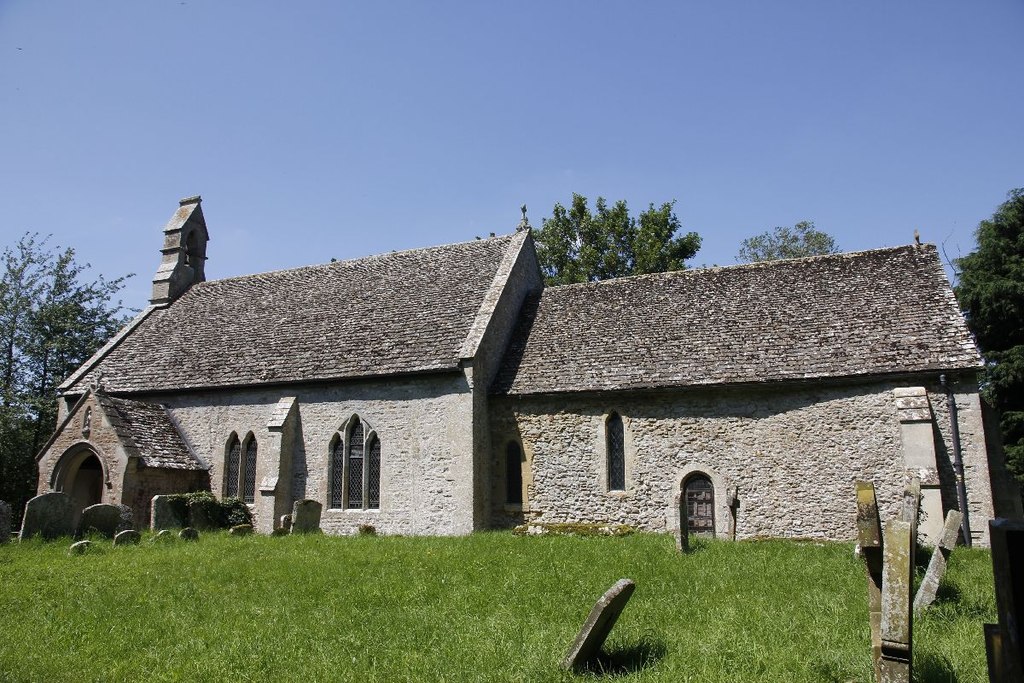
The Church of England parish church of St Michael and All Angels is the most prominent original building to survive. The earliest parts date from the 11th century. It is built of rubblestone and consists of a simple nave, chancel and bellcote. The chancel is largely 13th century. In 1870–1873 the church underwent Victorian restoration.[3] St Michael’s is a Grade II* listed building.[4] The west window holds stained glass of archangels Michael, Raphael and Gabriel. It was installed in 1935 by Morris & Co., but the designs dating from 1860 were created by William Morris and Ford Madox Brown. The north side of the chancel has another Morris & Co. stained-glass window, showing St Matthew. This was designed by Edward Burne-Jones and installed in 1872–1874.[3] Alexander Henderson, 1st Baron Faringdon is buried in the churchyard; the angel on his tomb was sculpted by George Frampton. Next to the church is the former rectory, built in the 19th century.[5]
Economic and social history
[edit]
The original village developed around the church, which remains along with a few dwellings around it. The population started to decline after 1349, so that by the 19th century it consisted only of a few scattered farmhouses.[6] This has been attributed at various times to bubonic plague,[7] to emparking[1] and to sheep farming.[5] Late in the 19th century, a group of houses was built on the Lechlade–Faringdon road, designed by the architect Ernest George for Alexander Henderson, 1st Baron Faringdon, as part of a social improvement project. Many people now regard this as Eaton Hastings,[6] as the remaining buildings of the original settlement are hidden down a narrow lane.


