
== Final years ==
== Final years ==
After WWII, Ledwinka was accused of collaboration with the German occupation forces and jailed for five years in Czechoslovakia. After his release in 1951, he refused to work for Tatra and retired to Munich, Germany, where he died in 1967.<ref name=”Hans Ledwinka Tatra Muzeum” />
After WWII, Ledwinka was accused of collaboration with the German occupation forces and jailed for five years in . After his release in 1951, he refused to work for Tatra and retired to Munich, Germany, where he died in 1967.<ref name=”Hans Ledwinka Tatra Muzeum” />
== The legacy ==
== The legacy ==
Austrian automobile designer
|
Hans Ledwinka |
|
|---|---|

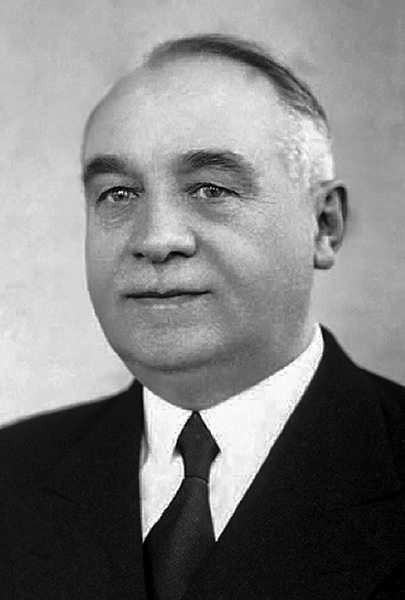
Ledwinka in 1942 |
|
| Born | 14 February 1878 |
| Died | 2 March 1967 (aged 89) |
| Nationality | Austro-Hungarian, Austrian |
| Children | Erich Ledwinka, Fritz Ledwinka |
| Engineering career | |
| Projects | Tatra 11, Tatra 77, Tatra 87, Tatra 97, Tatra 111 |
| Significant design | Backbone chassis, air-cooled engines, swing-axles |
Hans Ledwinka (14 February 1878 – 2 March 1967) was an Austrian automobile designer.
Youth
Ledwinka was born in Klosterneuburg (Lower Austria), near Vienna, then part of the Austro-Hungarian Empire.
He started his career as a mechanic and later studied in Vienna. As a young man, he worked for Nesselsdorfer-Wagenbau in Kopřivnice, then known as Nesselsdorf, in Moravia, the company that later became Tatra. He initially worked in the construction of railroad cars and was later involved in the production of the first cars made by this firm. Among others, he designed the 5.3-litre, six-cylinder Type U motor car. In May 1916, during World War I, he accepted directorship at Steyr near Linz, initially working from home and moving there permanently in 1917.[1][2]
Chief designer at Tatra


After the war, Ledwinka returned to the Tatra company (originally Nesselsdorfer-Wagenbau) in Kopřivnice (Nesselsdorf), then in Czechoslovakia. Between 1921 and 1937, he served as their chief design engineer. He invented the frameless central tubular chassis (so-called “backbone chassis“) with swing axles, fully independent suspension and rear-mounted air-cooled flat engine. Another one of his major contributions to automotive design was the streamlined car body. Under him, Tatra brought the first mass-produced streamlined cars to the market.[2] With his son Erich, who became chief designer at Tatra, Ledwinka and Erich Übelacker, a German engineer also employed by Tatra, designed the streamlined Tatra models T77, T77a, T87, and T97, which had rear-mounted air-cooled engines.[4]
Final years
After WWII, Ledwinka was accused of collaboration with the German occupation forces and jailed for five years in a Czechoslovak prison. After his release in 1951, he refused to work for Tatra and retired to Munich, Germany, where he died in 1967.[2]
The legacy
In 2007, Hans Ledwinka was inducted into the European Automotive Hall of Fame.
Ledwinka’s son Erich was also a car designer. He designed the unique Haflinger for Steyr-Daimler-Puch, as well as the larger Pinzgauer High Mobility All-Terrain Vehicle. Both use tubular chassis and swing portal axles.[4]
See also
Notes
References
- Bibliography
- Margolius, Ivan; Henry, John G. (1990). Tatra – The Legacy of Hans Ledwinka. Harrow: SAF. ISBN 0-946719-06-3.
- Margolius, Ivan; Henry, John G. (2015). Tatra – The Legacy of Hans Ledwinka. Dorchester: Veloce. ISBN 978-1-845847-99-9.

