
From Wikipedia, the free encyclopedia
Content deleted Content added
|
|
|||
| Line 7: | Line 7: | ||
|
| image1 = Mondrian – B300.jpg |
| image1 = Mondrian – B300.jpg |
||
|
| alt1 = Vertical and horizontal strips in blue, red, yellow and black on a white background. The horizontal strips are closer on the bottom. |
| alt1 = Vertical and horizontal strips in blue, red, yellow and black on a white background. The horizontal strips are closer on the bottom. |
||
|
| caption1 = ”New York City” as exhibited ( |
| caption1 = ”New York City” as exhibited (-) |
||
|
| image2 = Mondrian, New York City II.jpg |
| image2 = Mondrian, New York City II.jpg |
||
|
| alt2 = Vertical and horizontal strips in blue, red, yellow and black on a white background. The horizontal strips are closer on the top. |
| alt2 = Vertical and horizontal strips in blue, red, yellow and black on a white background. The horizontal strips are closer on the top. |
||
|
| caption2 = ”New York City” in the intended orientation |
| caption2 = ”New York City” in the intended orientation |
||
|
}} |
}} |
||
Latest revision as of 01:14, 2 October 2025
Practice of hanging paintings in inverted orientation
Most paintings are intended to be hung in a precise orientation, defining an upper part and a lower part.
Some paintings are displayed upside down, sometimes by mistake since the image does not represent an easily recognizable oriented subject and lacks a signature, or by a deliberate decision of the exhibitor.

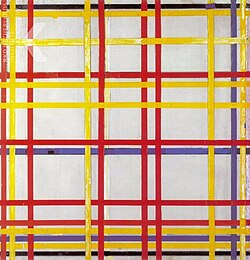
New York City as exhibited (upside-down)

New York City in the intended orientation


When both orientations are valid
[edit]

Some works display rotational symmetry or are ambiguous figures that allow both orientations to be meaningful.
Giuseppe Arcimboldo painted several works that are still lifes in one orientation and related portraits in the other.
- Spolia (fragments of sculpture and architecture recycled in new buildings) may not be in the original orientation for ideological or pragmatical reasons. An example is the blocks in the shape of a Medusa head reused as column bases in the Basilica Cistern of Constantinople.
- Pittura infamante, a genre depicting enemies hanging from their feet.
- Aerial landscape art – Visual art depicting the appearance of a landscape as viewed from an aircraft or spacecraft
- 🔝, a symbol to show the top side of an object.
- Denny Dent, an artist who sometimes painted upside-down portraits on stage before turning the canvas right-side-up for the audience
- ^ “Piet Mondrian artwork displayed upside down for 75 years”. BBC News. October 28, 2022.
- ^ Hülsmeier, dpa, Dorothea (October 27, 2022). “Mondrian: Berühmtes Bild hängt seit Jahrzehnten falsch herum”. Berliner Zeitung.
- ^ “Allemagne : le tableau “New York City 1″ du peintre Piet Mondrian accroché à l’envers depuis 77 ans”. Franceinfo. October 30, 2022.
- ^ “Seit Jahrzehnten: Mondrian-Bild hängt auf dem Kopf”. www.zdf.de.
- ^ “Mondrian painting has been hanging upside down for 75 years”. the Guardian. October 28, 2022.
- ^ “Piet Mondrian artwork New York City I hung upside down for 75 years”. Sky News.
- ^ “Piet Mondrian’s Painting Has Been Displayed Upside Down for 75 Years”. Town & Country. October 28, 2022.
- ^ a b c d e f Gómez Ruiz, Lara (2 November 2022). “Este cuadro está del revés: Mondrian, Matisse y otros artistas con obras que fueron mal colgadas”. La Vanguardia (in Spanish). Retrieved 2 November 2022.
- ^ Robertson, Nan. “Modern Museum Is Startled by Matisse Picture” The New York Times, December 5, 1961
- ^ Gohr, Siegfried. “Georg Baselitz. Kunst als Akt des Schaffens und Zerstörens. In: Detlef Bluemler”. Künstler – Kritisches Lexikon der Gegenwartskunst. 18: 3ff.
- ^ Calvocoressi, Richard (1985). “A Source for the Inverted Imagery in Georg Baselitz’s Painting”. The Burlington Magazine. 127 (993): 894–899. JSTOR 882264.

