
== Origins and pre-bishopric life ==<!—
== Origins and pre-bishopric life ==<!—
[[File:Johanniskirche in Mainz.jpg|thumb|[[Église Saint-Jean (Mayence)|Saint-Jean Baptiste]], Guillaume III fut d’abord prévôt de la Collégiale Saint-Jean-Baptiste à Mayence]]
[[File:Johanniskirche in Mainz.jpg|thumb|[[Église Saint-Jean (Mayence)|Saint-Jean Baptiste]], Guillaume III fut d’abord prévôt de la Collégiale Saint-Jean-Baptiste à Mayence]]
[[Fichier:A canon In Winter-dress II.JPG|thumb|Guillaume III fut chanoine séculier avant son épiscopat. Habit du chanoine avec la barrette.]]
[[:A canon In Winter-dress II.JPG|thumb| .]]
Guillaume est originaire d’une famille noble de [[Thuringe]]. Son père était Ernest IV, comte de Hohnstein (* 1440; † 1508), sa mère Anna-Margaretha von Gera<ref name=”Gloeckler344″>{{Harv|Glöckler|1879|p=344}}.</ref>.
[[]]. Ernest IV, Hohnstein (1440 1508) Anna-Margaretha von Gera<ref name=”Gloeckler344″>{{Harv|Glöckler|1879|p=344}}.</ref>.
Son grand-père était Heinrich XI le Téméraire (* 1402; † 1454) qui a épousé la comtesse Margareta von Waldeck.
Par manque de descendance mâle, le titre de comte de Hohnstein est passé à d’autres maisons dynastiques comme les [[Roi de Prusse|rois de Prusse]]<ref group=”N”>Informations généalogiques issues de la page allemande sur les {{lien|lang=de|trad=Hohnstein (Adelsgeschlecht)|fr=Maison d’Hohnstein|texte=Hohnstein}}.</ref>.
Son demi-frère François de Hohnstein, issu d’un second mariage de leur père Ernest IV, comte de Hohnstein et seigneur de Lohra et Klettenburg, est [[chanoine]] capitulaire de Strasbourg et [[prévôt (religion)|prévôt]] à Saverne en 1512.
==Episcopate==
Guillaume a fait ses études aux universités de [[Université de Fribourg-en-Brisgau|Fribourg]] et de [[Université de Pavie|Pavie]].
===Election and consecration===
On 9 October 1505 he was unanimously elected by the capitulary canons after the preaching of [[Johann Geiler von Kaysersberg|Jean Geiler]]. The election was confirmed by [[Pope Julius II]] on 4 December 1506, despite his only being a [[subdeacon]] at the time. By then he was Lord of Lohra and Klettenburg.<ref name=”Gloeckler345″>{{Harv|Glöckler|1879|p=345}}.</ref>
He was ordained a priest in Saverne on 28 February 1507 and consecrated bishop on the fourth Sunday of Lent in the choir of [[Strasbourg Cathedral]] by Ernest, [[archbishop of Magdeburg]], [[Duke of Saxony]] and primate of Germany, assisted by Konrad Wickram, titular bishop of Speyer, and Johann Ortwin, titular bishop of Strasbourg.<ref name=”Gloeckler345″ /> [[Maximilian I, Holy Roman Emperor|]]’s twentieth stay in Strasbourg lasted from 1492 to 1511 and so he also assisted at the consecration ceremony, since he was then in residence at the [[Knights Hospitaller]] convent there.<ref name=”Gloeckler345″ /> Two days later Maximilian invested Wilhelm as a [[Prince of the Empire]] in [[Haguenau]].<ref name=”Gloeckler346″>{{Harv|Glöckler|1879|p=346}}</ref>
Guillaume était [[chanoine]] de [[Cologne]] et de [[Mayence]] (1482-1488), de Strasbourg (1488 – 1506), [[custode (liturgie)|custode]] de Strasbourg et prévôt de la [[collégiale]] de [[Église Saint-Jean (Mayence)|Saint-Jean-Baptiste]] à Mayence (1499-1507), prévôt de [[Sondershausen|Jechaburg]]<ref group=”N “>Jechaburg et aujourd’hui un quartier de [[Sondershausen]], l’église est dorénavant protestante</ref> en 1505 lorsqu’il fut élu par les chanoines capitulaires le {{date-|9 octobre}} à l’unanimité des voix après le prêche de [[Geiler de Kaysersberg|Jean Geiler]]. Le pape Jules II confirma l’élection de Guillaume le {{date-|4 décembre 1506}}.
Guillaume de Honstein, seigneur de Lohra et Klettenburg<ref name=”Gloeckler345″>{{Harv|Glöckler|1879|p=345}}.</ref>, était juste sous-diacre lorsqu’il fut élu. Le {{date-|28 février 1507}}, il reçut l’ordination sacerdotale à [[Saverne]] et la consécration épiscopale le quatrième dimanche du carême dans le cœur de la cathédrale de Strasbourg des mains de l’archevêque de [[Magdebourg]], Ernest, duc de Saxe et primat de Germanie, assisté par l’évêque de [[Coire]] et les évêques titulaires de Spire, Konrad Wickram, et Strasbourg, Johann Ortwin<ref name=”Gloeckler345″ />.
L’empereur [[Maximilien Ier (empereur des Romains)|Maximilien {{Ier}}]], qui séjourna une vingtaine de fois à Strasbourg de 1492 à 1511, assista à la cérémonie puisqu’il résidait à ce moment-là au couvent de l'[[ordre de Saint-Jean de Jérusalem]]<ref name=”Gloeckler345″ />. Deux jours plus tard, l’empereur conféra à Guillaume dans la ville de [[Haguenau]] tous les insignes de Prince d’empire le {{date-|16 mars 1507}}<ref name=”Gloeckler346″>{{Harv|Glöckler|1879|p=346}}</ref>.
—>
== Major events during his episcopate ==
== Major events during his episcopate ==
<!—
<!—

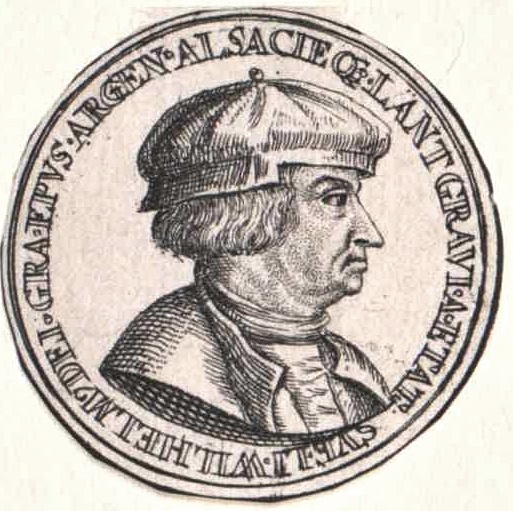
Wilhelm von Hohnstein or Honstein (1466 – 29 June 1541) was prince bishop of Strasbourg from 1506 to 1541 under Maximilian I and Charles V and the papacies of Julius II, Leo X, Adrian VI, Clement VII and Paul III. He was assisted by a titular bishop, initially Johann Ortwin bishop of Mathones, then Konrad Wickgram bishop of Dunes.[1]
His episcopate, like that of his successor, was very representative of the medieval and modern history of Alsace and Strasbourg, in illustrating the complex mechanisms of Holy Roman Empire‘s geopolitics in a troubled era marked by the arrival of the Protestant Reformation, the Alsace anchorage’s place in a then largely German-speaking Rhine basin, and tensions between Strasbourg (a multiconfessional and multicultural free imperial city) and the prince bishopric deep in Lower Alsace with a diocese which formerly extended beyond the modern-day frontiers of Alsace and France.
Wilhelm and his brother Francis originated in Thuringia, showing how the influence of the chapters, collegiate churches and cathedrals of Strasbourg extended beyond its region, with the city’s nobles proud of being prebendary canons like the chapters in Cologne, Speyer, Worms, Mainz and Bamberg. Very many major clerics, reformers and politicians in Strasbourg under Wilhelm did not come from Strasbourg or Alsace but a larger interconnected territory between Lorraine and Swabia and between the Rhineland and Switzerland. Despite their diverse origins, several major figures in 16th century Strasbourg’s political and theological life totally identified themselves with that city’s future, meaning their lives are more often linked to the history of Strasbourg than of the city where they were born – Wilhelm himself is one example, as are the Erasmus of Strasbourg from Franconia, Jean Sturm from Westphalia, Nicolas Gerbel and Christophe Welsinger from Baden and Johannes Sleidanus from Luxembourg.

Origins and pre-bishopric life
[edit]
Solemn entry into Strasbourg
[edit]
Delegations and people in the procession
[edit]
Peasants’ War or the Bundschuh Uprising
[edit]
Disagreements within Protestantism
[edit]
Epitaph of the two counts of Hohnstein in the collegial church at Saverne
[edit]
- ^ (in German) Glöckler, Ludwig Gabriel (1879). Geschichte des Bistums Straßburg (in German). Strasbourg: Druck Le Roux. p. 344-385..

