
==”Trust No One” vs ”Ace of Spies” narrative==
==”Trust No One” vs ”Ace of Spies” narrative==
Robin Bruce Lockharts book ”Reilly: Ace of Spies” and the 1983 television adaptation fixed a heroic, proto-[[James Bond|Bond]] archetype that emphasized singular brilliance, clean loyalties, and glamour. Spences study counters that frame by documenting Reilly primarily as a diplomatic businessman and arms broker who kept a foot in multiple camps and built access through commerce as much as through espionage. The contrast pivots on method and evidence. Lockhart popularized a romance of mastery and daring, while Spence uses archival records to recast motive, risk, and payoff around opportunism, transactional relationships, and self promotion.<ref name=Lume>{{cite web |title=Reilly: Ace of Spies |url=https://www.lumebooks.co.uk/book/reilly-ace-of-spies/ |website=Lume Books |access-date=October 7, 2025}}</ref><ref name=PBS>{{cite web |title=Reilly Ace of Spies |url=https://www.pbs.org/show/reilly-ace-spies/ |website=PBS |access-date=October 7, 2025}}</ref><ref name=PW/><ref name=SP>{{cite web |title=Book Review: Trust No One The Secret World of Sidney Reilly |url=https://www.strategypage.com/bookreviews/186 |website=StrategyPage |access-date=October 7, 2025}}</ref>
Robin Bruce Lockharts book ”Reilly: Ace of Spies” and the 1983 television adaptation a heroic, proto-[[James Bond|Bond]] archetype that emphasized singular brilliance, clean loyalties, and glamour. study counters that frame by documenting Reilly primarily as a diplomatic businessman and arms broker who kept a foot in multiple camps and built access through commerce as much as through espionage and . Lockhart popularized a romance of mastery and daring, while Spence uses archival records to recast motive, risk, and payoff around opportunism, transactional relationships, and self promotion.<ref name=Lume>{{cite web |title=Reilly: Ace of Spies |url=https://www.lumebooks.co.uk/book/reilly-ace-of-spies/ |website=Lume Books |access-date=October 7, 2025}}</ref><ref name=PBS>{{cite web |title=Reilly Ace of Spies |url=https://www.pbs.org/show/reilly-ace-spies/ |website=PBS |access-date=October 7, 2025}}</ref><ref name=PW/><ref name=SP>{{cite web |title=Book Review: Trust No One The Secret World of Sidney Reilly |url=https://www.strategypage.com/bookreviews/186 |website=StrategyPage |access-date=October 7, 2025}}</ref>
Specific claims long repeated in ”Ace of Spies” style retellings are pared back or rejected when set against documents. [[Richard B. Spence|Spence]] shows that [[Sidney Reilly|Reilly’s]] oft quoted origin tale about arriving in England from service in Brazil was a fabrication, a case where his own autobiographical version collides with records. He also demonstrates that Reilly’s boast about donating most of his fortune to [[Boris Savinkov]] was false, and that his business conduct included short shipments and diversions of goods to Germany, outcomes preserved in the paper trail of wartime contracting. The book further replaces tidy career timelines with conflicting dates for Reilly’s entry into the [[Royal Flying Corps]] and [[Secret Intelligence Service|SIS]], and it treats his multiple marriages as real yet imprecisely countable events in a life that multiplied identities and legal exposures. The cumulative effect reduces the heroic coherence projected by [[Robin Bruce Lockhart|Lockhart]] and substitutes a pattern of profit seeking and improvisation anchored in verifiable transactions.<ref name=CIA47/>
[[Richard B. Spence|Spence]] shows that [[Sidney Reilly|Reilly’s]] oft quoted origin tale about arriving in England from service in Brazil was a fabrication. He also demonstrates that Reilly’s boast about donating most of his fortune to [[Boris Savinkov]] was false, and that his business conduct included short shipments and diversions of goods to Germany, preserved in the paper trail of wartime contracting. The book further replaces tidy career timelines with conflicting dates for Reilly’s entry into the [[Royal Flying Corps]] and [[Secret Intelligence Service|SIS]], and it treats his multiple marriages as real yet imprecisely countable events in a life that multiplied identities and legal exposures. The cumulative effect reduces the heroic coherence projected by [[Robin Bruce Lockhart|Lockhart]] and substitutes a pattern of profit seeking and improvisation anchored in verifiable transactions.<ref name=CIA47/>
When reviewing Reilly’s execution in 1925, [[Richard B. Spence|Spence]] tackles head-on what he calls “the most enduring mystery” of Reilly’s story. Instead of indulging in speculation, he plainly presents the documented facts: Reilly’s capture, questioning, and execution by Soviet authorities. While he acknowledges the many reported sightings that followed, he treats these as interesting footnotes rather than evidence of a daring escape. This marks a significant departure from the ”Ace of Spies” tradition, which often embraced dramatic rumors in the absence of solid proof.<ref name=CIA47/>
[[Richard B. Spence|Spence]] repeatedly tests celebrated episodes against files and leaves them unresolved when the record is inconclusive. ”[[Publishers Weekly]]” noted the books reliance on newly released Russian and British material and its refusal to force certainty, a stance that undercuts legend by shrinking narrative space for unverified exploits tied to the ”Ace of Spies” image. That editorial line demystifies by weighting probative documents over anecdote and by foregrounding ambiguity where sources break or contradict one another.<ref name=PW/><ref name=Feral/>
[[Richard B. Spence|Spence’s]] closing treatment of 1925 confronts the most persistent myth directly. He presents the capture, interrogation, and shooting in Soviet custody as the documentary endpoint, then catalogs later sightings as postscript rather than rescue plot, a framing that strips the survival legend of probative status while recording its circulation. The result preserves what can be evidenced and quarantines rumor, which reverses the logic of the ”Ace of Spies” narrative that long preferred rumor when records were sparse.<ref name=CIA47/>
==Reception==
==Reception==
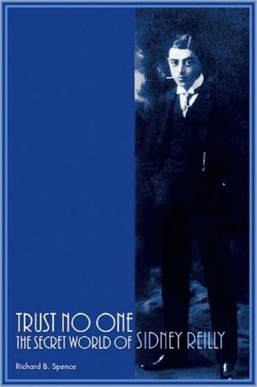
2002 biography of Sidney Reilly by Richard B. Spence

First edition cover |
|
| Author | Richard B. Spence |
|---|---|
| Language | English |
| Subject | Biography, espionage |
| Genre | Nonfiction |
| Publisher | Feral House |
|
Publication date |
November 2002 |
| Publication place | United States |
| Media type | |
| Pages | 544 |
| ISBN | 0-922915-79-2 |
| OCLC | 51111112 |
Trust No One: The Secret World of Sidney Reilly is a 2002 biography of the intelligence operative Sidney Reilly by historian Richard B. Spence. The book was published in hardcover by Feral House and draws on British and Russian intelligence records, photographs, and other archival sources to reconstruct Reilly’s career and reassess his reputation.[1][2]
Approach and sources
[edit]
Spence uses newly available files from British and Russian intelligence repositories, contemporary press, private papers, and business records. The publisher characterizes the work as correcting decades of disinformation around Reillys story.[1] Publishers Weekly notes Spences use of newly released archival material and describes Reilly as a globe traveling broker of information and arms whose activities spanned multiple camps and interests.[3] A CIA Studies in Intelligence bookshelf entry describes the work as a “bewildering mix” of “names, dates and events” that reveals “how little is reliably known” about Reilly, noting that his life remains “shrouded in mystery” from beginning to end. The review highlights the books closing survey of reported post 1925 sightings.[4]
Trust No One vs Ace of Spies narrative
[edit]
Robin Bruce Lockharts book Reilly: Ace of Spies and the 1983 television adaptation casts a heroic, proto-Bond archetype that emphasized singular brilliance, clean loyalties, and glamour. In contrast, Spence’s study counters that frame by documenting Reilly primarily as a diplomatic businessman and arms broker who kept a foot in multiple camps and built access through commerce as much as through espionage through methodical evidence review, including newly uncovered Russian and British documents.[1] Lockhart popularized a romance of mastery and daring, while Spence uses archival records to recast motive, risk, and payoff around opportunism, transactional relationships, and self promotion.[5][6][3][7]
Spence shows that Reilly’s oft quoted origin tale about arriving in England from service in Brazil was a fabrication. He also demonstrates that Reilly’s boast about donating most of his fortune to Boris Savinkov was false, and that his business conduct included short shipments and diversions of goods to Germany, operations preserved in the paper trail of wartime contracting. The book further replaces tidy career timelines with conflicting dates for Reilly’s entry into the Royal Flying Corps and SIS, and it treats his multiple marriages as real yet imprecisely countable events in a life that multiplied identities and legal exposures. The cumulative effect reduces the heroic coherence projected by Lockhart and substitutes a pattern of profit seeking and improvisation anchored in verifiable transactions.[4]
When reviewing Reilly’s execution in 1925, Spence tackles head-on what he calls “the most enduring mystery” of Reilly’s story. Instead of indulging in speculation, he plainly presents the documented facts: Reilly’s capture, questioning, and execution by Soviet authorities. While he acknowledges the many reported sightings that followed, he treats these as interesting footnotes rather than evidence of a daring escape. This marks a significant departure from the Ace of Spies tradition, which often embraced dramatic rumors in the absence of solid proof.[4]
Publishers Weekly reviewed the book positively for its research depth and geographic range, while observing that its density and multiple aliases can challenge readers. The review notes that the narrative often resists certainty where only conjecture is possible.[3] The CIA Studies in Intelligence bookshelf cites the books value in aligning legend with documentation and remarks on the extensive treatment of claimed post execution sightings.[4] Lobster highlighted the books research apparatus, pointing to more than 1,800 footnotes and a large bibliography.[8] A military history oriented review praised Spence’s archival work and his reassessment of stories that earlier writers accepted from Reillys own accounts.[7]
Writing in History: Reviews of New Books, David Alvarez found that despite Spence’s extensive research drawing on newly declassified British and Russian intelligence files, the biography was “exhaustive in its scope, but also exhausting in its impact on the reader.” He criticized that “no event is too marginal, no character too minor, no connection too tenuous, no explanation too improbable to escape inclusion in the story” with details accumulating “with little attempt to discriminate between the true and the false, the likely and the unlikely, the important and the unimportant.” Alvarez concluded that many of the book’s “elaborate discussions and important assertions at times rest on flimsy evidence or assumptions that are, at best, little more than speculation” and correctly suggested, as noted in its appearance on CIA reading lists, the book would likely appeal mainly to “specialists in intelligence history.”[9]
Reilly, Ace of Spies, Robin Bruce Lockharts 1967 book that shaped popular depictions of Reilly and was adapted for television in 1983.[5]
- ^ a b c “Trust No One”. Feral House. Retrieved October 7, 2025.
- ^ “Trust no one: the secret world of Sidney Reilly”. WorldCat. OCLC. Retrieved October 7, 2025.
- ^ a b c “Trust No One: The Secret World of Sidney Reilly”. Publishers Weekly. October 28, 2002. Retrieved October 7, 2025.
- ^ a b c d “The Intelligence Officers Bookshelf, Vol. 47 No. 3” (PDF) (PDF). Center for the Study of Intelligence. Retrieved October 7, 2025.
- ^ a b “Reilly: Ace of Spies”. Lume Books. Retrieved October 7, 2025.
- ^ “Reilly Ace of Spies”. PBS. Retrieved October 7, 2025.
- ^ a b “Book Review: Trust No One The Secret World of Sidney Reilly”. StrategyPage. Retrieved October 7, 2025.
- ^ “Trust no one: the secret world of Sidney Reilly”. Lobster. Summer 2003. Retrieved October 7, 2025.
- ^ Alvarez, David (2003). “Trust No One: The Secret World of Sidney Reilly”. History: Reviews of New Books. 31 (2): 110. doi:10.1080/03612759.2003.10527573. Retrieved October 7, 2025.

