
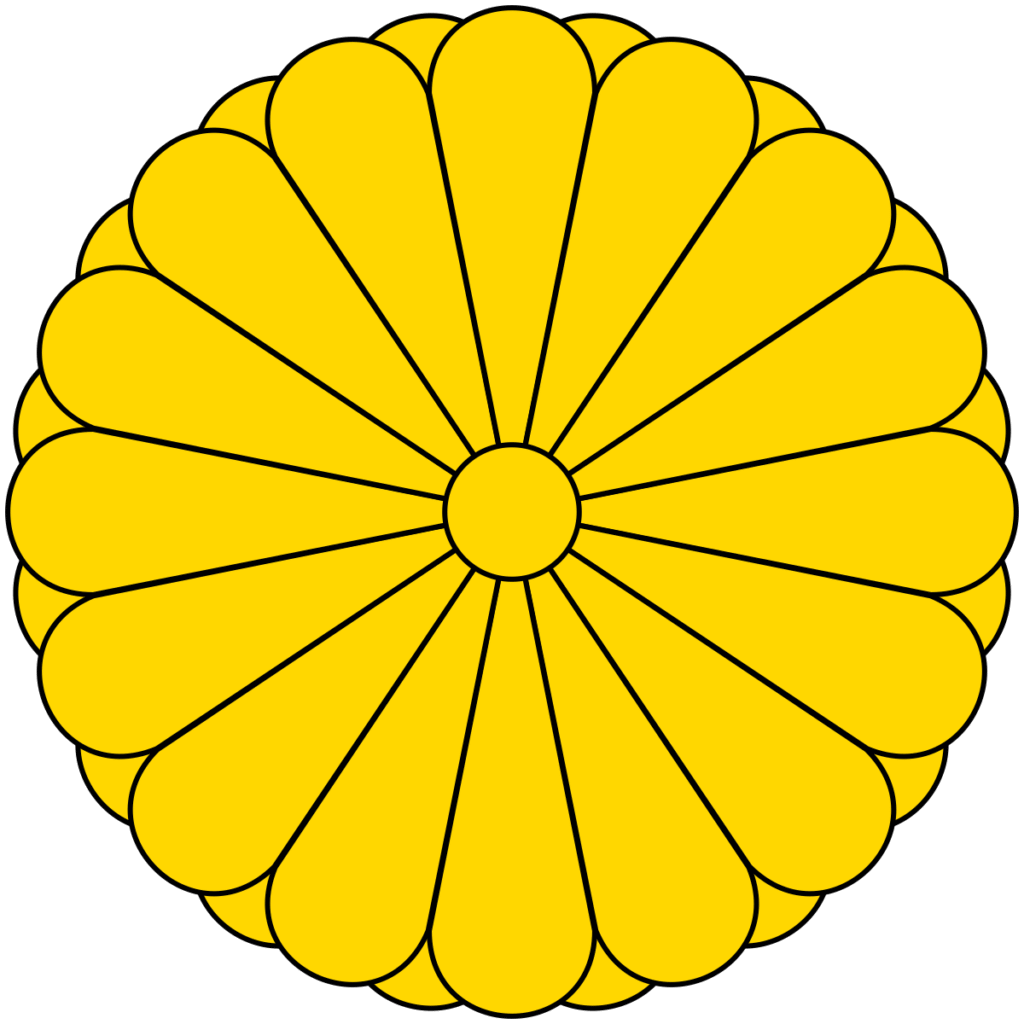
The imperial crest of Japan, most commonly known in English and Japanese as the chrysanthemum crest (菊紋, kikumon), and also known as the chrysanthemum flower crest (菊花紋, 菊花紋章, kikukamon, kikukamonshō), imperial chrysanthemum crest (菊の御紋, kikunogomon), and less commonly the imperial emblem or imperial seal[a] is the mon used by the emperor of Japan and members of the Imperial Family.
It is one of the national emblems of Japan and is used in a manner similar to a national coat of arms of Japan, e.g., on Japanese passports. The Japanese government uses a different emblem, the Paulownia crest.
During the Meiji period (1868–1912), no one was permitted to use the imperial crest except the Emperor of Japan, who used a 16-petalled chrysanthemum with sixteen tips of another row of petals showing behind the first row. Therefore, each member of the Imperial family used a slightly modified version of the seal. Shinto shrines either displayed the imperial seal or incorporated elements of the seal into their own tag.
Earlier in Japanese history, when Emperor Go-Daigo, who tried to break the power of the shogunate in 1333, was exiled, he adopted the seventeen-petalled chrysanthemum in order to differentiate himself from the Northern Court’s Emperor Kōgon, who kept the imperial 16-petalled mon.[citation needed]

The symbol is a yellow or orange chrysanthemum with black or red outlines and background. A central disc is surrounded by a front set of 16 petals. A rear set of 16 petals are half staggered in relation to the front set and are visible at the edges of the flower. An example of the chrysanthemum being used is in the badge for the Order of the Chrysanthemum.
Other members of the Imperial Family use a version with 14 single petals, while a form with 16 single petals is used for orders, passports, Diet members’ pins, and other items that carry or represent the authority of the Emperor. The Imperial crest is also used on the standards of the Imperial Family.[1]
- ^ Despite this name, which is used only in English, it is not a seal and should not be confused with the Privy Seal of Japan or State Seal of Japan, which are both also occasionally described as the imperial seal
- ^
“皇室儀制令(1926〔大正15〕皇室令第7号)” [Imperial Household Ceremonial Regulations (Year 1926 or the Year 15 of the Taishō era) Imperial Ordinance 7] (in Japanese). Archived from the original on August 9, 2007.
-

Media related to Imperial seals of Japan at Wikimedia Commons

