
Content deleted Content added
|
|
|||
| Line 35: | Line 35: | ||
|
== Gallery == |
== Gallery == |
||
|
<gallery> |
|||
|
|
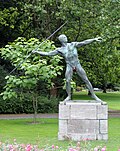
File:Skulptur Bundesallee 162 (Wilmd) Speerwerfer Karl Möbius 1921.jpg | thumb | The ”Speerwerfer” (1921/1954) by Karl Möbius near Bundesallee. |
||
|
|
File:Dovecote in Volkspark Wilmersdorf Berlin-Wilmersdorf with snow 2025-02-14 01.jpg | thumb | Dovecote in the park in winter, 2025. |
||
|
</gallery> |
|||
|
== References == |
== References == |
||
Latest revision as of 08:48, 11 October 2025
Public park in Berlin, Germany
Volkspark Wilmersdorf is a public park in the Charlottenburg-Wilmersdorf borough of Berlin, Germany. Together with the adjacent Rudolph Wilde Park in Tempelhof-Schöneberg, it forms a linear green corridor about 2.5 km (1.6 mi) long and roughly 150 m (490 ft) wide across south-western Berlin.[3][4] The Wilmersdorf section covers about 12.3 ha (30 acres) and includes the elongated Fennsee at its western end as well as sports fields near Bundesallee.[1][2]
Plans for a “Seepark” (lake park) in the low lying glacial channel were pursued from the late 19th century and placed under the direction of municipal head gardener Richard Thieme in 1904.[3] Construction progressed in stages: parts were laid out in 1912/13; further sections were built up to 1920 and, after redesign, between 1933 and 1936.[2] The former Wilmersdorfer See, once used for bathing, silted up and was finally filled in during the early 1920s; the area later hosted sports grounds.[4]
During the interwar and Nazi era, the park was commonly referred to as Hindenburgpark. Contemporary plans and municipal materials from the 1920s–30s use that name,[5] as well as the annual report of the Städtische Oberrealschule am Hindenburgpark (Municipal Upper Secondary School from the Hindenburg park), in 1933/34.[6]
Layout and features
[edit]
The park consists of three sections divided by major streets. East of Bundesallee, the oldest part (1912/13) follows Thieme’s landscape design and includes large lawns, plantings and a major playground near the former RIAS building (today Deutschlandradio).[2][3] A bright yellow pedestrian bridge, the Volksparksteg, completed in 1971, crosses Bundesallee and links the eastern and central parts.[3] The central section contains sports fields on the site of the former lake, and the western section is arranged around the elongated Fennsee.[2]
Near the Volksparksteg stands the Speerwerfer (Javelin Thrower), a bronze statue by Karl Möbius dated 1921; the original was melted down in 1944 and a new cast was erected on the same spot in 1954.[2][7] Other works in and around the park include the Sonnenuhr (1970) by Alfred Trenkel at Blissestraße and the sculpture Das Ding (1968) by Susanne Riée near Uhlandstraße.[8]
The continuous green corridor is popular with walkers and runnerssince it is a roughly 2.5 km (1.6 mi) “green band” traversing two districts.[4][9] Facilities include playgrounds, table-tennis tables, lawns and ball courts; a new themed “Zauberspielplatz” (magic playground) opened in May 2024 after refurbishment.[10] In February 2025, glass shards were found and the playground was temporarily closed and then reopened after cleaning, according to district and press reports.[11][12][13]
-

The Speerwerfer (1921/1954) by Karl Möbius near Bundesallee.
-

Dovecote in the park in winter, 2025.
_Speerwerfer_Karl_M%C3%B6bius_1921.jpg)

- Official page at the borough website (in German):

