
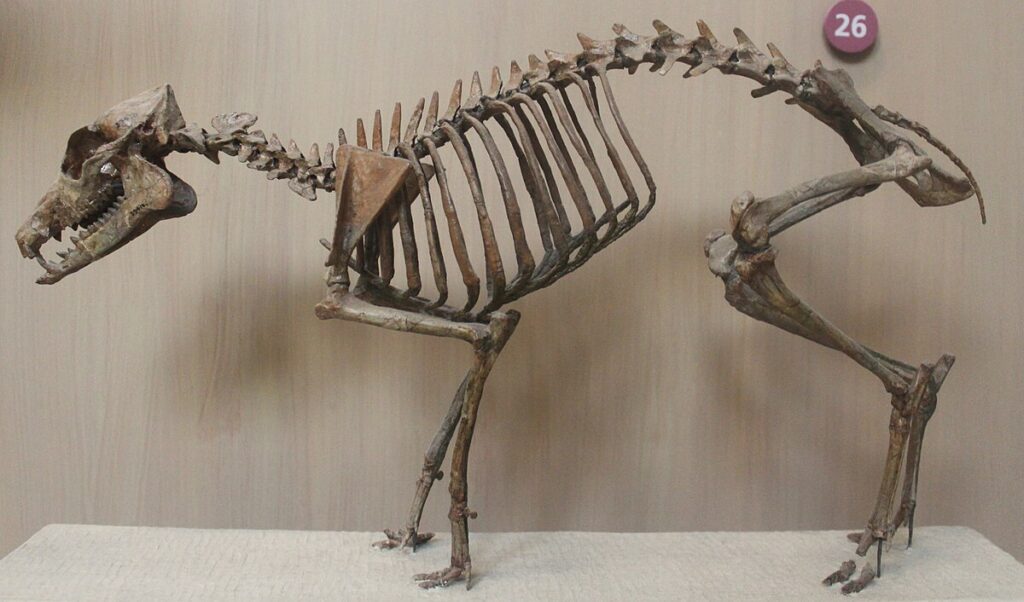
Created a section on this hypertragulid's ecology.
| ← Previous revision | Revision as of 17:33, 11 October 2025 | ||
| Line 14: | Line 14: | ||
|
}}
|
}}
|
||
|
””’Hypertragulus””’ is an extinct genus of [[Hypertragulidae|hypertragulid]] ruminant endemic to [[North America]]. It lived from the
|
””’Hypertragulus””’ is an extinct genus of [[Hypertragulidae|hypertragulid]] ruminant endemic to [[North America]]. It lived from the [[Eocene]] to the [[Miocene]], living {{Ma|37.2|16.0}}, existing for approximately {{Mya|37.2-16|million years}}.<ref>[https://paleobiodb.org/classic/checkTaxonInfo?taxon_no=42591 PaleoBiology Database: ”Hypertragulus”]</ref>
|
||
|
”Hypertragulus” were primitive and ancient [[ruminant]]s, resembling small [[deer]] or [[musk deer]], although they were more closely related to modern [[chevrotain]]s. Its diet is stated{{by whom|date=April 2019}} to be that of a [[frugivore]].
|
”Hypertragulus” were primitive and ancient [[ruminant]]s, resembling small [[deer]] or [[musk deer]], although they were more closely related to modern [[chevrotain]]s. Its diet is stated{{by whom|date=April 2019}} to be that of a [[frugivore]].
|
||
| Line 38: | Line 38: | ||
|
*[[Upper Pomerado Conglomerate Formation]], [[San Diego County, California]]
|
*[[Upper Pomerado Conglomerate Formation]], [[San Diego County, California]]
|
||
|
*[[Turtle Cove Member of the John Day Formation]], [[Grant County, Oregon]]
|
*[[Turtle Cove Member of the John Day Formation]], [[Grant County, Oregon]]
|
||
|
== Palaeoecology ==
|
|||
|
Because its [[Fossil|fossils]] are found predominantly in [[Semi-arid climate|semiarid]] [[Paleosol|palaeosols]], it is believed that ”Hypertragulus hesperius” primarily inhabited semiarid [[Biome|biomes]].<ref>{{Cite journal |last=Retallack |first=Gregory J. |last2=Samuels |first2=Joshua X. |date=2 January 2020 |title=Paleosol-based inference of niches for Oligocene and early miocene fossils from the John Day Formation of Oregon |url=https://www.tandfonline.com/doi/full/10.1080/02724634.2019.1761823#abstract |journal=[[Journal of Vertebrate Paleontology]] |language=en |volume=40 |issue=1 |pages=e1761823 |doi=10.1080/02724634.2019.1761823 |issn=0272-4634 |access-date=12 October 2025 |via=Taylor and Francis Online}}</ref>
|
|||
|
==References==
|
==References==
|
||

