
== Authorship ==
== Authorship ==
Scholars hold differing views on the authorship and date of composition of ”al-Ibana”. Some suggest that al-Ashari wrote the work immediately after his separation from the [[Mu’tazilism]], while others believe it was produced toward the end of his life. Fawkiyya Husayn Mahmud argued that the book was written during the early stage of his transition as a declaration of his affiliation with the [[Sunni Islam|Sunni]] school. Bekir Topaloglu and Hammuda Zeki Ghuraba also considered ”al-Ibana” earlier than [[Al-Luma|”al-Luma”]], which reflects a continuation of the kalam method. Hikmet Yagli Mavil (2016) similarly concluded that ”al-Ibana” preceded ”al-Luma”, though neither represented al-Ashari’s final work.
According to Ayetullah Ugurlu, in his master’s thesis, ”al-Ibana” was a direct result of al-Ashari’s separation from the Mu’tazilism. Ugurlu described it as both a statement of his new theological position and a rational response to his previous school of thought. Although the political conditions of the period and the decline of Mu’tazilism influence may have shaped the background, Ugurlu found no evidence that al-Ashari’s transformation was politically motivated. Despite some alignment with [[Atharism|Hanbali]] doctrines, al-Ashari was criticized by Hanbalis for continuing to use the kalam method. Ugurlu interpreted ”al-Ibana” as a representation of al-Ashari’s intellectual renewal and as a synthesis between Mutazilite rationalism and Hanbali traditionalism, marking an early stage in the formation of [[Ash’arism|Ash’arite theology]].
Other scholars, including [[Duncan Black MacDonald]], [[Arthur Stanley Tritton]], and [[Ignác Goldziher|Ignac Goldziher]], proposed that ”al-Luma” was written earlier, soon after al-Ashari left the Mutazila, when his views still contained rationalist elements, and that ”al-Ibana” was composed later in accordance with a more traditionalist orientation.
== Chapters ==
== Chapters ==
Book by al-Ash’ari
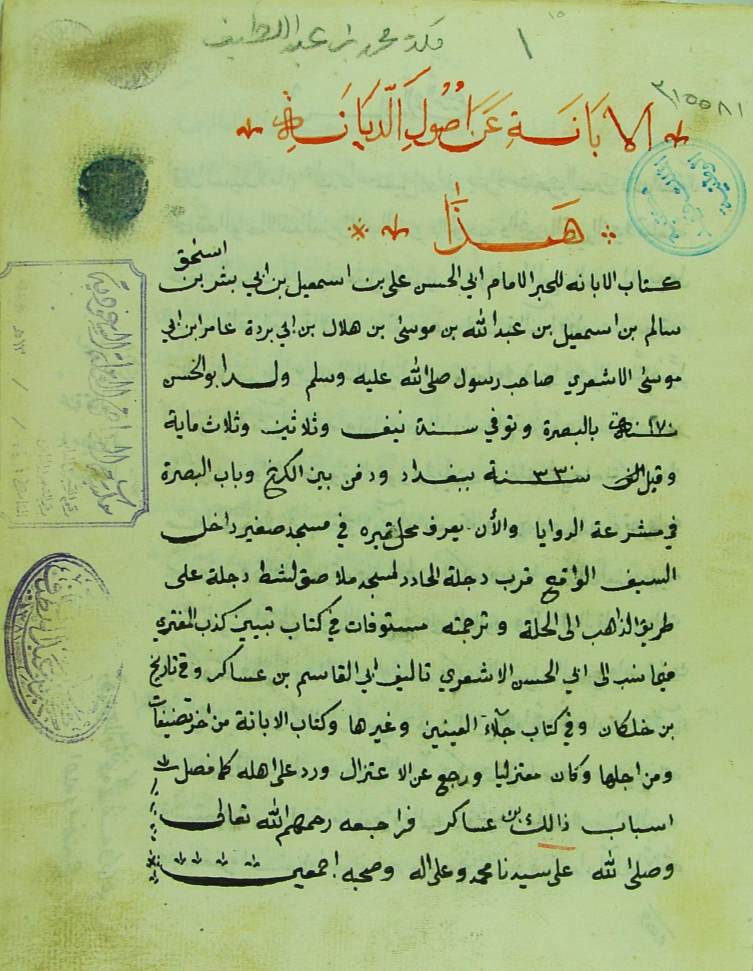
Al-Ibana an Usul al-Diyana (Arabic: الإبانة عن أصول الديانة), or simply Al-Ibana, is a 10th-century theological work attributed to Abu al-Hasan al-Ash’ari, the founder of the Ash’ari school. Scholars debate both its authorship and timing, as the book follows a traditional approach rather than the Ash’ari kalam method. Some suggest it was written soon after al-Ash’ari left the Mu’tazilism, representing a new declaration, while others argue it was composed later in his life, possibly showing a shift from his established kalam method. Due to these uncertainties, a few scholars even question whether al-Ash’ari himself wrote the book.
Authorship
Scholars hold differing views on the authorship and date of composition of al-Ibana. Some suggest that al-Ashari wrote the work immediately after his separation from the Mu’tazilism, while others believe it was produced toward the end of his life. Fawkiyya Husayn Mahmud argued that the book was written during the early stage of his transition as a declaration of his affiliation with the Sunni school. Bekir Topaloglu and Hammuda Zeki Ghuraba also considered al-Ibana earlier than al-Luma, which reflects a continuation of the kalam method. Hikmet Yagli Mavil (2016) similarly concluded that al-Ibana preceded al-Luma, though neither represented al-Ashari’s final work.
According to Ayetullah Ugurlu, in his master’s thesis, al-Ibana was a direct result of al-Ashari’s separation from the Mu’tazilism. Ugurlu described it as both a statement of his new theological position and a rational response to his previous school of thought. Although the political conditions of the period and the decline of Mu’tazilism influence may have shaped the background, Ugurlu found no evidence that al-Ashari’s transformation was politically motivated. Despite some alignment with Hanbali doctrines, al-Ashari was criticized by Hanbalis for continuing to use the kalam method. Ugurlu interpreted al-Ibana as a representation of al-Ashari’s intellectual renewal and as a synthesis between Mutazilite rationalism and Hanbali traditionalism, marking an early stage in the formation of Ash’arite theology.
Other scholars, including Duncan Black MacDonald, Arthur Stanley Tritton, and Ignac Goldziher, proposed that al-Luma was written earlier, soon after al-Ashari left the Mutazila, when his views still contained rationalist elements, and that al-Ibana was composed later in accordance with a more traditionalist orientation.
Chapters
The first chapter discusses the seeing of God (ruyat Allah), criticizing the Mu’tazila who deny that God can be seen in Paradise.[1] Chapters two to four focus on the creation of the Quran (khalq al-Quran), proving that the Quran is eternal and not created, refuting the views of the Jahmiyya and Mu’tazila, presenting some opinions of the traditionalist, and emphasizing that even the recitation of the Quran is not created. Chapters five and six examine certain divine attributes mentioned in the texts, such as istiwa, nuzul, maji’, ityan, wajh, ayn, and yad, explaining that these attributes should be accepted as they are without interpreting them anthropomorphically.[1] The seventh chapter deals with the attribute of knowledge (ilm) and the concept of affirmative attributes (sifat al-thubutiyya), showing that groups like the Jahmiyya and Mu’tazila indirectly denied divine attributes. Chapters eight to ten address destiny (qadar), refuting the Mu’tazila’s ideas about God’s will, divine power, grace, guidance, provision, and misguidance, and including relevant hadiths. Chapters eleven to thirteen cover intercession (shafa’a), the Pond (hawd), and punishment of the grave (adhab al-qabr), countering the Mu’tazila’s rejection or limitation of these concepts. The fourteenth chapter discusses leadership (imama), proving the legitimacy of the caliphate of Abu Bakr and the other three caliphs through Quranic indications and consensus, and emphasizing the importance of respecting all the Companions.[1]

