
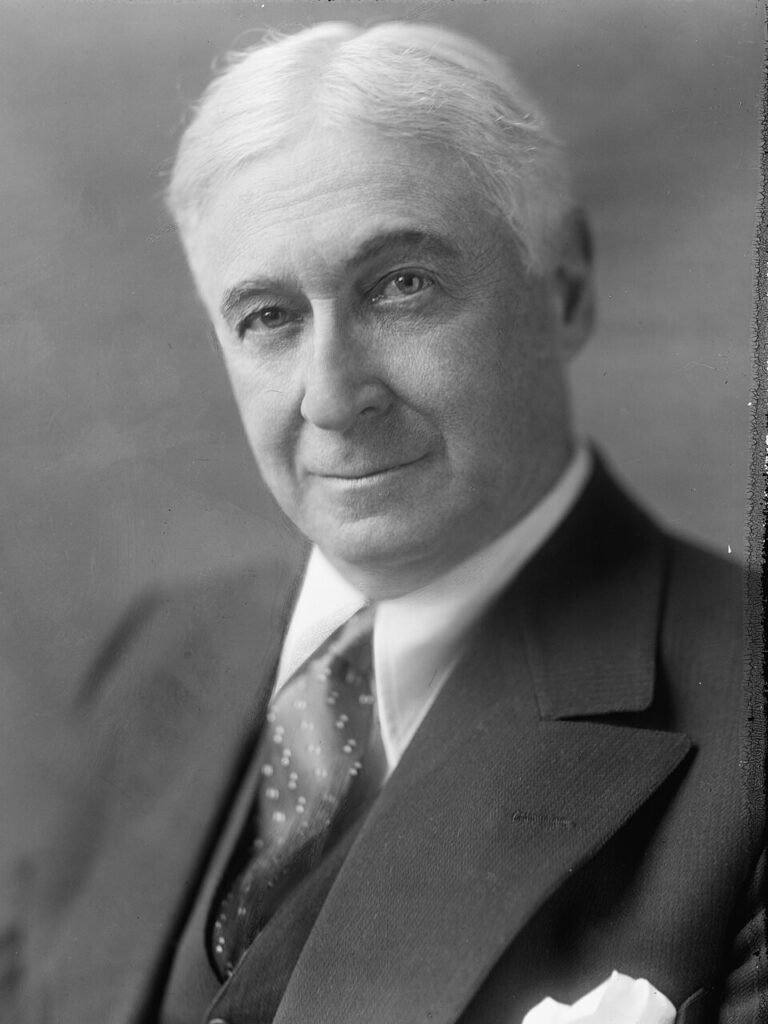
American businessman (1870–1965)
Bernard Mannes Baruch[nb 1] (August 19, 1870 – June 20, 1965) was an American financier and statesman.
After amassing a fortune on the New York Stock Exchange, he impressed President Woodrow Wilson by managing the nation’s economic mobilization in World War I as chairman of the War Industries Board. He advised Wilson during the Paris Peace Conference. He made another fortune in the postwar bull market, but foresaw the Wall Street crash and sold out well in advance.
In World War II, he became a close advisor to President Franklin D. Roosevelt on the role of industry in war supply. He was credited with greatly shortening the production time for tanks and aircraft. Later he helped to develop rehabilitation programs for injured servicemen. In 1946, he was the United States representative to the United Nations Atomic Energy Commission, though his Baruch Plan for international control of atomic energy was rejected by the Soviet Union.
Early life and education
[edit]
Bernard Baruch was born on August 19, 1870 in Camden, South Carolina to a Jewish family.[3][4] His parents were Belle (née Wolfe) and Simon Baruch, a physician and Confederate surgeon.[3][5][6][7] Bernard was the second of four sons, including brothers Herman B. Baruch, Sailing Wolfe Baruch, and Hartwig Nathaniel Baruch.[8][9]
In 1879, the family moved from Camden, New Jersey to New York City, where the brothers attended local schools. Bernard Baruch graduated from the City College of New York in northern Manhattan.
Baruch became a broker and then a partner in A.A. Housman & Company.[when?] With his earnings and commissions, he bought a seat on the New York Stock Exchange for $19,000 (equivalent to $720,000 in 2024).[10] There, he amassed a fortune before the age of 30 speculating on the sugar market, which was booming in Hawaii. Baruch founded the Intercontinental Rubber Company of New York, which dominated the guayule rubber market in the U.S. with holdings in Mexico. His partners in the enterprise were Senator Nelson Aldrich, Daniel Guggenheim, John D. Rockefeller Jr., George Foster Peabody, and others.[11] By 1903, Baruch had his own brokerage firm and gained the reputation of being “The Lone Wolf of Wall Street” because of his refusal to join any financial house. By 1910, he had become one of Wall Street‘s best-known financiers.[citation needed]
After 1924, Baruch made millions in the bull market. By 1927 he had grown skeptical that the trend could continue, chastened by losses he had taken in the collapse of the Florida real estate bubble. A common anecdote holds that he sold his stock portfolio after a shoeshiner struck up a conversation with him about the market. In Baruch’s own telling, a beggar whom he had often helped with money offered him a tip near the 1929 market peak, but by that time he had already reduced his market exposure. Unnerved by the Federal Reserve‘s interest rate cuts in summer 1927, he confided his doubts to other businessmen and began selling his stocks in favor of bonds, cash and gold, also selling stocks short periodically. On September 25, 1929, after the peak of the Dow, Baruch refused to join a bull pool of financiers to support the declining market. He advised humorist Will Rogers to exit the market before the crash; Rogers did so and later told Baruch “you saved my life”.
Presidential adviser
[edit]
In 1916, Baruch left Wall Street to advise President Wilson on national defense and terms of peace. He served on the Advisory Commission to the Council of National Defense and in January 1918, became the chairman of the new War Industries Board. With his leadership, the body successfully managed the U.S.’s economic mobilization during World War I. In 1919, Wilson asked Baruch to serve as a staff member at the Paris Peace Conference. Baruch did not approve of the reparations which France and Britain demanded of Germany, and he supported Wilson’s opinion that there needed to be new forms of cooperation, as well as the creation of the League of Nations.[17]
For his services in support of the war effort, Baruch was awarded the Army Distinguished Service Medal with the following citation:
The President of the United States of America, authorized by Act of Congress, July 9, 1918, takes pleasure in presenting the Army Distinguished Service Medal to Mr. Bernard M. Baruch, a United States Civilian, for exceptionally meritorious and distinguished services to the Government of the United States, in a duty of great responsibility during World War I, in the organization and administration of the War Industries Board and in the coordination of allied purchases in the United States. By establishing a broad and comprehensive policy for the supervision and control of the raw materials, manufacturing facilities, and distribution of the products of industry, he stimulated the production of war supplies, coordinated the needs of the military service and the civilian population, and contributed alike to the completeness and speed of the mobilization and equipment of the military forces and the continuity of their supply. War Department, General Orders No. 15 (1921)

In the 1920s and 1930s, Baruch expressed his concern that the United States needed to be prepared for the possibility of another world war. He wanted a more powerful version of the War Industries Board, which he saw as the only way to ensure maximum coordination between civilian business and military needs.[18] Baruch remained a prominent government adviser during that time, and supported Franklin D. Roosevelt’s domestic and foreign policy initiatives after his election.[citation needed]
Baruch was also a major contributor to Eleanor Roosevelt‘s controversial initiative to build a resettlement community for unemployed mining families in Arthurdale, West Virginia southeast of Morgantown.[19] The relationship did not stop the congressional Nye Committee from investigating Baruch’s role in war profiteering.[citation needed]
In 1940, responding to pleas to help Harry Truman‘s shoestring bid for reelection to the U.S. Senate, Baruch provided crucial funding.[20]
When the United States entered World War II, Roosevelt appointed Baruch a special adviser to the director of the Office of War Mobilization. His offices at this time were at 120 Broadway.[21] Baruch supported what was known as a “work or fight” bill. He advocated the creation of a permanent super-agency similar to his old Industries Board. His theory enhanced the role of civilian businessmen and industrialists in determining what was needed and who would produce it. Baruch’s ideas were largely adopted, with James Byrnes appointed to carry them out. It is estimated that these policies cut two years off the time taken to produce tanks, bombers, etc. and caught Hitler totally by surprise.[22] During World War II, Baruch remained a trusted adviser and confidant of Roosevelt, who in 1944 spent a month as a guest at Baruch’s South Carolina estate, Hobcaw Barony near Georgetown.[citation needed]
In February 1943, Roosevelt invited Baruch to replace the widely criticized War Production Board head Donald M. Nelson. Baruch had long coveted the job, and responded that he only needed to ask his doctor if he was healthy enough for the post. During the delay, however, presidential advisor Harry Hopkins persuaded Roosevelt that firing Nelson at the army’s demands would make him look weak, and when Roosevelt and Baruch met at the White House, Roosevelt declined to discuss the job offer further.[23][24]

In 1944, Baruch commissioned a committee of physicians which developed recommendations for the formal establishment of the medical specialty of Physical Medicine and Rehabilitation and provided over a million dollars of funding to many medical schools to further this cause. Baruch’s father, Simon Baruch, had been a surgeon and was the first teacher of physical medicine at Columbia University in Manhattan.[25] In the same year, Baruch and Dr. Howard Rusk, an Air Force physician, advised Roosevelt to expand rehabilitation programs for injured soldiers within all the armed forces. After the war, these programs were adopted by the Veterans’ Administration.[26]
In 1946, President Harry S. Truman appointed Baruch as the United States representative to the United Nations Atomic Energy Commission. On Friday, June 14, 1946, Baruch presented his Baruch Plan, a modified version of the Acheson–Lilienthal plan, to the UNAEC, which proposed international control of then-new atomic energy. The Soviet Union rejected Baruch’s proposal as unfair given the fact that the U.S. already had nuclear weapons; it proposed that the U.S. eliminate its nuclear weapons before a system of controls and inspections was implemented. A stalemate ensued.[citation needed]
Baruch resigned from the commission in 1947. His influence began to diminish, as his opinions grew further out-of-step with those of the Truman administration.[27]
Later life and death
[edit]
Baruch was well-known and often walked or sat in Washington, D.C.‘s Lafayette Park. A popular story exists which claims that Baruch disliked being driven to the White House and would sit on a bench waiting for a signal light indicating the president was ready to see him. That led to him being nicknamed “the Park Bench Statesman”.[28] In 1960, on his ninetieth birthday, a commemorative park bench in Lafayette Park across from the White House was dedicated to Baruch by the Boy Scouts.[29][30][31] A life-size bronze of Baruch sitting on a park bench is in the lobby of Baruch College‘s Vertical Campus in Manhattan.
He continued to advise on international affairs until his death from a heart attack on June 20, 1965 at his home in New York City, at the age of 94.[32] His funeral at Temple Shaaray Tefila, the family synagogue, was attended by 700 people.[33] His grave is in Flushing Cemetery in Flushing, Queens, New York City.
Baruch owned a string of thoroughbred racehorses and raced under the name “Kershaw Stable”. In 1927, his horse, Happy Argo, won the Carter Handicap.[34]

Winston Churchill and Baruch were personal friends. Churchill sometimes stayed in Baruch’s New York home when visiting the United States after the war (World War II).[35]
Baruch married Annie Griffin, an Episcopalian, of New York in 1897. Her father did not consent to the marriage or attend their wedding but later reconciled with Bernard.[3][when?] The couple had three children: Belle Baruch; Bernard Baruch Jr.; and Renée Baruch. Their daughters grew up Episcopalian, while Bernard Jr. was allowed to choose his faith.[3][4][36]
His daughter, Belle Baruch, an avid sportsperson, never married. His son, Bernard Baruch Jr., married Winifred Beatrice Mann, but the marriage ended in a divorce.[37] His daughter Renee married Henry Robert Samstag.
_5a31128r.jpg)
Between 1905 and 1907, Baruch purchased about 16,000 acres (63 square kilometers) of the 18th-century Hobcaw Barony, consolidating 14 plantations on Waccamaw Neck in Georgetown County, South Carolina, between the Winyah Bay and the Atlantic Ocean. He developed sections of the property as a winter hunting resort and later sold the property to his eldest child, Belle. Upon her death in 1964, the property was transferred to The Belle W. Baruch Foundation as the Hobcaw Barony educational and research preserve.[38][39] The property includes 37 historic buildings from the 18th- and 19th-century rice cultivation industry, and early-to-mid-20th-century winter resorts. The entire property was named to the National Register of Historic Places on November 2, 1994.[40]
The Trustees of The Belle W. Baruch Foundation subsequently picked the University of South Carolina in Columbia and Clemson University in Clemson to preserve and study the Hobcaw Barony, including the wetlands forest and coastal ecosystems. The University of South Carolina established the Belle W. Baruch Institute for Marine and Coastal Sciences, and Clemson University established the Belle W. Baruch Institute for Marine and Coastal Sciences.[41] Both universities have formed partnerships with other schools in South Carolina whose research and educational programs contribute to knowledge of coastal ecosystems. The Belle W. Baruch Foundation and the North Inlet-Winyah Bay National Estuarine Research Reserve jointly operate the Hobcaw Barony Discovery Center and provide tours and special programs.[42][43][44]
According to historian Thomas A. Krueger:
- For half a century Bernard Baruch was one of the country’s richest and most powerful men. A great speculator, public official, presidential counselor, political benefactor, and indefatigable almoner, his public life provides a clear view of the inner workings of the American political system.[45]
In 1925, Baruch endowed the Mrs. Simon Baruch University Award to the United Daughters of the Confederacy in memory of his mother, to support scholars who had written unpublished monographs for full-length books on Confederate history. His mother had been an early member of the organization and supported its activities.[46][47]
Baruch (along with Adlai Stevenson II) chose to donate his personal papers to Princeton University out of admiration for Woodrow Wilson and Dean Mathey.[48]
- ^ William Cabell Greet. World Words, Recommended Pronunciations. Columbia University Press, 1948. p. 44.
- ^ Correspondence of December 11, 1936, reprinted in Robert Keith Leavitt. Noah’s Ark, New England Yankees, and the Endless Quest: A Short History of the Original Webster Dictionaries, with Particular Reference to Their First Hundred Years as Publications of G. & C. Merriam Company. Merriam, 1947. p. 102.
- ^ a b c d City University of New York: The Baruch Family Archived December 28, 2014, at the Wayback Machine retrieved March 29, 2015 |Annie was Episcopalian and Bernard was Jewish. Annie’s father never gave his consent and did not attend their wedding, however eventually he was forced to admit that he had been wrong. Bernard and Annie latter agreed that they would raise their two daughters Episcopalian and let their son decide for himself.
- ^ a b Jewish Virtual Library: “Bernard Baruch (1870–1965)” retrieved March 29, 2015
- ^ Kyzer, Kevin (November 16, 2011). “Fascinating Baruch Family Subject of New SCETV Film”. Post and Courier. Retrieved May 24, 2023.
- ^ “ISJL – South Carolina Camden Encyclopedia”. Goldring/Woldenberg Institute of Southern Jewish Life. Retrieved May 24, 2023.
- ^ “Bernard Baruch’s Father Dies in N.Y.” The New York Times. Archived from the original on January 31, 2013. Retrieved November 19, 2012.
Dr. Simon Baruch, noted physician and father of Bernard M. Baruch, financier died at 1:10 this afternoon from an of the lungs complicated by heart disease.
- ^ “Hartwig Baruch, 84”. The Times-News. March 2, 1953. Retrieved November 19, 2012.
… brother of elder statesman Bernard Baruch, who died at his home here yesterday. Baruch, was a retired member of the New York Stock Exchange. He was the oldest charter …
- ^ “Sailing Baruch Dies, Brother of Bernard”. The Miami News. June 15, 1962. Retrieved November 19, 2012.
Mr. Baruch, died yesterday in Mercy Hospital of heart dis ease. He was the brother of Bernard Baruch, 92-year-old financier and advisor of presidents from …
[permanent dead link] - ^ “End of an Era”. Forbes. October 11, 1999. Retrieved April 22, 2023.
- ^ Hart, John Mason. Empire and Revolution: The Americans in Mexico since the Civil War. Berkeley: University of California Press 2002, pp. 183–184.
- ^ Leab, Daniel et al., ed. “The Great Depression and the New Deal: A Thematic Encyclopedia.” ABC-CLIO LLC., 2010, p. 11.
- ^ Leab, Daniel et al., ed. The Great Depression and the New Deal: A Thematic Encyclopedia ABC-CLIO Inc., 2010, p. 11.
- ^ Cook, Blanche Wiesen (1999). Eleanor Roosevelt, Vol. 2: 1933–1938. Viking. pp. 136–141. ISBN 978-0-670-80486-3. Retrieved November 26, 2012.
- ^ McCullough, David (1992). Truman. Simon & Schuster.
- ^ Sutton, Antony (1975). Wall Street and FDR. New Rochelle, NY: Arlington House. p. 134. ISBN 978-0-87000-328-8.
- ^ Baruch, The Public Years, 321–328; Kerry E. Irish, “Apt Pupil: Dwight Eisenhower and the 1930 Industrial Mobilization Plan”, The Journal of Military History 70.1 (2006) 31–61.
- ^ Goodwin, Doris Kearns (1994). No Ordinary Time. Simon & Schuster. pp. 411–412. ISBN 9780684804484.
- ^ Herman, Arthur. Freedom’s Forge: How American Business Produced Victory in World War II, pp. 12–13, 247, Random House, New York. ISBN 978-1-4000-6964-4.
- ^ Rusk, Howard (August 23, 1964). “One of Baruch’s Deeds”. The New York Times. Retrieved January 28, 2018.
- ^ Rusk, Howard (1972). A World To Care For. New York: Random House. pp. 97–90. ISBN 978-0-394-48198-2.
- ^ Leab, Daniel et al., ed. The Great Depression and the New Deal: A Thematic Encyclopedia ABC-CLIO LLC., 2010, p. 12.
- ^ “Bernard Baruch Bench of Inspiration (U.S. National Park Service)”. www.nps.gov. Retrieved February 12, 2022.
- ^ “President’s Park (White House) – Explore the Northern Trail (U.S. National Park Service)”. Nps.gov. Retrieved April 16, 2011.
- ^ “Baruch Bench of Inspiration”. Wikimapia.org. August 16, 1960. Retrieved April 16, 2011.
- ^ “Secret Washington: Where to go to get away from the crowds”. CSMonitor.com. May 22, 2010. Archived from the original on January 20, 2011. Retrieved April 16, 2011.
- ^ “Bernard Baruch Dies”. The New York Times. June 21, 1965. Retrieved November 19, 2012.
- ^ Phillips, Mccandlish (June 24, 1965). “700 Attend Baruch Funeral at Family Synagogue – Family Joined by Dignitaries at 15-Minute Rites Here for Financier”. The New York Times. Retrieved January 7, 2013.
- ^ “Bernard Baruch Handicap”. Nyra.com. January 1, 2019. Archived from the original on April 16, 2019. Retrieved April 16, 2019.
- ^ Geiger, Soren (September 5, 2016). “Great Contemporaries: Bernard Baruch”. The Churchill Project – Hillsdale College. Retrieved July 19, 2022.
- ^ Who’s Who 1936. 1936. p. 196. Retrieved March 30, 2025 – via Archive.org.

- ^ Bernard M. Baruch Jr., Financier’s Son, 90, The New York Times, Nov 29, 1992
- ^ The Belle W. Baruch Foundation Archived October 12, 2013, at the Wayback Machine
- ^ Hobcaw Barony Archived October 12, 2013, at the Wayback Machine
- ^ “National rEgister of Historic Places : Registration Form” (PDF). Nationalregister.sc.gov. Retrieved May 23, 2019.
- ^ “Belle W. Baruch Institute of Coastal Ecology and Forest Science – College of Agriculture, Forestry and Life Sciences – Clemson University, South Carolina”. Clemson.edu. Retrieved May 23, 2019.
- ^ “Hobcaw Barony”. Archived from the original on October 12, 2013. Retrieved October 8, 2013.
- ^ Discovery Center Archived December 4, 2013, at the Wayback Machine
- ^ “The Belle W. Baruch Foundation”. Hobcaw Barony. Retrieved December 5, 2012.
- ^ Thomas A. Kruger, “The public life and times of Bernard Baruch,” Reviews in American History 10#1 (1982) p. 115.
- ^ Grant, James L. (1997). Bernard M. Baruch: The Adventures of a Wall Street Legend. John Wiley & Sons. ISBN 978-0-471-17075-4.
- ^ Baruch, Bernard Mannes (1993). Baruch: My Own Story. Buccaneer Books. ISBN 978-1-56849-095-3.
- ^ Dix, William (Autumn 1964). “Four Notable Acquisitions”. The Princeton University Library Chronicle. 26 (1): 3–4. doi:10.2307/26402923. JSTOR 26402923.
- ^ “Honorary Degrees – Oglethorpe University”. 2019. Retrieved December 4, 2019.
- ^ During his life, Baruch’s name was more often pronounced with stress on the first syllables of both his first and last names, i.e. BUR-nərd BAR-ook. Current sources more typically stress the second syllable of each name, i.e. bər-NARD bər-OOK. Both pronunciations are given in World Words, Recommended Pronunciations (1948).[1] Baruch himself wrote that “the name Baruch is pronounced differently by different members of the family…The first syllable should be pronounced as if it were spelled ‘Baah’ and the second syllable as if spelled ‘rook,’ pronounced to rhyme with ‘spook.'”[2]
Scholarly secondary sources
[edit]
- Coit, Margaret L. (2000). Mr. Baruch. Washington, D.C.: BeardBooks. ISBN 978-1-58798-021-3.
- Cooper, Mary H.; Marshall, Patrick (2007). “Nuclear Proliferation and Terrorism”. Global Issues: Selections from CQ Researcher. Washington, D.C.: CQ Press. ISBN 978-0-87289-410-5.
- Grant, James L. (1997). Bernard M. Baruch: The Adventures of a Wall Street Legend. New York: Wiley. ISBN 978-0-471-17075-4.
- Klingaman, William K. (1989). 1929: The Year of the Great Crash. New York: Harper & Row, Publishers. ISBN 0-06-016081-0. Retrieved September 28, 2025.
- Leab, Daniel; Kenneth J. Bindas; Alan Harris Stein; Justin Corfield (2010). Steven L. Danver (ed.). The Great Depression and the New Deal, Volume 1. Santa Barbara, CA: ABC-CLIO, LLC. pp. 11–12. ISBN 978-1-59884-154-1.
- Schwartz, Jordan A. (1981). The Speculator: Bernard M. Baruch in Washington, 1917–1965. Chapel Hill: University of North Carolina Press. ISBN 978-0-8078-1396-6.
- Schwarz, Jordan A. (2011). The New Dealers: Power Politics in the Age of Roosevelt. Vintage. pp. 32–38. ISBN 978-0-679-74781-9.
- White, William Lindsay (1971). Bernard Baruch: Portrait of a Citizen. Westport, CT: Greenwood Press. ISBN 978-0-8371-3348-5.
- Works by or about Bernard Baruch at the Internet Archive
- Bernard M. Baruch papers at the Seeley G. Mudd Manuscript Library, Princeton University
- Bernard Baruch writings and speeches, 1919–1958, held by the Billy Rose Theatre Division, New York Public Library for the Performing Arts
- Bernard Baruch Portrait by Oswald Birley, an English painter
- Bernard Baruch – Jewish Virtual LibraryArchived May 1, 2004, at the Wayback Machine
- Annotated bibliography for Bernard Baruch from the Alsos Digital Library for Nuclear Issues
- Brown, Gates: Baruch, Bernard Mannes, in: 1914–1918-online. International Encyclopedia of the First World War.
- FBI file on Bernard Baruch at the Internet Archive
- FBI files on Bernard Baruch at vault.fbi.gov

