
From Wikipedia, the free encyclopedia
Content deleted Content added
|
|
|||
| Line 18: | Line 18: | ||
|
==History and description== |
==History and description== |
||
|
|
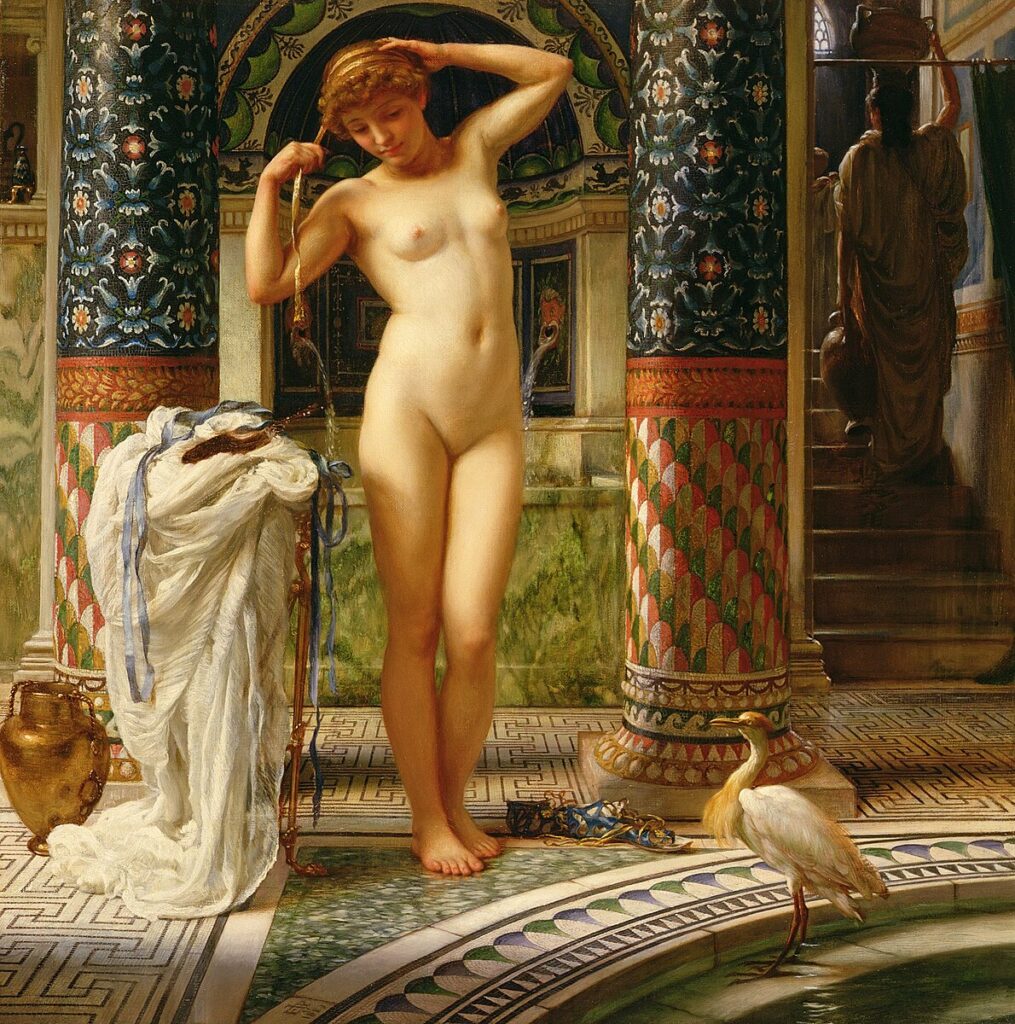
a scene in a [[Public bathing|bathhouse]] in [[Ancient Rome]], it combines [[history painting]] and [[nude art]], it drew heavily on [[archaeological]] discoveries about the architecture of the era. The female figure is modelled on the [[Esquiline Venus]] which had been [[Archaeological excavation|excavated]] in 1874 on the [[Esquiline Hill]]. The discovery also inspired [[Lawrence Alma-Tadema]]’s 1778 painting ”A Sculptor’s Model”. The title Poynter gave the painting makes reference to a female version of the statue ”[[Diadumenos]]” as she is shown in the act of tying her hair.<ref>Liversidge & Edwards p.152</ref> |
||
|
Pointer displayed the painting to the Royal Academy Exhibition of 1884 at [[Burlington House]], in [[London]], and subsequently at the [[Grosvenor Gallery]]. The following year he produced a much larger version, although with a significant amount of [[drapery]] added to partially obscure the nudity, to the Royal Academy Exhibition of 1885.<ref>Liversidge & Edwards p.152</ref> Today the original painting is in the [[Royal Albert Memorial Museum]], in [[Exeter]].<ref>https://artuk.org/discover/artworks/diadumene-95636</ref> |
Pointer displayed the painting to the Royal Academy Exhibition of 1884 at [[Burlington House]], in [[London]], and subsequently at the [[Grosvenor Gallery]]. The following year he produced a much larger version, although with a significant amount of [[drapery]] added to partially obscure the nudity, to the Royal Academy Exhibition of 1885.<ref>Liversidge & Edwards p.152</ref> Today the original painting is in the [[Royal Albert Memorial Museum]], in [[Exeter]].<ref>https://artuk.org/discover/artworks/diadumene-95636</ref> |
||
Latest revision as of 14:13, 15 October 2025
Painting by Edward Poynter
Diadumenè is an oil painting by the British artist Edward Poynter, from 1884[1]
History and description
[edit]
It depicts a scene taking place in a bathhouse in Ancient Rome, where a naked woman is near the pool, with her clothes nearby. it combines history painting and nude art, it drew heavily on archaeological discoveries about the architecture of the era. The female figure is modelled on the Esquiline Venus which had been excavated in 1874 on the Esquiline Hill. The discovery also inspired Lawrence Alma-Tadema‘s 1778 painting A Sculptor’s Model. The title Poynter gave the painting makes reference to a female version of the statue Diadumenos as she is shown in the act of tying her hair.[2]
Pointer displayed the painting to the Royal Academy Exhibition of 1884 at Burlington House, in London, and subsequently at the Grosvenor Gallery. The following year he produced a much larger version, although with a significant amount of drapery added to partially obscure the nudity, to the Royal Academy Exhibition of 1885.[3] Today the original painting is in the Royal Albert Memorial Museum, in Exeter.[4]
- Liversidge, Michael & Edwards, Catherine. Imagining Rome British Artists and Rome in the Nineteenth Century. Merrell Holberton, 1996.
- Smith, Alison. The Victorian Nude: Sexuality, Morality, and Art. Manchester University Press, 1996.

