
Content deleted Content added
| Line 31: | Line 31: | ||
|
==Historical localities== |
==Historical localities== |
||
|
===Pidzamche=== |
|||
|
Pidzamche is recognized to be the oldest part of Lviv. Starting from [[Galicia-Volhynia|princely times]] it was settled by craftsmen and traders. Located outside of the city walls, Pidzamche was accessible for settlement of newcomers from different countries and hosted free workers who didn’t belong to any [[guild]]. The waters of [[Poltva]] river flowing nearby led to the establishemnt of numerous [[tanning (leather)|tanneries]], slaughterhouses and mills. The emergence of [[railway]]s during the era of [[Austria-Hungary|Austro-Hungarian]] rule quickly turned the district into an industrial area. [[Pidzamche railway station]] served as a logistical hub for local enterprises, supplying among others the famous [[J. A. Baczewski|Baczewski]] alcohol factory. Among notable companies still active in Pidzamche are ”[[Svitoch]]” confectionery factory and ”Galca” company specializing in [[coffee]] production. A Jewish [[ghetto]] existed in the locality during the 20th century. In modern times, the district attained the image of a remote and depressive area. Following the closure of many industrial enterprises, reconstruction and revitalization works are ongoing in Pidzamche, including, among others the creation of [[mural]]s and establishment of a modern art centre.<ref>{{Cite web|title=Артцентри замість заводів|date=2021-10-07|url=https://zaxid.net/pidzamche_promislova_istoriya_kulturna_transformatsiya_n1527421|access-date=2025-10-16}}</ref> |
|||
|
===Riasne=== |
===Riasne=== |
||
|
The area of Riasne ({{langx|pl|Rzęsna}}) was first mentioned in the 15th century. A [[Catholic]] church existed in the settlement from that time, first built of wood, and in 1895 reconstructed in stone. In [[Kingdom of Galicia and Lodomeria|Austrian times]] a military [[fort]] was constructed in the area. Riasne was also known as a seat of one of the branches of [[Prosvita]] society. Heavy fighting took place in Riasne during the [[First World War|First]] and [[Second World War]]s, as well as during the [[Polish-Ukrainian War]] of 1919. Until the 1940s mass settlement of Poles took place in the area, facilitated by the railway line connecting Lviv with [[Rava-Ruska]]. Following the Second World War the Polish population was displaced, and many Ukrainians, including [[Lemkos]] deported from Poland, settled in the area.<ref name=zax>{{Cite web|title=Оборона Львова, район переселенців і придорожніх скульптур: що ми знаємо про Рясне|date=2024-12-05|url=https://zaxid.net/mikrorayon_ryasne_u_lvovi_istoriya_tsikavi_fakti_arhivni_foto_n1599230|access-date=2025-10-16}}</ref> |
The area of Riasne ({{langx|pl|Rzęsna}}) was first mentioned in the 15th century. A [[Catholic]] church existed in the settlement from that time, first built of wood, and in 1895 reconstructed in stone. In [[Kingdom of Galicia and Lodomeria|Austrian times]] a military [[fort]] was constructed in the area. Riasne was also known as a seat of one of the branches of [[Prosvita]] society. Heavy fighting took place in Riasne during the [[First World War|First]] and [[Second World War]]s, as well as during the [[Polish-Ukrainian War]] of 1919. Until the 1940s mass settlement of Poles took place in the area, facilitated by the railway line connecting Lviv with [[Rava-Ruska]]. Following the Second World War the Polish population was displaced, and many Ukrainians, including [[Lemkos]] deported from Poland, settled in the area.<ref name=zax>{{Cite web|title=Оборона Львова, район переселенців і придорожніх скульптур: що ми знаємо про Рясне|date=2024-12-05|url=https://zaxid.net/mikrorayon_ryasne_u_lvovi_istoriya_tsikavi_fakti_arhivni_foto_n1599230|access-date=2025-10-16}}</ref> |
||
Revision as of 23:05, 15 October 2025
Urban district in Lviv in Lviv Oblast, Ukraine
|
Shevchenkivskyi District Шевченківський район |
|
|---|---|

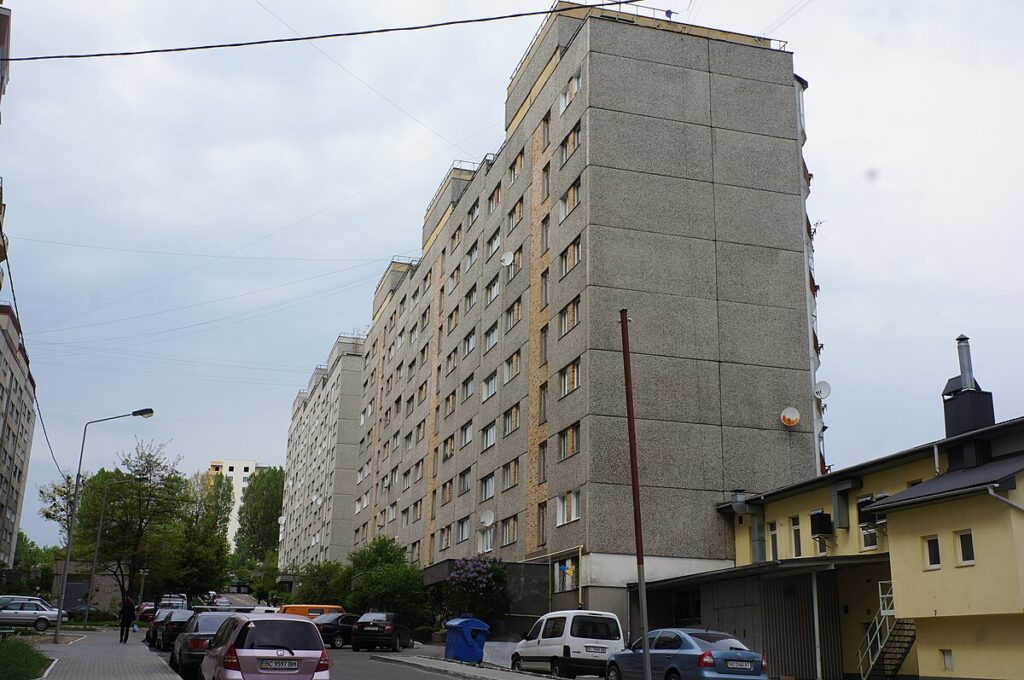
A Soviet-era apartment block in northern Lviv |
|

Map of Lviv and its districts with Shevchenkivskyi highlighted in red |
|
| Country |  Ukraine Ukraine |
| Oblast | Lviv Oblast |
|
• Total |
170,000 |
| Time zone | EET |
Shevchenkivskyi District (Ukrainian: Шевченківський район) is an urban district of the city of Lviv, named after Ukrainian poet and artist Taras Shevchenko. This district covers the northern part of the city. It contains such neighborhoods as Pidzamche, Holosko, Klepariv, Zamarstyniv, Zboyishcha, India, Kamyanka and Riasne. In the northwest it borders with the town of Briukhovychi and Briukhovychi forest.
Historical localities
Pidzamche
Pidzamche is recognized to be the oldest part of Lviv. Starting from princely times it was settled by craftsmen and traders. Located outside of the city walls, Pidzamche was accessible for settlement of newcomers from different countries and hosted free workers who didn’t belong to any guild. The waters of Poltva river flowing nearby led to the establishemnt of numerous tanneries, slaughterhouses and mills. The emergence of railways during the era of Austro-Hungarian rule quickly turned the district into an industrial area. Pidzamche railway station served as a logistical hub for local enterprises, supplying among others the famous Baczewski alcohol factory. Among notable companies still active in Pidzamche are Svitoch confectionery factory and Galca company specializing in coffee production. A Jewish ghetto existed in the locality during the 20th century. In modern times, the district attained the image of a remote and depressive area. Following the closure of many industrial enterprises, reconstruction and revitalization works are ongoing in Pidzamche, including, among others the creation of murals and establishment of a modern art centre.[1]
Riasne
The area of Riasne (Polish: Rzęsna) was first mentioned in the 15th century. A Catholic church existed in the settlement from that time, first built of wood, and in 1895 reconstructed in stone. In Austrian times a military fort was constructed in the area. Riasne was also known as a seat of one of the branches of Prosvita society. Heavy fighting took place in Riasne during the First and Second World Wars, as well as during the Polish-Ukrainian War of 1919. Until the 1940s mass settlement of Poles took place in the area, facilitated by the railway line connecting Lviv with Rava-Ruska. Following the Second World War the Polish population was displaced, and many Ukrainians, including Lemkos deported from Poland, settled in the area.[2]
Greek Catholic priest Oleksiy Zaryckyy was active in Riasne during the postwar years and became a martyr. From 1946 and until the declaration of Ukrianian independence, the local church belonged to the Moscow Partiarchate. A prominent wondermaking icon of Virgin Mary revered by Greek Catholics stems from Riasne. In modern days the district is known for its industrial enterprises working in the spheres of machine bulding and processing of wood.[2]
Zboyishcha
Before World War II, the area of Zboyishcha, located near the road connecting Lviv to Zhovkva, was famous for its batiar subculture. Batiars from the locality followed their own “code of honour”, which forbade them to do harm to inhabitants of their district, closely cooperated with criminals from nearby Zamarstyniv and were reported to have good relations with the local police and clergy.[3]
See also
References

