

From Wikipedia, the free encyclopedia
Content deleted Content added
|
|
|||
| Line 18: | Line 18: | ||
|
* There is no uniform lower bound on <math>p(G)</math>. In fact, for every positive [[integer]] <math>n</math> there exists a finite group <math>G</math> such that <math>p(G) = 1/n</math>. |
* There is no uniform lower bound on <math>p(G)</math>. In fact, for every positive [[integer]] <math>n</math> there exists a finite group <math>G</math> such that <math>p(G) = 1/n</math>. |
||
|
* If <math>G</math> is not abelian but [[simple group|simple]], then <math>p(G) \leq 1/12</math> (this upper bound is attained by <math>\mathfrak{A}_5</math>, the [[alternating group]] of degree 5). |
* If <math>G</math> is not abelian but [[simple group|simple]], then <math>p(G) \leq 1/12</math> (this upper bound is attained by <math>\mathfrak{A}_5</math>, the [[alternating group]] of degree 5). |
||
|
* The set of commuting probabilities of finite groups is reverse-well-ordered, and the reverse of its order type is |
* The set of commuting probabilities of finite groups is reverse-well-ordered, and the reverse of its order type is <math>\omega^\omega</math>.<ref>{{cite journal|title=Commuting probabilities of finite groups|journal=Bulletin of the London Mathematical Society|volume=47|issue=5|pages=796–808|year=2015|last=Eberhard|first=Sean|doi=10.1112/blms/bdv050 |arxiv=1411.0848|s2cid=119636430 }}</ref> |
||
|
== Generalizations == |
== Generalizations == |
||
Latest revision as of 07:50, 17 October 2025
Probability that two elements of a group commute
In mathematics and more precisely in group theory, the commuting probability (also called degree of commutativity or commutativity degree) of a finite group is the probability that two randomly chosen elements commute.[1][2] It can be used to measure how close to abelian a finite group is. It can be generalized to infinite groups equipped with a suitable probability measure,[3] and can also be generalized to other algebraic structures such as rings.[4]
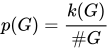
Let be a finite group. We define as the averaged number of pairs of elements of which commute:



where denotes the cardinality of a finite set .


If one considers the uniform distribution on , is the probability that two randomly chosen elements of commute. That is why is called the commuting probability of .

- The finite group is abelian if and only if .
- One has

-
- where is the number of conjugacy classes of .

- ^ Gustafson, W. H. (1973). “What is the Probability that Two Group Elements Commute?”. The American Mathematical Monthly. 80 (9): 1031–1034. doi:10.1080/00029890.1973.11993437.
- ^ Das, A. K.; Nath, R. K.; Pournaki, M. R. (2013). “A survey on the estimation of commutativity in finite groups” (PDF). Southeast Asian Bulletin of Mathematics. 37 (2): 161–180.
- ^ a b Hofmann, Karl H.; Russo, Francesco G. (2012). “The probability that x and y commute in a compact group”. Mathematical Proceedings of the Cambridge Philosophical Society. 153 (3): 557–571. arXiv:1001.4856. Bibcode:2012MPCPS.153..557H. doi:10.1017/S0305004112000308. S2CID 115180549.
- ^ a b Machale, Desmond (1976). “Commutativity in Finite Rings”. The American Mathematical Monthly. 83: 30–32. doi:10.1080/00029890.1976.11994032.
- ^ Baez, John C. (2018-09-16). “The 5/8 Theorem”. Azimut.
- ^ Eberhard, Sean (2015). “Commuting probabilities of finite groups”. Bulletin of the London Mathematical Society. 47 (5): 796–808. arXiv:1411.0848. doi:10.1112/blms/bdv050. S2CID 119636430.
- ^ Browning, Thomas (2023). “Limit points of commuting probabilities of finite groups”. Bulletin of the London Mathematical Society. 55 (3): 1392–1403. arXiv:2201.09402. doi:10.1112/blms.12799.

