
==Critical reception==
==Critical reception==
The film received mixed reviews, with several reviewers criticizing the film’s failure to deliver on its risqué premise. “The affair is not as wild as it pretends to be”<ref name=”radiotimes”>{{Cite book |date=2017 |title=Radio Times Guide to Films |location=London |publisher=[[Immediate Media Company]] |edition=18th |page=1025 |isbn=978-0-9929364-4-0}}</ref> and was “more silly than sexy.”<ref name=”retriever” /> ”[[Radio Times]]” awarded the film 3 out of 5 stars,<ref name=”radiotimes” /> and critic Leslie Halliwell acknowledged “interesting elements” despite the film’s flaws.<ref name=”halliwell”>{{Cite book |last=Halliwell |first=Leslie |date=1989 |title=Halliwell’s Film Guide |location=London |publisher=Paladin |edition=7th |page=1116 |isbn=978-0-586-08894-4 |url=https://archive.org/details/halliwellsfilmgu07edhall/page/1116/mode/1up}}</ref>
”[[The Monthly Film Bulletin]]” wrote: “Perhaps with someone other than Nancy Kwan in the leading role, this might have been a mildly effective cautionary tale about lower-middle-class aspirations to la dolce vita. As it is, her personality is too winsome by far, and the ‘daring’ dress which causes all those raised eyebrows at the office looks just about right for a children’s picnic. The whole final sequence of the ghastly office party is really rather well directed, but has nothing much behind it. There is a good performance by [[Betty Marsden]] in that familiar role of the ageing spinster pining with hopeless love for her boss.”<ref name=”monthly”>{{Cite journal |date=1 January 1965 |title=The Wild Affair |url=https://www.proquest.com/docview/1305833614 |journal=[[The Monthly Film Bulletin]] |volume=32 |issue=372 |pages=170 |id={{ProQuest|1305833614}}}}</ref>
”The [[Radio Times]] Guide to Films” gave the film 3/5 stars, writing: “Before her wedding, secretary Nancy Kwan decides to have a final fling, taking advantage of the opportunities offered by an office party. Kwan was not the best choice for the lead and, this being the early 1960s, the affair is not as wild as it pretends to be. But after a slow start, the party atmosphere becomes infectious, mainly because of a wealth of comedy talent. Wonderful Terry-Thomas plays the boss and his staff includes some giants of the British music-hall ([[Bud Flanagan]], [[Jimmy Logan]], [[Gladys Morgan]])”<ref>{{Cite book |date=2017 |title=Radio Times Guide to Films |location=London |publisher=[[Immediate Media Company]] |edition=18th |page=1025 |isbn=978-0-9929364-4-0}}</ref>
Nancy Kwan was not the best choice for the lead, . some giants of the British music-hall ([[Bud Flanagan]], [[Jimmy Logan]], [[Gladys Morgan]])”<ref = [[ ]] = />
British film critic [[Leslie Halliwell]] said: “Curious little comedy-drama which plays almost like ”[[The Road to Ruin (1934 film)|The Road to Ruin]]” and has an attractive but miscast leading lady. Interesting elements.”<ref>{{Cite book |last=Halliwell |first=Leslie |date=1989 |title=Halliwell’s Film Guide |location=London |publisher=Paladin |edition=7th |page=1116 |isbn=978-0-586-08894-4 |url=https://archive.org/details/halliwellsfilmgu07edhall/page/1116/mode/1up}}</ref>
Videohound deemed the film “more silly than sexy.”<ref name=”retriever” />
==References==
==References==
1963 British film by John Krish
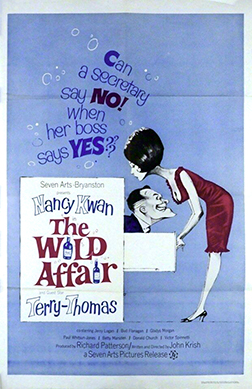
The Wild Affair is a 1965 British comedy film written and directed by John Krish and starring Nancy Kwan, Terry-Thomas, Jimmy Logan, Gladys Morgan, and Betty Marsden.[2] It was adapted from the 1961 novel The Last Hours of Sandra Lee by William Sansom.[3] Filmed in 1963,[4] the film’s release was delayed, finally opening in cinemas nationwide on 7 November 1965. The film went on to open in London cinemas from 28 November 1965.[1]
A few days before her wedding, secretary Marjorie Lee decides she wants to experience more of life before settling into married life. On her last day working at a large cosmetics firm, which happens to be the day of the office Christmas party, she arrives in a provocatively frilly dress. Her appearance catches the attention of several male colleagues, including her lecherous boss Godfrey Deane and a visiting sales manager named Craig, who invites her to lunch. Deane’s secretary, Monica, becomes noticeably upset by his interest in Marjorie.
After having the company’s new “Vampire Look” make-up tested on her by a colleague named Quentin, Marjorie allows Craig to buy her a new dress and joins him for lunch at his hotel suite. When he makes advances, she panics and flees. Returning to the office, she uses her Christmas bonus to purchase liquor to make the party more exciting than the modest gathering Deane had planned. When her fiancé Andy arrives to pick her up, Marjorie tells him she intends to enjoy her remaining time as a single woman and sends him away.
As the evening progresses, the party becomes increasingly wild and sexual in nature. Marjorie, now disgusted by the scene, activates the ceiling’s fire sprinkler system, drenching everyone. The group’s drunken anger quickly shifts to celebration when a phone call arrives with news that Ralph, one of the employees, has just become a father. The party breaks up, and Marjorie finds Andy waiting for her, and they reconcile.[5][6]

In 1963, Nancy Kwan’s long hair, famous from The World of Suzie Wong (1960), was chopped into a sharp modernist bob by Vidal Sassoon for the film The Wild Affair, at the request of director John Krish. The image of her new hairstyle was published in the October editions of both American and British Vogue.[7][1] Vidal’s new hairstyle was previously called the “Mary Quant cut”, as it had first featured in her fashion show, but became known as the “Nancy Kwan cut”.[1]
The film received mixed reviews, with several reviewers criticizing the film’s failure to deliver on its risqué premise. “The affair is not as wild as it pretends to be”[8] and was “more silly than sexy.”[5] Radio Times awarded the film 3 out of 5 stars,[8] and critic Leslie Halliwell acknowledged “interesting elements” despite the film’s flaws.[9]
Critics unanimously noted that Nancy Kwan was “attractive but miscast”[9] and “was not the best choice for the lead,”[8] and that her “daring” dress “looks just about right for a children’s picnic.”[6] The supporting cast received praise, including “a wealth of comedy talent” and “some giants of the British music-hall (Bud Flanagan, Jimmy Logan, Gladys Morgan),”[8] as well as Betty Marsden‘s “good performance.”[6]

