
[[Sydney Howard Gay]], (1814–1888) An abolitionist, he edited the National Anti-Slavery Standard for fourteen years. With the help of Louis Napoleon aided hundreds of fugitives from slavery passing through New York to freedom, and during the Civil War was the influential managing editor of the New-York Tribune. He settled with his wife Elizabeth (Neall) Gay in one of Dr. Elliott’s houses in 1847 and lived on the property, almost continuously, until his death.<ref name=”:4″ /><ref>{{Cite web |title=[Sydney Howard Gay house] – Print, Photographic {{!}} Staten Island Historical Society |url=https://statenisland.pastperfectonline.com/photo/6800B82C-9FAD-4722-BE2B-744030392368 |access-date=2025-09-29 |website=statenisland.pastperfectonline.com}}</ref><ref name=”:2″ />
[[Sydney Howard Gay]], (1814–1888) An abolitionist, he edited the National Anti-Slavery Standard for fourteen years. With the help of Louis Napoleon aided hundreds of fugitives from slavery passing through New York to freedom, and during the Civil War was the influential managing editor of the New-York Tribune. He settled with his wife Elizabeth (Neall) Gay in one of Dr. Elliott’s houses in 1847 and lived on the property, almost continuously, until his death.<ref name=”:4″ /><ref>{{Cite web |title=[Sydney Howard Gay house] – Print, Photographic {{!}} Staten Island Historical Society |url=https://statenisland.pastperfectonline.com/photo/6800B82C-9FAD-4722-BE2B-744030392368 |access-date=2025-09-29 |website=statenisland.pastperfectonline.com}}</ref><ref name=”:2″ />
[[Anna Leonowens]], (1831–1915) Opened a school attended by Elliottville children in 1868 [mostly taught by her daughter Avis Anna (Leonowens) Fyshe (1854–1902)] and became a life-long friend of many people in the neighborhood. Leonowens wrote the books on Siam for which she is known today in Elliottville, where she had her primary residence until 1874. Her friends George Curtis and Frank Shaw were crucial in establishing her as a writer and lecturer.<ref>{{Cite web |last=slepian@siadvance.com |first=Stephanie Slepian {{!}} |date=2011-03-13 |title=Our Island’s story, from people to places, featured in new book |url=https://www.silive.com/news/2011/03/our_islands_story_from_people.html |access-date=2025-09-29 |website=silive |language=en}}</ref><ref name=”:5″>{{Cite book |last=Kaser |first=James A. |title=Staten Island’s Elliottville: Abolitionist Enclave, Gilded Age Retreat, Ferry Suburb |date=2025 |publisher=State University of New York Press |isbn=979-8-8558-0239-9 |edition=1st ed |location=Albany |pages=123-134}}</ref><ref>{{Cite book |last=Habegger |first=Alfred |title=Masked: the life of Anna Leonowens, schoolmistress at the court of Siam |date=2014 |publisher=the University of Wisconsin press |isbn=978-0-299-29830-2 |series=Wisconsin studies in autobiography |location=Madison}}</ref><ref>{{Cite book |last=Morgan |first=Susan |title=Bombay Anna: the real story and remarkable adventures of the King and I governess |date=2008 |publisher=University of California Press |isbn=978-0-520-26163-1 |series=A Philip E. Lilienthal book |location=Berkeley}}</ref>
[[Anna Leonowens]], (1831–1915) Opened a school attended by Elliottville children in 1868 [mostly taught by her daughter Avis Anna (Leonowens) Fyshe (1854–1902)] and became a life-long friend of many people in the neighborhood. Leonowens wrote the books on Siam for which she is known today in Elliottville, where she had her primary residence until 1874. Her friends George Curtis and Frank Shaw were crucial in establishing her as a writer and lecturer.<ref>{{Cite web |last=slepian@siadvance.com |first=Stephanie Slepian {{!}} |date=2011-03-13 |title=Our Island’s story, from people to places, featured in new book |url=https://www.silive.com/news/2011/03/our_islands_story_from_people.html |access-date=2025-09-29 |website=silive |language=en}}</ref><ref name=”:5″>{{Cite book |last=Kaser |first=James A. |title=Staten Island’s Elliottville: Abolitionist Enclave, Gilded Age Retreat, Ferry Suburb |date=2025 |publisher=State University of New York Press |isbn=979-8-8558-0239-9 |edition=1st ed |location=Albany |pages=123-134}}</ref><ref>{{Cite book |last=Habegger |first=Alfred |title=Masked: the life of Anna Leonowens, schoolmistress at the court of Siam |date=2014 |publisher=the University of Wisconsin press |isbn=978-0-299-29830-2 |series=Wisconsin studies in autobiography |location=Madison}}</ref><ref>{{Cite book |last=Morgan |first=Susan |title=Bombay Anna: the real story and remarkable adventures of the King and I governess |date=2008 |publisher=University of California Press |isbn=978-0-520-26163-1 |series=A Philip E. Lilienthal book |location=Berkeley}}</ref>
[[Josephine Shaw Lowell|Josephine (Shaw) Lowell]] (1843–1905) was a Progressive Reform leader after the Civil War active in many social justice causes and is best known as the founder of the New York Consumers’ League in 1890.<ref>{{Cite web |title=Josephine Shaw Lowell {{!}} Women’s Rights, Philanthropy & Social Reform {{!}} Britannica |url=https://www.britannica.com/biography/Josephine-Shaw-Lowell |access-date=2025-09-29 |website=www.britannica.com |language=en}}</ref><ref>{{Cite book |last=Waugh |first=Joan |title=Unsentimental reformer: the life of Josephine Shaw Lowell |date=1997 |publisher=Harvard Univ. Press |isbn=978-0-674-93036-0 |location=Cambridge, Mass.}}</ref>
[[Josephine Shaw Lowell|Josephine (Shaw) Lowell]] (1843–1905) was a Progressive Reform leader after the Civil War active in many social justice causes and is best known as the founder of the New York Consumers’ League in 1890.<ref>{{Cite web |title=Josephine Shaw Lowell {{!}} Women’s Rights, Philanthropy & Social Reform {{!}} Britannica |url=https://www.britannica.com/biography/Josephine-Shaw-Lowell |access-date=2025-09-29 |website=www.britannica.com |language=en}}</ref><ref>{{Cite book |last=Waugh |first=Joan |title=Unsentimental reformer: the life of Josephine Shaw Lowell |date=1997 |publisher=Harvard Univ. Press |isbn=978-0-674-93036-0 |location=Cambridge, Mass.}}</ref>
[[Middy Morgan|Maria “Middy” Morgan]], (1828–1892) Nationally known as one of the first female journalists, she was respected for her knowledge of livestock and, particularly horses. For years, the detailed descriptions of the house she built on Bard Avenue attracted new interest in the neighborhood.<ref name=”:3″ />
[[Middy Morgan|Maria “Middy” Morgan]], (1828–1892) Nationally known as one of the first female journalists, she was respected for her knowledge of livestock and, particularly horses. For years, the detailed descriptions of the house she built on Bard Avenue attracted new interest in the neighborhood.<ref name=”:3″ />
Francis “Frank” George Shaw (1809–1882) Frank moved his family to Elliottville while his wife, Sarah Blake (Sturgis) Shaw (1815–1902) was being treated by Dr. Elliott. The Shaw house, between George Curtis’s and Sydney Gay’s was a focus of neighborhood social life. The Shaws were abolitionists and Frank helped fund Brook Farm, a social experiment to which many Elliottville residents were connected. Shaw held positions in national organizations focused on freedman’s education during and after the Civil War.<ref name=”:5″ />
Francis “Frank” George Shaw (1809–1882) Frank moved his family to Elliottville while his wife, Sarah Blake (Sturgis) Shaw (1815–1902) was being treated by Dr. Elliott. The Shaw house, between George Curtis’s and Sydney Gay’s was a focus of neighborhood social life. The Shaws were abolitionists and Frank helped fund Brook Farm, a social experiment to which many Elliottville residents were connected. Shaw held positions in national organizations focused on freedman’s education during and after the Civil War.<ref name=”:5″ />
[[Robert Gould Shaw]] (1837–1863) Died heroically in the Civil War while leading the first all-Black regiment formed in the Northeast.<ref name=”:6″>{{Cite book |last=Kaser |first=James A. |title=Staten Island’s Elliottville: Abolitionist Enclave, Gilded Age Retreat, Ferry Suburb |date=2025 |publisher=State University of New York Press |isbn=979-8-8558-0239-9 |edition=1st ed |location=Albany |pages=71-121}}</ref>
[[Robert Gould Shaw]] (1837–1863) Died heroically in the Civil War while leading the first all-Black regiment formed in the Northeast.<ref name=”:6″>{{Cite book |last=Kaser |first=James A. |title=Staten Island’s Elliottville: Abolitionist Enclave, Gilded Age Retreat, Ferry Suburb |date=2025 |publisher=State University of New York Press |isbn=979-8-8558-0239-9 |edition=1st ed |location=Albany |pages=71-121}}</ref>
| Elliottville | |
|---|---|
 |
|
| Location | Staten Island, NY |
| Settled | 1839 |
Elliottville was a former neighborhood on Staten Island from the 1850s through the mid-1870s. Today the area is part of the neighborhood of Livingston, which is located within West New Brighton, in the confines of Castleton in Staten Island, New York. The neighborhood itself remained a distinctive community from, approximately, 1840–1890. Such notable residents include Dr. Samuel Mackenzie Elliot, Francis George Shaw, and John Bard. [1][2]
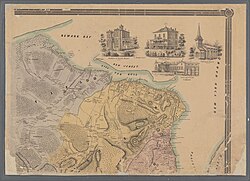
Elliottville was quite small, spanning around only twelve blocks on either side of a street that was later called Bard Avenue. The original owner of most of the land was a Scottish immigrant and eye surgeon named Dr. Samuel Mackenzie Elliott.[3] On this land he built tens of houses, most of them designed by William Ranlett. From this he preferred the name Elliottville for the enclave and the designation thus appears on a map from 1854. Some early residents had rejected the name, including resident John Bard, the son of William Bard, from whom Elliott had purchased land. Bard’s name became attached to the main avenue, and over time, the neighborhood then became known as the Bard Avenue section of West New Brighton. Then later the Bard Avenue neighborhood of Livingston. Most of these changes were because of developments within the neighborhood, such as a post office in West Brighton and a streetcar depot in the former Anson Livingston mansion.[4][5]
Residents, along with others on Staten Island, those in Manhattan, and the rest of the nation considered Elliottville as an enclave that was quite distinct from the rest of Staten Island. Initially, Elliottville was largely populated by Dr. Elliott’s patients, who would travel from other cities to receive treatment due to his national reputation. He would then rent out accommodations to them. Several former patients and their families relocated to Elliottville because of the scenic beauty of it, and they were convinced of the healthfulness of the location. There was also a ferry to Manhattan at the foot of Bard Avenue that was easy for residents to use. In addition to New England origins, residents shared a commitment to the abolition of slavery.[5] One prominent abolitionist who lived in the neighborhood, Sydney Howard Gay, was the editor of the National Anti-Slavery Standard. Through his Manhattan office, with the aid of Louis Napoleon, a free black man, he helped hundreds of fugitives from slavery escape to freedom.[6]
Residents were devoted to social change, including wide-sweeping economic and political changes as well as those rooted in philosophical and spiritual views. This is what we would now call American transcendentalism. Observing beauty was important to American transcendentalism as was participating in moral action. Elliottville offered this natural beauty and offered an opportunity to live in harmony with it as well as with one’s neighbors that an urban landscape couldn’t. Many of these residents were connected to Brook Farm and were friends and admirers of Ralph Waldo Emerson.[7]
After the Civil War, the neighborhood was still considered an enclave, but the qualities the residents shared were more fluid. There was more social distinction based on achievement or wealth rather than shared origins or a devotion to social reform (although these reformers and New Englanders still made up the majority of residents). There was a general agreement that the residents were distinctive, and the neighborhood stood apart from the rest of Staten Island during the 1840s to the 1890s. However, references to the neighborhood in the local and national press changed over time. They went from an enclave of abolitionists to “the intellectual part of Staten Island,” to “the Fifth Avenue” of Staten Island during this time.[8]
From 1840 to 1880, Elliottville was known for its rural beauty and easy access to a scenic coast where people swam and boated. Starting in the 1880s, heavy industry and a railroad freight line separated the community from the waterfront, and the water became polluted. By this time, New Jersey oil refineries across the Kill van Kull were destroying the air quality. The decline in quality of life in Elliottville was rapid and the community changed drastically. The estate properties were torn down, the land separated, and the environment became more consistent with other early-twentieth century suburban developments across Staten Island.[4]
George William Curtis, (1824–1892) A well-known novelist, essayist, and public speaker before marrying Anna Shaw (1836–1923) in 1855 and moving to Staten Island. Curtis was a founder of the Republican Party, had a long career in Republican politics, and wrote an influential columnist for Harper’s Magazine. He lived all his married life on Bard Avenue, and the neighborhood was closely identified with him.[9][10][11][12]
Sydney Howard Gay, (1814–1888) An abolitionist, he edited the National Anti-Slavery Standard for fourteen years. With the help of Louis Napoleon aided hundreds of fugitives from slavery passing through New York to freedom, and during the Civil War was the influential managing editor of the New-York Tribune. He settled with his wife Elizabeth (Neall) Gay in one of Dr. Elliott’s houses in 1847 and lived on the property, almost continuously, until his death.[10][13][7]
Anna Leonowens, (1831–1915) Opened a school attended by Elliottville children in 1868 [mostly taught by her daughter Avis Anna (Leonowens) Fyshe (1854–1902)] and became a life-long friend of many people in the neighborhood. Leonowens wrote the books on Siam for which she is known today in Elliottville, where she had her primary residence until 1874. Her friends George Curtis and Frank Shaw were crucial in establishing her as a writer and lecturer.[14][15][16][17]
Josephine (Shaw) Lowell (1843–1905) was a Progressive Reform leader after the Civil War active in many social justice causes and is best known as the founder of the New York Consumers’ League in 1890.[18][19]
Maria “Middy” Morgan, (1828–1892) Nationally known as one of the first female journalists, she was respected for her knowledge of livestock and, particularly horses. For years, the detailed descriptions of the house she built on Bard Avenue attracted new interest in the neighborhood.[8]
Francis “Frank” George Shaw (1809–1882) Frank moved his family to Elliottville while his wife, Sarah Blake (Sturgis) Shaw (1815–1902) was being treated by Dr. Elliott. The Shaw house, between George Curtis’s and Sydney Gay’s was a focus of neighborhood social life. The Shaws were abolitionists and Frank helped fund Brook Farm, a social experiment to which many Elliottville residents were connected. Shaw held positions in national organizations focused on freedman’s education during and after the Civil War.[15][20]
Robert Gould Shaw (1837–1863) Died heroically in the Civil War while leading the first all-Black regiment formed in the Northeast.[21]
Mary Otis Gay Willcox, (1861–1933) The youngest daughter of Sydney and Elizabeth Gay, she married William Goodenow Willcox (1859–1923) and the two of them lived on the Gay family property until they died. Willcox was a long-time board member of the Tuskegee Institute and Mary was a leader in the New York suffragist movement and, later in the League of Women’s Voters.[10][15]
Theodore Woolsey Winthrop, (1828–1861) During the 1850s, he lived in the Elliottville household of his sister, Laura (Winthrop) Johnson and wrote novels. After his heroic battlefield death at Big Bethel, the first pitched land battle of the Civil War, he quickly became the Union’s first martyr. While living on Staten Island, he became friends with neighbors Robert Gould Shaw and George William Curtis. Curtis wrote a biographical essay for the first of his posthumously published novels.[21][22]
Category:Former New York City neighborhoods
Category:Livingston, Staten Island
Category:Neighborhoods in Staten Island
Category:Spa towns in New York (state)
Category:Underground Railroad in New York (state)
- ^ Kaser, James A. (2025). Staten Island’s Elliottville: Abolitionist Enclave, Gilded Age Retreat, Ferry Suburb (1st ed ed.). Albany: State University of New York Press. ISBN 979-8-8558-0239-9.
- ^ Hine, Charles Gilbert; Davis, William T. (1923). Legends, Stories and Folklore of Old Staten Island: Part I—The North Shore. New York: The Staten Island Historical Society. p. 36.
- ^ Advance, Thomas Matteo | For the Staten Island (2015-06-24). “Dr. Samuel Elliott left his mark on Staten Island history”. silive. Retrieved 2025-09-29.
- ^ a b “The Author’s Corner with James A. Kaser”. The Way of Improvement Leads Home. 2025-08-21. Retrieved 2025-09-29.
- ^ a b “Beside the Evening Sea: Staten Island as Haven for Writers and Reformers”. The Gotham Center for New York City History. 2017-02-14. Retrieved 2025-09-29.
- ^ Papson, Don; Calarco, Tom (2015). Secret lives of the Underground Railroad in New York City: Sydney Howard Gay, Louis Napoleon and the Record of Fugitives. Jefferson, North Carolina: McFarland & Company, Inc., Publishers. ISBN 978-0-7864-6665-8.
- ^ a b Kaser, James A. (2025). Staten Island’s Elliottville: Abolitionist Enclave, Gilded Age Retreat, Ferry Suburb (1st ed ed.). Albany: State University of New York Press. pp. 135–173. ISBN 979-8-8558-0239-9.
- ^ a b Kaser, James A. (2025). Staten Island’s Elliottville: Abolitionist Enclave, Gilded Age Retreat, Ferry Suburb (1st ed ed.). Albany: State University of New York Press. pp. 175–211. ISBN 979-8-8558-0239-9.
- ^ jsomma@siadvance.com, Jan Somma-Hammel | (2018-08-21). “Cool Spaces: George William Curtis House is a landmark in Livingston”. silive. Retrieved 2025-09-29.
- ^ a b c “Women of the Nation Arise!”. Staten Island Museum. Retrieved 2025-09-29.
- ^ Milne, Gordon (1956). George William Curtis and the Genteel Tradition. Bloomington, Indiana University Press.
- ^ Dowling, Linda (2021). Galahad in the Gilded Age: A Life of George William Curtis. Xlibris US.
- ^ “[Sydney Howard Gay house] – Print, Photographic | Staten Island Historical Society”. statenisland.pastperfectonline.com. Retrieved 2025-09-29.
- ^ slepian@siadvance.com, Stephanie Slepian | (2011-03-13). “Our Island’s story, from people to places, featured in new book”. silive. Retrieved 2025-09-29.
- ^ a b c Kaser, James A. (2025). Staten Island’s Elliottville: Abolitionist Enclave, Gilded Age Retreat, Ferry Suburb (1st ed. ed.). Albany: State University of New York Press. pp. 123–134. ISBN 979-8-8558-0239-9.
- ^ Habegger, Alfred (2014). Masked: the life of Anna Leonowens, schoolmistress at the court of Siam. Wisconsin studies in autobiography. Madison: the University of Wisconsin press. ISBN 978-0-299-29830-2.
- ^ Morgan, Susan (2008). Bombay Anna: the real story and remarkable adventures of the King and I governess. A Philip E. Lilienthal book. Berkeley: University of California Press. ISBN 978-0-520-26163-1.
- ^ “Josephine Shaw Lowell | Women’s Rights, Philanthropy & Social Reform | Britannica”. www.britannica.com. Retrieved 2025-09-29.
- ^ Waugh, Joan (1997). Unsentimental reformer: the life of Josephine Shaw Lowell. Cambridge, Mass.: Harvard Univ. Press. ISBN 978-0-674-93036-0.
- ^
- ^ a b Kaser, James A. (2025). Staten Island’s Elliottville: Abolitionist Enclave, Gilded Age Retreat, Ferry Suburb (1st ed ed.). Albany: State University of New York Press. pp. 71–121. ISBN 979-8-8558-0239-9.
- ^ “Theodore Winthrop (1828-1861). The Reader’s Biographical Encyclopaedia. 1922”. www.wehd.com. Retrieved 2025-09-29.

