
| genus = Fagraea
| genus = Fagraea
| species = berteroana
| species = berteroana
| authority = A.Gray ex Benth. (1856)
| authority = A.Gray ex Benth.
| synonyms = {{collapsible list|bullets=true
| synonyms =
{{Species list |header=28 synonyms |hidden=yes
|title={{small|Synonymy}}
|”Carissa grandis” {{small|Bertero ex A.DC. (1844)}}
|Carissa grandis |Bertero ex A.DC.
|”Fagraea affinis” {{small|S.Moore (1923)}}
|Fagraea affinis |S.Moore
|”Fagraea berteriana” (orth. var.)
|Fagraea . .)
|Fagraea berteroana var. kusaiana |(Hosok.) Fosberg
|Fagraea berteroana var. ladronica |Fosberg
|Fagraea berteroana var. marquisensis |Fosberg & Sachet
|Fagraea berteroana var. pogas |(Hosok.) Fosberg
|”Fagraea kusaiana” {{small|Hosok. (1934)}}
|Fagraea . ()
|”Fagraea longituba” {{small|M.L.Grant (1974)}}
|Fagraea |
|”Fagraea novae-guineae” {{small|Cammerl. (1924)}}
|Fagraea |
|”Fagraea obovata” var. ”papuana” {{small|F.M.Bailey (1898)}}
|”Fagraea pachypoda” {{small|Gilg & Gilg-Ben. (1916)}}
|Fagraea |Gilg & Gilg-Ben.
|”Fagraea peekelii” {{small|Gilg & Gilg-Ben. (1916)}}
|Fagraea |.
|”Fagraea pluvialis” {{small|S.Moore (1929)}}
|Fagraea |.
|”Fagraea pua” {{small|Nadeaud (1864)}}
|Fagraea |
|”Fagraea rosenstromii” {{small|C.T.White (1935 publ. 1936)}}
|Fagraea . .
|”Fagraea sair” {{small|Gilg & Gilg-Ben. (1921)}}
|Fagraea |Gilg & Gilg-Ben.
|”Fagraea salomonensis” {{small|Gilg & Gilg-Ben. (1921)}}
|Fagraea |Gilg & Gilg-Ben.
|”Fagraea samoensis” {{small|Gilg & Gilg-Ben. (1921)}}
|Fagraea |.
|Fagraea pua |Nadeaud
|”Fagraea tahitensis” {{small|Butteaud (1891)}}
|Fagraea |
|”Fagraea vitiensis” {{small|Gilg & Gilg-Ben. (1921)}}
|Fagraea |Gilg & Gilg-Ben.
|Fagraea sair var. pogas |Hosok.
|Fagraea tahitensis |Butteaud
}}
}}
| synonyms_ref = {{R|POWO}}
}}
}}
It is known as the ”pua-lulu” in the Samoan Islands, and as ”pua” in Tonga and [[Tahiti]].<ref>{{Cite web|url=http://www.temarareo.org/PPN-Pua.html|title=Pua|website=Te Māra Reo: The Language Garden|year=2023|publisher=Benton Family Trust}}</ref><ref>{{cite journal|last=Whistler|first=W. Arthur|year=1978|title=Vegetation of the montane region of Savai’i|publisher=University Press of Hawai’i|volume=32|issue=1|page=89|url=http://scholarspace.manoa.hawaii.edu/bitstream/10125/1423/1/v32n1-79-94.pdf|journal=Pacific Science|access-date=10 July 2010}}</ref>
It is known as the ”pua-lulu” in the Samoan Islands, and as ”pua” in Tonga and [[Tahiti]].<ref>{{Cite web|url=http://www.temarareo.org/PPN-Pua.html|title=Pua|website=Te Māra Reo: The Language Garden|year=2023|publisher=Benton Family Trust}}</ref><ref>{{cite journal|last=Whistler|first=W. Arthur|year=1978|title=Vegetation of the montane region of Savai’i|publisher=University Press of Hawai’i|volume=32|issue=1|page=89|url=http://scholarspace.manoa.hawaii.edu/bitstream/10125/1423/1/v32n1-79-94.pdf|journal=Pacific Science|access-date=10 July 2010}}</ref>
It is native to the tropical Pacific, ranging from [[Queensland]] and [[Papuasia]] (New Guinea, the Bismarck Archipelago, and Solomon Islands) to [[Micronesia]] (Caroline Islands, Gilbert Islands, and Marianas), [[Vanuatu]], [[New Caledonia]], [[Fiji]], and parts of Polynesia ([[Cook Islands]], [[Marquesas]], [[Nauru]], [[Niue]], [[Samoan Islands]], [[Society Islands]], [[Tonga]], [[Tubuai Islands]], and [[Wallis and Futuna]]).<ref name = powo/>
It is native to the tropical Pacific, ranging from [[Queensland]] and [[Papuasia]] (New Guinea, the Bismarck Archipelago, and Solomon Islands) to [[Micronesia]] (Caroline Islands, Gilbert Islands, and Marianas), [[Vanuatu]], [[New Caledonia]], [[Fiji]], and parts of Polynesia ([[Cook Islands]], [[Marquesas]], [[Nauru]], [[Niue]], [[Samoan Islands]], [[Society Islands]], [[Tonga]], [[Tubuai Islands]], and [[Wallis and Futuna]]).
The ITIS database clarifies the spelling of the name (“Published as “berteriana” in honor of Bertero; correctable to “berteroana,”..).<ref>[https://www.itis.gov/servlet/SingleRpt/SingleRpt?search_topic=TSN&search_value=822515#null ITIS database entry for Fagraea berteroana]</ref>
The ITIS database clarifies the spelling of the name (“Published as “berteriana” in honor of Bertero; correctable to “berteroana,”..).<ref>[https://www.itis.gov/servlet/SingleRpt/SingleRpt?search_topic=TSN&search_value=822515#null ITIS database entry for Fagraea berteroana]</ref>
==References==
==References==
{{Reflist}}
{{Reflist
}}
* {{Hawaiian Dictionaries|Pua kenikeni|id=D18816}}
* {{Hawaiian Dictionaries|Pua kenikeni|id=D18816}}
Species of plant
| Fagraea berteroana | |
|---|---|

|
|
Scientific classification 
|
|
| Kingdom: | Plantae |
| Clade: | Tracheophytes |
| Clade: | Angiosperms |
| Clade: | Eudicots |
| Clade: | Asterids |
| Order: | Gentianales |
| Family: | Gentianaceae |
| Genus: | Fagraea |
| Species: |
F. berteroana |
| Binomial name | |
| Fagraea berteroana | |
| Synonyms[2] | |
|
28 synonyms
|
|
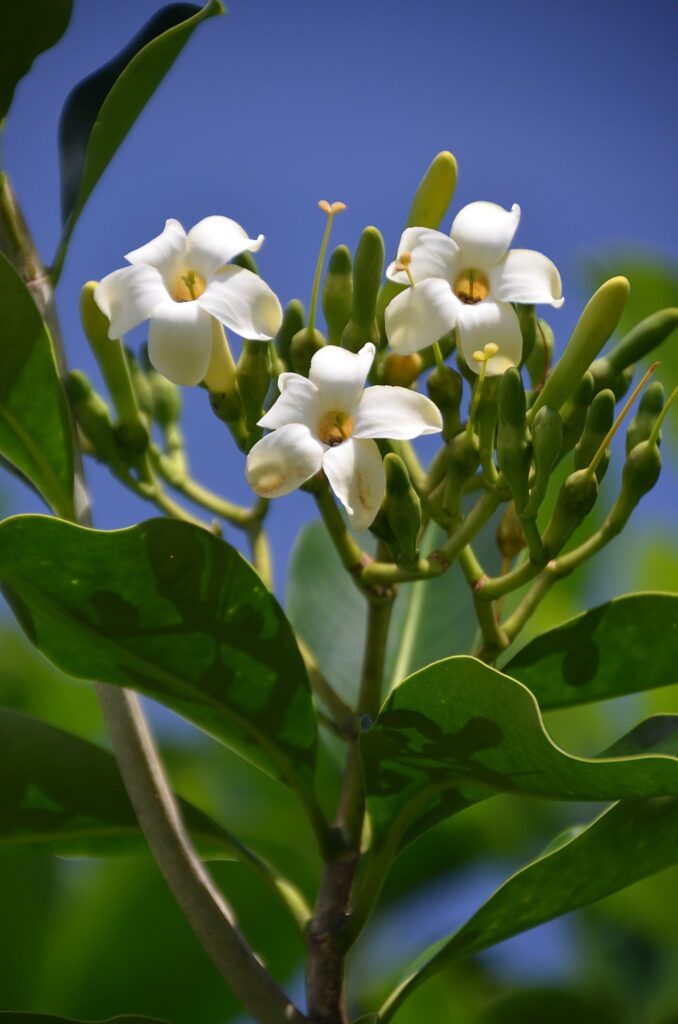
Fagraea berteroana (orth. variant F. berteriana), commonly known as the pua keni keni, pua kenikeni or perfume flower tree, is a small spreading tree or a large shrub.
It is known as the pua-lulu in the Samoan Islands, and as pua in Tonga and Tahiti.[3][4]
It is native to the tropical Pacific, ranging from Queensland and Papuasia (New Guinea, the Bismarck Archipelago, and Solomon Islands) to Micronesia (Caroline Islands, Gilbert Islands, and Marianas), Vanuatu, New Caledonia, Fiji, and parts of Polynesia (Cook Islands, Marquesas, Nauru, Niue, Samoan Islands, Society Islands, Tonga, Tubuai Islands, and Wallis and Futuna).[2]
The ITIS database clarifies the spelling of the name (“Published as “berteriana” in honor of Bertero; correctable to “berteroana,”..).[5]
The plant has quad-angular branches, blunt tipped leaves, and fragrant 7 cm tubular shaped flowers of creamy white, which become yellow with time.
It was introduced to Hawaii, where the flowers are popular for making lei. The tree’s name, in Hawaiian, means “ten cent flower”, referring to the sale price for a single flower in the past.[6]
-

Stem and leaves
-

Flower, fruit and leaves
-

Ripe and unripe fruits
-

Flowers and flower buds
-

Crown
-

White and orange flowers


,_Guam.jpg)

.jpg)


