
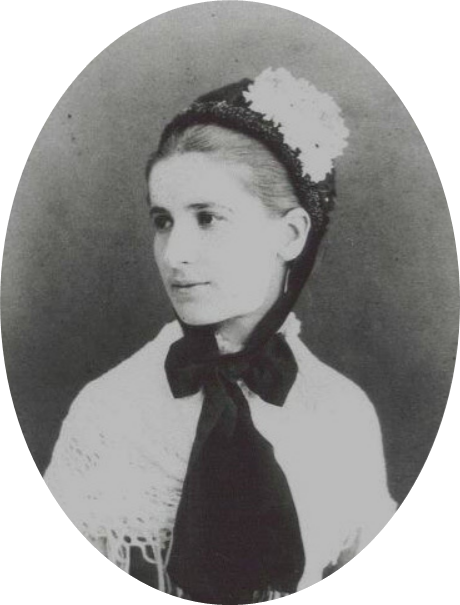
Montenegrin princess (1859–1896)
Olga Petrović-Njegoš (Cetinje, 19 March 1859 — Venice, 21 September 1896), was a Montenegrin princess, an only child of Danilo I, Prince of Montenegro and his wife, Darinka Kvekić, who was descendant of one of the wealthiest and most prominent families of Triestine Serbs.[1]
Biography


Early life and ancestry
Olga was born on 19 March 1859 in Cetinje, as a member of the House of Petrović-Njegoš, ruling family of the small Principality of Montenegro since 1697.[3] She was an only child of Danilo I, Prince of Montenegro and his wife, Darinka Kvekić, younger daughter of the rich Serbian merchant, banker and shipowner Marko Kvekić (1786-1855) from Trieste, and his wife, Elisabetta Cattarina Contessa de Mircovich (b. 1807) from Venice, niece of Conte Demetrio de Mircovich, owner of Villa Farsetti.[4][5][6][7] Alexander II of Russia and Eugénie, Empress of the French were appointed as Olga’s godparents, a delicate diplomatic choice that illustrated the strong dynastic ties linking their courts with Montenegro.[8]
During the first year of her life, Olga lived in the Biljarda Palace, surrounded by the devoted care of her parents. Her mother arranged the residence to her own taste, introducing European customs and etiquette, as well as French cooks and footmen—refinements she had grown accustomed to during her upbringing in Trieste.[9] When her father was assassinated in 1860, Olga’s first ceremonial role came while still an infant, carried on horseback in her mother’s arms, at the head of his funeral procession.[10] After the accession of Nicholas I, she and her mother departed quickly Montenegro for political reasons and took up residence in Venice. In accordance with the will of her father, Olga was placed under the guardianship of her mother until she reached the age of eighteen, and after that she was to come in to the inheritance and lands of her father. However, Nicholas I did not give permission to her or Princess Darinka to permanently return to Montenegro again once they had left, so she was never able to take control of her inheritance.
Upon their departure, the Montenegrin court agreed to grant Olga a dowry of 250,000 francs, payable upon marraige and an annual allowance of 5,000 francs. Dissatisfied with the sum, her mother requested an increase. Following the intervention of Hyacinthe Louis Hecquard, the French Consul in Skadar and Darinka’s ally, Prince Nicholas agreed to contribute an additional 5,000 francs from his personal funds, raising Olga’s annual support to 10,000 francs.[11]
He and his influential father, Olga’s paternal uncle, Mirko Petrović-Njegoš, Grand Duke of Grahovo, President of the Montenegrin Senate, were fond of her and they consistently expressed their readiness to oversee and support her upbringing and education, while reminding her she was always welcome back home.[12]
During her visit to the Russian Empire, which lasted nearly a year—from September 1861 until August 1862—Princess Darinka, labeled as a great Francophile, secured from Emperor Alexander II an annual pension of 4,000 silver rubles (16,000 francs) to provide for both her own support and her daughter’s education.[13]
After the fall of their protégé, Napoleon III and the Second French Empire, the temporarily loss of their previously granted annual French pension of 12,000 francs—combined with the misfortunes of the once-wealthy Kvekić family of Trieste, whom Darinka had long supported—left the princess and her daughter Olga in a precarious financial state. Following the death of her father, Marko Kvekić, misfortune befell the family when her brothers; Nikola and Jovan Kvekić, squandered the inherited family fortune. In an effort to assist them, Darinka transferred to the Kvekić family the dowry she had once received (150,000 francs), further straining her own financial security. Although their French pension was reinstalled during the Third Republic, but reduced to half (6,000 francs), the severity of their ongoing difficulties is evident in a letter from Olga to Prince Nicholas, in which she requested an advance of 12,000 francs from the dowry promised to her upon marriage.
Seeking broader relief, mother and daughter appealed to the prince directly, who provided 106,000 francs to settle their debts on the condition that ten and a half of the Princess’s annual Russian pensions be assigned to him. A formal contract to that effect was drawn up in 1875 in the Russian Consulate in Venice, and later personally approved and signed by the Emperor of Russia. Even this support proved inadequate to meet their expenses, sustain their extravagant way of life and lavish spending habits. A few years later the Montenegrin government guaranteed another loan of 40,000 francs in the names of Princess Darinka and her young daugher, Princess Olga. Amid ongoing financial difficulties, they considered returning permanently to Montenegro, but the Russian diplomatic service—eager to remove Darinka’s pro-French influence from court—opposed the idea, arguing that her creditors would follow them even to Cetinje, risking embarrassment for both the Prince and his government, especially if the Kvekićs accompanied her; under this pressure, the Prince relented and ultimately didn’t permit their return.[14]
Marriage prospects
.jpg)
Described as “an intelligent little girl who played the piano beautifully”, Olga was also noted for her fair prettiness and her timid, sweet-tempered personality.[16] Even in her youth, her future marriage was considered a matter of significant importance, frequently discussed and negotiated among family and political circles.
According to the reports of Serbian statesman Milan Nedeljković Piroćanac, her mother, Princess Darinka, hoped to see her daughter married to Milan Obrenović, member of the Obrenović dynasty and heir apparent to Mihailo III and the Serbian throne, citing provisions of the secret Serbian-Montenegrin treaty as validation. By then, however, relations between the two dynasties had cooled, and Prince Nicholas had no intention of supporting such a match.[17]
Around the same time, in the early months of 1867, Alexander Semenovich Ionin (1836-1900), the Russian consul in Dubrovnik, reported to the Ministry of Foreign Affairs of the Russian Empire, that Mihailo Obrenović, Prince of Serbia, who was persistently intent on replacing his wife Julia, had, through the mediation of his aide-de-camp, Colonel Ljubomir Ivanović (1836-1879), pledged himself in marriage to Olga’s mother, Princess Darinka. The envisioned union, however, was not merely personal; its deeper intention and purpose was the political consolidation of Serbia and Montenegro under a single sovereign authority.[18]
Based on the report dated 20 January 1867 by Franz Philippovich, Freiherr von Philippsberg (1820–1903), the Austrian Governor of the Kingdom of Dalmatia, Princess Olga had become engaged to her relative, Marko “Mašan” Petrović-Njegoš (b. 1854), member of the cadet branch of the Petrović-Njegoš dynasty. He was the younger son of Drago Petrović-Njegoš (1818–1872), who was a nephew of the renowned poet, philosopher, and ruler Petar II Petrović-Njegoš—one of the most significant figures in Montenegrin history—and his wife, Marija “Mare” Daković, the daughter of Jakov Daković and sister of Anto Daković, who both held the title Grand Duke of Grahovo. Because Marko’s elder brother, Duke Božo Petrović-Njegoš, had already been named heir apparent to the throne should Prince Nicholas die without a male successor, whispers emerged that Princess Darinka was maneuvering to alter the line of succession so that Marko—then only twelve years old and supposedly promised to Olga—might one day become the ruling Prince of Montenegro.[19]
Though of royal birth, Olga possessed no substantial property and lived in constant financial uncertainty. Expected to marry within royalty, she nevertheless remained unmarried, as her limited dynastic significance and lack of personal wealth reduced her prospects in the royal marriage market. Although she had been raised from an early age to possess all the personal qualities expected of someone of her rank—arguably surpassing those of many contemporary princesses—after the death of her ambitious mother from pneumonia in 1892, Olga’s prospects for a dynastic marriage diminished further.[20] While seeking inspiration for new characters, author Henry James once heard the story of Princess Olga, who was often referred to in high society as “the poor little princess with no fortune or art,” a remark that reflected her limited, nearly impossible—prospects for an equal marriage, while marrying outside royal circles was not considered acceptable.[21]
Life in Venice

.jpg)

The brutal assassination of her father, Prince Danilo, in 1860, together with the political intrigues that followed, compelled Princess Darinka and her daughter Olga to leave Montenegro and make their home in Venice in 1867. They established their permanent residence in the Palazzo Tiepolo, situated in the heart of historic Sestieri of San Polo, the smallest yet one of the oldest districts of Venice, known for its illustrious residents, elegant palaces and proximity to the Grand Canal.[25] According to contemporaries, special attention was given to Olga’s education, guided by the works of Italian senator Achille Mauri.[26] It was also recorded that:
“Having taken up residence in Venice, Darinka devoted herself entirely to her daughter’s upbringing. Olga was educated so as to bring honor to her House in every princely and aristocratic circle, a reputation she indeed gained—both among the elite and among the populace in Venice. Conscious of her House’s glorious name and of her immortal father, she held her name to be her highest sacred trust.”[27]
At her request, Olga was introduced to American writer Constance Fenimore Woolson through another writer Edith Wharton, and the two soon formed a warm and lasting friendship.[28] Clare Benedict, Constance’ niece, also a writer and a patron, met Princess Olga while traveling through Venice and recorded in her memoirs:
“My most recent acquaintance is Princess Olga of Montenegro. I have long wished to visit Montenegro, and Olga tells me it is now quite easy: you go to Rijeka, opposite Venice, and from there take a steamer down the Adriatic. Olga’s father was a prince [or king, as sometimes said]. After his death, his nephew inherited the throne, and the widow and her little girl came to Venice. The elder princess died last year, and Olga now spends her time with relatives—sometimes here, sometimes in Russia, sometimes with her cousin, the current ruler of Montenegro.”
“Like all Russians [!], she is marvelous in languages,” the Benedict continued. “She speaks English perfectly in all she says, though with a light foreign accent. It is a very sweet accent. She speaks half a dozen languages equally well. She is about twenty-eight years old; small, dark-complexioned, not ‘beautiful’ by some standards [?], but very interesting. She asked whether she might visit ‘very soon’ again, so I believe she intends to continue the acquaintance. The Emperor has granted her a pension.”[29]
During her years in exile, Olga moved in artistic circles and became acquainted with several renowned painters and artists; among them was the Italian painter Cherubino Kirchmayr, who is known to have sketched a portrait of her.[30] She also became acquainted with the painter John Singer Sargent while attending tea with her mother in the renowned Red salon of Contessa Andriana Marcello (1839–1893), widow of Conte Alessandro Marcello (1813-1871), who served as a Podestà of Venice and member of the Italian Parliament.[31] Olga formed a close friendship with their elder daughter, Contessa Teresa Agostini (1862–1946), a prominent figure in Venice’s salon society renowned for her refined intellect, and their correspondence, along with her other extensive literary exchanges, is still preserved in the Agostini–Marcello family archives.[32] She also cultivated a friendship with the philanthropist Isabella Stewart Gardner, whose famous guestbook bears her signature, and with an author Margaret “Madge” Vaughan, daughter of John Addington Symonds, whom she visited at her Swiss home in Davos.[33][34]
In Venice, Princess Olga became acquainted with Lady Layard (1843-1912), famous for her Journals, and her husband, Sir Austen Henry Layard, who were her neighbors at their sixteenth-century Palazzo Cappello Layard on the Grand Canal. Together, they often attended the opera and took part in the Venetian carnivals—notably in December 1888, when Olga appeared as a Turkish coffee bearer, and again in December 1890, when she was dressed as a “Dame Mince Pie,” (the traditional English Christmas cake).[35][36][37] She often joined the Layards for concerts, balls, and intimate dinners, where she enjoyed fine wine and played the piano in the evenings. In turn, they accompanied her and her mother to the Greek Church in Venice for Orthodox Christmas Day, afterward hosting joyful festive gatherings for a select circle of guests in their palazzo in honor of the celebration.[38][39] Over the years, Princess Olga changed her residence in Venice, moving with her mother, her aunt Aspasia, and her elderly maternal grandmother, Contessa Elisabetta Cattarina de Mircovich, to Palazzo Molin, in the San Stin Square. The Countess, then eighty-four and blind, was described by Layard as “a handsome old lady, but feeble and confined to bed.”[40] All three of the ladies would, in time, meet their end within the walls of this Venetian palazzo. After Darinka contracting pneumonia following a lecture by Giosuè Carducci at the Liceo—where she arrived late and was seated in a draughty doorway—Lady Layard often sent gifts of beef tea and port wine to ease her illness and to support Olga. All three—mother, daughter, and Lady Layard—were under the attentive care of the same trusted physician, Dr. Cini, who kept them informed of one another’s health.[41]
Lady Layard later wrote of “the terrible details of the death of the poor Princess of Montenegro”—that Darinka had remained conscious until the very end and had entreated the doctors to save her, saying she could not leave her daughter alone. Through the night, the Countess Papadopoli, her sisters, and the Duchess della Grazia kept vigil at her side, never leaving Olga for a moment. Even the gondoliers were allowed to enter the room to pay their respects to the dying grand lady.[42]
After her mother’s passing, Olga—composed yet deeply afflicted—was unable to shed tears, which, as her friends observed, caused her even greater suffering. The day after the death, she went to the Russian church with Contessa Nana Valmarana, to pray beside her mother’s coffin and, overwhelmed by grief, refused to receive visitors. A day after, Lady Layard tried to comfort her, gently saying, “Darling, try to live.”, to which she replied, “Darling, I want to live, but you see, I can’t, because God does not wish me to.” From that moment, she seemed resigned to die. For her mother’s funeral in Montenegro, she was accompanied by her distant cousin, Marina Pavlovna Ionina (1837-1900) née Petrović-Njegoš, the graceful wife of Alexander Semenovich Ionin, the Russian consul in Dubrovnik.[43][44] Upon her return to Venice, Olga remarked to her friends that Alexander III of Russia had been most generous, promising to pay her all debts and grant her a pension.[45] During the final years of her life, she often kept close to Baroness du Pury, herself an artist, and Layard’s nieces Olivia Du Cane and Lady Olwen Ponsonby.[46][47]
After Olga’s death, her only surviving aunt Aspasia moved out of the Pallazo Molin, and lived alone, in ill health, sad, poor, but proud, clinging to the glory of past days, her sour nature making her “not so beloved” among Venice high society.[48] In the years that followed, she entered royal service, becoming a lady-in-waiting to Olga’s cousin, Queen Elena—a position made possible by her previous family connections and one that provided her with some source of modest income.[49]
Visits to Montenegro

Despite her ongoing financial difficulties and life in exile, Princess Olga maintained a deep devotion for her country of birth and returned to Montenegro whenever circumstances allowed. She made several visits over the years—most notably in 1881, 1884, 1886, 1888, 1889, and 1892—demonstrating her enduring bond to the land of her birth and to her Montenegrin heritage.[50] At first, they stayed at the Cetinje Royal Palace, initially built for them, though it was later repurposed.[51]
Endowed with a fine voice and a deep affection for music, she frequently performed during her visits to her homeland. Her appearances at musical soirées held at the Court were especially well-received, where she often sang alongside her cousin, Princess Zorka of Montenegro, the eldest child and eldest daughter of Prince Nicholas I and his wife, Princess Milena. These refined gatherings were sometimes further enlivened by the participation of the children of foreign diplomats, creating a harmonious blend of local tradition and international charm.[52]
In addition to her love of music, Olga held a deep affection for the theatre. During a visit to Montenegro in 1881, she demonstrated her support for the performing arts in her native country by presenting a fine piano to the “Zetski Dom” (Montenegrin Royal Theater), an institution also supported by her cousin, Prince Mirko.[53]
In the autumn of 1888, Princess Olga arrived in Cetinje from Venice with her mother Darinka, and in their honor, Prince Nicholas arranged an exclusive court performance of his romantic-patriotic drama “The Balkan Empress“, originally staged in 1886, now revived before a select circle of carefully chosen guests.[54]
Her next visit to Montenegro came in February 1892, when she led the funeral procession of her mother, who had succumbed to pneumonia in Venice. It was her sole wish to fulfill her mother’s last desire—to be laid to rest in her homeland, among her people, “the Serbs“.[55][56] Following the funeral of her mother, Olga remained in Venice for several months before deciding to come back and spend the autumn of 1892 in the country of her birth with her cousins, but returned in the first half of December to be with her ailing maternal grandmother, whose health now was in serious decline.[57][58] It proved her last known visit to Montenegro.
During all these visits, Olga and her mother took part in the official gatherings, public life and court functions, formally receiving Cabinet ministers and diplomats—a privilege reserved for the ruling family—though their role in Montenegro remained purely ceremonial, and they were regarded only as an honored guests.[59]
Illness and death
.jpg)

.jpg)
Montenegrin press frequently reported on Olga’s health, which had become increasingly fragile two years after the passing of her mother. According to the Lady Layard’s Journal, Dr. Cini informed her that Princess Olga fell ill with an incurable disease that has declared itself internally and fixed on her lungs (lung cancer), despite having had an operation in 1895.[62][63] Though gravely ill, Olga remained composed, sitting up in bed despite her frailty and cold hands, and spoke with quiet hope of recovery in her final days.[64] That illness necessitated a winter spent in Cairo, but by summer it had grown overwhelming and ultimately claimed her life. In the final days of her life, Prince Tommaso, Duke of Genoa, received daily telegrams concerning her condition, while Vittorio Emanuele, Count of Turin, his relative, paid frequent visits to her Palazzo Molin upon his return from military maneuvers in the German Empire.[65] The Italian press reported that the abjuration of her cousin, Princess Elena of Montenegro, who was converting from Orthodoxy to Catholicism on the occasion of her wedding to the Prince of Naples, planned for the second fortnight of October 1896, might face further delays due to the serious illness of Princess Olga in Venice.[66]
On the morning of 21 September 1896 (9 September according to the Julian calender observed in Montenegro), at 7:45 a.m., Princess Olga died at her Palazzo Molin at San Stin Square, Venice, aged 37. According to reports in the Italian press, she had endured a long and painful illness. Feeling her strength fading, she summoned Dr. Cini to her bedside shortly after 7:00 a.m. and quietly dictated the names of those with whom she wished to share her final moments.[67]
When the news of Olga’s death reached Cetinje, the Court Church in Ćipur bells tolled. Later that same day, a memorial service was held in the monastery church, attended by the ruling family, Russian, French, and Greek diplomatic representatives, dignitaries with their ladies, and a large gathering of citizens in mourning attire. Her death was announced in the Montenegrin press with a following article:
“From the sea to the Tara, Montenegrins truly share the sorrow of the House of Petrović-Njegoš. Her Serenity, Princess Olga—the only child of the immortal Prince Danilo and the last dear sister of His Highness, our sovereign Prince Nicholas—after a long, incurable illness, departed this life in Venice on 9 September 1896.”
In Venice, the funeral began with local Greek clergy at the Orthodox Church of St. George, followed by members of the Greek colony, friendly families, and the Venetian nobility. With gondolas, wreaths, and flowers, her body was placed aboard the Austro-Hungarian steamer “Crkvenica“, accompanied by Montenegrin adjutants Slavko Slava Đurković and Niko Pejanović, as well as Olga’s aunt Aspasia Kvekić, the sole surviving member of her generation, the only one of seven siblings left to mourn. Their late mother Elisabetta, with quiet dignity and unimaginable sorrow, had borne the misfortune of outliving all her children but one.[68]
When the steamer arrived in Cattaro, then part of the Austro-Hungarian Empire, the body was received by Montenegrin government officials and clergy of the Metropolitanate of Montenegro, along with priests from the Bukovina-Dalmatian Metropolitanate. Two local Montenegrin priests—Jovan Radonjić from Njeguši and Ilija Jovićević from Rijeka Crnojevića—were noted as receiving the coffin. Authorities from the Principality of Montenegro also journeyed to Cattaro (Kotor) to greet the procession: Minister Nikola Matanović, Deputy Foreign Minister, Commander Mitar Boškov Martinović, Officer Stevo Jovićević, and the Montenegrin agent in Kotor, Pero Ramadanović. At the Montenegrin-Austro-Hungarian border, the funeral cortege was received with full honors by two of Olga’s cousins; Crown Prince Danilo and Duke Božo Petrović-Njegoš, once a contender for the Bulgarian throne in 1879, now served as the Prime Minister of Montenegro. Both were escorted by a detachment of the princely guard.[69] The Crown Prince formally reviewed the Austro-Hungarian troops assigned to accompany Olga’s funeral procession, acknowledging their presence with a measured display of courtesy. He also exchanged greetings with their commanding officer, a gesture of diplomatic respect.
The procession carried the coffin along the main route, where local congregations also joined. In Cetinje, the whole population came out to join the sad, mournful procession. The coffin draped in white silk with gilded trim under a canopy and surrounded by wreaths, then the ruling family, diplomats, relatives, dignitaries, and clergy. Upon arrival at the Cetinje Monastery, the coffin was carried solemnly into the church by the sovereign, the heir, relatives, and dignitaries. A brief memorial service was held, followed by final prayers and the burial in a new tomb adjacent to her mother’s. Gunnery salutes accompanied the burial, concluding the funeral ceremonies.[70] Princess Olga’s funeral was also attended by every member of the Montenegrin royal family and the whole diplomatic corps. Special, big wreath of fresh flowers was sent by Queen Margherita of Italy, soon to be mother-in-law of her paternal cousin, Princess Elena.[71][72] On the eve of the 200th anniversary of the Petrović-Njegoš dynasty, Olga’s death halted preparations and resulted in the postponement of the official visit of King Alexander I of Serbia to Montenegro.[73]
Legacy
During her lifetime, Princess Olga devoted herself to the humanitarian activities of the Montenegrin Red Cross, extending assistance to the sick and wounded, supporting relief efforts, and taking part in sanitary and medical aid work.[74] In 1890, a hospital in Podgorica, named Knjaginja Olga Danilova (Princess Olga Danilova), was established in her honor.[75] One of the articles printed posthumously on 30 September 1896 in “Bosanska vila” was dedicated to Princess Olga Danilova, as she was commonly known in Montenegro, whose noble origin, education, and cultural engagement abroad embodied the contemporary ideal of womanhood. The magazine, devoted to women who offered inspiration and support to national and cultural causes, commemorated her as a figure of dignity, intellect, and devotion to her people.[76][77]

