
American Pigeon Journals Available as PDF files 1941 – 1950
| year | Jan | feb | Mar | Apr | May | Jun | Jul | Aug | Sep | Oct | Nov | Dec | |
|---|---|---|---|---|---|---|---|---|---|---|---|---|---|
| 19 | Jan | Feb | Mar | Apr | May | Jun | Jul | Aug | Sep | Oct | Nov | Dec | |
| 19 | Jan | Feb | Mar | Apr | May | Jun | Jul | Aug | Sep | Oct | Nov | Dec | |
| 19 | Jan | Feb | Mar | Apr | May | Jun | Jul | Aug | Sep | Oct | Nov | Dec | |
| 19 | Jan | Feb | Mar | Apr | May | Jun | Jul | Aug | Sep | Oct | Nov | Dec | |
| 19 | Jan | Feb | Mar | Apr | May | Jun | Jul | Aug | Sep | Oct | Nov | Dec | |
| 19 | Jan | Feb | Mar | Apr | May | Jun | Jul | Aug | Sep | Oct | Nov | Dec | |
| 19 | Jan | Feb | Mar | Apr | May | Jun | Jul | Aug | Sep | Oct | Nov | Dec | |
| 19 | Jan | Feb | Mar | Apr | May | Jun | Jul | Aug | Sep | Oct | Nov | Dec | |
| 19 | Jan | Feb | Mar | Apr | May | Jun | Jul | Aug | Sep | Oct | Nov | Dec | |
| 19 | Jan | Feb | Mar | Apr | May | Jun | Jul | Aug | Sep | Oct | Nov | Dec |
xxxxxxxxxxxxxxxxxxx
American Pigeon Journals Available as PDF files 19?? – 19??
| year | Jan | feb | Mar | Apr | May | Jun | Jul | Aug | Sep | Oct | Nov | Dec | |
|---|---|---|---|---|---|---|---|---|---|---|---|---|---|
| 19 | Jan | Feb | Mar | Apr | May | Jun | Jul | Aug | Sep | Oct | Nov | Dec | |
| 19 | Jan | Feb | Mar | Apr | May | Jun | Jul | Aug | Sep | Oct | Nov | Dec | |
| 19 | Jan | Feb | Mar | Apr | May | Jun | Jul | Aug | Sep | Oct | Nov | Dec | |
| 19 | Jan | Feb | Mar | Apr | May | Jun | Jul | Aug | Sep | Oct | Nov | Dec | |
| 19 | Jan | Feb | Mar | Apr | May | Jun | Jul | Aug | Sep | Oct | Nov | Dec | |
| 19 | Jan | Feb | Mar | Apr | May | Jun | Jul | Aug | Sep | Oct | Nov | Dec | |
| 19 | Jan | Feb | Mar | Apr | May | Jun | Jul | Aug | Sep | Oct | Nov | Dec | |
| 19 | Jan | Feb | Mar | Apr | May | Jun | Jul | Aug | Sep | Oct | Nov | Dec | |
| 19 | Jan | Feb | Mar | Apr | May | Jun | Jul | Aug | Sep | Oct | Nov | Dec | |
| 19 | Jan | Feb | Mar | Apr | May | Jun | Jul | Aug | Sep | Oct | Nov | Dec |
xxxxxxxxxxxxxxxxx
Breed of pigeon
.jpg)
American Show Racer |
|
| Conservation status | Common |
|---|---|
| Other names | Show Pen Racer |
| Nicknames | Bird of Dignity |
| Country of origin | United States |
| Crest type | none |
| Feather ornamentation | none |
| Australian Breed Group | Group 4 Homers and Hens |
| US Breed Group | Form |
| EE Breed Group | Formentauben |
| This breeds development included several names from Show Pen Racer, Show Racing Homers, and the now accepted Show Racer | |
American Show Racer
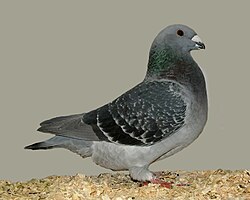
This breed of pigeon began being crafted over 100 years ago[1] in the United States with selective breeding It is primarily considered a show breed of form rather than racing. The Show racer along with other varieties of domesticated pigeons are all direct descendants of the rock dove (Columba livia). It was also known as also known as the Show Pen Racer. Pigeon historian Wendell Levi mentions Show Pen Racers in his book The Pigeon.[2]
-
-
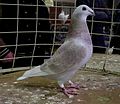
British Show Racer
-

Characteristics
The entire pigeon is wedge-shaped from head to toe, standing around nine inches tall, and weighing just over a pound. The cocks are slightly larger than the hens by an once or two. There is no feather ornamentation of any kind, the breed relying completely on form and condition. The head is smooth, broad, and stout, in an unbroken curved oval. It measures about 1.5 inches in length, without a prominent forehead or stop above the nose wattle. The wattle is heart shaped on a medium length and thickness of beak, smooth in texture and free from coarseness. The eyes are a dark red chestnut color, with small, smooth, neat, and finely laced, dark or plum colored cere. The tail is rather short, having the usual 12 tail feathers but lying so tightly on one another as to appear as a single feather. The legs are short to medium length, dark in color, and have no feathering below the hocks. The bird stands rather horizontally, keeping the tail well off the ground[3]
Bill Schlieper nicknamed the it “Bird of Dignity.”)[4]
Colors
Colors now run the full range from the original of blue/black and ash reds, to Dun, Silver, Splashes, Grizzles, Opal, Andalusian, Almond, Recessive Reds and Yellow, Yellow bar and check, Indigo bar and check, and White bar.
History
From the very beginning, the ordinary flying Homer was crossed with an Antwerp to get the substance, a Scandaroon to get the length of head and curve of the top of’ the skull, and with the Cumulet to get the delicate cere around the eyes.[5] The American Pigeon Journal displayed the Show Homer, bred by Neuerburg on its cover in May 1927. Showing began during the late 1920s and 1930s, on the east coast but it was not until the early 40s that a standard was drawn to guide the breed’s development. Breeders on the west coast, including Twombly, also began developing the breed and by the early 1950s they were being shown at the famous Pageant of Pigeons show,
[6]
The breeds further development had firmly become national in scope. By the 60’s with the aid of established standard the breed, breeders in the Nortwest began outcrossing with other breeds to incorporate new colors without changing form. Earl Dean of Wichita, however, is credited with establishing the rare colors now found in the breed.[7]
Status
The American Show Pen Racer Club was formed at the National Show held in Des Moines, Iowa in 1952. As years passed, the word “pen” was removed from the club name and it was officially changed to The American Show Racer Association (ASRA). The The National Pigeon Association recognized the breed during the 1960’s standardizing the name and adopting a national standard of perfection. The breed is popular in November 2007, at the Pageant of Pigeons held in San Bernardino, California, approximately 150 were entered by 15 exhibitors.[8] They are shown at all major shows across the country. Frank Barrachina expedited the breed’s expansion into Europe. It was recognized in Europe at the 71st National Poultry Show in Nuremberg in 1989. By 1998 in Germany, 38 exhibitors exhibited 408 show racers in 23 color varieties, and the breed is also known in South Africa, New Zealand and Australia.[9]
The standard has remained largely unchanged, but the standard was updated and in the year 2000, a new standard drawing was created,.emphasis is placed on “station” (which includes an upright posture) and a powerful head.
The ASRA currently[as of?] has approximately 150 members in 37 US states and seven other countries. It is an affiliate club of the National Pigeon Association.
Diet
Pigeons are fed either a raw whole grain or a pellet mix designed specifically for pigeons. There are mixes on the market designed specifically for pigeons. Inorganic materials are also needed in their diets, including salts, minerals, and calcium. Mixes made specifically for pigeons are readily available, called pigeon grit. Clean water is naturally also required. Pigeons suck water to drink, as you do with a straw. A container with at least one inch or more of free standing water is perfect.[10]
Gallery
-
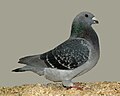
Blue Check
-

Red check
-

Blue Check
-

Blue Check
-

Dark Blue Check
.jpg)

.jpg)
.jpg)
See also
External links
References
- ^ American Pigeon Journal May 1932
- ^ Levi, Wendell (1977), The Pigeon, Sumter, S.C.: Levi Publishing Co, Inc, ISBN 0-85390-013-2
- ^ Show Racer Standard National Pigeon Association 1979
- ^ Schlieper, Bill (August 1997), “Success to the ASRA “The Bird of Dignity”“, Pigeon Debut – American Show Racer Special
- ^ American Pigeon Journal May 1932
- ^ American Pigeon Journal August 1973
- ^ Pigeon Debut March 1993
- ^ Connally, Doratha (Jan–Feb 2008), “America Show Racer Show Season”, Purebred Pigeon
- ^ Geflügel-Börse 1999 #19 Show Racer
- ^ “National Pigeon Association”. www.npausa.com.

