
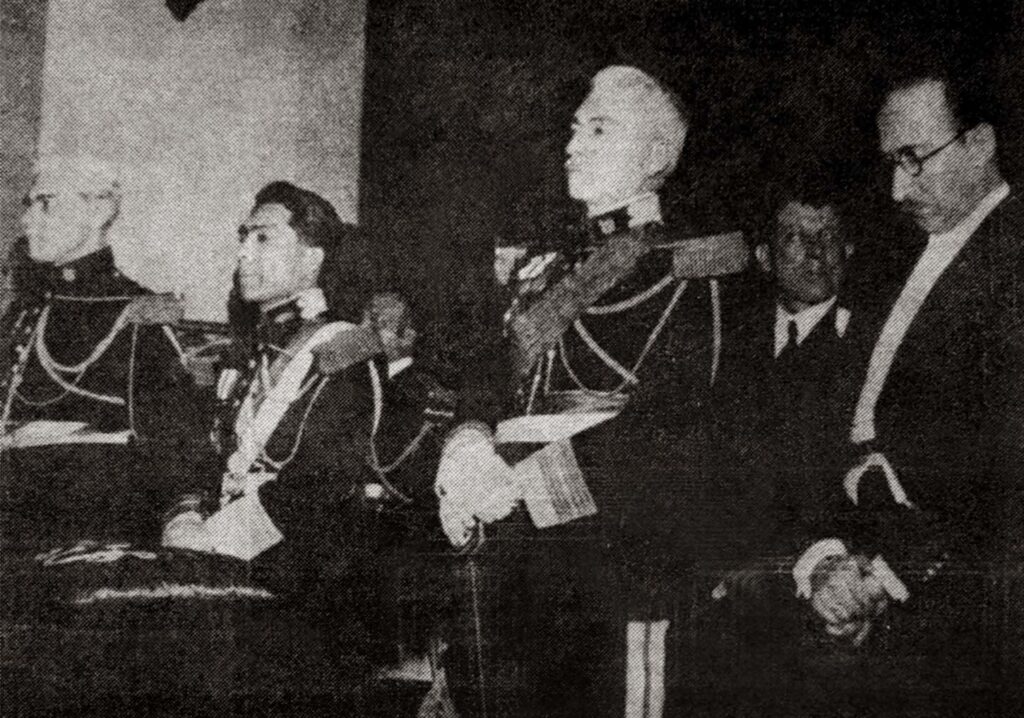
Period of Peruvian history, 1930–1939
The Third Militarism (Spanish: Tercer Militarismo) was the period between 1930 and 1939 in Peruvian history, in which Peru was ruled by a military dictatorship.
In 1930, dictator of Peru, Augusto B. Leguia, was ousted by military forces led by Luis Miguel Sánchez Cerro in the 1930 Peruvian coup d’état, ending his regime known as the Oncenio. Sánchez Cerro ruled a military junta for 6 months, which oversaw the liquidation of the Oncenio and the rise of the left-wing American Popular Revolutionary Alliance (APRA) in politics. By 1931, he forced to resign due to opposition from many sectors of the nation. After a month of political instability with 3 temporary presidents, David Ocampo assumed the presidency for 8 months and reformed the electoral law until elections were called, which Sánchez Cerro won.
Sánchez Cerro’s 2-year presidency (1931–1933) was marked by heavy repression of APRA, through the use of martial law and arresting many of the party’s followers, known as Apristas. The Apristas fought back, conspiring with dissident military officers and starting uprisings, such as the 1932 Trujillo uprising. In the same year, Peruvian forces illegally marched into Colombia, beginning a border conflict which lasted a year. In 1933, Sánchez Cerro was assassinated, which led to General Oscar Benavides taking power.
Benavides’ regime (1933–1939) was initially conciliatory and hoped to build a rapport between APRA and the government. However, discord between the government and APRA erupted soon after, and repression of the party was resumed. His term was meant to end in 1936, with a new president being elected in the 1936 Election. However, when Luis A. Eguiguren won with votes of the banned APRA, the results were declared invalid and Benavides continued ruling until 1939 as dictator. Benavides’ term was also marked by Italian fascist influences in the country, spread by propaganda newspapers and the country’s Italian diaspora. Following a failed coup d’état against him, new elections were held in 1939, in which Manuel Prado Ugarteche was declared the winner, restoring civilian rule in Peru.
Downfall of the Oncenio
[edit]
In 1919, Augusto B. Leguía carried out a coup d’état in Peru, leading to the establishment of an 11-year period (known as the Oncenio) from 1919 to 1930 in which he ruled the country as a dictator.
In 1929, the United States stock market crashed, beginning a worldwide economic crisis known as the Great Depression. Built on economic support from the United States and foreign corporations, Peru was heavily affected. As a result of the economic crisis, the country’s banks went bankrupt. Export prices of copper, wool, and cotton fell as much as 70 percent. Mass unemployment was an issue, with many in the mining industry, government bureaucracy, and the middle-class working as clerks, were laid off. This was a partly a result of all public works being discontinued. Leguía became the target of these attacks and was ultimately blamed for the crisis.
Coup d’état of 1930
[edit]

On 24 August 1930, Lieutenant Colonel Luis Miguel Sánchez Cerro, with the aid of civilian political leaders in Arequipa, led a coup d’état against the government. Sánchez Cerro proclaimed himself: “Commander in Chief of the Southern Army” and: “Chief as Government”, in which he guaranteed the normalisation of all commercial and civil activities in Arequipa for all residents of the city, which would be enforced by his rebel militia. On the same day, he appointed his secretaries who were:
- Major Alejandro Barco (Military Affairs)
- José Luis Bustamante y Rivero (Political Affairs)
- Manuel A. Vinelli (Financial and Administrative Affairs)
- Major Rubén del Castillo (Postal Affairs and Transmissions);
- Major Julio Arboleda Viñas (Transportation and Communications)
- Gustavo de la Jara (Comptroller General).
On August 25, he announced the appointment of investigative committees in a decree endorsed by future president Bustamante y Rivero.
The coup quickly gained the support of garrisons in Cuzco and Puna, and opposition quickly mounted against him in the capital city, Lima. He resigned and escaped on the cruiser Almirante Grau. For reasons which have been subject of historical debate, he arrived back to Peru at Callao, where he was arrested and detained, later exiled from Peru.
Military junta, 1930
[edit]
Sánchez Cerro’s arrival in Lima was hailed by the general populace. He became a national hero, gaining the support of the popular masses. For the rest of his political career, his support would be based on the masses.
There was opposition to him from the upper-classes. Many intellectuals disliked him due to his lack of a political philosophy, while Aristocrats were still very conscious of his partly-negro skin colour (Sánchez Cerro was a cholo). This enhanced his appeal to the common citizen, however, especially to the poor and young members of the military.

With the removal of Leguia from office, the country entered a political and economic crisis caused by the disappearance of many of its traditional political parties, and their replacement by new parties which preached social revolution and denial of national sentiment.
Liquidation of the Oncenio
[edit]
With Leguía exiled, his political opponents who had been exiled during his regime returned. One such was Victor Raúl Haya de la Torre, who was founder and leader of the American Popular Revolutionary Alliance (APRA), a leftist anti-leguia party founded by Mexican students who had been exiled from Peru in 1924. With the Oncenio destroyed, APRA quickly became the major political organisation in the aftermath of the 1930 coup d’état.
Civilians looted and burned the houses of Leguia’s supporters after the change of government, including Leguia himself. Some newspapers began a series of denunciations and accusations against leading figures of the Leguia regime. The anti-leguia newspaper Libertad directed by Fransico A. Loayza, reached 70000 to 80000 copies.
Actions of the Government
[edit]
Once in office, Sánchez Cerro abolished the conscripción vial, the forced public work introduced by Leguia, which garnered him popularity among the masses. He arrested Leguia’s followers and government officials, distributed food to the poor, and decreed the legalization of civil marriage and divorce. These actions were mainly meant to ensure that the urban poor would support him in the upcoming elections.
Relations with APRA and end of the Military Junta
[edit]
Upon his inauguration, several aristocratic groups were formed which aimed to remove him from power and install one of their own in the presidency. In addition, a pro-APRA rival figure, Gustavo A. Jiménez, challenged him. He shared the same motives as the party; that in order for Peru to its solve problems, the country needed to wage class warfare against its upper classes.
After establishing a brief alliance with APRA against Leguia’s supporters, he was forced to repress it by foreign firms which dominated the export economy of 1930. In September and November 1930, workers in the Cerro de Pasco Corporation mining camps were unionised by the Peruvian Communist Party and called a strike. Sánchez Cerro and his APRA-leaning minister of government, Gustavo Jiménez, were slow to respond, and as a result, faced a campaign of strong pressure from foreign mining and oil firms together with British and American embassies. Their aim was to have APRA repressed and Jiménez dismissed for his pro-worker sympathies. A clash broke out between police forces and the strikers at Malpaso, leaving a number of workers dead and triggering riots, which gave Cerro Corporation an opportunity to close down its company, and demand terms to the government. Still in the aftermath of the great depression, he had no choice but to accept these terms. Following the incident, he would continuously repress APRA.
With the fallout of relations between APRA and Sanchez Cerro, APRA began to initiate revolts in Cuzco and other cities. These were promptly suppressed by Sanchez Cerro, who arrested their perpetrators. In response to this, APRA directed appeals to young military officers, asking them to overthrow Sanchez Cerro. Furthermore, his announcement that he would run for presidency while still head of the military junta caused a revolt in Arequipa. Faced with opposition from the aristocracy, APRA and rival military officers, he stepped down, before vowing to return for the next presidential election.
Political crisis and ‘Ocampo’s junta
[edit]
Following Sanchez Cerro’s resignation, archbishop Mariano Holguín assumed the presidency for a few hours before it was handed over to Leoncio Elías. Elías formed a Military Junta, however its unpopularity led him to hand over power to David Samanez Ocampo after a meeting on 4 March 1931. This transfer of power never happened as Gustavo Jiménez overthrew Elías on 5 March, but Ocampo’s popularity forced him to hand power back to him on 10 March.
Ocampo’s 8-month Junta
[edit]
During his brief tenure, he reformed the electoral law in March 1931, by abolishing property requirements for voting and introduced the secret ballot, these changes expanded the electorate by 60%. He also transferred power to supervise elections from provincial authorities to departmental authorities. These changes reduced the ability of Gamonales (wealthy landowners) to dominate elections and opened more electoral prospects for parties whose support was based on the popular masses. They may have been made with the intention of improving APRA’s chances of winning the elections.
With popular resistance to the new Junta due to the departure of Sánchez Cerro, it was decided that Victor Haya de la Torre and Sánchez Cerro, would both be urged to withdraw from the 1931 Election. Initially, Sánchez Cerro who was in Paris at the time agreed, but after APRA refused to withdraw its candidate, he refused, planning to return to Peru for the elections. The Junta attempted to stop him, by instructing the Peruvian consular service in Europe not to supply him a required visa. However, when he insisted that he would return with or without one, together with his popular support of the masses, the Junta permitted his return.
With most of Peru’s traditional political parties extinguished, a new party, the Revolutionary Union, emerged to back Sánchez Cerro. It was formed by his supporters, mainly Antonio Miro Quesada, owner of the conservative newspaper El Comercio. El Comercio carried out a series of attacks on Haya de la Torre and APRA, which damaged their campaign in Lima. Sánchez Cerro took an extensive tour around the country, which brought him to some extremely remote areas of the country to explain his party’s programme. His programme called for “hard work and sacrifice” and “to acknowledge the abilities of all races to contribute to Peru.” He also called for the expropriation of the unutilized portions of large agrarian holdings, administrative decentralisation, a stable currency, and a balanced budget.

Haya de la Torre offered his programme based on Marxism-Leninism, depicting the Upper-classes and the clergy as “black-hearted knaves” and denounced Capitalism as well as foreign investment. He remained vague on specific economic policies to solve the economic crisis, other than recommending Bimetalism. He directly appealed to the middle class, small and medium-size farmers, and small businessmen who had suffered from the expansion of the Grace Corporation‘s holdings in the Trujillo region. These would be the core of APRA’s support. The party hoped to establish a broad alliance of the middle sectors, urban working classes and Indian peasantry in the mountain areas. This alliance was never achieved, as much of Peru’s farmers were unable to vote due to literacy restrictions. Haya de la Torre’s rhetoric, appeared unconvincing to many. The army also feared APRA, as it could have posed an armed challenge to them.
As the election day drew closer, Revolutionary Union rallies consistently outdrew those of APRA. The situation became violent, when about 20 Revolutionary Union supporters were killed. At the end of the election, Sánchez Cerro won the election with 152062 votes to Haya de la Torre’s 106007, with 2 other minor candidates scoring around 40000 votes. APRA rejected the results of the election and alleged that the Revolutionary Union had committed fraud.
Sánchez Cerro, 1931–1933
[edit]
Once Sánchez Cerro was elected, the party immediately began making connections with dissident armed forces to overthrow the new regime.
In the 1930s, APRA frequently attacked capitalism in general and foreign investment in Peru. It also attacked the influence of religion and declared that it was necessary to destroy “whatever Spain had brought to the country.” In December 1931, El Comercio published documents allegedly containing proof of Aprista plans for revolution. Anticipating that this would push the government to destroy APRA by force, Haya de la Torre called a meeting in Trujillo on 8 December, where he gave a speech which signaled to his followers to rise up against Sánchez Cerro’s regime and install him in the presidency.
The same day that Sánchez Cerro’s was inaugurated, the new constituent assembly began its first sessions. The APRA delegates of the assembly carried out obstructive tactics and insistence upon “revolutionary innovations”, which antagonized the large majority of the assembly. In response to APRA’s maneuvers, Sanchez Cerro declared martial law in January 1932. On 8 January, the government installed the Emergency Law, which authorized the executive branch to impose judicial sanctions, to suspend congress, and to close centers or associations. On 20 February, the University of San Marcos was closed. In February, 23 Aprista deputies in the assembly were deported together with Gustavo Jiménez. In March, an Aprista assassination attempt was carried out on Sanchez Cerro. APRA denied affiliation, stating that the assassin had distanced himself from the party, “realizing that violence was not permitted in APRA”. In May, an aborted Aprista uprising in Callao was carried out. Haya de la Torre was arrested the same month.
On 7 July 1932, APRA forces carried out a revolt in Trujillo. After 5 hours of fighting, APRA forces succeeded in taking over the city, and most of its pro-APRA civilian populace had been armed. The government responded quickly, ordering the cruiser Almirante Grau to Salaverry and bringing troops from nearby cities to quell the rebellion. By night, APRA’s defeat seemed imminent. On 8 July, top-level APRA leaders fled the city. Many Trujillo civilians continued to fight. The revolt was declared over on 18 July, with prisoner of war executions carrying on until 27 July. Though the revolt caused most officers of the armed forces to antagonize APRA, the party now provided an outlet for those who were discontented with the regime to leverage change in the military and society.
Border conflict with Colombia
[edit]

Dating back to 1821, the Colombian–Peruvian border had always been subject of dispute, sometimes resulting in military action. In 1922, the Salomon-Lozano Treaty was signed, handing over the port of Leticia and a large area of forest to Colombia, much to the dissatisfaction of the Peruvian populace. On September 1, 1932, about 200 armed Peruvians seized Leticia. On October 21, the Colombian town of Tarapacá was also taken by Peruvian forces.
At first, Sanchez Cerro condemned the incident, but after APRA used his reluctant stance to carry out a propaganda campaign against him, he decided to support the idea of war against Colombia. APRA’s campaign to launch “all-out war” against Colombia was popular among the masses, and he feared for his own popularity if he did not endorse the incident. He nationalized the conflict, ordered the entire army to be mobilized, army drafting to be fully activated, and appointed general Oscar R. Benavides as the head of a military defence board with the duty of carrying out a military campaign. The conflict ended in 1933 after the assassination of Sánchez Cerro.
Assassination of Sánchez Cerro
[edit]
On 13 April 1933, while leaving the San Beatriz racetrack after examining about 25000 men who had been mobilised in the conflict against Colombia, Sánchez Cerro was assassinated by an Aprista named Abelardo Mendoza Leyva. In the aftermath, Congress chose Oscar Benavides to assume the presidency, though this was against the 1933 constitution which stated that no active members of the military could assume the presidency.
Benavides, 1933–1939
[edit]
End of the conflict with Colombia
[edit]
Benavides’s first actions were to begin negotiations with the president of Colombia, Alfonso López Pumarejo, regarding the conflict between their nations. As a result of the negotiations, Peru and Colombia jointly accepted a proposed cease-fire prepared by the League of Nations to end the conflict. From October 1933 to May 1934, meetings for a permanent settlement were commenced in Rio de Janeiro, which resulted in a status quo ante bellum; Peru was to abide by the terms of the Salomón-Lazono Treaty. In the aftermath of the settlement, Peruvian forces withdrew from Leticia and the army was demobilised.
Internal politics, 1933-1936
[edit]

Upon the beginning of his presidency, rumors were sparked accusing him of involvement in the assassination of Sánchez Cerro. At a press conference in Washington, he criticized the government’s harsh repression of APRA. After Sánchez Cerro’s assassination, he also dispatched troops to the Lima penitentiary which thwarted plans to execute Haya de la Torre.
Operating under the slogan “Paz, Orden, Trabajo” (Peace, Order, Work), and promising an administration of “Peace and Concord” at his inauguration, he took a moderate and conciliatory stance to the country’s internal politics, attempting to reconcile with APRA. His prime minister, Jorge Prado Ugarteche, served as a moderate and conciliator between APRA and the government. On 10 August 1933, a partial political amnesty was decreed, allowing many APRA supporters and members to be released from prison, including Haya de la Torre. The brief conciliation sparked rumors that he had also conspired with APRA in the assassination of Sánchez Cerro.
Many supporters of the ex-president were alienated from Benavides’ for his decision to end the conflict with Colombia. Between May and November 1933, the Sánchez Cerro’s supporters grew violent, and launched a revolt in Iquitos. Benavides’ moderate approach also drew hostility from right-wing and nationalist groups such as the Revolutionary Union, which had become increasingly fascist under its new leader, Luis A. Flores. Several of the party’s members were arrested for planning an assassination of the president. His administration was also criticized by El Comercio. He had hoped for APRA’s support in defending his regime, but the party gave little aid to his administration. APRA believed that Benavides had not done enough to dismantle Sanchez Cerro’s regime and that his political concessions were forced by the power of public opinion in favor of APRA.
Benavides held 3 personal meetings with Haya de la Torre. In these meetings, and in the press, APRA made several demands to the government. The party demanded the revocation of the Emergency Law, full restoration of civil liberties, and pardons for all Apristas convicted of crimes. Most importantly, the party pressed on the reinstallation of all 23 APRA delegates who had been ousted from the legislature in 1932. Excluding the reopening of San Marcos University in 1935, most of these demands were never fulfilled. Though Benavides promised that he would not abuse the Emergency Law, and that congressional elections would be scheduled soon. The elections were postponed to September 1934, as the government reasoned that the current congress needed time to accept the Rio Protocol first. This caused tensions between APRA and the government to rise again.
In July, the government demanded APRA to stop its plans to commentate the Trujillo Uprising. The party refused and carried out its rallies on 7 July, leading police forces to disrupt their rallies throughout the country. A new round of strikes led by APRA unions began. In mid-August, the party’s headquarters and newspapers were closed by the government. As September approached, the Rio Protocol had not yet been approved, and the government delayed the elections to November. Late in October, Haya de la Torre was nearly killed in an airplane malfunction. APRA accused the government of having rigged the aircraft. On 1 November, the election was delayed again, supposedly to purge fraudulent voters from the elections. On 2 November, the Rio Protocol was accepted by congress.
Jorge Prado was also forced to resign as prime minister in November due to mounting political pressure and opposition. Benavides’ replaced him with José de Riva Agüero, an intellectual conservative, who advocated for harsh repression of APRA.
On 26 November, APRA carried out a revolt led by César E. Pardo, the party’s secretary of defense, which was defeated by the end of the month. In December of the same year and January of 1934, unsuccessful attacks were carried out in Ayacucho and Huancavelica respectively. The regime arrested nearly 1000 Apristas, including many top-level leaders, though Haya de la Torre remained unarrested. Shortly after the rebellions were quelled, Benavides passed new legislation which increased penalties for political opponents and rebels of the government, while also passing legislation which increased his emergency powers. The regime outlawed Aprista and Communist worker organizations.
On 25 May 1935, Antonio Miro Quesada, the publisher of El Comercio, was assassinated by a man named Carlos Steer. Under the terms of the Emergency Law, the assassin was to be given a death sentence by a military tribunal, but was given 25 years in prison instead. This garnered more anti-Benavides sentiment among extreme conservative groups and began a conflict between Benavides and the the Miro Quesada family.
Benavides’ term was to end in December 1936, at the end of Sánchez Cerro’s term. The president declared that he had no desire to remain as president and scheduled presidential and congressional elections for October 11.
Annulled 1936 election
[edit]

Oscar Benavides had hopes to form a broad coalition representing the center of the political spectrum in support of his favoured candidate Jorge Prado Ugarteche. Hence, he formed the Frente Nacional, primarily made up of small political parties led by the elite and upper-class leadership. The Frente Nacional also included Luis Antonio Eguiguren‘s Social Democratic Front, Leguia’s Reformist Democratic Party, and the Arequipa-based Decentralist Party. The alliance was very loosely united, only by the goal of achieving Liberal democracy. Benavides’ aimed to achieve a peaceful transfer of power without repressing excessively APRA.
A moderate conservative with democratic views, he seemed capable of winning the election with support from the center of the political spectrum. However, the Prado family, which had been involved in the country’s politics since the 19th century, had acquired many enemies. Jorge Prado’s father, Mariano Ignacio Prado, had a tainted reputation for having abandoned Peru during its war with Chile.
Jorge Prado was also opposed by the moderate left and far-right, with Benavides’ prime minister, the fascist supporter José de Riva Agüero, fearing that Prado would compromise with the left and eventually allow them to take over the country. Many on the centre, far, and moderate right who had no faith in Jorge Prado supported the intellectual Manuel Vincente Villaran, whose reputation was partly damaged by his extremist allies. Luis A. Flores also joined the presidential election as a candidate, hoping that he would inherit Sánchez Cerro’s mass popularity. The majority of his support was from the portion of upper-class which chose not to vote for Manuel Villarán.
Haya de la Torre also announced his candidacy in early June, hoping to demonstrate that APRA was not a violent, anti-military party. However, many members of the party doubted that the election would be conducted fairly and began a conspiracy with David Toro, president of Bolivia, to overthrow the Benavides regime. The conspiracy was discovered, and APRA was disqualified from the elections. The government justified this action by citing article 53 of the constitution, which stated that international parties could not participate in elections. Less than a month before polling day, APRA approached Luis Eguiguren, and convinced him to revoke his support for Jorge Prado. He quickly organised a coalition named the Frente Democrática with the support of APRA and the Peruvian Communist Party (PCP). The PCP initially intended to form a coalition made of Socialists, Communists and APRA members named the Frente Popular, but this was ardently refused by APRA. Hence, they supported Eguiguren instead. With three candidates appealing to the right and only one appealing to the left, the right wing voter-ship was split, leading to Luis A. Eguiguren winning the election.
However, the National Election Board disqualified Luis A. Eguiguren on the pretense that he had won with the votes of the banned APRA. Benavides then installed a military cabinet and convened an emergency session of the National Assembly. He then presented the assembly with his solution to resolve the crisis; an annulation of the elections; a 3-year extension of his term; and the amplification of his powers allowing him to pass legislation by decree. After 10 days of debate, with Eguiguren also participating, his proposal was accepted by the assembly and the election was declared null, extending Benavides’ term to 1939. For the remainder of his term, no congress would serve, and he was given full dictatorial powers.
Dictatorship, 1936–1939
[edit]
Using a system of torture and arrest, Benavides managed to nullify any threat against the regime, ruling over a relatively stable Peru until 1939. Improving economic conditions as well as a greater understanding of the populace’s problems helped in this regard. Paquita Peña described the development of Peru during the Benavides dictatorship as “never ceasing”, becoming “increasingly more significant and consistent”.
By the 1936 elections, right-wing groups such as the fascist Revolutionary Union began to gain more supporters as the leftist threat, particularly from APRA increased. José de Riva Aguero was a prominent figure in the opposition to APRA. He was an admirer of Italian Fascism and Catholicism, denouncing APRA and Bolshevism as anti-Catholic.
Following the elections, failed attempts were made by both APRA and the Revolutionary Union to rebel against the annulation of the results. APRA attempted to seize a military base in Lima and a police station in Ancón district in October, while Luis A. Flores and General Cirilo H. Ortega of the Revolutionary Union were implicated in a plot to overthrow Benavides. Flores was deported along with 8 other associates.
Through Law N° 8463, the executive branch of the government was allowed to assume the powers of the legislative branch, blurring the political structure of the country.
For the entirety of his dictatorial rule, Benavides’ had no political opposition, though he did not have support from civilian groups either. Although the regime was able to improve the quality of the armed forces, it’s loyalty was never entirely secured as subversion by APRA and other civilian groups continued. In September 1938, Haya de la Torre claimed that if economic conditions worsened, Benavides would quickly be overthrown, proclaiming: “The army will come to me for support, since I have many partisans among the officers, particularly the younger ones”. At the start of 1939, many believed that Benavides would not end his term.
1939 Coup d’état attempt
[edit]

In February 1939, APRA and Revolutionary Union forces began conspiring with General Antonio Rodríguez Ramírez, a member of Benavides’ cabinet, to overthrow the regime. Rodriguez intended to install himself as military president and allied with APRA in his efforts. The party decided to join the conspiracy when it failed to convince colonel Eloy G. Ureta to lead a revolution against Benavides. The coup aimed to restore participation of all political parties in the country’s politics and to guarantee amnesty to prepare for the upcoming 1939 Elections. Upon overthrowing Benavides, he would then set up a provisional coalition government with participation from nearly all of Peru’s political parties.
He launched his coup on the morning of 19 February, after Benavides had departed for a holiday in Ica. The coup had widespread support, with all branches of the military participating, together with police forces and the Guardia Civil. In the first hours of the coup, Rodriguez attempted to use his position as minister of government and police to secure military control of Lima.
This has been regarded as a tactical error, as he did so before securing civilian support for his coup in other areas of the country. As a result, confusion spread throughout military and civilian insurgents, preventing the coup from being activated simultaneously. A consequence of this confusion was that most of the subverted military forces believed that the coup had been aborted, and hence did not join Rodriguez in his headquarters at the National Palace.
Six hours after the launch of the coup, Rodriguez met Major Luis Rizo Patrón, along with other police and army forces. Rodriguez was unaware that Rizo Patrón was not involved in the coup, and was shot by the police captain. In the gun battle that followed, Rodriguez’s forces were overwhelmed and defeated. A supporting movement led by air force Major José Extremadoyro Navarro at Ancón was also suppressed.
During the last week of March 1939, Benavides announced his intention to resign on 8 December as planned and announced presidential and congressional elections to be held in November. As with the last election, he desired a civilian to succeed him. Benavides’ pick was Manuel Prado Ugarteche, the brother of Jorge Prado. Manuel Prado was initially exiled from Peru during the Oncenio for his opposition to Leguía, but returned in 1933, and became politically loyal to the Benavides government. Benavides once again formed a coalition in support of his favored candidate, named the Concentración Nacional.
A plebiscite was also held that month, regarding Benavides’ ambition to lengthen the presidential term from 4 years to 6 years and the congressional tenure from 5 years to 6 years. The president’s proposal was accepted by the plebiscite in Mid-June with 90% of the vote despite opposition from APRA and some junior army officers.
- Ciccarelli, Orazio Andrea (1969). The Sanchez Cerro regimes in Peru, 1930-1933. University of Florida.
- Masterson, Daniel (1991). Militarism and Politics in Latin America: Peru from Sanchez Cerro to Sendero Luminoso. Bloomsbury Publishing. ISBN 9780313368837.
- Masterson, Daniel (2009). The History of Peru. Greenwood Press. ISBN 9780313340727.
- Werlich, David P. (1978). Peru: a short history. London Amsterdam: Feffer & Simons. ISBN 978-0-8093-0830-9.
- Klaren, Peter F. (2000). Peru: society and nationhood in the Andes. Latin American histories. New York, NY Oxford: Oxford University Press. ISBN 978-0-19-506928-0.
- Pike, Fredrick B. (1967). The Modern History of Peru. Praeger.
- Martín, Luis (1974). The kingdom of the sun: a short history of Peru. New York: Scribner. ISBN 978-0-684-13939-5.
- Hunefeldt, Christine (2010). A Brief History of Peru (2nd ed.). ISBN 9780816081448.
- Bertram, Geoffrey (1991). The Cambridge History of Latin America: Vol. 8, Latin America since 1930, Spanish South America. Vol. 8: Latin American since 1930: Spanish South America. Cambridge University Press. ISBN 978-0-521-26652-9.
- Dobyns, Henry F.; Doughty, Paul L. (1976). Peru: a cultural history. Latin American histories. New York: Oxford Univ. Pr. ISBN 978-0-19-502089-2.
- Quiroz, Alfonso W. (2008). Corrupt circles: a history of unbound graft in Peru. Washington, D.C.: Woodrow Wilson Center Press [u.a.] ISBN 978-0-8018-9128-1.
Specialized Studies
[edit]
- Ciccarelli, Orazio A. (November 1988). “Fascist Propaganda and the Italian Community in Peru during the Benavides Regime, 1933–39”. Journal of Latin American Studies. 20 (2). Cambridge University Press: 361–388. doi:10.1017/S0022216X00003035. ISSN 1469-767X.
- Ciccarelli, Orazio (1990-08-01). “Fascism and Politics in Peru during the Benavides Regime, 1933-39: The Italian Perspective”. Hispanic American Historical Review. 70 (3). Duke University Press: 405–432. doi:10.1215/00182168-70.3.405. ISSN 0018-2168.
- Doyle, Henry Grattan (1932). “Rebellious South America”. Current History. 36 (1): 95–98. ISSN 2641-080X.
- Doyle, Henry Grattan (1933). “Pan-American Cooperation”. Current History. 39 (1): 88–93. ISSN 2641-080X.
- Corrales, Cobas; Efraín, Manuel (2018-07-15). “Las elecciones de 1936 y su anulación”. Revista de sociología. 26: 251–290.
- Clayton, Lawrence A. (1999). Peru and the United States: the condor and the eagle. The United States and the Americas. Athens, Ga.: Univ. of Georgia Press. ISBN 978-0-8203-2024-3.
- Stein, Steve (1980). Populism in Peru: the emergence of the masses and the politics of social control (1. print ed.). Madison, Wis: University of Wisconsin Press. ISBN 978-0-299-07990-1.
- Molinari, Morales (2004). La Unión Revolucionaria, 1931-1939 : una aproximación a la historia del fascismo en el Perú. Pontificia Universidad Católica del Perú.
- Pons Muzzo, Gustavo (1980). Historia del Perú (in Spanish). Vol. La República (1868-1980). Distribuidora Bazar “San Miguel” E.I.R.L.
- Peña, Paquita (1981). El Mariscal Benavides: su vida y su obra (in Spanish). Vol. 2. Atlantida.
- Orrego, Juan Luis (2000). Historia del Perú (PDF) (in Spanish). Vol. La República Oligárquica (1850-1950).
- Pease G. Y., Franklin (1999). Breve historia contemporánea del Perú (PDF). Colección popular (3. reimpr ed.). México: Fondo de Cultura Económica. ISBN 978-968-16-4522-9.
- Pease, Franklin (1993). Perú, Hombre e Historia: Vol. III (PDF).
- Henry Pease, García; Sommer, Gonzalo Romero (2014). La politica en la Peru del siglo XX. ISBN 978-612-4146-90-9.
- Basadre, Jorge (2005). Historia de la República del Perú (PDF). Vol. 15. Empresa Editora El Comercio S. A. ISBN 9972-205-74-6.
- Rodríguez, Raúl Palacios (2005). Historia de la República del Perú (PDF). Vol. 18. Empresa Editora El Comercio S. A. ISBN 9789972205804.
- Jiménez, Candela; Iván, Emilio (2012). El régimen de Óscar R. Benavides (1933-1939) ¿una experiencia populista?. Pontificia Universidad Católica del Perú.
- Molinari Morales, Tirso Aníbal (2017). Dictadura, cultura autoritaria y conflicto político en el Perú (1936-1939) (Primera edición ed.). Lima, Perú: Universidad Nacional Mayor de San Marcos, Fondo Editorial, Universidad de Perú, Decana de América. ISBN 978-9972-46-595-6.

