
== Distribution ==
== Distribution ==
It is indigenous to the Himalayan region and can be found at altitudes ranging from 150 to 1300 m <ref>Dangol, D.R. Economic uses of forest plant resources in western Chitwan, Nepal. Banko Janakari 2002, 12, 56.</ref>
It is indigenous to the Himalayan region and can be found at altitudes ranging from 150 to 1300 m <ref>Dangol, D.R. Economic uses of forest plant resources in western Chitwan, Nepal. Banko Janakari 2002, 12, 56.</ref>
== Uses ==
Different parts of the plant are used in various traditional preparations—such as decoctions, fresh extracts, poultices, and infusions—to treat a range of ailments, including depression, infections, sexual weakness, intermittent fever, and intestinal disorders <ref>Aryal, S.; Adhikari, B.; Panthi, K.; Aryal, P.; Mallik, S.K.; Bhusal, R.P.; Salehi, B.; Setzer, W.N.; Sharifi-Rad, J.; Koirala, N. Antipyretic, antinociceptive, and anti-inflammatory activities from Pogostemon benghalensis leaf extract in experimental wister rats. Medicines 2019, 6, 96. </ref>, <ref>Dahiya, S.; Batish, D.R.; Singh, H.P. Ethnobotanical, phytochemical and pharmacological aspects of Bengal Pogostemon (Pogostemon benghalensis). J. Herbmed. Pharmacol. 2020, 9, 318–327. </ref>.
== References ==
== References ==
Species of plant
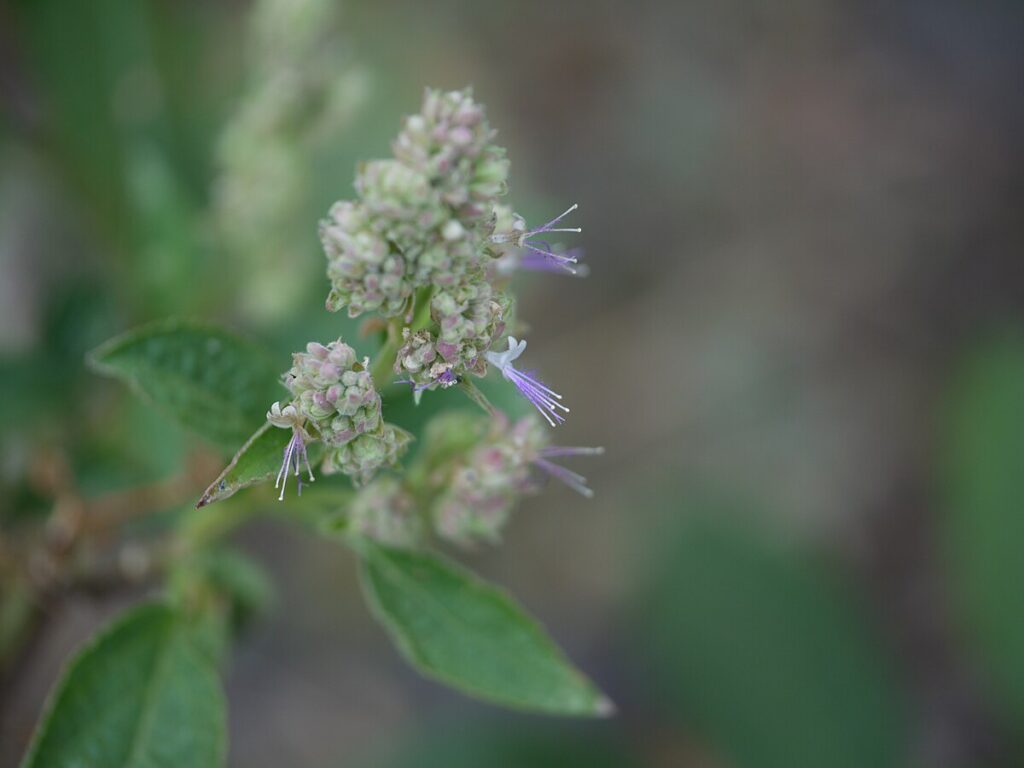
Pogostemon benghalensis, commonly known as the Bengal Shrub Mint, is a species of flowering plant belonging to the family Lamiaceae.
Description
It is a herb with a strong, solid, and angular stem. The leaves are opposite, with petioles up to 2.5 cm long; the lamina is ovate, about 13 × 6 cm in size, with a cuneate base, double-dentate margin, and acuminate apex. The inflorescence is a verticillaster arranged in a terminal false spike, about 7 cm long, often branched at the base into two or more lateral spikes. The calyx is inflated, tubular, about 4 mm long, hairy on the outside and glabrous within, with five ciliate teeth approximately 1 mm long. The corolla is tubular, up to 8.7 mm long, two-lipped, with the upper lip three-lobed. There are four stamens inserted at different heights in the corolla tube, with filaments 5–7 mm long [2].
The fruit consists of four nutlets that are obovoid, about 1.2 mm long, and finely punctate. The species closely resembles Pogostemon plectranthoides Desf., but can be distinguished by its narrower corolla tube and less crowded inflorescence [3].
Distribution
It is indigenous to the Himalayan region and can be found at altitudes ranging from 150 to 1300 m [4]
Uses
Different parts of the plant are used in various traditional preparations—such as decoctions, fresh extracts, poultices, and infusions—to treat a range of ailments, including depression, infections, sexual weakness, intermittent fever, and intestinal disorders [5], [6].
References
- ^ https://powo.science.kew.org/taxon/urn:lsid:ipni.org:names:454823-1#synonyms
- ^ The Wealth of India, A dictionary of India raw material and Industrial products, (Publications and Information Directorate, CSIR, New Delhi, 1988) Vol. II, 182-3.
- ^ Uprety, Y.; Poudel, R.C.; Gurung, J.; Chettri, N.; Chaudhary, R.P. Traditional use and management of NTFPs in Kangchenjunga Landscape: Implications for conservation and livelihoods. J. Ethnobiol. Ethnomed. 2016, 12, 19.
- ^ Dangol, D.R. Economic uses of forest plant resources in western Chitwan, Nepal. Banko Janakari 2002, 12, 56.
- ^ Aryal, S.; Adhikari, B.; Panthi, K.; Aryal, P.; Mallik, S.K.; Bhusal, R.P.; Salehi, B.; Setzer, W.N.; Sharifi-Rad, J.; Koirala, N. Antipyretic, antinociceptive, and anti-inflammatory activities from Pogostemon benghalensis leaf extract in experimental wister rats. Medicines 2019, 6, 96.
- ^ Dahiya, S.; Batish, D.R.; Singh, H.P. Ethnobotanical, phytochemical and pharmacological aspects of Bengal Pogostemon (Pogostemon benghalensis). J. Herbmed. Pharmacol. 2020, 9, 318–327.

