
Content deleted Content added
|
|
|||
| Line 36: | Line 36: | ||
|
==Accident== |
==Accident== |
||
|
Shortly after taking off from runway 30, the aircraft reached a maximum altitude of 140 feet and ground speed of 160 knots, then entered into a descent from which it did not recover, hitting trees around 938 m from the runway and crashed 1265 m from the end of the runway and 98 m left of the center-line.<ref name=”TSB” /> After the crash, an extensive post-crash fire broke out, which destroyed 80% of the wreckage. The sole survivor was ejected from the aircraft during the accident sequence and suffered minor injuries.<ref>{{cite web | url=https://www.tsb.gc.ca/eng/enquetes-investigations/aviation/2024/A24W0008/A24W0008.html | title=Air transportation safety investigation A24W0008 – Transportation Safety Board of Canada | date=23 January 2024 }}</ref> |
Shortly after taking off from runway 30, the aircraft reached a maximum altitude of 140 feet and ground speed of 160 knots, then entered into a descent from which it did not recover, hitting trees around 938 m from the runway and crashed 1265 m from the end of the runway and 98 m left of the center-line.<ref name=”TSB” /> After the crash, an extensive post-crash fire broke out, which destroyed 80% of the wreckage. The sole survivor was ejected from the aircraft during the accident sequence and suffered minor injuries.<ref>{{cite web | url=https://www.tsb.gc.ca/eng/enquetes-investigations/aviation/2024/A24W0008/A24W0008.html | title=Air transportation safety investigation A24W0008 – Transportation Safety Board of Canada | date=23 January 2024 }}</ref> |
||
|
==Investigation== |
==Investigation== |
||
| Line 43: | Line 43: | ||
|
A preliminary report was released sometime in March 2024, which confirmed what was known and revealed what the conditions were at the time the accident aircraft attempted to takeoff.<ref name=”TSB” /> |
A preliminary report was released sometime in March 2024, which confirmed what was known and revealed what the conditions were at the time the accident aircraft attempted to takeoff.<ref name=”TSB” /> |
||
|
The [[Transportation Safety Board of Canada]] (TSB) classified the investigation as Class 2, indicating a complex investigation with an expected duration of up to 600 days. The investigation team has conducted multiple interviews, analyzed good-quality CVR data, and reviewed CCTV footage from fuelling, passenger loading, and departure. Examination of the engines and propellers revealed no anomalies, and aircraft performance analysis determined that snow on critical surfaces did not negatively affect performance. The investigation is currently focusing on human performance and decision-making elements. The TSB is in the report-writing phase, with an initial draft under internal review, and no safety communications have been issued as of January 2025. A final report will be released upon completion of the investigation.<ref>{{cite web |url=https://www.tsb.gc.ca/eng/enquetes-investigations/aviation/2024/a24w0008/a24w0008.html |title=Air transportation safety investigation A24W0008 |publisher=Transportation Safety Board of Canada |date=January 2025|accessdate=2025-05-29}}</ref> |
The [[Transportation Safety Board of Canada]] (TSB) classified the investigation as Class 2, indicating a complex investigation with an expected duration of up to 600 days. The investigation team has conducted multiple interviews, analyzed good-quality CVR data, and reviewed CCTV footage from fuelling, passenger loading, and departure. Examination of the engines and propellers revealed no anomalies, and aircraft performance analysis determined that snow on critical surfaces did not negatively affect performance. The investigation is currently focusing on human performance and decision-making elements. The TSB is in the report-writing phase, with an initial draft under internal review, and no safety communications have been issued as of January 2025. A final report will be released upon completion of the investigation.<ref>{{cite web |url=https://www.tsb.gc.ca/eng/enquetes-investigations/aviation/2024/a24w0008/a24w0008.html |title=Air transportation safety investigation A24W0008 |publisher=Transportation Safety Board of Canada |date=January 2025|accessdate=2025-05-29}}</ref> |
||
|
As of May 2025, icing has been ruled out as a factor.<ref name=”TSB” /> |
|||
|
==References== |
==References== |
||
Latest revision as of 17:12, 12 September 2025
2024 aviation accident in Canada
 |
Parts of this article (those related to article) need to be updated. The reason given is: No new developments since March of 2024. (May 2025) |
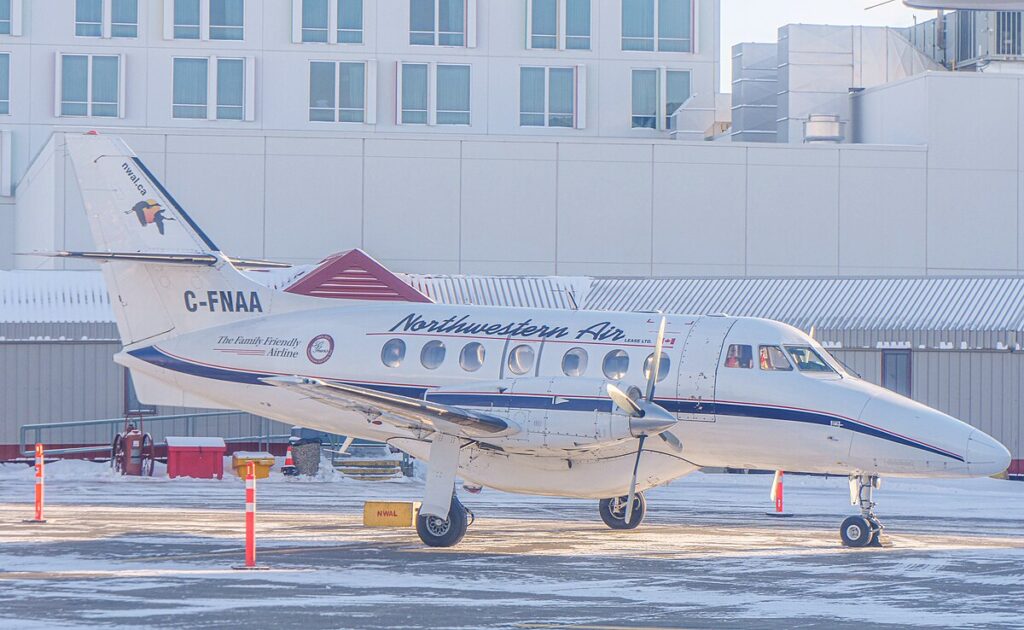
On 23 January 2024, Northwestern Air Flight 738, a British Aerospace Jetstream, was chartered by the Rio Tinto Group to carry mine workers from Fort Smith to the Diavik Diamond Mine, located around 300 km (190 mi) northeast of Yellowknife.[1][2] The aircraft crashed shortly after takeoff, 1,200 m (3,900 ft) from the runway near Fort Smith Airport, killing six of the seven passengers and crew.[3][4][5][6] The only survivor was taken to the Fort Smith Health Centre and was later airlifted to the Stanton Territorial Hospital in Yellowknife for further treatment.[1][7]
The aircraft involved was a BAe-3212 Jetstream Super 31, MSN 929, registered as C-FNAA, manufactured by British Aerospace in 1991.[6] The aircraft had suffered a previous incident on 1 April 2019 where it departed the runway while landing at Fort Chipewyan, Canada.
Shortly after taking off from runway 30, the aircraft reached a maximum altitude of 140 feet and ground speed of 160 knots, then entered into a descent from which it did not recover, hitting trees around 938 m from the runway and crashed 1265 m from the end of the runway and 98 m left of the center-line.[8] After the crash, an extensive post-crash fire broke out, which destroyed 80% of the wreckage. The sole survivor was ejected from the aircraft during the accident sequence and suffered minor injuries.[9] Four mine employees and both pilots were killed.[10]
The Transportation Safety Board of Canada sent a team, which included lead investigator Jeremy Warkentin to investigate the cause of the crash.[8] Although the aircraft was not equipped with a full flight data recorder, the cockpit voice recorder was recovered.[11][8]
A preliminary report was released sometime in March 2024, which confirmed what was known and revealed what the conditions were at the time the accident aircraft attempted to takeoff.[8]
The Transportation Safety Board of Canada (TSB) classified the investigation as Class 2, indicating a complex investigation with an expected duration of up to 600 days. The investigation team has conducted multiple interviews, analyzed good-quality CVR data, and reviewed CCTV footage from fuelling, passenger loading, and departure. Examination of the engines and propellers revealed no anomalies, and aircraft performance analysis determined that snow on critical surfaces did not negatively affect performance. The investigation is currently focusing on human performance and decision-making elements. The TSB is in the report-writing phase, with an initial draft under internal review, and no safety communications have been issued as of January 2025. A final report will be released upon completion of the investigation.[12][13]
- ^ a b Heidenreich, Phil (24 January 2024). “6 people killed, 1 survivor after Northwest Territories plane crash: coroner’s office”. Global News. Archived from the original on 25 January 2024. Retrieved 24 January 2024.
- ^ Hradecky, Simon (24 January 2024). “Crash: Northwestern JS32 at Fort Smith on Jan 23rd 2024, lost height after takeoff”. The Aviation Herald. Archived from the original on 26 January 2024. Retrieved 26 January 2024.
- ^ “Coroner confirms deaths in plane crash near Fort Smith, N.W.T.” CBC News. 23 January 2024. Archived from the original on 26 January 2024. Retrieved 23 January 2024.
- ^ Williams, Nia (24 January 2024). “Plane carrying Rio Tinto workers crashes in Canada’s Northwest, some killed”. Reuters. Archived from the original on 24 January 2024. Retrieved 23 January 2024.
- ^ O’Connor, James (23 January 2024). “BREAKING: Fatalities confirmed after aircraft crashes at Fort Smith”. CKLB Radio. Archived from the original on 24 January 2024.
- ^ a b “Accident BAe 3212 Jetstream 32 C-FNAA”. Aviation Safety Network. Archived from the original on 22 February 2024. Retrieved 26 January 2024.
- ^ “Six dead in N.W.T. plane crash, one survivor taken to hospital”. CityNews Vancouver. 24 January 2024. Archived from the original on 5 February 2024. Retrieved 24 January 2024.
- ^ a b c d “Air transportation safety investigation A24W0008”. www.tsb.gc.ca. Transportation Safety Board of Canada. 25 January 2024. A24W0008. Retrieved 11 April 2024.
- ^ “Air transportation safety investigation A24W0008 – Transportation Safety Board of Canada”. 23 January 2024.
- ^ Hager, Mike; McGee, Niall; Stueck, Wendy (27 January 2024). “Diavik plane crash a grim reminder of the challenges facing workers in the Far North”. The Globe and Mail. Toronto, Ontario. p. B1. Gale A780565245 ProQuest 2918678731.
- ^ Blake, Emily (30 January 2024). “TSB examining cockpit voice recorder from Fort Smith plane crash”. Cabin Radio. Archived from the original on 4 February 2024. Retrieved 30 January 2024.
- ^ “Air transportation safety investigation A24W0008”. Transportation Safety Board of Canada. January 2025. Retrieved 29 May 2025.
- ^ Blake, Emily (11 September 2025). “No date yet for safety board’s Fort Smith plane crash report”. Cabin Radio. Retrieved 12 September 2025.

