
From Wikipedia, the free encyclopedia
Content deleted Content added
|
|
|||
| Line 95: | Line 95: | ||
|
[[Category:Submarines sunk by submarines]] |
[[Category:Submarines sunk by submarines]] |
||
|
[[Category:World War II shipwrecks in the Mediterranean Sea]] |
[[Category:World War II shipwrecks in the Mediterranean Sea]] |
||
|
[[Category:Maritime incidents in June 1941]] |
|||
Latest revision as of 16:33, 23 October 2025
French Navy submarine
.jpg)
Souffleur in 1926 |
|
| History | |
|---|---|
 France France |
|
| Name | Souffleur |
| Builder | Arsenal de Cherbourg |
| Laid down | 2 October 1922 |
| Launched | 1 October 1924 |
| Commissioned | 10 August 1926 |
| Fate | Torpedoed and sunk on 25 June 1941 off Beirut, Lebanon |
| General characteristics | |
| Class & type | Requin-class submarine |
| Displacement | |
| Length | 78.30 m (256 ft 11 in) |
| Beam | 6.84 m (22 ft 5 in) |
| Draught | 5.10 m (16 ft 9 in) |
| Propulsion |
|
| Speed |
|
| Range |
|
| Test depth | 80 m (260 ft) |
| Complement | 51 men |
| Armament |
|
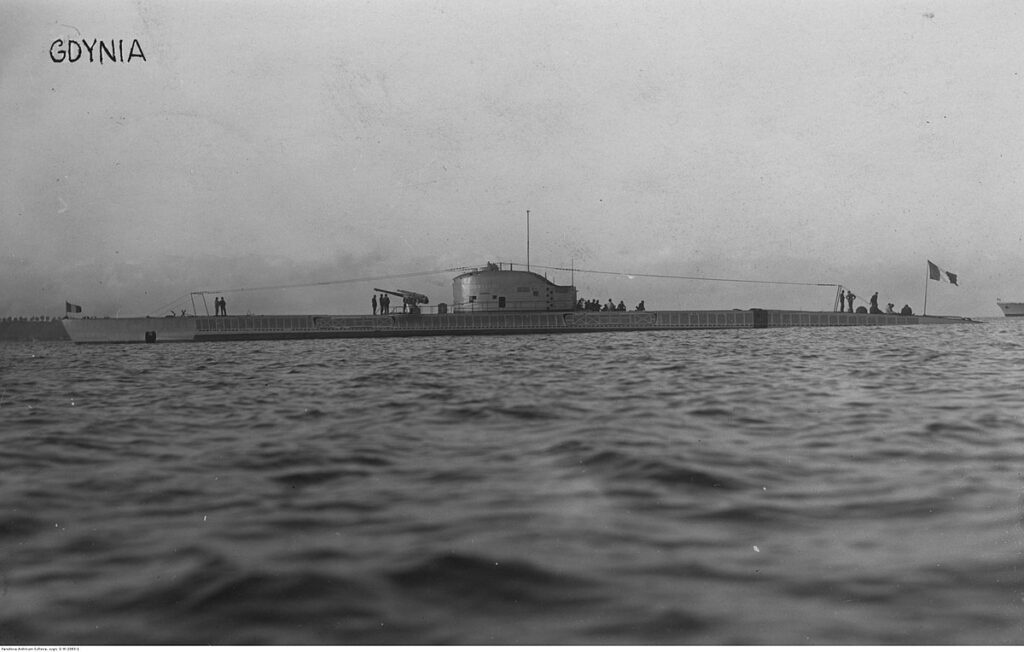
The French submarine Souffleur was a Requin-class submarine built for the French Navy in the mid-1920s. Laid down in October 1922, it was launched two years later and commissioned in August 1926. Souffleur was torpedoed and sunk on 25 June 1941 in the Mediterranean Sea off Beirut, Lebanon in position 33°49′N 35°26′E / 33.817°N 35.433°E by the British submarine HMS Parthian.[1][2]
78 m (255 ft 11 in) long, with a beam of 6.8 m (22 ft 4 in) and a draught of 5.1 m (16 ft 9 in), Requin-class submarines could dive up to 80 m (260 ft). The submarine had a surfaced displacement of 1,150 long tons (1,168 t) and a submerged displacement of 1,441 long tons (1,464 t). Propulsion while surfaced was provided by two 2,900 hp (2,163 kW) diesel motors and two 1,800 hp (1,342 kW) electric motors. The submarines’ electrical propulsion allowed it to attain speeds of 9 knots (17 km/h; 10 mph) while submerged and 15 knots (28 km/h; 17 mph) on the surface. Their surfaced range was 7,700 nautical miles (14,300 km) at 9 knots (17 km/h), and 4,000 nautical miles (7,400 km) at 12 knots (22 km/h), with a submerged range of 70 nautical miles (130 km) at 5 knots (9.3 km/h).[3]
- Fontenoy, Paul E. (2007). Submarines: An Illustrated History of Their Impact (Weapons and Warfare). Santa Barbara: ABC-CLIO Publishing. ISBN 978-1-85109-563-6.

