
| settlement_type = [[Territory_of_the_Islamic_State#Administrative_organization|Province]] of the [[Territory of the Islamic State|Islamic State]]
| settlement_type = [[Territory_of_the_Islamic_State#Administrative_organization|Province]] of the [[Territory of the Islamic State|Islamic State]]
| image_flag = Islamic State flag.svg
| image_flag = Islamic State flag.svg
| flag_link = Jihadist flag
| flag_link =
| image_seal = Islamic State – West Africa Province.svg{{!}}class=skin-invert
| image_seal = Islamic State – West Africa Province.svg{{!}}class=skin-invert
| motto = لَا إِلَٰهَ إِلَّا ٱللَّٰهُ، مُحَمَّدٌ رَسُولُ ٱللَّٰهِ<br>{{transliteration|ar|lā ʾilāha ʾillā -llāh, muḥammadun rasūlu llāh}}<br />”There is no deity but [[God in Islam|God]], [[Muhammad in Islam|Muhammad]] is the messenger of God.”
| motto = لَا إِلَٰهَ إِلَّا ٱللَّٰهُ، مُحَمَّدٌ رَسُولُ ٱللَّٰهِ<br>{{transliteration|ar|lā ʾilāha ʾillā -llāh, muḥammadun rasūlu llāh}}<br />”There is no deity but [[God in Islam|God]], [[Muhammad in Islam|Muhammad]] is the messenger of God.”
Province of the Islamic State
|
West Africa Province ولاية غرب إفريقية |
|
|---|---|
| West Africa Wilayah | |
 
Seal |
|
| Motto(s): | |
| Anthem: أُمَّتِي قَدْ لَاحَ فَجْرٌ (Arabic) Ummatī qad la-hā fajrūn “My Ummah, Dawn Has Appeared” (de facto)[1] |
|

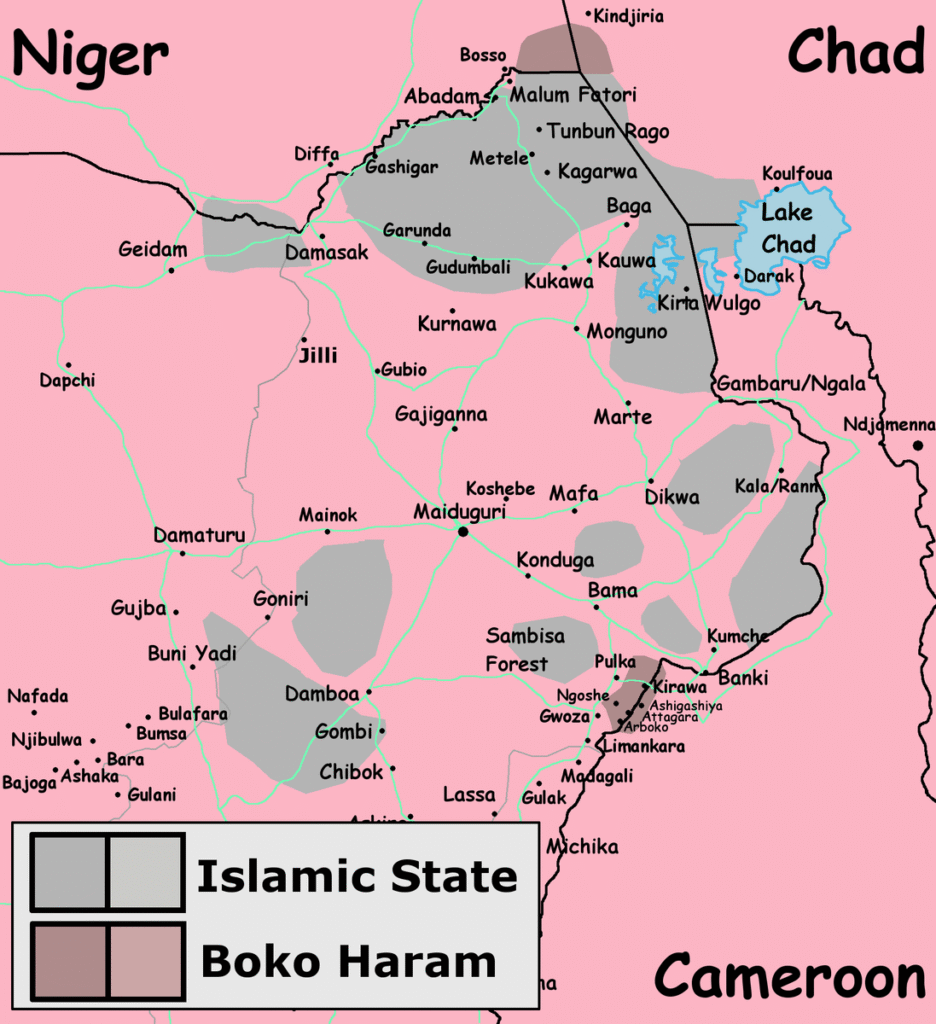
Area of control in 2022 |
|
| Country |  Islamic State Islamic State |
| Capital | Unknown (2014–January 24) Gudumbali (January 24–26, 2022) Unknown (January 26, 2022–Present) |
| Established | 2014 |
| Named after | West Africa |
| • Type | Administrative division of the Islamic State governed by a shura council |
| • Leader | Unknown |
|
• Total |
800,000–3,000,000 |
| Time zone | UTC+01:00 (West Africa Time) |
The territory of the Islamic State – West Africa Province (ISWAP) officially known as Wilāyat Garb Ifrīqīyā[3], refers to territory under the control or influence of the Islamic State’s West Africa Province (ISWAP) in and around the Chad Basin area.[4]
The Islamic State – West Africa Province (ISWAP)[4] is a militant group and administrative division of the Islamic State (IS), ISWAP is primarily active in the Chad Basin, and fights an extensive insurgency against the states of Nigeria, Cameroon, Chad, Niger. It is an offshoot of Boko Haram with which it has a violent rivalry.[5][6]
Rise of Boko Haram and fracture of the group
[edit]
Boko Haram began to seize territory aggressively in late 2014, declaring northeast Nigeria to be a caliphate under their control. By the end of 2014, Boko Haram controlled an area roughly the size of Belgium.[8] Following the 2015 West African offensive Boko Haram lost most of its territory and was “technically defeated” according to Muhammadu Buhari, the President of Nigeria.[9]
In August 2016, ISWAP attempted to remove Shekau from his leadership role and replace him with Abu Musab al-Barnawi. ISWAP attempted to remove Shekau because he had disobeyed Abu Bakr al-Baghdadi‘s order to cease targeting Muslim civilians. Shekau rejected the move, leading to a split between the groups. As of 2017, there were three factions which were all Boko Haram in origin, all rejecting Western influence, and seeking to establish an Islamic state with sharia law. These were the Islamic State West African Province (ISWAP) which is part of IS; Boko Haram, under Shekau’s control; and “Ansaru which is loyal to al-Qaeda and rejected IS, however, it shares IS’s disapproval of Shekau.[10][11]
Territorial Control
[edit]
As of 2022, International Crisis Group researchers estimated that 800,000 to over 3 million civilians live under ISWAP’s rule. As IS maintains to be a state despite haing lost its territory in the Middle East, ISWAP’s ability to run a basic government is ideologically important for all of IS.[12] Despite not fully controlling the areas where it is present,[13] ISWAP maintains more control over large swaths of the countryside than the Nigerian government.[14]
In 2021, ISWAP attacked and overran Boko Haram’s bases in the Sambisa Forest and Abubakar Shekau killed himself.[15] As a result, many Boko Haram fighters defected to ISWAP or fled south into Kaduna State, Nigeria.[16][17][18][19][20] A faction of Boko Haram led by four commanders of the Njimiya camp, that rebelled and waged a low-level insurgency against IS in Sambisa Forest following the Battle of Sambisa in 2021. The group eventually surrendered to security forces in December 2022, having been defeated by the Islamic State.[21][22]
On 24 January 2022, the small town of Gudumbali was captured and declared as ISWAP’s capital. However, it was recaptured by Nigerian troops on 26 January.[23]
In late 2022, the Battles of Toumbun Allura Kurnawa and Toumbun Gini erupted between ISWAP and Boko Haram. By January 2023, these clashes had ended in a substantial Boko Haram victory and the loss of several ISWAP bases at Lake Chad, though heavy fighting continued during the next months.
In 2021, ISWAP created 4 governorates centered on the Lake Chad, Sambisa Forest, Timbuktu, and Tumbuma, each are headed by a wali and have their own governing structures. Each governorate has its own military commanders, and sends at least two representatives to ISWAP’s shura.[24][25] By early 2022, ISWAP acknowledged five governorates, namely Lake Chad, Sambisa, Al Farouq, Kerenoa, and Banki. Another sub-division “Central Nigeria”, became active in the following months, though this one appeared operate as an insurgent force instead of trying to caputure territory. By late 2022, ISWAP’s subdivisions enjoyed a high level of autonomy.[26]
ISWAP’s leadership is subordinate to IS’s core group headed by its caliph. Initially, ISWAP was headed by a single commander, termed the wali or governor. The group’s first overall wali was Abubakar Shekau who was succeeded by Abu Musab al-Barnawi in 2016. Shekau was replaced by Ba Idrisa in March 2019 who was in turn purged and executed in 2020.[28] He was replaced by Ba Lawan.[28] In general, the shura, a consultative assembly,[29] holds great power within the group. This has led researcher Jacob Zenn to argue that the shura gives the group an element of “democracy”. The shura’s influence has allowed ISWAP to expand its popular support, yet has also made it more prone to leadership struggles. Appointments to leadership positions such as the shura or the governorships are discussed internally and by IS’s core group; IS’s core group also has to approve new appointments.[29] In general, journalist Murtala Abdullahi argued that ISWAP mirrors the tendence of the IS core group to release little information on its leaders to the public, making even top commanders like Abu Musab al-Barnawi “elusive” figures.[31]
In May 2021, the shura was temporarily dissolved and Abu Musab al-Barnawi was appointed “caretaker” leader of ISWAP.[33] By July 2021, the shura had been restored,[34] and ISWAP’s internal system had been reformed.[34][35] The regional central command now consists of the Amirul Jaish (military leader) and the shura. There is no longer an overall wali, and the shura’s head instead serves as leader of ISWAP’s governorates, while the Amirul Jaish acts as chief military commander. “Sa’ad” served as new Amirul Jaish, while Abu Musab al-Barnawi became head of the shura.[34] However, non-IS sources still claim that a position referred to as the overall “wali” or “leader of ISWAP” continues to exist.[35][36][37] This position was reportedly filled by ex-chief wali Ba Lawan (also “Abba Gana”)[35][37] before passing to Abu-Dawud (also “Aba Ibrahim”), Abu Musab al-Barnawi, Malam Bako, Sani Shuwaram, Bako Gorgore, and Abu Ibrahim in quick succession in late 2021 and early 2022.[36][38][39]
The Islamic State in the Greater Sahara (IS-GS) was put under ISWAP’s command. ISWAP and IS-GS maintain logistical connections, but the former’s actual influence on the latter is limited.[40] IS-GS was later separated from ISWAP, becoming its own province. Regardless, ISWAP and IS-GS continued to cooperate through the al-Furqan Office in the General Directorate of Provinces. The al-Furqan Office is located in IS-GS territory, but headed by ranking ISWAP commander Abu Bakr ibn Muhammad ibn Ali al-Mainuki (alias “Abubakar Mainok”).
In ISWAP-held areas, the sharia law is enforced, including severe punishments such as the amputation of hands of thieves and the execution of adulterers. The sharia courts also offer to settle disputes over cattle rustling and various other crimes, winning some acceptance among the rural population. ISWAP also punishes its own fighters who commit unauthorized abuses toward civilians.
The group makes considerable efforts to win local grassroots support,[43] and has employed a “hearts and minds” policy toward the local communities.[44] It encourages locals to live in de facto rebel-held communities.[45] It has also massacred civilians who collaborate with the local governments or disobey ISWAP orders, as well as persecuted the Christian minority in its territory.
In addition to funding delivered by IS-Central and supportive international businessmen, ISWAP collects taxes on agriculture, fishing, and trade in its territories.[48][49][50]
ISWAP also collects the zakat, a traditional Muslim tax and form of almsgiving which is used to provide for the poor. ISWAP’s zakat has been featured in propaganda distributed by IS’s newspaper, al-Naba.[51] ISWAP’s “Zakat Office” is known to operate fairly systematically and effectively, raising substantial funds to support both ISWAP as well as local civilians. Experts Tricia Bacon and Jason Warner have described ISWAP’s taxation system as being locally less corrupt and more fair than that of the Nigerian state; some local traders argue that ISWAP creates a better environment for trade in rice, fish, and dried pepper. However, ISWAP militants are also known to kill those who refuse to pay taxes.[53]
In 2022, Nigeria announced its intention to redesign its currency in an effort to combat corruption and the financing of terrorism. ISWAP responded by declaring that from then on, people should pay their taxes to the group in the CFA franc.[54]
ISWAP provides various health services, builds public toilets and boreholes, and has implemented its own education system based on Jihadist literature.[55][56] At the same time, ISWAP is known for targeting agencies providing humanitarian aid, thereby depriving locals of basic necessities in government-held areas.[45][57][58] ISWAP also has law enforcement and appoints its own police chiefs, and its police also enforces the hisbah.[59]
ISWAP had also established a “Khilafah Cadet School” for 8-16 year old boys. They are carefully selected, indoctrinated and given physical and military training. The child soldiers were featured in an ISWAP propaganda video titled “The Empowerment Generation”, showing them executing captured Nigerian soldiers.
- Bacon, Tricia; Warner, Jason (2021-09-08), “Twenty Years After 9/11: The Threat in Africa—The New Epicenter of Global Jihadi Terror”, CTC Sentinel, vol. 14, no. 7, Combating Terrorism Center at West Point, pp. 76–90, retrieved 2025-09-17
- “After Shekau: Confronting Jihadists in Nigeria’s North East” (PDF). Africa Briefing. Brussels, Dakar: Crisis Group. 29 March 2022.
- Zenn, Jacob (20 March 2020). “Islamic State in West Africa Province and the Battle With Boko Haram” (PDF). Terrorism Monitor. 18 (6). Jamestown Foundation: 6–8.
- Zenn, Jacob (24 May 2021). “Killing of Boko Haram Leader Abubakar Shekau Boosts Islamic State in Nigeria” (PDF). Terrorism Monitor. 19 (10). Jamestown Foundation: 1–2.
- Zenn, Jacob (August 2023). “Malam Bana Musaid Reflects on His Time as Boko Haram’s “Number Four”“. Militant Leadership Monitor. 14 (6). Jamestown Foundation.
- ^ Marshall, Alex (9 November 2014). “How Isis got its anthem”. The Guardian. ISSN 0261-3077. Retrieved 8 September 2020.
- ^ Al-Tamimi, Aymenn Jawad (2021-05-28). “The Islamic State’s Imposition of Zakat in West Africa”. Aymenn Jawad Al-Tamimi. Retrieved 2025-09-16.
- ^ a b Defence Technology News (18 May 2021). “Who are Boko Haram and what are their goals?”. Medium.com. Retrieved 20 October 2023.
- ^ Aymenn Jawad Al-Tamimi (28 March 2021). “The Islamic State’s Imposition of Zakat in West Africa”. Retrieved 28 July 2021.
- ^ “Boko Haram and the Islamic State’s West Africa Province” (PDF). Congressional Research Service. 26 March 2021. Retrieved 28 July 2021.
- ^ Ardo Abdallaha (April 23, 2015). “Nigeria military says still in Boko Haram stronghold despite mines”. Reuters. Retrieved May 2, 2015.
- ^ “Nigeria Boko Haram: Militants ‘technically defeated’ – Buhari”. BBC News. 24 December 2015. Retrieved 24 December 2015.
- ^ Zenna, Jacob; Pierib, Zacharias (Summer 2017). “How much Takfir is too much Takfir? The Evolution of Boko Haram’s Factionalization”. Journal for Deradicalization (11): 283–4. ISSN 2363-9849. Retrieved 6 March 2021.
- ^ Zenna, Jacob; Pierib, Zacharias (Summer 2017). “How much Takfir is too much Takfir? The Evolution of Boko Haram’s Factionalization”. Journal for Deradicalization (11): 282. ISSN 2363-9849. Retrieved 6 March 2021.
- ^ Aymenn Jawad Al-Tamimi (28 March 2021). “The Islamic State’s Imposition of Zakat in West Africa”. Retrieved 28 July 2021.
- ^ “Death of Boko Haram’s leader spells trouble for Nigeria and its neighbors”. DW. 8 June 2021. Retrieved 10 June 2021.
- ^ Dulue Mbachu (17 June 2021). “Death of Boko Haram leader doesn’t end northeast Nigeria’s humanitarian crisis”. The New Humanitarian. Retrieved 18 June 2021.
- ^ “ISWAP militant group says Nigeria’s Boko Haram leader is dead”. Reuters. 7 June 2021. Retrieved 8 June 2021.
- ^ “DSS: Boko Haram relocating from Sambisa forest to Kaduna”. 15 September 2021.
- ^ “Leaked DSS memo shows fleeing Boko Haram terrorists are moving to Kaduna”. 15 September 2021.
- ^ Parkinson, Drew Hinshaw and Joe (2021-05-21). “Boko Haram Leader, Responsible for Chibok Schoolgirl Kidnappings, Dies”. The Wall Street Journal. ISSN 0099-9660. Retrieved 2021-05-21.
- ^ Jason Burke; Emmanuel Akinwotu (20 May 2021). “Boko Haram leader tried to kill himself during clash with rivals, officials claim”. Guardian. Retrieved 26 May 2021.
- ^ Jason Burke (22 May 2021). “Rise of Isis means Boko Haram’s decline is no cause for celebration”. Guardian. Retrieved 26 May 2021.
- ^ “Four Boko Haram Commanders Surrender To Nigerian Army In Borno After Years In Sambisa Forest”. Sahara Reporters. 17 December 2022. Retrieved 10 January 2023.
- ^ “Abubakar Shekau’s Boko Haram Faction Confirms Death Of Leader, Issues Fresh Threats”. Sahara Reporters. 15 June 2021. Retrieved 16 June 2021.
- ^ Maina, Maina (26 January 2022). “Troops battle ISWAP in Borno, dislodge caliphate HQ, recover Gudumbali”. Daily Post.
- ^ Malik Samuel (13 July 2021). “Islamic State fortifies its position in the Lake Chad Basin”. Institute for Security Studies. Retrieved 25 July 2021.
- ^ Kunle Adebajo (21 May 2021). “How Did Abubakar Shekau Die? Here’s What We Know So Far”. Humangle. Retrieved 30 May 2021.
- ^ Murtala Abdullahi (8 December 2022). “ISWAP’s Pledge To New ISIS Leader Shows Transformation”. Humangle. Retrieved 10 January 2023.
- ^ a b Malik Samuel (13 July 2021). “Islamic State fortifies its position in the Lake Chad Basin”. Institute for Security Studies. Retrieved 25 July 2021.
- ^ Murtala Abdullahi (15 December 2022). “Counter Terrorism Operations Squeeze Islamic State Despite Elusive Leadership”. Humangle. Retrieved 10 January 2023.
- ^ Ahmad Salkida (21 May 2021). “What Shekau’s Death Means For Security In Nigeria, Lake Chad”. Humangle. Retrieved 18 June 2021.
- ^ a b c Malik Samuel (13 July 2021). “Islamic State fortifies its position in the Lake Chad Basin”. Institute for Security Studies. Retrieved 25 July 2021.
- ^ a b c “ISWAP-Boko Haram Reshuffles ‘Cabinet’, Imposes Levies On Agricultural, Trade Activities In Nigerian Communities”. Sahara Reporters. 4 July 2021. Retrieved 23 September 2021.
- ^ a b Wale Odunsi (6 November 2021). “ISIS crowns Sani Shuwaram as new ISWAP leader”. Daily Post. Retrieved 8 November 2021.
- ^ a b Wale Odunsi (18 August 2021). “ISWAP reshuffles Nigerian leaders after ISIS order”. Daily Post. Retrieved 23 September 2021.
- ^ Maina Maina (14 May 2022). “ISWAP commanders, Bako Gorgore, Abu Ibrahim killed in airstrike in Borno”. Daily Post. Retrieved 10 June 2022.
- ^ Murtala Abdullahi (8 December 2022). “ISWAP’s Pledge To New ISIS Leader Shows Transformation”. Humangle. Retrieved 10 January 2023.
- ^ “Boko Haram and the Islamic State’s West Africa Province” (PDF). Congressional Research Service. 26 March 2021. Retrieved 28 July 2021.
- ^ Jason Burke; Emmanuel Akinwotu (20 May 2021). “Boko Haram leader tried to kill himself during clash with rivals, officials claim”. Guardian. Retrieved 26 May 2021.
- ^ Jason Burke (22 May 2021). “Rise of Isis means Boko Haram’s decline is no cause for celebration”. Guardian. Retrieved 26 May 2021.
- ^ a b Dulue Mbachu (17 June 2021). “Death of Boko Haram leader doesn’t end northeast Nigeria’s humanitarian crisis”. The New Humanitarian. Retrieved 18 June 2021.
- ^ Danielle Paquette (21 May 2021). “Is Boko Haram leader Abubakar Shekau dead this time? The Nigerian military is investigating”. Washington Post. Retrieved 26 May 2021.
- ^ “Boko Haram and the Islamic State’s West Africa Province” (PDF). Congressional Research Service. 26 March 2021. Retrieved 28 July 2021.
- ^ Abdulkareem Haruna (12 November 2022). “ISWAP Collects Taxes In CFA As Nigeria Government Plans Currency Redesign”. Humangle. Retrieved 10 January 2023.
- ^ Aymenn Jawad Al-Tamimi (28 March 2021). “The Islamic State’s Imposition of Zakat in West Africa”. Retrieved 28 July 2021.
- ^ Abdulkareem Haruna (12 November 2022). “ISWAP Collects Taxes In CFA As Nigeria Government Plans Currency Redesign”. Humangle. Retrieved 10 January 2023.
- ^ Abdulkareem Haruna (12 November 2022). “ISWAP Collects Taxes In CFA As Nigeria Government Plans Currency Redesign”. Humangle. Retrieved 10 January 2023.
- ^ Aliyu Dahiru (1 October 2022). “ISWAP Rebrands, Expands Scope Of Operations”. Humangle. Retrieved 10 January 2023.
- ^ Aliyu Dahiru (1 October 2022). “ISWAP Rebrands, Expands Scope Of Operations”. Humangle Media. Retrieved 8 December 2022.
- ^ “Boko Haram and the Islamic State’s West Africa Province” (PDF). Congressional Research Service. 26 March 2021. Retrieved 28 July 2021.
- ^ Dulue Mbachu (17 June 2021). “Death of Boko Haram leader doesn’t end northeast Nigeria’s humanitarian crisis”. The New Humanitarian. Retrieved 18 June 2021.
- ^ “Chaos as Boko Haram/ISWAP executes its own ‘governor of Lake Chad’ in power struggle”. Reuben Abati Media. 28 July 2020. Archived from the original on 7 August 2021. Retrieved 7 August 2021.

