
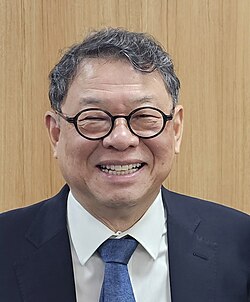
|
Ki-Woong Park |
|
|---|---|
| Born | November 30, 1958
Busan, Korea |
| Education | Nottingham Trent University |
| Known for | Painter and Sculptor |
| Notable work | Freedom V 2000, Hamlet 2020-1, Running Soldier 2009, Time 2025, The goose that lays Golden Eggs 2025 |
| Style | Sculpture, Painting Combine |
| Spouse(s) | Hee, Ahn |
| Children | Sung-Hoon Park, PHD of Industrial Science, Seoul National University |
| Awards | Grand Prize 1994, Tokyo International Fine Art Contest |
| Website | https://iron-park.blogspot.com/ |
Park Ki-woong (Korean: 박기웅; Hanja: 朴起雄; born born November 30, 1958 in Busan, South Korea) is a South Korean visual artist, Sculptor and painter.
Early Life and Training
[edit]
ki-Woong_Park_photo.jpg)
• Graduated from Suyeong Elementary School, Busan, 1971
• Graduated from Daeyeon Middle School, Busan, 1974
• Graduated from Peniel High School, Busan, 1978
• Graduated from Hongik University, Department of Fine Arts, 1986
• Graduated from Hongik University, Graduate School (Painting), 1989
• Graduated from Hongik University, Graduate School (Painting), 2000
• Graduated from Nottingham Trent University, Graduate School (Sculpture), 2012
2000, He submitted his doctoral dissertation to Hongik University as the title “Deconstructive Methods in Late 20th-Century Painting: Focusing on Frank Stella and Anselm Kiefer.”
It compares between two cases: where external deconstruction is prominent and where internal expression is prominent in the art works.
The former case presents Frank Stella‘s example, <Amabel, 1997>, which describes a wild, external deconstructive nature; and is installed at the POSCO Building in Korea. Anselm Kiefer‘s example is <Breaking the Vessel, 1989-1990>, which ambiguously conveys meaning between positivity and negativity. [1]
2012, he also submitted his dissertation to Nottingham Trent University in the United Kingdom as the title “Korean Art and the Avant-garde Dilemma.”
It argues a key topic in Korean art history, discussing the dilemmas faced by Korean arising artists in defining their own style. Especially, from the late 1980s to the early 2000s, when Korea began to adopt international trends (a time when postmodernism was in full swing in the West), the argument focuses on whether to follow among three styles: a monochrome(Korean: 단색화) type, or activism(Korean: 민중미술), or hyper-realism (Korean: 극사실주의), which was internationally popular at the time.[2]
The behind story of his decision to adopt the style known as “Iron Age,” a hybrid form of painting and sculpture is explained.[2]
Teaching and Investigation
[edit]
2015-34.jpg)
From 2007 to 2013, Park served as a professor at the Hongik University Graduate School of Fine Arts.
After 2018, he serves as the director of the Spring of Creation Art Institute (SCAI), where he focuses on to research the fusion of painting and sculpture.
Development as Artist
[edit]
1982 to 1994 marked a period of building up his career as a painter, during which he explored both figurative and non-figurative works.
1995 to 2000, he focused primarily on non-figurative paintings and installations.
2001, he pioneered “Iron Age,” a ten-year project utilizing melted iron to utilize its materiality.
2009, he transitioned to use stainless steel as his primary medium and he continues to explore it today.
Many of his works exhibit a multi-genre nature. While the period from 2009 to 2019 was characterized by strong drawing, painting, and sculpture. For example, his work, Female in front of the Mirror <2015-34>, is a wire drawing that concisely depicts a woman’s daily life and Ahead to the Sun 1 <2017-43> is the combination of bronze and stainless steel sculpture. These works prominently address the daily lives of modern people, subtly emphasizing the message that “the present life is brief, yet the most important moment.” [3]

2020, he starts to combine metalwork and stage design to describe the narratives from Bible, Greco-Roman mythology, Arabian Nights, and Shakespeare‘s plays.
The artist has produced approximately 30 series of works since 2001, demonstrating an experimental spirit between painting and sculpture. Based on iron and stainless steel, these series works visualize aesthetic perspectives, social implications, and others.[3]
Summery of Park’s Artist History
[edit]
| Ki-Woong Park History of Art works (Series Titles) Since 1994 | |||
| Mixed Media Period
1994-2000 |
Iron Age Period
2001-2008 |
Early Stainless steel Period
2009-2019 |
Stainless steel Period
2020- |
| Botanic Map | Material paradise | wire-Drawing | Shakespeare |
| Urban Map | Reverse Assemblage | Female in front
of the mirror |
Free & Soft |
| mandala | Metamorphosis | Small bronze | Time & Speed |
| Bangsan Market | Messenger’s Voice | Running soldier | Small Fantasia |
| Recycling | Void Womb | IASP | Literature |
| Cosmism | Rush hour | Life is drama | Tonotenacela
Space |
| Un-uclid space | Beautiful Chatting | Religion | |
| upper ground | In-between | ||
| Freedom |
Abstract painting |
||
Iron Age (2001-2008)
[edit]
Since 2001, Park has pioneered the “Iron Age” (abbreviated as “IA”) series. It has approximately 15 sub-series: <Material Paradise>, <A man of Isolation>, <Image of Temple>, <Messenger‘s Voice> <Metamorphosis>, <Void Womb>, <Image of New York>. <Uncertainty> … and others.

The two incidents: <September 11 terrorist attacks> and <the collapse of the Sampoong Department Store> in South Korea, directly inspired him to create <IA> series.[4]
To criticize material civilization (because he thinks that modern society is built by iron), he adopts steel. Arguably, in the creation of <IA>, he describes this society with using both positive and negative visual languages. For the former, he describes imaginable images of cathedrals and temples in the series of < Messenger’s Voice> and <Where Temple is>…and others. For the latter, he describe damaged surfaces in the series of <Paradise of Material> and <Uncertainty> …and others.
Especially, <A man of Isolation> series, which describe the isolated humans trapped within the flaming, shapeless rubble of the building demonstrate the signified meaning: “Iron is not a strong, so it’s civilization is not perfect.”
That is quite different from common signified that “Iron is a strong, so it is able to be forever”. Because, just we see the steel frames (I beam) of the Twin Towers in New York melted away by severe terrorism. .[4]
2008-4.jpg)
‘Metamorphosis’
Arguably, to create these specific signifiers, the artist has experimented metamorphosis skill to reveal hidden images of iron that are not visible in usual condition. Because, usually we see the shape of iron polished.
You are able to see the behind image of it only when the iron is damaged: irregularly melted and hardened. Driven by this will, he began to shatter the external forms of iron plates and steel frames using powerful fire and smoke. As a result, the signified of iron has been reconstructed. From strong sharp and clean changed into weak dull and ugly.[5]
Usually, UK artist Tony Cragg has created his works (for example. beautiful looking Towers <Wirbelsule, 1997>) with using cheap materials such as pieces of plastic cases, wooden boxes, and discarded cement blocks. His method has been compared to that of German Joseph Beuys. According to critic Demostines Davvetas, the idea underlying his method stems from the practice of metamorphosis, explaining that “this connection derives its power first and foremost from the artistic title given to discarded material. And then, the metamorphosis of matter: what Tony Cragg achieves in his pursuit of a more or less transformation, that is in fact of the same charm.”[6]
Various methods are employed in the realm of art to achieve metamorphosis. For example, if one wants to use stone to create a material with completely different external shapes, such as a sponge or rubbery appearance, it must be carved or polished. In such cases, the techniques of carving and polishing stone can be considered metamorphic techniques. To transform the surface of iron, methods such as burning, melting, drilling, and smoking are employed in the most <IA> series.
‘Warning Nuclear War’
Furthermore, the artist pioneered a technique that deconstructs the materiality of the external perceptions that everyone harbors within their minds. He writes in his book, “This technique(deconstruction) does not transform the properties or values of materials, but rather transforms the very perceptions of human beings.”[7]
Based on this ideology, he created his early <Material paradise> series, where he began to transform the external form of iron to achieve the metaphorical expression: to satire the weakness iron civilization. The symbolism of iron after its metamorphosis signifies the collapse of wealth, the fall of humanity, the age of greed, and the final age of spiritual death. It also refers to the collapsing worldliness.
Further arguably, <Void womb> and <Nuclear Energy> series warns against the nuclear war. Because, they show the final result of the shape of the steel to be used for evil purposes and becoming the basic material for weapons: our civilization is changed like the after image of metamorphosis.” [8]
In other words, in the process, techniques of auto-deconstruction or self-deconstruction have been used in various ways to create metaphorical signifier.
‘Painting made by the method of sculpture’
2001-2005, Park has explored the fusion of sculpture and painting. While his work primarily pursues sculpture in terms of materials and techniques, on the other hand, it adheres to painterly traditions (2 Dimension) in its presentation. Using sculptural techniques like welding and cutting to create iron sculptures, he has demonstrated a persistent interest in the blending of these two genres. Consequently, his works, which present a variety of creation within a square (for example, <material Paradise> series) or free-style frame (for example, <A man of Isolation> series), evoke a unique sensibility for the viewer’s eye.[9]
The chemical and physical changes in the steel plates caused by high-temperature heat form the basis of his work. Quite different from relief, the surface patterns that emerge as the steel plates are heated, as well as the diverse combinations of iron fragments created through welding, are what make his work appear as a kind of painting.
Grappling with the boundaries between sculpture and painting, it’s combination of content and form is being experimented within various ways through the medium of ironwork. While the act of welding iron to create a frame, then folding or cutting and joining variously manipulated iron plates within it is fundamental skill to create sculpture, however, the resulting work presents a kind of pictorial landscape. Because, you are able to see the intensity not only from the black color of the surface, but also from the heavy imagery itself. [9]
Finally, <IA> can be described as a kind of sculptural collage or abstract art using steel plates.
Early Stainless Steel Period (2009-2019)
[edit]

The early “Iron Age Stainless & Plastic” (abbreviated as “IASP”) series have the following sub-series: <Running Soldier>, <Tree of Life>, <Walking Soldier>, <The Flying Soldier>, <Image of Paradise>, and <Iron Empire>.<Upper Ground>, <Wire drawing>…and others.
Stainless Steel Transparent Plastic Combination
The <IASP> series reveals the cutting-edge technological civilization of modern society. The materials used—stainless steel and plastic—symbolize an eternal civilization.
To reflect this, rather than the previous somewhat concise and easy titles, more ambiguous subtitles have been given recently.
From these signifiers, he hopes to convey the following thought: “Most people perceive that they live in a material civilization, or, to put it another way, in a material paradise…. However, they need to think that a paradise of mere matter (excluding the mind) is imperfect; therefore, that civilization is also imperfect…. Material civilization must be achieved with consideration for the well-being of others….”[8]
bright and glossy
Furthermore, his material experiments can also be described as heterogeneous, as they connect various configurations or engage with deconstructive techniques for plural (ambiguous) meanings to reveal the paradise of modern material civilization, thereby heterogeneously differencing them. This method, based on steel, stainless steel, and plastic, can be seen in the series <IA, Celestial Glory, 2007-2008> and in specific parts of the <IASP> series. For example, in the <IASP> series, a plastic with a bright glossy surface was adopted, such as in works like <IASP, Material Paradise, 2009-1004>, to express places involving imagination: the glory of God or the eternal life of mankind. The surface and materiality were like ice, and when illuminated by fire, it shone brighter than the relatively dark iron parts.[8]
‘Coexistance’
This juxtaposition of materials conveys a specific message. Focusing on the expression of “coexistence in the diverse contexts of 21st-century modern society,” he juxtaposes plastic, iron, and stainless steel in a single work to demonstrate the harmony of three different materials in a single juxtaposition.[8]
Stainless Steel Period (Since 2020)
[edit]
Since 2021, narratives and visual beauty drawn from the Bible, Greco-Roman mythology, the Arabian Nights, and Shakespeare’s plays have been combined to reveal various types of work that straddle the line between abstraction and figuration.
Shakespeare Series
• Four Great Tragedies: <Hamlet>, <King Lear>, <Othello>, <Macbeth>
• Five Great Comedies: <The Taming of the Shrew>, <As You Like It>, <Twelfth Night>, <The Merchant of Venice>, <A Midsummer Night’s Dream>
These works were presented in stainless steel. Great scenes from William Shakespeare‘s tragedies and comedies were reborn in reflective stainless steel.
This series features Shakespeare’s five-act plays, presented on stainless steel mirror stages (mainly triptych-type) and incorporating low-relief sculptures.The Shakespeare series has a multi-genre characteristic, as it embraces the characteristics of painting, sculpture, metalwork, and stage design. For example, in the case of <Hamlet 2020-24>, in the center of the work, there is a scene where the ghost King Hamlet appears and shows the scene of his poisoning (to be dead) to his son Hamlet, on the left is the death of Hamlet’s fianceée Ophelia, and on the right is a stage depicting Hamlet’s death.
In a recent email interview with The Korea Times, he stated, “In my work, I sought to convey a timeless message that resonates with the current reality, beyond simply pursuing aesthetic expression.” The artist found this message in the dramas envisioned by one of history’s most renowned British playwrights. In the “Shakespeare” series, the artist reconstructed the playwright’s five-act plays in triptych form, focusing on symbolic scenes unfolding on mirrored stainless steel surfaces. One piece in the series, “Hamlet 2020-24,” depicts the tragic assassination of King Hamlet by his brother Claudius, who pours poison into his ear. “Viewers who encounter the work see their own emotions superimposed on striking scenes from the classic play… past and present intersect and engage in a dialogue,” Park said. [10]
Furthermore, the artist actively utilized content from literature, film, and drama as material for his works, drawing key motifs from Chunwon Lee Gwang-su’s novel “Soil” and Korean Drama “Sea Village Cha Cha Cha.”[11]

Religion Series
.jpg)
Through these several works, artist Park Ki-woong speaks to the importance and reason of humanity, living in eternal time. The former has a strong painterly quality, involving pouring paint onto a circular canvas, while the latter possesses a multi-genre character, incorporating elements of painting, sculpture, metalwork, and stage design. Through these works, the artist subtly emphasizes that while life is brief, it is also filled with the most crucial moments. Indeed, the trajectory of human existence, while a fraction of a second compared to the universe’s time since the Big Bang, holds profound significance. This is because embracing humanity may be the very reason for the universe’s existence. In other words, the universe was created for life, and humanity itself, the ultimate form of life. Artist Park Ki-woong is convinced that countless life forms exist on planets other than Earth, and that other human species exist there as well. Furthermore, the universe is God’s domain, and within it, Earth may be a very small stage where humanity currently lives. However, I believe there is no need to place importance on this relative size. In the <Religion> series, works such as <The Last Supper>, <Jacob’s Dream>, <The Descent of the Cross>, and <Resurrection> appear as illusions created within the mirrors of reflective objects. In <The Last Supper>, the apostles and Christ are depicted standing, with the stage depicted as a two-tiered structure based on the Bible, with women serving on either side ascending ladders to the second tier. The biblical account of the Last Supper is as follows: [12]
Go into the city “to such a man, and say unto him, The master saith My time is at hand; I will keep the passover at thy house with my disciples,[13] and he will show you a large upper room furnished and prepared; there make ready for us. [14][15]
He realistically depicts the moment of that day in his work, The Last Supper <2023-402>. (Low ceiling on the second floor)[14][15]
In the case of <Jacob’s Dream>, angels are usually depicted ascending and descending a ladder, and Christ is depicted in the center of the heavenly world. [12] If we check the content of the Bible, it is as follows.
And Jacob went out from Beersheba, and went toward Haran. And he lighted upon a certain place, and tarried there all night, because the sun was set; and he took of the stones of that place, and put them for his pillows, and lay down in that place to sleep. And he dreamed, and behold a ladder set up on the earth, and the top of it reached to heaven, and behold the angels of God ascending and descending on it. And, behold, the Load stood above it, and said, I am the Lord God of Abraham thy father, and the God of Issac: the land whereon thou liest, ti thee will I give it, and to thy seed; And thy seed shall be as the dust of the earth, and thou shalt spread abroad to the west, and to the east, and to the north, and to the south: and in thee and in thy seed shall all the families of the earth be blessed. And behold, I am with thee, and will keep thee in all places whither thou goes, and will bring again into thus land; for I will not leave thee, until I have done that which I have spoken to thee of And Jacob awaked out of his sleep, and he said, Surely the Lord is in this place; and I knew it not. <Genesis 28:10∼16>[16]
What is unusual is that angels do not have wings. Typically, paintings of Jacob’s Ladder show angels with wings, as this eliminates the need to climb up and down the ladder.[12]

The Descent from the Cross, currently housed in the Prado Museum in Madrid, is a panel painting by Rogier van der Weyden, created in 1435 (scene direction: Joseph of Arimathea receives the body of Christ and prepares it for burial). The artist remade it into a sculptural version of the Descent from the Cross <2023-403>. A closer look at the biblical text reveals the following:
Mary Cleophas (half-sister to the Virgin Mary); John the Evangelist, Mary Salome (in green, another half-sister of the Virgin Mary), The Virgin Mary (swooning), the corpse of Jesus Christ, Nicodemus (in red), a young man on the ladder – either a servant of Nicodemus or of Joseph of Arimathea (in field-of-cloth-of-gold robes, the most sumptuous costume in the painting), the bearded man behind Joseph holding a jar and probably another servant and Mary Magdalene who adopts a dramatic pose on the right of the painting. (John 19:39∼42)[17]
<Resurrection> is a work created with reference to the description in The Book of Mormon, depicting Christ descending after the Resurrection and coming to the Nephites on the American continent. [18]
“And it came to pass… they cast their eyes towards heaven; and behold, they saw a Man descending out of heaven…. And it came to pass that he stretched forth his hand and spake unto the people, saying: Behold, I am Jesus Christ, whom the prophets testified shall come into the world. And behold, I am the light and life of the world…”[19] 34 AD
Space Series
The works featured in the Space Series are celestial objects, including “Big Bang,” “Galaxy,” “Black Hole,” “Star Factory,” and “Tonotenasela.” The artist creates these works by referencing photographs of light observed through astronomical telescopes from the origins of the universe to the present. These works primarily simplify and abstractly view the mysterious shapes of the universe captured in this way. The pieces appearing as components within this vast cosmic expanse are small to medium-sized stainless steel sculptures. Framed within a painterly, two-dimensional box-like frame, they depict human reliefs, including passages from the Bible and the plays of Shakespeare, humanity’s greatest intellectual figure, as well as the artist’s own vision of dramatic, fleeting moments. In the “Space” series, a circular canvas seems more natural than a square one as a vessel for capturing celestial bodies. This is likely because observations made through a telescope feel more dramatic. For overall composition and focus, a linear motif is set toward the center of the frame, then galaxies and countless stars, filled with a variety of colors and materials, are displayed in the vast expanse of space.[12]
.jpg)
An official from the Sejong University Museum Gallery, where the artist recently exhibited, explained, “Through the ‘Cosmos’ series, the artist artistically solves the organic relationship between nature, humans, and the universe, and explores human existence and identity within the order of the universe. Furthermore, he explores the essence and inner self of humans through works that reinterpret characters from classical literature and mythology in a modern way and utilize their gestures to express emotions and psychology.” They added, “Through works that harmoniously capture the order of nature and the universe, human emotions and philosophy, and mythical symbols, we will have the opportunity to deeply reflect on personal identity, social relationships, and the modern world.”[20][21]
Proverb Series
Well-known proverbs and sayings, such as, “Time flies like anarrow,” “Even a mouse hole has its day,” “The goose that lays golden eggs,” and “No one is above or below anyone.”are included for Park’s Stainless art works. The works Time <25T-2> and The Goose That Laid the Golden Eggs <25SH-01> visualize these proverbs. To create these works, Time <25T-2> welded rusty pipes to form letters, and a stainless steel arrow piercing through them symbolizes the rapid passage of time. In the case of The Goose That Laid the Golden Eggs <25SH-01>, the artist depicts an elegant woman, like a queen, laying a golden egg without filtering, and at the bottom of the screen, a round hole symbolizing continuous golden egg birth gradually expands. In this way, the artist usually creates free-form works by combining various techniques of painting, sculpture, and metalwork without being restricted by a specific genre, and through this, he expands the boundaries of formative art and attempts to fuse genres, thereby exploring new possibilities in contemporary art. At the same time, he explores the relationship between nature, humans, and the universe, and he formatively interprets the concepts of botany and microcosm and incorporates human movement and gestures into his works. In particular, he utilizes personally made frames such as circles, rectangles, and squares rather than relying on traditional canvases or frames. This formative experimentation induces interaction between the works, adds depth and layers, and creates the artist’s unique formative beauty.[22]


Exhibitions (1981~ )
[edit]
<Solo Exhibitions>
2025 Damda Art Museum of Modern and Contemporary History (Yongin)- Gallery LaON (Seoul)- Sejong University Museum gallery (Seoul)
2024 LaOn Gallery(Seoul)- Gallery ℼ Youngjong (Incheon, Korea) – Chaman gallery (Seoul)- Vit Gallery(Seoul)
2023 AnSAngChul Art Museum (Yangju)- Chaman Gallery (Seoul)
2022 Esther Gallery (Yangpyung)- Laon Gallery (Seoul)
2020 NeTi Gallery(Gimpo)- Gallery SCAI(Gimpo)- Gallery Neil(Seoul)- AGallery Qualia(Seoul)
2019-2020 Ottche Art (Namhe, Korea)
2018 Momo Art Museum (Sam rye Art and Culture Village)
2015 Able gallery (Seoul)
2012 Sun Gallery (Seoul)- 1851 Gallery (Nottingham Trent University, UK)
2010 Gallery MIZ (Seoul)- Hanbyukwon Gallery –Woljun Art Museum(Seoul, Korea)
2009 Gallery Ho (Seoul, Korea)
2008 Galerie Kalt (Munchen, Germany)
2007 Korea Electricity Plaza Gallery (DVD. 4 art.co.kr) (Seoul, Korea)
2006 Gasan Gallery (Seoul, Korea)- Hun Gallery (New York, USA)- Central Utah Art Center (Utah, USA) – Seoul Art Center (Seoul, Korea)- Artodrome Gallery (Forchheim, Germany)
2005 – Insa Art Center(Seoul, Korea)- Gallery Ho (Seoul, Korea)
2004 Sejong Art and Cultural Center (Seoul, Korea) – Insa Art Plaza Gallery (Seoul ,Korea)- COEX Convention Hal l(Seoul, Korea)
2003 Noam Gallery (Seoul, Korea)- Insa Art Plaza Gallery (Seoul,Korea)
2002 Lotte Gallery (Anyang, Korea)
2000 Cable TV 37 A&C Collection (Seoul, Korea) (Regular Broadcasting, Video)- Internet E Gallery (Seoul,Korea)- Hanjoo Gallery (Seoul,Korea)- Jongro Gallery (seoul,Korea)
1999 Hanjoo Gallery (Seoul,Korea)
1998 Korean CAAF (Seoul,Korea)- Kyung Ki province Art and Cultural Center (Suwon, Korea)
1996 Insa Gallery (Seoul,Korea)
1995 Gallery Doal (Seoul,Korea) – Munhwa Daily Newspaper Gallery (Seoul,Korea)
1994 Korean CAAF (Seoul,Korea)
1993 Yukyung Gallery (Seoul,Korea)
1982 Moyer Art Center (Se0ul, Korea)
<Group Exhibitions>
2025 Chicago Art EXPO (Chicago, USA)- Summer River Circular Exhibition (Gallery ℼ Youngjong, Anseli Art Museum) – Grand Central Station Exhibition (Gallery Lamer, Seoul)
2024 KIAF (KOEX. Seoul Korea)- Gallery Art Fair (Su won, Korea)- SPACE+ART Fair (KINTEX, Seoul Korea) – Korea, India Exchange Exhibition (Gallery Qallia, Seoul)- Stone Eye Exhibition (Lamer Gallery, Seoul)- Walking Street Exhibition (Cha gallery, Seoul)
2023 Start Art Fair (Saachi Gallery, UK) – Seoul Art Fair (SETEC, Seoul)- Seoul Art Show (COEX)- Finding Pearl bead (Yunjung gallery, Incheon)- Korea India international Exchange Exhibition (Seoul City Conference Museum)
2022 Arising Korean Contemporary Arts (Gallery LaOn)- International Exchange Association membership Exhibition(Insa Art Center)
2021 Incheon Asia Art Show (Songdo Techno park, InCheon)- Majung Exhibition(Eunha Gallery, Seoul- Spring Picnic Exhibition (Pyungchang Intirol Gallery)
2020 International Art Exchange Association Small Art Exhibition (Cheon Grigo Cafe Gallery)
– International Art Exchange Association Annual Exhibition (InsaArt Center)
– Arising Korean Contemporary Arts (Gallery SCAI))
– International Art Exchange Association Invite Exhibition(IncheonVian Gallery)
2019 Seoul Art Show (COEX, Seoul)
– AQUA Art Miami (USA)
– Korea-India Contemporary Exchange Exhibition(India, Changwon National Art Museum)
– Autumn Smile(Ecorock Gallery Art Festival: Koyang Star field)- Meet Bauhaus Again(ShemaArt Museum)
– Pentagon (Ecorock Gallery Art Festival: Koyang Star field)
– Arising Arising Korean Contemporary Arts (SejongArt & Cultural Center Kwang gallery)
– Hongmiyeon Art Exhibition(Korea Art Museum)
2018 Arising Korean Contemporary Arts (SejongArt & Cultural Center Kwang gallery)
– Pyungchang Winte rOlympic game Memorial Art Exhibition (Metro Art Museum)
– AQUA Art Miami (USA)
2017 Arising Korean Contemporary Arts (SejongArt & Cultural Center Kwang gallery)
– Affordable ART FAIR Singapore (F1 Fit Building)
– Art Kwangju (Kimdaejung convention center)
2016 Small sculpture Exhibition (SCAI gallery)
– 3 Artists Exhibition (Arisoo Gallery)
– Aqua Art Miami (Miami)
– Affordable ART FAIR Singapore (F1 Fit Building)
– Spectrum Art Miami (Miami)
2015 Venice Art Binelle (European Cultural Center)
– Concept Art Miami (Miami)
-Art Kwangju (Kimdaejung convention center)
-SCOPE Basel (Swiss Basel, SCOPE Pavilion)
-Affordable ART FAIR Singapore (F1 Fit Building)
-Affordable ART FAIR (DDP plaza)
2014 SCOPE Basel (Swiss Basel, SCOPE Pavilion)
2013 SCOPE Basel (Swiss Basel, SCOPE Pavilion)
–32nd Line Art (Planders Expo, Gent, Belgium)
2012 Korea India Contemporary Art Exchange Exhibition (AW Convention Center)
– Open Village memorial Exhibition (Kurye Artist Village)
– Muri Exhibition(Seoul)- 31st Line Art (Planders Expo, Gent, Belgium)
– KIAF-Art Seoul (COEX)
-Art Gyungju (Kyungju)
2011 –30thLine Art (Planders Expo, Gent, Belgium)
– 2nd Art by Geneve, Swiss Geneva International Art Fair (Palexpo, Geneve, Swiss)
– Sungsan Art Community Exhibition (Seoul)
– Posco Art Museum Invite Exhibition-Water and Wind
– World Peace Art Contest Invite Artists’ Exhibition
2010-Hongik University Fine Art Dept professor Exhibition(Hongik Art Museum)
– Vision. 2010-Korea Contemporary Art’s Direction(Insa Art Center)
– World Peace Art Contest Invite Artists’ Exhibition
– KyungHyang News paper Good Art works Exhibition(Kyunghyang gallery)
– 29th Line Art (Planders Expo, Gent, Belgium)
– KIAF (COEX, Seoul)
– 1st Art by Geneve, Swiss Geneva International Art Fai r(Palexpo, Geneve, Swiss)
2009 -KIAF (COEX, Seoul)
-28thLine Art (Planders Expo, Gent, Belgium)
– 18thEurop’Art, Galleryho, Swiss Geneva International Art Fair (Paleexpo, Geneva, Swiss)
– 31thNew York Art Expo (Jacob K. Javits Convention Center, New York, USA)
2009 -2009 Hongik Art & Design Festival (Hongik Museum of Art)
– Park & Arthure 2 men Show (Galerie du Passage/ Gallery Ho)
– Hongik University Alumni Exhibition (Jiri mountain special exhibition Hall)
– Kyunghyang newspaper special preview 2009 (kyunghyang gallery, Seoul)
– World Peace Art Exhibition 2009 (Art Spece Yul, Sungnam)
– 2009 New year calender Exhibition (gallery Ho)
2008 Origin 2008, Painting, its essence and wave exhibition (Incheon Art Museum)
– Hongik University Alumni Exhibition (Jirimountain special exhibition Hall)
– A song of Fire (Kyungnam province Art Museum)
2008 –27thLine Art (Planders Expo, Gent, Belgium)
– Art Center Berlin Museum (Berlin, Germany)
– 17thEurop’ Art, Gallery ho, Swiss Geneva International Art Fair (Paleexpo, Geneva, Swiss)
– 30thNew York Art Expo (Jacob K. Javits Convention Center, New York, USA)
2007 26th Line Art (Planders Expo, Gent, Belgium)
– Korea international Art (Art Center Berlin, Germany)
– 16thEurop’Art, Galleryho, Swiss Geneva International Art Fair (Paleexpo, Geneva, Swiss)
– 7thKorean Contemporary Art Festival (Seoul Art Museum, Korea)
– International KG Gallery, Art Expo New York (JacobK. Javits Convention Center, New York ,USA)
– West Japan Convention Center, Northeast Asia Art Festival in Kitakyushu 2007(Kitakyushu, Japan)
– 2007-2008 Exhibition Divided (Bayreuth, Ausstellungshalle, Forchheim, Rathaushallen, Germany)
– Jasinmanman exhibition (Jungle book Gallery)
– Origin 2007, Picnic Searching for Feeling(Chungmu Art Museum, Seoul)
– New York-Seoul Circular Exhibition (Hun Gallery-New York, Gallery Ho-Seoul)
– Von Forchheim to New York (Gallery Artodrome, Germany)
– Kyunghyang Newspaper, Special preview (Kyunghyang Gallery, Seoul. Korea)
– 4thContemporary Painting Direction Exhibition(Suwon Art Museum,Suwon,Korea)
– 408 artist special Circular Exhibition-Korea, Japan, China (Busan Art Museum-Korea, Kitakyushu City Museum, China People Cultural Palace)
2006 Vision : Worship and Share Exhibition (Light Gallery, Seoul)
– The Contemporary Art of Full Autumn (Gallery Ho, Seoul)
– The Eye of Typhoon (Gallery Ho, Seoul)
– Korean Painting Small Pieces Art Festival (Korean Cultural Art Center)
– San Francisco Contemporary Korean Art (Gallery Kang, Berkley, USA)
– Who’s Who (Apgujung Department Store Exhibition Hall, Seoul)
– Real Place of Contemporary Art (Gallery Ho, Seoul)
– Gallery Ho Auction (Gallery Ho, Seoul)
– Art Interchange, The interchange Exhibition of Korean and Australia Art Colleges (Museum of Contemporary Art, Hongik Univ., Seoul)
– Contemporary art direction (SuwonArtCenter)
– Puzzle project (Tokyo,Japan)
– Art International Zürich 2006 (Congress House, Zürich, Swiss)
– Incheon Art Fair (Incheon, Korea)
– 15thEurop’Art, Galleryho, Swiss Geneva International Art Fair (Paleexpo, Geneva, Swiss)
2005 Art International Zürich 2005 (Congress House, Zürich, Swiss)
– George Mason University, Invitational Exhibition of Prominent Korean Artists (USA, Arlington Campus Art Gallery) – Nature and I: Japan and Korea exchange Exhibition (Gallery Ho, Seoul)
– Japan Korea Contemporary Art 100artist Exhibition (Gallery Artist Space, Japan)
– Contemporary Small Art Exhibition (Gallery Ho, Seoul, Korea)
– ContemporaryArt-Spring(Gallery Ho, Seoul Korea)
– Haman Art and Cultural Center Open Exhibition (Haman Art and Cultural Center)
– Contemporary Direction (SuwonArtMuseum)
– New Year Celebrating (Insa Art Plaza Gallery)
– Winter Site-specific (Gapyung island, Kangwondo,Korea)
2004 Origin Art Community Exhibition (Danwon 3 hall, Suwon Korea) – Korea-Japan PhD. Exchange Exhibition (Hongik Univ. ContemporaryArtHall,SeoulKorea)
– Contemporary Art Direction (Suwon Total Art and Cultural Center)
– Blue-X Invite Exhibition (Gallery Jung)
– C. A. T, s Exhibition (Jongro Gallery)
2003 Korea-Japan Art Exchange (Sejong Art & Culture Center)
– Blue-X invite Exhibition (Noam Gallery)
– Full spirit of Painting (Jongro Gallery)
– Beautiful Imagination -Origin Exhibition (Gallery Lamer)
– 2003 New plaza-New Year Exhibition (Insa Art Plaza Gallery)
– 8 person Curator & 8 person Artist Exhibition (Gallery Gaia)
– 2003 year Start 100 artist (Insa Art plaza Gallery)
– Winter site-specific (North Han river Desungri)
2002 Junju Univ. Prof. Exhibition (JunjuUniv.Gallery)
– Korea Art Festival (Insa art Plaza Gallery)
– Lee dong Jun Hwa Exhibition (Jongro Gallery)
– Today Together 43rd Origin Art Community Exhibition (Sejong Art Museum)
– Expression and Text (YoungeunArtMuseum)
– Winter Site-specific Exhibition (North Han river Desungri)
2001 Junju Univ. Prof. Exhibition (JunjuUniv.Gallery
– Kangnung Univ. Prof. Exhibition (Kangnung Univ. Gallery)
– Hwasangdaehwa exhibition (Jongro Gallery)
2000 For them and for You Exhibition (Myungdong Gallery)
– Korean Art Association Membership Exhibition (Korean Art & Cultural Center)
– ASROPA Internationale Kunstausstellung (Lurdy Gallery In Hungary Budapest)
– Contemporary Art Stream and prospect (Lotte Gallery, Seoul Korea)
– Junju Univ. Prof. Exhibition(Junju Univ. Gallery,Korea)
– Myungdong Gallery open Exhibition (Myungdong Gallery, Korea) – Blue-X Exhibition (Gallery Artside, Korea)
– Ho ho sil sil Exhibition (Jongro Gallery)
– New Millennium Korean Art Exhibition in Austria (Galerie “SALA TERRENA”, Austria)
– Boy and Girl family leader help fund Exhibition (Hanso Gallery)
– HongikUniv.2000Architect (Hongik Art Museum)
– 42nd Origin Art community Exhibition (Seoul City Art Museum, Korea)
1999 Ah! Korea Exhibition (Sang Gallery)
– 41st Origin Art community Exhibition (Seoul City Art Museum, Korea)
– Blue X Exhibition (Eve Gallery, Seoul, Korea)
– Korea-Japan Art Festival (Songpa Art Museum,Korea)
1998 Cosmism Big-bang 5 artist (Woongjun Gallery,Korea)
– 40th Origin Art community Exhibition (Korean Art & Cultural Center, Seoul, Korea)
– Blue- X exhibition (EveGallery)
– Today’s Artists (Contemporary Korean Art & Cultural Center, Seoul, Korea)
– Korean Art Contest (National Art Museum of Contemporary Art, Kwachun, Korea)
1997 Report 1997 Exhibition (Munhwa daily Newspaper Gallery)
– Le37éme Salon Grand et jeunes d’aujourd’hui (Espace Eiffel Branley, Paris)
– Circumstance and Art Exhibition(Kongpyung Art center, Seoul, Korea)
– Korean Art Contest (National Art Museum of Contemporary Art, Gwachun, Korea)
1996 Le36éme Salon Grand et jeunes d’aujourd’hui (Espace Eiffel Branley, Paris)
– 5th Artex Tokyo → Paris ’96 International (Gallery Eleyette Peyre, Paris)
– Circumstance and Art Exhibition (Lotte Gallery, Seoul)
– Dong-A Art Festival (National Art Museum of Contemporary Art, Gwachun, Korea)
1995 The exhibition of contemporary trend in Korean Art (Noho Gallery, New York)
– Korean Contemporary Art Russian Invite Exhibition (Moscow Artist House)
– Le49éme Salon de Mai (Espace Eiffel Branley, Paris)
– Korean Art Contest (National Art Museum of Contemporary Art)
– ’95 MBC Art Festival (Korean Art and Cultural Center, Seoul Art Museum, Korea)
– Art World art Festival (Kyungin Art Museum)
1994 15th Fine Art International Art Contest (tokyo) (Catorea Salon, Japan) – 8294 exhibition (Sonamu Gallery, Seoul, Korea)
1993 8283 exhibition (Maeul gallery, Seoul, Korea)
1990 Seoul Contemporary Art Festival (Korean Art and Cultural Center, Seoul, Korea)
1989 Cube 3 Exhibition (Kwanhoon Gallery, Seoul Korea)
1987 Contemporary Art plaza (Doal gallery, Seoul Korea)
– C-517 Exhibition (Soo Gallery, Seoul,Korea)
– Cube 2 Exhibition (Total Art Museum, Jangheung, Korea)
1986 “Matter” New generation (Kwanhoon Art Museum, Seoul, Korea)
– Cube 1 Exhibition (Kwanhoon Art Museum, Seoul, Korea)
1985 Independent exhibition (Korean Art Museum, Seoul, Korea)
1984 1st Seoul International Drawing Biennale (Korean Art Museum, Seoul, Korea)
1983 Korean Art 83 Grand Festival (Korean Design and Package Center, Seoul, Korea)
1982 1st Seoul Art Festival (Korean Design and Package Center, Seoul, Korea)
1981 All Army Art Contest (Moyer Recreation Center, Yongsan,
Korea)
<Wall Painting>
2012 <patriot> Kurye Army (3x120m)
1995 <Indulged in Study> YounseiUniv.Plaza (9×120m)
(Seoul, Korea)
1994 <Immediate Motivation> Seogyo Rotery (2×35m)
(Seoul, Korea)
<Performance>
1995 Microscopic World (Body Investigation) Ehwa Univ. Street (Shinchon Culture Festival, Seoul Korea)
<Statue>
1987 Harry Holt (Harry Holt Memorial Center, Ilsan, Korea)
2009-2010 Sword of Justice (Belgium)
2011 Icarus (Belgium)
2011-2012 The beginning (Samrye Artist Village Rent)
2013-2014 Adam & Eve (Ottche Art)
2012 Artist Village Memorial Statue (Kurye Artist Village)
2017-2018 Jae Kyung Lee Statue (Junju Jeil Highshool Alumni Center)
<Thesis>
2005 A Study of destructive the styles from Contemporary Painting ―Focused on distinguishing enmity-destruction and self-destruction (Korean Society for Science of Art & Design)
2004 A Study of using physical body in Contemporary Painting (Korean Society for Science of Art & Design)
2002-The Issue of Teaching Information by Digital Media in Contemporary Design (Journal of Korean Society of Design Science Vol.15 No.3)
-A Study of Scribbling expression in Late 20th century Painting-centered on the changedness to the multi-codificative expression (Journal of science of Art & Design Vol 4, 2002)
2001 A study of Gerhard Richter’s trans-modern Style -centered on recent abstract painting (Kangnung National University Department of Fine Art)
– The problem of multi-dimension communication and 21st century Media Art (Korean Society for Science of Art & Design Vol 3)
– 21st century high Art and suggestion for new Art Education-centered on Communication Art (The Journal of Korea Elementary Education 2001, Vol. 13 No.1)
2000 About Western Art and Today’s Art Education <Text of High School teacher>
– A Study of the direction to the 21st Century Art Education(The Journal of Korea Elementary Education 2001, Vol. 12 No.1)
– A prospect of 21st Century Art: The Art of Light and Space-centered on Eric Orr and Bruce Nauman>(Korean Art Critic Review 2000 Winter)
– A Study of Contemporary Artistic Space and Circumstance-centered on Christo, Joseph Kosuth, Robert Irwin- (Circumstance Development Association Hongik. ⅩⅩⅩⅡ)
– A Study of Destruction in Contemporary painting-centered on Vandalic and Iconoclastic Mode (Journal of science of Art & Design Vol 2, 2000)
<Conference>
2001 A prospect of 21st Century Art-Centered on Communication Art (Korean Society for Science of Art & Design)
<Awards>
2025 13th Internationational Religious Art Competition (Selected, LDS Church history Museum)
2015 Imsil Cheese sculpture contest (Gold prize, Imsil Cheese Company Hall)
1995-1998 Korean Art Contest (3 Times HONORABLE MENTION Selected, National Art Museum of Contemporary Art)
1996 Dong-A Art Festival (HONORABLE MENTION, National Art Museum of Contemporary Art)
1995 ’95 MBC Art Festival (Selected Award, Korean Art and Cultural Center)
1995 Art World art Festival (Special Prize, Kyungin Art Museum)
1994 5th Fine Art International Art Contest (Grand Prize, Tokyo, Japan)
1984 1st Seoul International Drawing Biennale (HONORABLE MENTION, Korean Art Museum, Seoul, Korea)
1983 Korean Art 83 Grand Festival (Special Prize, Korean Design and Package Center))
1982 1st Seoul Art Festival (Korean Design and Package Center, Seoul Korea)
1981 8th All Army Art Contest (Grand Prize & First Frize, Moyer Recreation Center, Seoul Korea)
Park Ki-woong’s works are held in the following collections: the UN Mission to Korea (Geneva, Switzerland), the Hongik University Museum of Modern and Contemporary Art, Seoul National University (Seoul), Atordrome Gallery (Berlin, Germany), Hoon Gallery (New York, USA), Otchae Art (Namhae), Jung Gallery (Seoul), Munhwa Ilbo Gallery (Seoul), Myeongdong Gallery (Seoul), Dool Gallery (Seoul), Insa Gallery (Seoul), Hanju Gallery (Seoul), Noam Gallery (Seoul), Gasan Gallery (Seoul), Jinwoo Architecture Building (Suwon), Sound Place Co. LTD (Seoul), Songjeong Art and Culture Foundation (Seoul), Gallery Pai (Yeongjong, Incheon), Sejong University Museum of Art Gallery (Seoul), and private collectors in Basel, Switzerland, Singapore, Miami, Ghent, Belgium, and New York.
Publications (Author)
[edit]
Park, Ki-Woong (2003, 2006 2nd ed), Contemporary Art Theory 1: The birth and Settlement of Modernism , Seoul Hyungsul printing Company, ISBN:8947225746
[edit]
Unlike many journals and art history books that focus on a phenomenological approach, this book is a theoretical work that discusses the methodologies of artists who led the art movement from the birth of Impressionism in 1870 to 1940: the grand consciousness of “art for art,” the “dual nature of heat and cold,” and the “avant-garde spirit and the world of the unconscious.”[23]
Park, Ki-Woong (2003, 2006 2nd ed), Contemporary Art Theory 2: The Climax of Modernism, Seoul Hyungsul printing Company, ISBN: 89-472-2573-8
[edit]
This book focuses on the specific characteristics of each ism’s development rather than on individual contexts. It examines Western art from the perspectives of artists who worked on themes such as “the restoration and realization of humanity lost after World War II,” “popular painting,” “exposing the fiction of materialism,” “the prominence of pictorial depiction,” “the expansion of the pictorial realm by introducing materials, objects, and objects,” and “the play of movement and vision.”[24]
Park, Ki-Woong (2003, 2006 2nd ed), Contemporary Art Theory 3: Deconstruction of Modernism and After, Seoul Hyungsul printing Company, ISBN: 9788947225762
[edit]
Unlike many journals and art history books that focus on a phenomenological approach, this book is a theoretical work that delves into the fundamental essence of modern art and elucidates the grand shifts in consciousness at its core. It examines the working methods of artists who have led contemporary art from 1970 to 2000.[25]
Park, Ki-Woong (2005), The Theory and methods of 21st Century ISBN: 9788947211741
[edit]
This book presents the fundamental principles of modern painting and the methodologies achieved through them. It focuses on tracing the principles that drive modern painting and the methods achieved through them, examining various relevant cases. By understanding the formative principles that drive the times, it helps readers understand the logic of minor concepts and introduces guidelines for studying the subjective world of painting.[26]
Spring of Creation Art Institute http://www.scai.co.kr/
- ^ 박 Park, 기응 Ki-Woong (2000). 20세기 후기회화에 있어서 해체적 방법: 프랭크 스텔라와 안젤름 키이퍼를 중심으로, 박사논문 [Deconstructive Methods in Late 20th-Century Painting, Focused on Frank Stella and Anselm Kiefer, Doctoral Thesis] (in Korean). Seoul: Hongik University Graduate School. pp. 230–245.
- ^ a b Park, Ki-Woong (2012). Korean Art and Avant-garde Dilemma [Korean Art and Avant-garde Dilemma]. UK: Nottingham Trent University, UK. pp. 43–45, 78–81.
- ^ a b “현대 미술계 새로운 패러다임 만드는 ‘박기웅 작가 개인전’“. 인천공항뉴스 (in Korean). Retrieved 2025-10-13.
- ^ a b Lindner, Pauline (2005-03-06). “Ki-Woong Park “A Man of Isolation” 《Künstler mit Eisen (Eisen)》”. Termine.
- ^ Farrell, Joseph (1992). “Dialogue of Genres in Ovid’s “Lovesong of Polyphemus”“. American Journal of Philology. 113(2): 235–268.
- ^ Davvetas, Demosthenes (1988). Tony Cragg, XLIII [Tony Cragg, A Dictionary of Dematerialization]. London, UK: The British Council, UK. p. 9.
- ^ Park, Ki-Woong (2005). Theory and Methods of Painting in the 21st Century [Theory and Methods of Painting in the 21st Century] (in Korean). Seoul: Hyungseol Publishing. pp. 98–107. ISBN 9788947211741.
- ^ a b c d Stephan, Kunkler (September 2012). Ki-Woong Park Solo Exhibion [Ki-Woong Park Solo Exhibion]. Seoul: Sun Gallery. pp. 11–20.
- ^ a b Yoon, Jin-Seop (October 2005). ““Park Ki-Woong Exhibition (Insa Art Center, August 24-30)”. Monthly Art, October Issue: 175 – via Monthly Art History.
- ^ “Sculptor reconnects past and present through reimagined world of Shakespeare, heavenly paradise – The Korea Times”. www.koreatimes.co.kr. 2022-07-16. Retrieved 2025-10-13.
- ^ “Kiwoong Park”. kiwoongpark.co/. 2025-10-05. Retrieved 2025-10-05.
- ^ a b c d Kunkler, Stephan (2023). A Moment in Eternal Time in the Age of Humanity: In Remarks on Ki-Woong Park’s Solo Exhibition. Seoul: Ahn Sang-Chul Museum. p. 7.
- ^ Holy Bible New Testament. Utah, USA: The Church of Jesus Christ of Latter Day Saints. 2009. pp. Matthew 26:18. ISBN 9781592975044.
- ^ a b Holy Bible New Testament. Utah, USA: The Church of Jesus Christ of Latter Day Saints. 2009. pp. Mark 14:15. ISBN 9781592975044.
- ^ a b Holy Bible Old Testament, New Testament. Utah, USA: The Church of Jesus Christ of Latter Day Saints. 2009. pp. Luke 22 : 12. ISBN 9781592975044.
- ^ The Bible, Old Testament. Utah, USA: The Church of Jesus Christ of Latter Day Saints. 2009. pp. Genesis 28:10∼16. ISBN 9781592975044.
- ^ Holy Bible, New Testament. Utah, USA: The Church of Jesus Christ of Latter Day Saints. 2009. pp. John 19:39∼42. ISBN 9781592975044.
- ^ The Book of Mormon: Another Testament of Jesus Christ. Utah USA: The Church of Jesus Christ of Latter-day Saints Publishing House. 2005. pp. 3 Nephi 11:8–11.
- ^ The Book of Mormon. Utah, USA: The Church of Jesus Christ of Latter Day Saints. 2009. pp. 3 Nephi 11:8-11. ISBN 9781592975044.
- ^ Lee, Cho-Rok (2025-03-12). “Sejong Museum Gallery Holds Invitational Exhibition of Artist Ki-Woong Park”. Open News Agency. Retrieved 2025-10-07.
- ^ “세종대 미술관, 박기웅 개인전”. 조선일보 Chosun Daily Newspaper. 2025-03-12. Retrieved 2025-10-13.
- ^ Kim, Ye-rang (2025-09-09). “Time flies like an arrow’… Artist Park Ki-woong’s 53rd solo exhibition.”“. Maeil Business Newspaper. Retrieved 2025-10-08.
- ^ ““Contemporary Art Theory 1″. 《Introduction to Books Published by Hyung-Seol Publisher》”. Hyung-Seol. 2025-10-07. Retrieved 2025-10-15.
- ^ ““Contemporary Art Theory 2″. 《Hyung-Seol Publisher”. Hyung-Seol Publisher. 2025-10-07. Retrieved 2025-10-07.
- ^ ““Contemporary Art Theory 3.”“. Hyung-Seol Publisher. 2025-10-07. Retrieved 2025-10-07.
- ^ “Theory and Methods 0f 21st Century Painting, Book Introduction”. Hyung-seol. 2025-10-08. Retrieved 2025-10-08.

