
Content deleted Content added
|
|
|||
| Line 25: | Line 25: | ||
|
The mine is located in the [[Farellones Formation]] and consists of a [[vein (geology)|vein system]] from which copper is extracted, as well as gold and [[tin]] in smaller quantities.<ref>{{Cite report|url=http://bibliotecadigital.ciren.cl/bitstream/handle/123456789/23604/Informe%2031.pdf?sequence=1&isAllowed=y|title=La minería de las provincias de O’Higgins y Colchagua|last=Di Biase|first=Francisco|year=1973|series=Informe IREN N°31|access-date=2020-07-21|page=14|doi=|pmid=|archive-date=2020-07-21|archive-url=https://web.archive.org/web/20200721231438/http://bibliotecadigital.ciren.cl/bitstream/handle/123456789/23604/Informe%2031.pdf?sequence=1&isAllowed=y}}</ref> It covers an area of approximately ten hectares and is located between the Anita and La Mina ravines, on the northeastern slopes of a massif of the [[Chilean Coast Range]].<ref>{{Cite journal|url=http://repositorio.uchile.cl/bitstream/handle/2250/114834/jorquera_m.pdf?sequence=1&isAllowed=y|title=Análisis Regional de Sitios Abandonados con Potencial Presencia de Contaminantes. Región del Libertador General Bernardo O’Higgins.|last=Jorquera Aliste|first=Mauricio Antonio|year=2013|journal=Memoria para optar al título de Geógrafo. Universidad de Chile|access-date=2020-07-21|doi=|pmid=}}</ref> |
The mine is located in the [[Farellones Formation]] and consists of a [[vein (geology)|vein system]] from which copper is extracted, as well as gold and [[tin]] in smaller quantities.<ref>{{Cite report|url=http://bibliotecadigital.ciren.cl/bitstream/handle/123456789/23604/Informe%2031.pdf?sequence=1&isAllowed=y|title=La minería de las provincias de O’Higgins y Colchagua|last=Di Biase|first=Francisco|year=1973|series=Informe IREN N°31|access-date=2020-07-21|page=14|doi=|pmid=|archive-date=2020-07-21|archive-url=https://web.archive.org/web/20200721231438/http://bibliotecadigital.ciren.cl/bitstream/handle/123456789/23604/Informe%2031.pdf?sequence=1&isAllowed=y}}</ref> It covers an area of approximately ten hectares and is located between the Anita and La Mina ravines, on the northeastern slopes of a massif of the [[Chilean Coast Range]].<ref>{{Cite journal|url=http://repositorio.uchile.cl/bitstream/handle/2250/114834/jorquera_m.pdf?sequence=1&isAllowed=y|title=Análisis Regional de Sitios Abandonados con Potencial Presencia de Contaminantes. Región del Libertador General Bernardo O’Higgins.|last=Jorquera Aliste|first=Mauricio Antonio|year=2013|journal=Memoria para optar al título de Geógrafo. Universidad de Chile|access-date=2020-07-21|doi=|pmid=}}</ref> |
||
|
It was owned by the [[ENAMI (Chile)|National Mining Enterprise]] in the 1970s.<ref>{{cite web|access-date=21 July 2020 |date=18 August 2010 |first=Tania |language=es |last=Arce Saavedra |title=La sacrificada historia de los Pirquineros de Chancón |url=https://www.elrancaguino.cl/2010/08/18/pirquineros-de-chancon-la-sacrificada-historia-del-sueldo-de-chile/ |website=[[El Rancagüino]]}}<!– auto-translated from Spanish by Module:CS1 translator –></ref> In 1975, the El Inglés treatment plant began operations through the mining contract company Minera El Inglés. Beginning in 1984, the company was acquired by CEMIN and processed its own and purchased gold ores using the flotation process until 1998. On December 29, 2011, the Graneros Mining Company acquired the company, changing its corporate name to Compañía Minera El Inglés on March 19, 2012.<ref>{{cite web|access-date=21 July 2020 |title=Ficha del Proyecto: Planta El Inglés |url=https://seia.sea.gob.cl/expediente/ficha/fichaPrincipal.php?id_expediente=7650219 |website=seia.sea.gob.cl}}<!– auto-translated from Spanish by Module:CS1 translator –></ref> |
It was owned by the [[ENAMI (Chile)|National Mining Enterprise]] in the 1970s.<ref>{{cite web|access-date=21 July 2020 |date=18 August 2010 |first=Tania |language=es |last=Arce Saavedra |title=La sacrificada historia de los Pirquineros de Chancón |url=https://www.elrancaguino.cl/2010/08/18/pirquineros-de-chancon-la-sacrificada-historia-del-sueldo-de-chile/ |website=[[El Rancagüino]]}}<!– auto-translated from Spanish by Module:CS1 translator –></ref> In 1975, the El Inglés treatment plant began operations through the mining contract company Minera El Inglés. Beginning in 1984, the company was acquired by CEMIN and processed its own and purchased gold ores using the flotation process until 1998. On December 29, 2011, the Graneros Mining Company acquired the company, changing its corporate name to Compañía Minera El Inglés on March 19, 2012.<ref>{{cite web|access-date=21 July 2020 |title=Ficha del Proyecto: Planta El Inglés |url=https://seia.sea.gob.cl/expediente/ficha/fichaPrincipal.php?id_expediente=7650219 |website=seia.sea.gob.cl}}<!– auto-translated from Spanish by Module:CS1 translator –></ref> |
||
|
In the 1950s, the film ”Llampo de sangre” (lit. “Flash of Blood”) was filmed at the mine, based on the novel of the same name by Oscar Castro, a local man from Rancagua.<ref>{{cite web|access-date=21 July 2020 |date=23 February 1954 |language=es |title=Doble traspiés de cinta chilena: actor herido y negativa policial para actuar |url=https://cinechile.cl/archivos-de-prensa/doble-traspies-de-cinta-chilena-actor-herido-y-negativa-policial-para-actuar/ |website=Cinechile}}<!– auto-translated from Spanish by Module:CS1 translator –></ref> |
In the 1950s, the film ”Llampo de sangre” (lit. “Flash of Blood”) was filmed at the mine, based on the novel of the same name by Oscar Castro, a local man from Rancagua.<ref>{{cite web|access-date=21 July 2020 |date=23 February 1954 |language=es |title=Doble traspiés de cinta chilena: actor herido y negativa policial para actuar |url=https://cinechile.cl/archivos-de-prensa/doble-traspies-de-cinta-chilena-actor-herido-y-negativa-policial-para-actuar/ |website=Cinechile}}<!– auto-translated from Spanish by Module:CS1 translator –></ref> |
||
Latest revision as of 02:35, 13 September 2025
Mine in Commune of Rancagua, O’Higgins Region, Chile
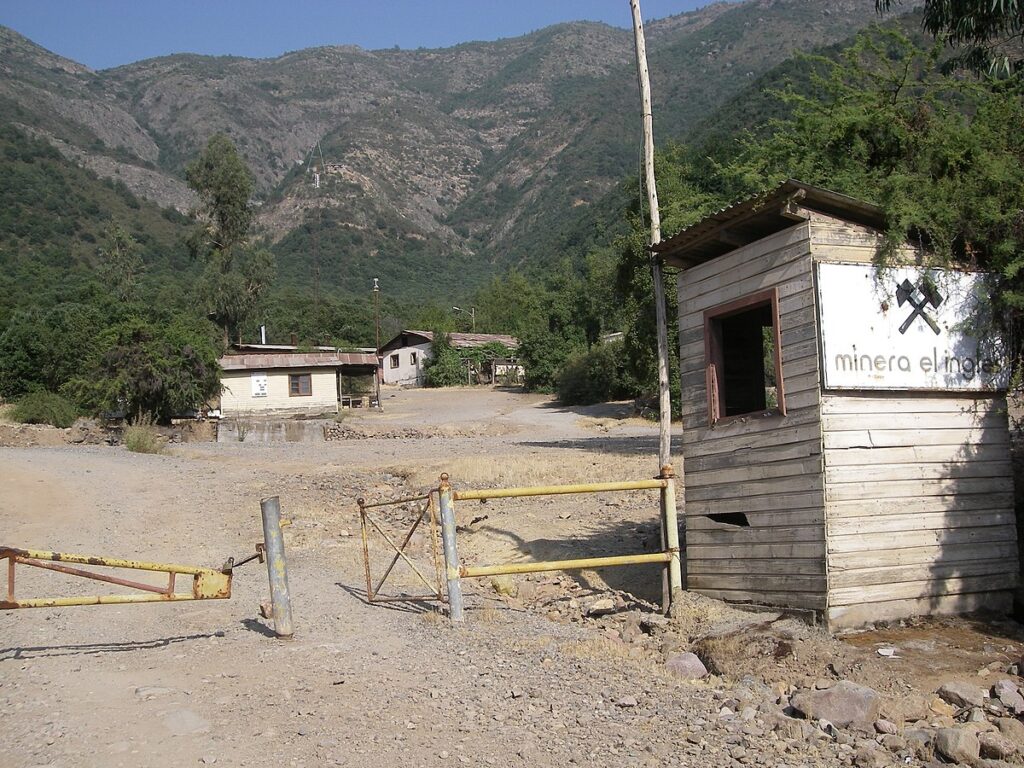
The El Inglés mine is a copper ine located in O’Higgins Region, Chile, 15 km northwest of the city of Rancagua. It is the oldest deposit in the Chancón mining district.[1]
The mine is located in the Farellones Formation and consists of a vein system from which copper is extracted, as well as gold and tin in smaller quantities.[2] It covers an area of approximately ten hectares and is located between the Anita and La Mina ravines, on the northeastern slopes of a massif of the Chilean Coast Range.[3]
It was owned by the National Mining Enterprise in the 1970s.[4] In 1975, the El Inglés treatment plant began operations through the mining contract company Minera El Inglés. Beginning in 1984, the company was acquired by CEMIN and processed its own and purchased gold ores using the flotation process until 1998. On December 29, 2011, the Graneros Mining Company acquired the company, changing its corporate name to Compañía Minera El Inglés on March 19, 2012.[5]
In the 1950s, the film Llampo de sangre (lit. “Flash of Blood”) was filmed at the mine, based on the novel of the same name by Oscar Castro, a local man from Rancagua.[6]

