
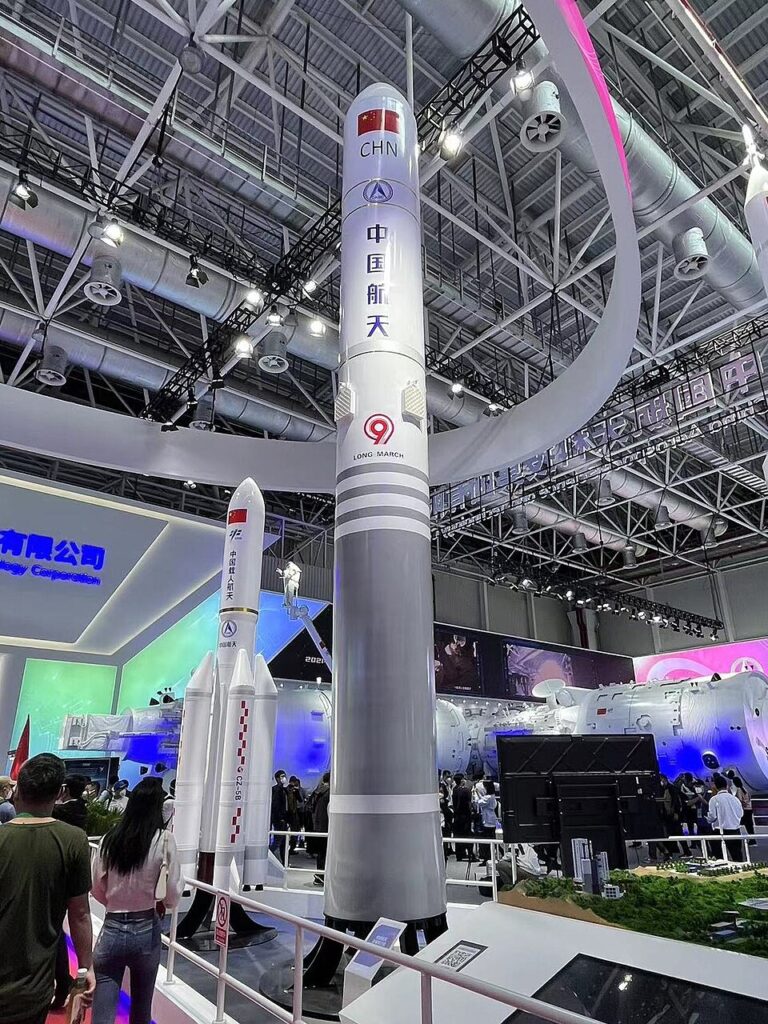
=== 2021, new design ===
=== 2021, new design ===
[[File:Long March 9.png|thumb|Previous Long March 9 design]]
[[File:Long March 9.png|thumb|Previous Long March 9 design]]
On 24 June 2021, [[Long Lehao]], chief designer of the Long March series, provided some updates regarding the Long March 9 at the [[University of Hong Kong]] in a presentation titled “Long March Rocket and China’s Aerospace”. The original design, called the 11th version (2011), had been supplanted by a new design, called the 21st version, which featured many changes, including an enlarged diameter of 10.6 meters, a length of 108 meters, and a weight of 4,122 tons. 16 [[YF-130|YF-135]] liquid oxygen kerosene engines, each with over 300 tons of thrust, will be used in the first stage; 120-ton hydrogen-oxygen engines will be used in the second and third stages, with four in the second stage, and one in the third stage. All fuel tanks were changed to a common bulkhead design, and all external boosters had been removed. The payload capacity to low Earth orbit was increased from 140 to 150 metric tons, and the payload to [[trans-lunar injection]] was increased to 53 tons. Long noted that this new version was still under review at the time of the presentation.<ref>{{cite web|last=Jones|first=Andrew|url=https://spacenews.com/chinas-super-heavy-rocket-to-construct-space-based-solar-power-station/|title=China’s super heavy rocket to construct space-based solar power station|work=[[SpaceNews]]|date=28 June 2021|access-date=30 June 2021|archive-date=24 February 2024|archive-url=https://web.archive.org/web/20240224025156/https://spacenews.com/chinas-super-heavy-rocket-to-construct-space-based-solar-power-station/|url-status=live}}</ref><ref>{{Cite web|title=[线上同步直播] 驰骋大航天时代 – 与国家航天工程科学家现场交流 {{!}} Mainland Affairs Office (MAO), HKU|url=https://mainlandaffairs.hku.hk/zh-hans/20210622|access-date=2021-06-25|website=mainlandaffairs.hku.hk|archive-date=2022-09-22|archive-url=https://web.archive.org/web/20220922053915/https://mainlandaffairs.hku.hk/zh-hans/20210622|url-status=live}}</ref>
On 24 June 2021, [[Long Lehao]], chief designer of the Long March series, provided some updates regarding the Long March 9 at the [[University of Hong Kong]] in a presentation titled “Long March Rocket and China’s Aerospace”. The original design, called the 11th version (2011), had been supplanted by a new design, called the 21st version, which featured many changes, including an enlarged diameter of 10.6 meters, a length of 108 meters, and a weight of 4,122 tons. 16 [[YF-130|YF-135]] liquid oxygen kerosene engines, each with over 300 tons of thrust, will be used in the first stage; 120-ton hydrogen-oxygen engines will be used in the second and third stages, with four in the second stage, and one in the third stage. All fuel tanks were changed to a common bulkhead design, and all external boosters had been removed. The payload capacity to low Earth orbit was increased from 140 to 150 metric tons, and the payload to [[trans-lunar injection]] was increased to 53 tons. Long noted that this new version was still under review at the time of the presentation.<ref>{{cite web|last=Jones|first=Andrew|url=https://spacenews.com/chinas-super-heavy-rocket-to-construct-space-based-solar-power-station/|title=China’s super heavy rocket to construct space-based solar power station|work=[[SpaceNews]]|date=28 June 2021|access-date=30 June 2021|archive-date=24 February 2024|archive-url=https://web.archive.org/web/20240224025156/https://spacenews.com/chinas-super-heavy-rocket-to-construct-space-based-solar-power-station/|url-status=live}}</ref><ref>{{Cite web|title=[线上同步直播] 驰骋大航天时代 与国家航天工程科学家现场交流 {{!}} Mainland Affairs Office (MAO), HKU|url=https://mainlandaffairs.hku.hk/zh-hans/20210622|access-date=2021-06-25|website=mainlandaffairs.hku.hk|archive-date=2022-09-22|archive-url=https://web.archive.org/web/20220922053915/https://mainlandaffairs.hku.hk/zh-hans/20210622|url-status=live}}</ref>
The new design was seen as being more suitable for first-stage reuse, and was a response to [[SpaceX Starship|SpaceX’s Starship]],<ref name=”Szeftel-2022″>{{Cite web |title=The Space Review: Red Heaven: China sets its sights on the stars (part 1) |url=https://www.thespacereview.com/article/4347/1 |access-date=2023-06-15 |website=www.thespacereview.com |archive-date=2022-11-20 |archive-url=https://web.archive.org/web/20221120111510/https://www.thespacereview.com/article/4347/1 |url-status=live }}</ref> while the 2011 design for LM9 was seen as matching the USA’s [[Space Launch System]].<ref name=Szeftel-2022/>
The new design was seen as being more suitable for first-stage reuse, and was a response to [[SpaceX Starship|SpaceX’s Starship]],<ref name=”Szeftel-2022″>{{Cite web |title=The Space Review: Red Heaven: China sets its sights on the stars (part 1) |url=https://www.thespacereview.com/article/4347/1 |access-date=2023-06-15 |website=www.thespacereview.com |archive-date=2022-11-20 |archive-url=https://web.archive.org/web/20221120111510/https://www.thespacereview.com/article/4347/1 |url-status=live }}</ref> while the 2011 design for LM9 was seen as matching the USA’s [[Space Launch System]].<ref name=Szeftel-2022/>
On 23 April 2022, Long provided some updates on yet another new design for the Long March 9. This one, referred to as Version 22, is a reusable, booster-less design very similar to Version 21. The second and third stages will be powered by 120-tonne hydrolox engines, just like Version 21. Four engines are on the second stage and one engine is in the third stage. However, the first-stage and second-stage core diameters have been increased to 11 meters, while the third-stage diameter is 7.5 meters. The total length has been increased to 111 meters, with a mass of 4122 tonnes. The first stage will be powered by twenty-six 200-tonne methane/LOX engines instead of the YF-135 engine from the previous design. Payload capacities are 150 tonnes to LEO and 50 tonnes to TLI.<ref>{{cite web|date=2022-04-25|title=China National Space Day|url=https://kevinjamesng.com/2022/04/25/cnsa-chinanationalspaceadministration-%E5%9B%BD%E5%AE%B6%E8%88%AA%E5%A4%A9%E5%B1%80-beltandroadinitiative-apirl2022%E4%B8%AD%E5%9B%BD%E5%A4%A9%E6%96%87%E6%97%A5-chinaspaceday-%E9%95%BF/|access-date=2022-04-27|website=kevinjamesng.com|archive-date=2022-11-28|archive-url=https://web.archive.org/web/20221128023706/https://kevinjamesng.com/2022/04/25/cnsa-chinanationalspaceadministration-%E5%9B%BD%E5%AE%B6%E8%88%AA%E5%A4%A9%E5%B1%80-beltandroadinitiative-apirl2022%E4%B8%AD%E5%9B%BD%E5%A4%A9%E6%96%87%E6%97%A5-chinaspaceday-%E9%95%BF/|url-status=live}}</ref><ref>{{cite web|date=2022-04-27|title=10 more engines!The Long March 9 rocket has a new configuration, which is thicker and taller and can be reused|url=https://inf.news/en/military/5249f3bc1a4f016c8781df63714ee5e3.html|access-date=2022-04-27|website=inf.news|archive-date=2022-08-05|archive-url=https://web.archive.org/web/20220805090956/https://inf.news/en/military/5249f3bc1a4f016c8781df63714ee5e3.html|url-status=live}}</ref>
On 23 April 2022, Long provided some updates on yet another new design for the Long March 9. This one, referred to as Version 22, is a reusable, booster-less design very similar to Version 21. The second and third stages will be powered by 120-tonne hydrolox engines, just like Version 21. Four engines are on the second stage and one engine is in the third stage. However, the first-stage and second-stage core diameters have been increased to 11 meters, while the third-stage diameter is 7.5 meters. The total length has been increased to 111 meters, with a mass of 4122 tonnes. The first stage will be powered by twenty-six 200-tonne methane/LOX engines instead of the YF-135 engine from the previous design. Payload capacities are 150 tonnes to LEO and 50 tonnes to TLI.<ref>{{cite web|date=2022-04-25|title=China National Space Day|url=https://kevinjamesng.com/2022/04/25/cnsa-chinanationalspaceadministration-%E5%9B%BD%E5%AE%B6%E8%88%AA%E5%A4%A9%E5%B1%80-beltandroadinitiative-apirl2022%E4%B8%AD%E5%9B%BD%E5%A4%A9%E6%96%87%E6%97%A5-chinaspaceday-%E9%95%BF/|access-date=2022-04-27|website=kevinjamesng.com|archive-date=2022-11-28|archive-url=https://web.archive.org/web/20221128023706/https://kevinjamesng.com/2022/04/25/cnsa-chinanationalspaceadministration-%E5%9B%BD%E5%AE%B6%E8%88%AA%E5%A4%A9%E5%B1%80-beltandroadinitiative-apirl2022%E4%B8%AD%E5%9B%BD%E5%A4%A9%E6%96%87%E6%97%A5-chinaspaceday-%E9%95%BF/|url-status=live}}</ref><ref>{{cite web|date=2022-04-27|title=10 more engines!The Long March 9 rocket has a new configuration, which is thicker and taller and can be reused|url=https://inf.news/en/military/5249f3bc1a4f016c8781df63714ee5e3.html|access-date=2022-04-27|website=inf.news|archive-date=2022-08-05|archive-url=https://web.archive.org/web/20220805090956/https://inf.news/en/military/5249f3bc1a4f016c8781df63714ee5e3.html|url-status=live}}</ref>
In October 2022, Long Lehao once again disclosed the new design of the Long March 9. The diameter of the first and second stages of the new version changed back to 10.6 meters, the diameter of the third stage became the same as the first and second stages, the total length increased to 114 meters, and the first stage power was changed to twenty-four of 240 tons kerosene/LOX engine. The payload capacity is 100-160 tonnes to LEO, and 35-53 tonnes to TLI.<ref>{{Cite web |url=https://tw.news.yahoo.com/%E9%A0%AD%E6%A2%9D%E6%8F%AD%E5%AF%86-%E4%B8%AD%E5%9C%8B%E7%89%88%E6%98%9F%E8%89%A62030%E9%A6%96%E9%A3%9B-%E9%99%B8%E9%95%B7%E5%BE%819%E8%99%9F%E8%B6%85%E9%87%8D%E5%9E%8B%E7%81%AB%E7%AE%AD%E5%AE%9A%E6%A1%88-204232061.html |title=頭條揭密》中國版星艦2030首飛 陸長征9號超重型火箭定案 |author=盧伯華 |date=2022-12-01 |publisher=中国新闻网 |language=zh-hant |accessdate=2023-01-07 |archive-date=2023-05-03 |archive-url=https://web.archive.org/web/20230503201422/https://tw.news.yahoo.com/%E9%A0%AD%E6%A2%9D%E6%8F%AD%E5%AF%86-%E4%B8%AD%E5%9C%8B%E7%89%88%E6%98%9F%E8%89%A62030%E9%A6%96%E9%A3%9B-%E9%99%B8%E9%95%B7%E5%BE%819%E8%99%9F%E8%B6%85%E9%87%8D%E5%9E%8B%E7%81%AB%E7%AE%AD%E5%AE%9A%E6%A1%88-204232061.html |url-status=live }}</ref>
In October 2022, Long Lehao once again disclosed the new design of the Long March 9. The diameter of the first and second stages of the new version changed back to 10.6 meters, the diameter of the third stage became the same as the first and second stages, the total length increased to 114 meters, and the first stage power was changed to twenty-four of 240 tons kerosene/LOX engine. The payload capacity is tonnes to LEO, and tonnes to TLI.<ref>{{Cite web |url=https://tw.news.yahoo.com/%E9%A0%AD%E6%A2%9D%E6%8F%AD%E5%AF%86-%E4%B8%AD%E5%9C%8B%E7%89%88%E6%98%9F%E8%89%A62030%E9%A6%96%E9%A3%9B-%E9%99%B8%E9%95%B7%E5%BE%819%E8%99%9F%E8%B6%85%E9%87%8D%E5%9E%8B%E7%81%AB%E7%AE%AD%E5%AE%9A%E6%A1%88-204232061.html |title=頭條揭密》中國版星艦2030首飛 陸長征9號超重型火箭定案 |author=盧伯華 |date=2022-12-01 |publisher=中国新闻网 |language=zh-hant |accessdate=2023-01-07 |archive-date=2023-05-03 |archive-url=https://web.archive.org/web/20230503201422/https://tw.news.yahoo.com/%E9%A0%AD%E6%A2%9D%E6%8F%AD%E5%AF%86-%E4%B8%AD%E5%9C%8B%E7%89%88%E6%98%9F%E8%89%A62030%E9%A6%96%E9%A3%9B-%E9%99%B8%E9%95%B7%E5%BE%819%E8%99%9F%E8%B6%85%E9%87%8D%E5%9E%8B%E7%81%AB%E7%AE%AD%E5%AE%9A%E6%A1%88-204232061.html |url-status=live }}</ref>
=== 2023 ===
=== 2023 ===
Chinese super-heavy rocket in development
 |
|
| Function | Super heavy-lift launch vehicle |
|---|---|
| Manufacturer | China Academy of Launch Vehicle Technology |
| Country of origin |  People’s Republic of China People’s Republic of China |
| Height | 114 m (374 ft) |
| Diameter | 10.6 m (35 ft) |
| Mass | 4,369,000 kg (9,632,000 lb) |
| Stages | 3 |
| Mass | 150,000 kg (330,000 lb) |
| Mass | 54,000 kg (119,000 lb) |
| Mass | 44,000 kg (97,000 lb) |
| Family | Long March (rocket family) |
| Comparable | |
| Status | In development |
| Diameter | 10.6 m (35 ft) |
| Propellant mass | 3,420,000 kg (7,540,000 lb) |
| Powered by | 30 YF-215 |
| Maximum thrust | 60 MN (13,000,000 lbf) |
| Specific impulse | 330 s (3.2 km/s) |
| Propellant | CH4 / LOX |
| Diameter | 10.6 m (35 ft) |
| Propellant mass | 370,000 kg (820,000 lb) |
| Powered by | 2 YF-215 |
| Maximum thrust | ~4.4 MN (990,000 lbf) |
| Specific impulse | ~363 s (3.56 km/s) |
| Propellant | CH4 / LOX |
| Diameter | 10.6 m (35 ft) |
| Propellant mass | 140,000 kg (310,000 lb) |
| Powered by | 4 YF-79 |
| Maximum thrust | 1.0 MN (220,000 lbf) |
| Specific impulse | 455.2 s (4.464 km/s) |
| Propellant | LH2 / LOX |
Long March 9 (Chinese: 长征九号火箭, LM-9 or Changzheng 9, CZ-9) is a Chinese super-heavy lift launch vehicle that is currently under development.[1][2] It is the ninth iteration of the Long March rocket family, named for the Chinese Red Army‘s 1934–35 Long March campaign during the Chinese Civil War.
Current plans call for the Long March 9 to have a maximum payload capacity of 150,000 kg to low Earth orbit (LEO) and 54,000 kg to trans-lunar injection.[3][4] Its first flight is planned for 2033,[5] in anticipation of an increase in cadence by China’s crewed lunar missions during the 2030s.[6][2] (As of 2023, the first crewed lunar landing attempt by China is expected to occur by the year 2030; this initial effort would use the under-development Long March 10 carrier rocket, the new Mengzhou crewed spacecraft, and the Lanyue crewed lunar lander.[7])
The CZ-9 was initially designed as a three-staged rocket, with a first-stage core diameter of 10 meters and using a cluster of four engines. Multiple variants of the rocket have been proposed, with CZ-9 being the largest: this ‘base variant’ has four additional liquid-fuel boosters strapped onto the core stage (each individual booster would be up to 5 meters in diameter) and it is this variant that has the aforementioned LEO payload capacity of 140 tons. In addition to the base variant, there is the CZ-9A variant, which has only two additional boosters and an LEO payload capacity of 100 tons. Finally, there is the CZ-9B, having only the bare 10-meter diameter core stage and an LEO payload capacity of 50 tons.[8] The expected payload capacities of the Long March 9 place it in the class of the super heavy-lift launch vehicle. The rocket’s development program was formally approved by the Chinese government in 2021.[2]

On 24 June 2021, Long Lehao, chief designer of the Long March series, provided some updates regarding the Long March 9 at the University of Hong Kong in a presentation titled “Long March Rocket and China’s Aerospace”. The original design, called the 11th version (2011), had been supplanted by a new design, called the 21st version, which featured many changes, including an enlarged diameter of 10.6 meters, a length of 108 meters, and a weight of 4,122 tons. 16 YF-135 liquid oxygen kerosene engines, each with over 300 tons of thrust, will be used in the first stage; 120-ton hydrogen-oxygen engines will be used in the second and third stages, with four in the second stage, and one in the third stage. All fuel tanks were changed to a common bulkhead design, and all external boosters had been removed. The payload capacity to low Earth orbit was increased from 140 to 150 metric tons, and the payload to trans-lunar injection was increased to 53 tons. Long noted that this new version was still under review at the time of the presentation.[9][10]
The new design was seen as being more suitable for first-stage reuse, and was a response to SpaceX’s Starship,[11] while the 2011 design for LM9 was seen as matching the USA’s Space Launch System.[11]
On 23 April 2022, Long provided some updates on yet another new design for the Long March 9. This one, referred to as Version 22, is a reusable, booster-less design very similar to Version 21. The second and third stages will be powered by 120-tonne hydrolox engines, just like Version 21. Four engines are on the second stage and one engine is in the third stage. However, the first-stage and second-stage core diameters have been increased to 11 meters, while the third-stage diameter is 7.5 meters. The total length has been increased to 111 meters, with a mass of 4122 tonnes. The first stage will be powered by twenty-six 200-tonne methane/LOX engines instead of the YF-135 engine from the previous design. Payload capacities are 150 tonnes to LEO and 50 tonnes to TLI.[12][13]
In October 2022, Long Lehao once again disclosed the new design of the Long March 9. The diameter of the first and second stages of the new version changed back to 10.6 meters, the diameter of the third stage became the same as the first and second stages, the total length increased to 114 meters, and the first stage power was changed to twenty-four of 240 tons kerosene/LOX engine. The payload capacity is 100–160 tonnes to LEO, and 35–53 tonnes to TLI.[14]
During a presentation at the Nanjing University of Science and Technology in March 2023,[3][4] Long Lehao presented yet other modification to the plans. The reusable first stage is now powered by 30 200-tonne-thrust YF-215 engines burning methane and liquid oxygen, while the expendable second stage uses 2 engines of the same type. The third stage is optional and uses a single 120-tonne-thrust liquid hydrogen/liquid oxygen staged combustion engine named the YF-91. Long-term plans exist to make the 2nd stage reusable as well.
In April 2023 a new presentation by CALT showed the 3rd stage as powered by 4 YF-79 expander cycle liquid hydrogen/liquid oxygen engines instead, each of 25-tonnes of thrust.[15] Another presentation on the same month shows a planned fully reusable, 2-stage version of the Long March 9 to be developed during the 2040s, in a configuration similar to the SpaceX Starship.[5]
Aviation Week & Space Technology, December 23, 2024 to January 12, 2025, p. 63, Snapshot: Long March 9

