
[[Category:7th-century Christian martyrs]]
[[Category:7th-century Christian martyrs]]
[[Category:Portuguese Roman Catholic saints]]
[[Category:Portuguese Roman Catholic saints]]
[[Category:Pre-Schism Western saints]]
[[Category:Tomar]]
[[Category:Tomar]]
[[Category:Santarém, Portugal]]
[[Category:Santarém, Portugal]]
Portuguese Christian martyr
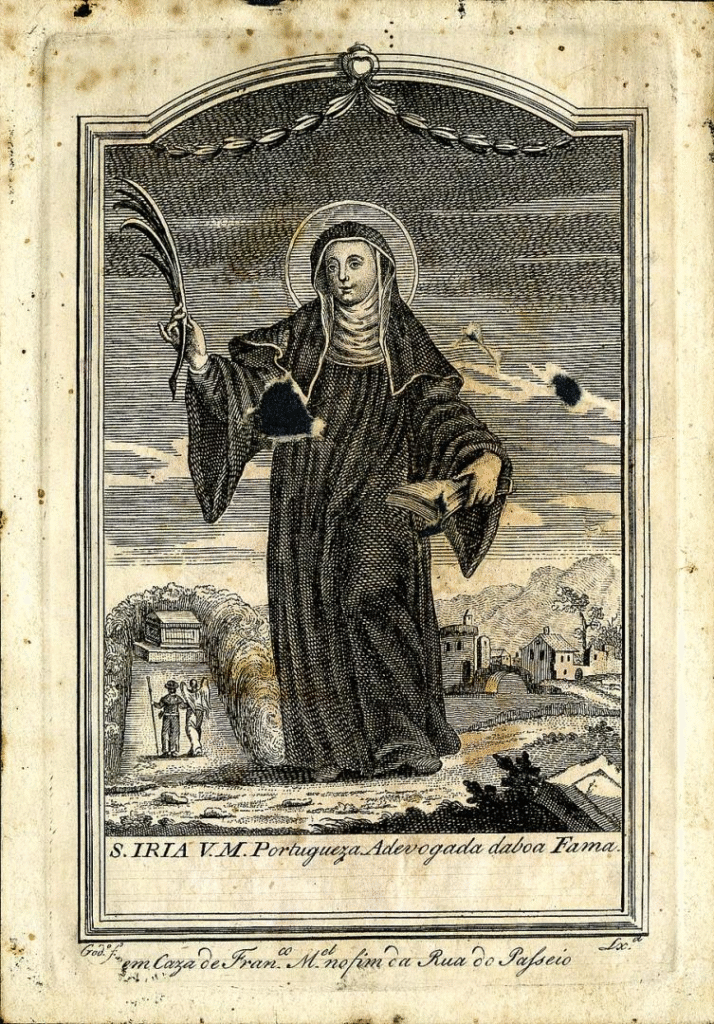
Saint Irene of Tomar (Portuguese: Template:Lang-pt or Template:Lang-pt; c. 635 – c. 653) is a pre-Schism Christian virgin-martyr especially venerated in Portugal. Her feast is kept on **20 October**. The oldest secure notice is a brief entry (“virgo in Scallabi Castro”) in the Antiphonary of León; most narrative vitae are much later and legendary in tone.[1]
Later hagiographic accounts relate that Irene was a noble maiden or nun from Nabância (Tomar). She rejected the advances of the noble Britald and of her tutor, the monk Remígio; in revenge, Remígio allegedly administered a potion that made her appear pregnant. Britald then hired a mercenary who killed Irene with a sword; her body was cast into the Nabão River and later recovered near Scalabis by monks, who spread her cult.[2][3]
Veneration and legacy
[edit]
Irene is patron of Tomar and Santarém. In Tomar, the **Santa Iria Fair** has been held annually in October since at least the 17th century.[4][5] A traditional shrine site is the former **Convent of Santa Iria** by the Nabão in Tomar.[6]
In the Eastern Orthodox Church
[edit]
As a **pre-Schism Western saint**, Irene is commemorated in some Orthodox calendars on **20 October**, often listed among the Latin saints of Hispania.[7][8]
Sources and historicity
[edit]
The earliest attestation is the Antiphonary of León (10th century?), while detailed narratives appear only in later medieval breviaries (Braga, Évora); as such, the story blends local legend and toponymy (the name Santarém is traditionally derived from Sancta Irene).[9]
Some modern summaries list additional patronages (e.g., Santa Iria de Azóia in the municipality of Loures).[10]
Legend says that Irene was born in Nabância, present-day Tomar, Portugal. She was born into an influential family, and her parents, wishing to protect her, sent her to a convent school and a private tutor. The only times she left her house was to attend Mass or pray at the sanctuary of Saint Peter. A young nobleman named Britald saw her once and fell in love with her. Every time she left to go to church, he would follow her. Eventually he came forward with his proposal to court her; however, Irene made it clear that she would never marry him. When Britald became depressed, Irene hastened to make it clear to him that the reason for her celibacy was that she had given herself to God as a nun.[11]
Meanwhile, her tutor, a monk named Remigius (or Remígio) made improper advances to her, and when she declined, quit and spread vicious rumors about her. When asked why he was no longer tutoring the girl, he replied that he had left upon having learned that she was pregnant. In addition, he managed to give her a drink that brought about her belly to inflate. All these news circulated around the town, and eventually Britald learned of her supposed infidelity. Enraged, he hired a mercenary soldier to kill her; as Irene was returning home from visiting an elderly disabled man, the assassin approached from behind and killed her with a single stroke of his sword.[11]
Her body was thrown into the Nabão River, that flows into the Tagus. Later, it was recovered uncorrupted from this river by Benedictines near the town of Scalabis. Legend says that her uncle abbot Celius had received from Christ a revelation about the true story of her niece and the location of her body. The monks gave her a proper burial, and spread her cultus. Eventually, so great was the reverence paid to the virgin saint, that the name of the town of Scalabis was changed to Santarém (“Saint Irene”).[11]
Irene is the patron saint of Tomar and namesake of Santarém.
Her feast day is celebrated on 20 October.
- Oliveira, Miguel de, Santa Iria e Santarém. Lenda e História. Estudos hagiográficos, Lisboa, União Gráfica, 1964
- Costa, Avelino de Jesus, Santa Iria e Santarém, revisão de um problema hagiográfico e toponímico, Coimbra, FLUC, 1972

