
- Short description|none}}
- Use American English|date=October 2025}}
- Use mdy dates|date=October 2025}}
|
|
A gubernatorial special election was held in Virginia on February 10, 1827. The member of the Virginia House of Delegates from Amelia County William Branch Giles defeated the member from Albemarle County Hugh Nelson and the U.S. representative from Virginia’s 20th congressional district John Floyd.[1]
The incumbent governor of Virginia John Tyler resigned effective March 4, 1827, following his election to the United States Senate. The election was conducted by the Virginia General Assembly in joint session. Floyd formally declined to run in a letter to the legislature, after which the race narrowed to between Giles and Nelson. Giles’s supporters praised his opposition to internal improvements and his hostility to the national Adams administration, while Nelson was celebrated as an Old Republican of the “School of ’98.”[1] All three candidates were “opposition men” aligned with the national Jacksonian movement.[4] Giles was elected with a majority on the first ballot.
William Branch Giles
[edit]
John W. Nash of Amelia County nominated Giles. He praised Giles’s record in public office and claimed that the governorship would be a “just reward” for his “long[,] distinguished, and important services to the country.” Nash referred to Giles’s well-known views on the issues of the day, particularly his opposition to internal improvements, as reason to prefer him over his rivals. He clarified that Giles did not oppose all internal improvements, but favored a more limited plan than that proposed by Tyler, which, Nash said, placed too great a strain on the state’s finances.[1]
Richard Eppes of Sussex County and Daniel A. Wilson of Cumberland County spoke in support of Giles. Eppes condemned the conduct of the sitting president of the United States John Quincy Adams in the controversy surrounding the Treaty of Indian Springs.[1] Adams had intervened on behalf of the Muscogee Nation in the dispute over the treaty, which he annulled, resulting in the Treaty of Washington. Eppes claimed the administration had brought the nation to the brink of disunion, and that only strict constructionism as espoused by Giles could avert secession and civil war.[1]
William Cabell Rives of Nelson County and Thomas B. Griffin of York nominated Nelson. Griffin recalled Nelson’s long service in office as a member of the legislature, U.S. representative, and former speaker of the House of Delegates. Rives did not address Nelson’s views in detail, but pronounced him a “Republican of the Old School.”[1] Privately, Nelson offered assurances that his loyalties lay with Jackson in the 1828 United States presidential election.[6]
As in 1825, uncertainty about the candidate’s intentions divided Floyd’s supporters in the legislature. The congressman was considered the frontrunner to succeed Tyler in the days preceding the election.[4] When the legislature met on February 10, however, Alexander Smyth of Wythe County presented letters from Floyd declining to become a candidate for governor. Floyd stated his preference to remain in Congress, where he could best serve the national Jacksonian movement. Letters from Floyd’s congressional colleagues testifying to the importance of Floyd’s presence in the national legislature were also read.[1]
Despite this testimony, Floyd was nominated for governor by Joseph Alderson of Greenbrier County. Robert Craig of Montgomery County and John B. Christian of Charles City County announced they would vote for Floyd regardless of the contents of his letters to Smyth. Craig read a letter from Floyd expressing a personal wish to serve as governor, and said he felt duty-bound to vote for Floyd after his name was placed in nomination. Christian cited Floyd’s support for Andrew Jackson in the upcoming presidential campaign and said “he would vote for no man who did not prefer Gen. Jackson.”[1]
Internal improvements
[edit]
Tyler had called for the state to fund expansion
Presidential campaign
[edit]
The upcoming United States presidential election was a major topic of discussion. Nelson was the latest gubernatorial candidate to endorse Andrew Jackson when the joint session convened; all of the leading candidates were “opposition men”[4] and Jacksonians.[6] Floyd’s association with the Jacksonian movement was a significant factor driving support for his candidacy, while national Jacksonians emphasized Floyd’s importance to their party’s interests in Congress.[1]
- Chitwood, Oliver Perry (1964). John Tyler: Champion of the Old South. New York: Russell and Russell.
- Howe, Daniel Walker (2007). What Hath God Wrought: The Transformation of America, 1815–1848. New York: Oxford University Press.
- Kallenbach, Joseph E.; Kallenbach, Jessamine S. (1977). American State Governors, 1776–1976. Vol. 1. Dobbs Ferry, NY: Oceana Publications.
- Sobel, Robert; Raimo, John (1978). Biographical Directory of the Governors of the United States 1789–1978. Vol. 4. Westport, CT: Meckler Books.
- Virginia (1826). Journal of the House of Delegates […]. Richmond.
- Category:1827 Virginia elections|Gubernatorial]]
- Category:Virginia gubernatorial elections]]
- Category:1827 United States gubernatorial elections|Virginia]]
- Category:February 1827]]
- Category:1827 in Virginia]]
- Category:Indirect elections]]
1827
1828
1830
Abolitionists held a presidential nominating convention at Albany, New York, on April 1 and 2, 1840, and nominated James G. Birney of New York for president and Thomas Earle of Pennsylvania for vice president in the 1840 United States presidential election. Although the name was not in general use at the time, this is considered the founding convention of the Liberty Party.
Delegates from six states attended the convention, which was preceded by local abolitionist meetings in the burned-over district of Upstate New York. New Yorkers accounted for all but a handful of those present, while the remainder came chiefly from New England. Winter weather and lack of funds precluded the attendance of delegates from Pennsylvania and the Old Northwest. Birney had previously received the endorsement of a gathering of political abolitionists at Warsaw, New York, but declined, believing a candidate should be selected by a “national” convention. Garrisonian abolitionists opposed any involvement in electoral politics and attended with the aim to prevent an independent nomination.
Robust argument between the Garrisonians and the political abolitionists preceded the voting on the second day of the convention. The motion to nominate candidates for president and vice president narrowly passed, and the convention named Birney and Earle as the national ticket. The convention did not specify a name for the new party, and Birney and Earle were known variously as the Abolitionist, Freemen’s, Human Rights, Liberty, and People’s ticket. The pair polled 0.3 percent of the vote in the fall election, which was won by the Whig candidate, William Henry Harrison.
Political abolitionism
[edit]
Abolitionists debated their stance on electoralism during the 1830s, with a minority favoring creation of a new antislavery party. Alvan Stewart and Myron Holley emerged as the most prominent political abolitionists. The need for political action was evident from the failure of existing institutions to respond to the moral suasion of abolitionists.
Initially, most abolitionists preferred to work within the established two-party system. By 1839, efforts to influence the Democratic and Whig parties had apparently failed. Adherents to the philosophy of nonresistance opposed participation in the electoral system as a moral and religious principle. Many abolitionists believed that political parties were essentially corrupt and warned that a descent into partisanship would undermine the movement’s moral message.
Interest in an independent antislavery party increased following the 1839 Whig National Convention in response to the nominations of slaveholders William Henry Harrison and John Tyler as the national Whig candidates. Holley travelled across Upstate New York tirelessly advocating for independent nominations in the fall of 1839. Other prominent abolitionists became converts to the necessity of independent nominations, including Joshua Leavitt, Gerrit Smith, Elizur Wright, John Greenleaf Whittier, Austin Willey, and William Goodell, although the timing and form of the nominations—whether an independent candidacy or the base for a permanent party organization—remained controversial.
The New York State Anti-Slavery Society held a convention at the Presbyterian church in Warsaw, New York, on November 13 and 14, 1840. The more than 500 attendees included abolitionists from Western New York and neighboring Pennsylvania. Josiah Andrews of Perry, New York, presided over the meeting, while Holley and William L. Chaplin served on the five-member committee on resolutions. Most of the measures reported by the committee passed unanimously, but the third resolution declaring “that the elector who votes for a candidate for the state or national legislature not known to be the decided advocate of impartial freedom […] is no less criminal than he would be, if in the primary assemblies he should vote directly against freedom, and in favor of oppressive, cruel and chattelizing laws,” was adopted in a contested vote, 22 to 12. The sixth resolution endorsing the creation of a new antislavery party was adopted unanimously. The convention nominated Birney for president and Francis Julius LeMoyne of Pennsylvania for vice president, and appointed Holley, Andrews, and Joshua H. Darling to prepare an address to the electorate.[4]
Both Birney and LeMoyne declined the nomination of the Warsaw convention. LeMoyne felt an independent ticket was untimely and inexpedient, and warned that the action of the convention suggested a worrying lack of confidence in the moral influence of abolitionism. Birney approved the principle of independent nominations, but felt the Warsaw convention was not an appropriate venue, and that a candidate should be selected by a national gathering of abolitionists. His conditional refusal set in motion the chain of events that would culminate in the first national convention of the unnamed new antislavery party the following year.
A gathering of between 600 and 700 abolitionists from the vicinity of Genesee County, New York, met at Arcade, New York, on January 28 and 29, 1840. Holley and Gerrit Smith were the principal organizers of this meeting. Reuben Sleeper was president of the convention.[6] The delegates met in a temporary structure constructed for the purpose, the village meeting house having been found too small to admit the crowds that flocked from as far away as 60 miles in all directions.[7]
Holley, Smith, and Chaplin led the political abolitionists on the floor of the convention. A large number of antislavery Whigs attended in order to oppose the formation of a new antislavery party, but were outvoted three to one by the advocates of independent nominations. The resolutions adopted by the convention denounced the Harrison-Tyler ticket and the Democratic incumbent president Martin Van Buren and endorsed the creation of a new antislavery party. The delegates called for a national convention of the “friends of the immediate abolition of slavery” to meet at Albany on April 1 to nominate candidates for president and vice president.[6]
The Birney-Earle ticket won 0.3 percent of the vote and helped to establish the Liberty Party as the vehicle for antislavery third party activism.
Reactions to the convention varied in antislavery circles, and ultimately only a minority of abolitionists voted for Birney. Garrisonian abolitionists opposed any involvement in electoral politics and ridiculed the meeting as the “April Fools’ Convention.” Some antislavery voters persevered in support of Harrison, while others who backed Birney did so silently. Despite the disappointing national showing, the committee of correspondence called for political abolitionists to redouble their efforts in the aftermath of the election. The committee called the 1841 Liberty National Convention that formally established the new party and adopted the “Liberty Party” as the name of the national organization.
Albany Convention – Number of delegates from ea. state
The Liberator’s response to Arcade
Albany Convention acct. of
Short description|1824 abolitionist tract by Elizabeth Heyrick
Italic title

First edition title page |
|
| Author | Elizabeth Heyrick |
|---|---|
| Language | English |
| Subject | Abolitionism |
|
Publication date |
1824 |
| Publication place | United Kingdom |
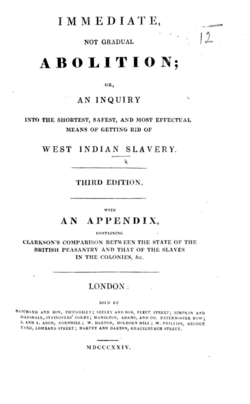
Immediate, Not Gradual Abolition: Or, an Inquiry into the Shortest, Safest, and Most Effectual Means of Getting Rid of West Indian Slavery is an 1824 abolitionist tract written by the British abolitionist Elizabeth Heyrick. It is one of the earliest works to advocate immediate emancipation and marks a turning point in the Transatlantic antislavery movement. In it, Heyrick defends the moral and strategic necessity of immediatism over gradual emancipation. Heyrick addresses the logical premises of gradualism, arguing that enslaved people’s inalienable right to liberty and that British consumers are implicated in slavery by purchasing the produce of slave labor. She criticizes the strategy of petitioning Parliament as ineffective and calls for direct action to abolish slavery in the form of a consumer boycott of slave labor produce, especially cane sugar cultivated in the British West Indies.
The tract was positively received and widely circulated in abolitionist circles, and is credited with reviving the boycott of slave labor goods in Britain. It was quickly reprinted in the United States and serialized in Benjamin Lundy‘s Genius of Universal Emancipation. Heyrick’s arguments for immediatism were highly influential, contributing to passage of the Slavery Abolition Act 1833 and the founding of the American Anti-Slavery Society later that same year. Recently, historians have examined Immediate, Not Gradual Abolition in the context of gender and politics as an important example of women’s contributions to the abolitionist movement.
Heyrick wrote Immediate, Not Gradual Abolition 17 years after the Slave Trade Act 1807 and the Act Prohibiting Importation of Slaves abolished the Atlantic slave trade in the British Empire and the United States. In that time, disappointed hopes that prohibition of the slave trade would lead to the decline of slavery led abolitionists to question the efficacy of indirect methods to abolish slavery. Major slave rebellions occurred in Barbados (1816) and Demerara (1823), and planned insurrections were prevented in Charleston, South Carolina (1822) and Jamaica (1823). In the United States, the founding of the American Colonization Society and the Missouri Crisis revived slavery as a major issue in national politics following the War of 1812.
The London Anti-Slavery Society formed in 1823 to advocate the gradual elimination of slavery in the British Empire. That year, Parliament adopted several non-binding resolutions endorsing limited reforms to curb the worst abuses of the plantation system. When news of the resolutions reached the West Indies, the rumor spread among the enslaved population of Demerara that the king had abolished slavery. Believing their enslavers to be suppressing the royal proclamation of emancipation, 12,000 enslaved people rose in revolt. Proslavery polemicists blamed the resurgence of abolitionist activity for the rebellion.
In Immediate, Not Gradual Abolition, she notes that contrary to the expectations of many, abolition of the slave trade had not been followed by the decline of slavery in the British Caribbean. She concludes that the hypocrisy of British abolitionists in castigating the slave trade while tolerating slavery itself undermines the moral clarity of the movement while leaving the material incentives for slaveholding intact.
Heyrick condemns the gradualism of abolitionists for prioritizing the interests of slaveholders over the liberty of enslaved people, asserting that the former are comparatively unimportant in the consideration of emancipation, which is fundamentally a question of justice.
Heyrick asserts that slaveholders are motivated by gain and that British consumers, by purchasing the produce of slave labor, incentivize and perpetuate slaveholding.
Whereas the advocates of gradualism alleged that immediate emancipation would lead to violence, Heyrick argues that it is slavery, not freedom, that causes slave rebellions; thus, only ending slavery can prevent future violence. She drew upon the history of the Haitian Revolution and recent revolts in
Reception and legacy
[edit]
The Conservative Party was a political party in the United States immediately following the American Civil War. It was a regional counterpart to the Democratic Party in the border states and the former Confederacy. The party appealed to ex-Confederates and conservative Southern Unionists who opposed the extension of civil and political rights to freedpeople during Reconstruction.
Unionists organized campaigns and political parties to oppose secession in 1861. During the war, the movement became divided between Conservative and Radical Unionists on issues related to emancipation and Reconstruction. Conservatives initially opposed the abolition of slavery and sought to preserve the Antebellum political order. By 1862, wartime realities led some Conservatives to advocate gradual emancipation. After the war, Conservatives were increasingly drawn into collaboration with the Democratic Party in opposition to the Republican-aligned Radicals. Francis Preston Blair Jr., a notable Conservative Unionist, was the Democratic vice presidential candidate in 1868; his racist invectives during the campaign are often credited with causing the defeat of the Democratic ticket.
Unionism was a political ideology in the United States during the nineteenth century. It held the unity of the states within a federal constitutional system to be the basis for liberty and republicanism. During the sectional crisis, self-proclaimed unionists decried a wide variety of antagonists that were seen to threaten the Union, including sectionalism, nationalism, social inequality, slavery, and abolitionism. Although virtually all national leaders professed a commitment to Union, no single definition of unionism ever gained unanimous acceptance. Following the secession of the Confederate states in 1861, unionism became identified with the Union Army and the policies of the wartime Lincoln administration. The military defeat of the Confederacy in 1865 secured the preservation of the Union and simultaneously retired unionism as a significant issue in national politics.

