
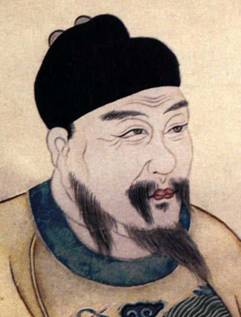
Emperor of Southern Ming from 1645 to 1646
| Longwu Emperor 隆武帝 |
|||||||||||
|---|---|---|---|---|---|---|---|---|---|---|---|
 |
|||||||||||
| Reign | 18 August 1645 – 6 October 1646 | ||||||||||
| Predecessor | Hongguang Emperor | ||||||||||
| Successor | Shaowu Emperor | ||||||||||
| First tenure | 18 July 1632 – 17 December 1632 | ||||||||||
| Predecessor | Zhu Shuohuang, Prince Duan | ||||||||||
| Successor | Zhu Yuse, Prince Min | ||||||||||
| Second tenure | 31 July 1645 – 18 August 1645 | ||||||||||
| Predecessor | Zhu Yuse, Prince Min | ||||||||||
| Successor | Zhu Yuyue | ||||||||||
| Tenure | 1644 – 31 July 1645 | ||||||||||
| Born | 25 May 1602 | ||||||||||
| Died | 6 October 1646 (aged 44) | ||||||||||
| Burial |
Luohanling (羅漢嶺), Tingzhou |
||||||||||
| Spouse | Empress Xiaoyixiang | ||||||||||
| Issue | Zhu Linyuan, Crown Prince Zhuangjing | ||||||||||
|
|||||||||||
| House | Zhu | ||||||||||
| Dynasty | Southern Ming | ||||||||||
| Father | Zhu Qisheng | ||||||||||
| Mother | Lady Mao | ||||||||||
| Chinese | 隆武帝 | ||||||||||
Zhu Yujian (1602 – 6 October 1646), nickname Changshou,[f] originally the Prince of Tang, later reigned as the Longwu Emperor of the Southern Ming dynasty from 18 August 1645, when he was enthroned in Fuzhou, to 6 October 1646, when he was captured and executed by a contingent of the Qing army.[1] He was an eighth generation descendant of Zhu Jing, Prince Ding of Tang, who was the 23rd son of Ming founder Zhu Yuanzhang (Hongwu Emperor).[2]
Before ascending to the throne, he followed his father as the Prince of Tang, their fief being situated in Nanyang prefecture, in Henan province. In 1636, he was stripped of his title by the Chongzhen Emperor and put under house arrest in Fengyang. His former title was transferred to his younger brother Zhu Yumo (朱聿鏌). In 1641, Zhu Yumo committed suicide when Li Zicheng invaded Nanyang. After the death of the Chongzhen Emperor 1644, his successor on the Ming throne, the Hongguang Emperor, released the Prince of Tang from his arrest.
When Qing forces captured Nanjing in June 1645, he fled to Hangzhou. However, when Hangzhou fell to the Qing on 6 July 1645, the Prince of Tang managed to escape by land to the southeastern province of Fujian.
In August of the same year, at the behest of several high officials, he ascended to the Ming throne in Fuzhou, taking the reign title “Longwu” (隆武; pinyin: Lóngwǔ). His era name means “plentiful and martial”. After a promising start, Fujian‘s geographical position on the margin of the empire, cut off from the heartland by several mountain ranges, as well as his lack of effective troops and the failure on part of the officialdom to find a united stance doomed the Longwu government. When Qing forces invaded Fujian in the late summer of 1646, Zheng Zhilong, the emperor’s strongest ally, surrendered while his son Zheng Chenggong (the famous Koxinga) retreated to the sea.
The Prince of Tang was left with a dwindling court. On 6 October 1646, he was captured and immediately executed.
Against the Ming policy of keeping imperial princes out of politics, the Prince of Tang early on showed interest in the government of the empire and strove for a larger role of the princes in it. His initiatives had brought him under house arrest during the reign of the Chongzhen Emperor, but his knowledge of history and of Ming institutions, paired with a diligent personality, made him take his imperial role seriously.[4]
Zhu Yujian is said to have had a very close relationship with his wife, who had shared his hardship when he was incarcerated.[4] Contrary to Chinese custom, he steadfastly declined to take any concubines.
- Empress Xiaoyixiang, of the Zeng clan (孝毅襄皇后 曾氏; d. 1646)
- Zhu Linyuan, Crown Prince Zhuangjing (莊敬太子 朱琳源; 1646-1646), first son
- Concubine, of the Shen clan (沈嫔)
- Concubine, of the Chen clan (陳嬪)
| Patrilineal descent |
|---|
|
Zhu Yujian was the senior-most male-line descendants of Zhu Jing, Prince Ding of Tang, the 23rd son of Zhu Yuanzhang, after his father’s death. Therefore, he was an eighth cousin of the Wanli Emperor. This chart only showed the latest actual title of the person(s).
|

