
He joined the cabinet of [[W. T. Cosgrave]] between 1924 and 1927, after the office was reconstituted as the [[Minister for Posts and Telegraphs|Department of Posts and Telegraphs]]. He was elected at every election for the [[Cork Borough (Dáil constituency)|Cork Borough]] constituency until 1927 when he retired from government. In 1924 he served as the chairman of the Cumann na nGaedheal organising committee and later as the chairman of the organisation in general from 1926 to 1927.<ref>{{cite book |last1=Pine |first1=Richard |title=2RN and the Origins of Irish Radio |date=2002 |publisher=Four Courts Press |pages=52-53}}</ref> Walsh was a supporter of agricultural [[tariffs]] and championed the proposals of the Cork Industrial Development Association.<ref>{{cite book |last1=Daly |first1=Mary E. |title=Industrial development and Irish national identity, 1922-1939 |date=1992 |publisher=Syracuse University Press |page=27}}</ref> In 1927 he resigned from the party and announced that he would not be contesting the election [[September 1927 Irish general election|in September]]. Walsh cited his disagreement with the party’s policy on [[free trade]] as a reason for his resignation. He wrote that Cumann na nGaedheal “has gone bodily over to the most reactionary elements of the state who will henceforth control its policies”.<ref>{{cite book |last1=Daly |first1=Mary E. |title=Industrial development and Irish national identity, 1922-1939 |date=1992 |publisher=Syracuse University Press |page=35}}</ref>
He joined the cabinet of [[W. T. Cosgrave]] between 1924 and 1927, after the office was reconstituted as the [[Minister for Posts and Telegraphs|Department of Posts and Telegraphs]]. He was elected at every election for the [[Cork Borough (Dáil constituency)|Cork Borough]] constituency until 1927 when he retired from government. In 1924 he served as the chairman of the Cumann na nGaedheal organising committee and later as the chairman of the organisation in general from 1926 to 1927.<ref>{{cite book |last1=Pine |first1=Richard |title=2RN and the Origins of Irish Radio |date=2002 |publisher=Four Courts Press |pages=52-53}}</ref> Walsh was a supporter of agricultural [[tariffs]] and championed the proposals of the Cork Industrial Development Association.<ref>{{cite book |last1=Daly |first1=Mary E. |title=Industrial development and Irish national identity, 1922-1939 |date=1992 |publisher=Syracuse University Press |page=27}}</ref> In 1927 he resigned from the party and announced that he would not be contesting the election [[September 1927 Irish general election|in September]]. Walsh cited his disagreement with the party’s policy on [[free trade]] as a reason for his resignation. He wrote that Cumann na nGaedheal “has gone bodily over to the most reactionary elements of the state who will henceforth control its policies”.<ref>{{cite book |last1=Daly |first1=Mary E. |title=Industrial development and Irish national identity, 1922-1939 |date=1992 |publisher=Syracuse University Press |page=35}}</ref>
During [[World War II]], known at the time in Ireland as “[[The Emergency (Ireland)|the Emergency]]”, Walsh’s connections with fascism, including his association with [[Ailtirí na hAiséirghe]],<ref name=”:0″>{{cite book |last=Ryle Dwyer |first=T. |url=https://books.google.com/books?id=QzG-LKq5a10C&q=Defending+Ireland:+The+Irish+State+and+Its+Enemies |title=Strained relations: Ireland at peace and the USA at war, 1941–45 |publisher=Rowman & Littlefield |year=1988 |isbn=978-0-7171-1580-8 |pages=40}}</ref> brought him to the attention of the [[Directorate of Military Intelligence (Ireland)|Directorate of Intelligence]] (G2), the Intelligence branch of the [[Irish Army]]. Their request to the [[Minister for Justice, Home Affairs and Migration|Minister for Justice]], [[Gerald Boland]], to place a tap on Walsh’s phone was, however, refused.<ref>O’Halpin [https://books.google.com/books?id=S6KjQbEBFigC&dq=%22Ailtiri+na+hAiseirghe%22+walsh&pg=PA223 ”Defending Ireland” p223]</ref> Walsh would take the same tram as the head of the G2, [[Dan Bryan]]. Bryan recalls that in 1940, as reports of German military successes were reported in Irish newspapers, Walsh looked up from his newspaper and told him “I see we are still winning”. Although his phone was not wiretapped, the telephones in the German embassy were. After the [[Belfast Blitz]] began in 1941, he was recorded telling the Germans that they ought to bomb Enniskillen, not Belfast.<ref>{{cite book |last1=Fisk |first1=Robert |title=In Time of War: Ireland, Ulster and the Price of Neutrality 1939-45 |date=1985 |publisher=Paladin |page=432}}</ref> Walsh was closely associated with Irish-based pro-[[Nazi]] initiatives through his association with [[Ailtirí na hAiséirghe]],<ref name=”:0″ /> namely the “Irish Friends of Germany” and the “Young Ireland Association” groups, and also “Cumann Náisiúnta”, a pro-Nazi political party.<ref>{{cite book |last1=McMahon |first1=Paul |title=British Spies and Irish Rebels: British Intelligence and Ireland, 1916-1945 |date=2008 |publisher=The Boydell Press |page=309}}</ref><ref>{{cite journal |last1=Douglas |first1=R.M. |title=The Pro-Axis Underground in Ireland, 1939-1942 |journal=The Historical Journal |date=December 2006 |volume=49 |issue=4 |url=https://www.jstor.org/stable/4140154}}</ref> He frequently expressing his views with [[Anti-Semitism|anti-semitic rhetoric]].<ref>Walsh pp12-13,44</ref> He was a major financial backer of Ailtirí na hAiséirghe.<ref>{{cite book |last1=Douglas |first1=R.M. |title=Architects of the Resurrection: Ailtirí na hAiséirghe and the fascist ‘New Order’ in Ireland |date=2009 |publisher=Manchester University Press |pages=153–4}}</ref> He provided money and offices for the party’s newspaper and paid many of their [[election deposits]] in the [[1944 Irish general election|1944 election]].<ref>{{cite book |last1=Moore |first1=Cormac |title=The GAA v Douglas Hyde: The Removal of Ireland’s First President as GAA Patron |date=2012 |publisher=The Collins Press |page=155}}</ref> Walsh was considered by [[MI6]] as a potential “[[Quisling]]” in the case of a German invasion of Ireland.<ref>{{cite book |editor1-last=McGarry |editor1-first=Fearghal |title=Republicanism in Modern Ireland |date=2003 |publisher=University College Dublin Press |pages=124–5}}</ref>
During [[World War II]], known at the time in Ireland as “[[The Emergency (Ireland)|the Emergency]]”, Walsh’s connections with fascism, including his association with [[Ailtirí na hAiséirghe]],<ref name=”:0″>{{cite book |last=Ryle Dwyer |first=T. |url=https://books.google.com/books?id=QzG-LKq5a10C&q=Defending+Ireland:+The+Irish+State+and+Its+Enemies |title=Strained relations: Ireland at peace and the USA at war, 1941–45 |publisher=Rowman & Littlefield |year=1988 |isbn=978-0-7171-1580-8 |pages=40}}</ref> brought him to the attention of the [[Directorate of Military Intelligence (Ireland)|Directorate of Intelligence]] (G2), the Intelligence branch of the [[Irish Army]]. Their request to the [[Minister for Justice, Home Affairs and Migration|Minister for Justice]], [[Gerald Boland]], to place a tap on Walsh’s phone was, however, refused.<ref>O’Halpin [https://books.google.com/books?id=S6KjQbEBFigC&dq=%22Ailtiri+na+hAiseirghe%22+walsh&pg=PA223 ”Defending Ireland” p223]</ref> Walsh would the same tram as the head of the G2, [[Dan Bryan]] recalls that in 1940, as reports of German military successes were reported in Irish newspapers, Walsh looked up from his newspaper and told him “I see we are still winning”. Although his phone was not wiretapped, the telephones in the German embassy were. After the [[Belfast Blitz]] began in 1941, he was recorded telling the Germans that they ought to bomb Enniskillen, not Belfast.<ref>{{cite book |last1=Fisk |first1=Robert |title=In Time of War: Ireland, Ulster and the Price of Neutrality 1939-45 |date=1985 |publisher=Paladin |page=432}}</ref> Walsh was closely associated with Irish-based pro-[[Nazi]] initiatives through his association with [[Ailtirí na hAiséirghe]],<ref name=”:0″ /> namely the “Irish Friends of Germany” and the “Young Ireland Association” groups, and also “Cumann Náisiúnta”, a pro-Nazi political party.<ref>{{cite book |last1=McMahon |first1=Paul |title=British Spies and Irish Rebels: British Intelligence and Ireland, 1916-1945 |date=2008 |publisher=The Boydell Press |page=309}}</ref><ref>{{cite journal |last1=Douglas |first1=R.M. |title=The Pro-Axis Underground in Ireland, 1939-1942 |journal=The Historical Journal |date=December 2006 |volume=49 |issue=4 |url=https://www.jstor.org/stable/4140154}}</ref> He frequently expressing his views with [[Anti-Semitism|anti-semitic rhetoric]].<ref>Walsh pp12-13,44</ref> He was a major financial backer of Ailtirí na hAiséirghe.<ref>{{cite book |last1=Douglas |first1=R.M. |title=Architects of the Resurrection: Ailtirí na hAiséirghe and the fascist ‘New Order’ in Ireland |date=2009 |publisher=Manchester University Press |pages=153–4}}</ref> He provided money and offices for the party’s newspaper and paid many of their [[election deposits]] in the [[1944 Irish general election|1944 election]].<ref>{{cite book |last1=Moore |first1=Cormac |title=The GAA v Douglas Hyde: The Removal of Ireland’s First President as GAA Patron |date=2012 |publisher=The Collins Press |page=155}}</ref>
In 1944 he published a short memoir, ‘Recollections of a Rebel’.<ref name=doib/>
In 1944 he published a short memoir, ‘Recollections of a Rebel’.<ref name=doib/>
Irish politician (1880–1948)
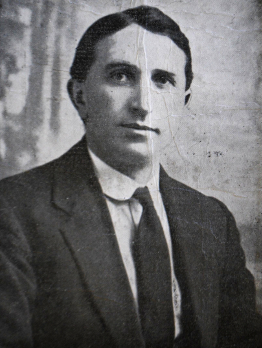
James Joseph Walsh (20 February 1880 – 3 February 1948), generally referred to as J. J. Walsh, was Postmaster General, (later Minister for Posts and Telegraphs) of the Irish Free State from 1923 to 1927.[1] He was also a senior Gaelic Athletic Association organiser and Cumann na nGaedheal politician. Later, Walsh had heavy connections with fascism, including his association with Ailtirí na hAiséirghe.[2]
Early years
J. J. Walsh was born in the townland of Rathroon, near Bandon, County Cork.[3] His family came from a farming background, “working a substantial holding of medium but well-cultivated land”.[4] Until the age of fifteen, Walsh attended a local school in Bandon, but by his own account “as far as learning went, I may as well have been at home”.[4] Together with his school-friend P. S. O’Hegarty, he passed the Civil Service exams for the Postal service. He later worked locally as a clerk in the Post Office. Like O’Hegarty, he spent three years in London at King’s College, studying for the Secretary’s Office “a syllabus (which) differed little from the Indian Civil Service“. While O’Hegarty succeeded in his studies, Walsh did not, and returned to Cork where a friend, Sir Edward Fitzgerald, arranged work for him on the Entertainments Committee of the Cork International Exhibition.[5]
Sport
Walsh was active in the Gaelic Athletic Association, promoting Gaelic games in many areas, but particularly in Cork city and county. His interest in organised sports had a strong political dimension.
I happened to be one of those who realised the potentialities of the G.A.A. as a training ground for Physical Force. Contamination with the alien and all his works was taboo. I gathered around me a force of youthful enthusiasts from the University, Civil Service and Business. With this intensely organised instrument, war was declared on foreign games which were made to feel the shock so heavily that one by one, Soccer and Rugby Clubs began to disappear.[6]
He was also instrumental in establishing the ‘revived’ Tailteann Games.
He was Chairman of the Cork County Council GAA.[7]
Politics
He was involved of the founding of the Cork City Irish Volunteers.[7]
He participated in the Easter Rising in 1916 in the GPO.[8] He claims he was responsible for mobilising 20 members of the Hibernian Rifles and took them to the GPO.[7] However Rifles commandant John J. Scollan contradicts this account.[9] He was promoted from Rifleman to Vice-Commandant of the Hibernian Rifles in 1915.[10]
He was arrested following the general surrender and sentenced to death after a court-martial at Richmond Barracks. This was almost immediately commuted to life imprisonment, but he was released the following year under a general amnesty.
In later 1917 he was arrested and imprisoned after making a speech declaring “the only way to address John Bull is through the barrel of a rifle”.[11] In Autumn 1919 he was involved in a failed assassination attempt on Lord French.[12]
Walsh was elected as a Sinn Féin Member of Parliament (MP) in the 1918 general election for the Cork City constituency.[13] As a member of the 1st Dáil he was arrested for partaking in an illegal government. He was released in 1921 and supported the Anglo-Irish Treaty and went on to become a founding member of the new political party, Cumann na nGaedheal. Walsh served as Postmaster General from 1922 until 1924. In March 1922 the government cut the biannual cost of living bonuses given to post office workers and in September there were further cuts, this led to a strike by the post office workers. Walsh threatened the strikers with dismissals and the government sent in the Army to disrupt pickets and do the work of the strikers. Later that month the strike came to an end.[14] In August 1922 he was part of a government committee which was intended to consider what the Irish Free State‘s policy towards North-east Ulster would be.[15]
He joined the cabinet of W. T. Cosgrave between 1924 and 1927, after the office was reconstituted as the Department of Posts and Telegraphs. He was elected at every election for the Cork Borough constituency until 1927 when he retired from government. In 1924 he served as the chairman of the Cumann na nGaedheal organising committee and later as the chairman of the organisation in general from 1926 to 1927.[16] Walsh was a supporter of agricultural tariffs and championed the proposals of the Cork Industrial Development Association.[17] In 1927 he resigned from the party and announced that he would not be contesting the election in September. Walsh cited his disagreement with the party’s policy on free trade as a reason for his resignation. He wrote that Cumann na nGaedheal “has gone bodily over to the most reactionary elements of the state who will henceforth control its policies”.[18]
During World War II, known at the time in Ireland as “the Emergency“, Walsh’s connections with fascism, including his association with Ailtirí na hAiséirghe,[19] brought him to the attention of the Directorate of Intelligence (G2), the Intelligence branch of the Irish Army. They considered Walsh as a potential “Quisling” in the case of a German invasion of Ireland. Their request to the Minister for Justice, Gerald Boland, to place a tap on Walsh’s phone was, however, refused.[20][21] Walsh would took the same tram as the head of the G2, Dan Bryan, who recalls that in 1940, as reports of German military successes were reported in Irish newspapers, Walsh looked up from his newspaper and told him “I see we are still winning”. Although his phone was not wiretapped, the telephones in the German embassy were. After the Belfast Blitz began in 1941, he was recorded telling the Germans that they ought to bomb Enniskillen, not Belfast.[22] Walsh was closely associated with Irish-based pro-Nazi initiatives through his association with Ailtirí na hAiséirghe,[19] namely the “Irish Friends of Germany” and the “Young Ireland Association” groups, and also “Cumann Náisiúnta”, a pro-Nazi political party.[23][24] He frequently expressing his views with anti-semitic rhetoric.[25] He was a major financial backer of Ailtirí na hAiséirghe.[26] He provided money and offices for the party’s newspaper and paid many of their election deposits in the 1944 election.[27]
In 1944 he published a short memoir, ‘Recollections of a Rebel’.[11]
On Sunday 24 April 2016 a plaque commemorating J.J. Walsh was unveiled in Kilbrittain.[28]
Bibliography
References
- ^ “James Joseph Walsh”. Oireachtas Members Database. Retrieved 12 February 2012.
- ^ O’Halpin, Eunan (2000). Defending Ireland: The Irish State and Its Enemies Since 1922. Oxford University Press. ISBN 978-0-19-924269-6.
- ^ Maume, Patrick. “Walsh, James Joseph”. Dictionary of Irish Biography. Retrieved 8 January 2022.
- ^ a b Walsh p9
- ^ Walsh p10
- ^ Walsh p16
- ^ a b c “Statement by James Joseph Walsh” (PDF). Archived from the original (PDF) on 29 October 2017. Retrieved 28 October 2017.
- ^ O’Mahony P65 par. 13
- ^ “Statement by John Joseph Scollan” (PDF). Archived from the original (PDF) on 29 October 2017. Retrieved 28 October 2017.
- ^ “Statement by witness – Document No. W.S. 341” (PDF). Archived from the original (PDF) on 29 October 2017. Retrieved 28 October 2017.
- ^ a b Maume, Patrick. “Walsh, James Joseph”. Dictionary of Irish Biography.
- ^ The Twelve apostles by Tim Pat Coogan page 141
- ^ “James Walsh”. ElectionsIreland.org. Retrieved 12 February 2012.
- ^ Kissane, Bill (2005). The Politics of the Irish Civil War. Oxford University Press. p. 159.
- ^ Michael Collins by Tim Pat Coogan, page 384.
- ^ Pine, Richard (2002). 2RN and the Origins of Irish Radio. Four Courts Press. pp. 52–53.
- ^ Daly, Mary E. (1992). Industrial development and Irish national identity, 1922-1939. Syracuse University Press. p. 27.
- ^ Daly, Mary E. (1992). Industrial development and Irish national identity, 1922-1939. Syracuse University Press. p. 35.
- ^ a b Ryle Dwyer, T. (1988). Strained relations: Ireland at peace and the USA at war, 1941–45. Rowman & Littlefield. p. 40. ISBN 978-0-7171-1580-8.
- ^ McGarry, Fearghal, ed. (2003). Republicanism in Modern Ireland. University College Dublin Press. pp. 124–5.
- ^ O’Halpin Defending Ireland p223
- ^ Fisk, Robert (1985). In Time of War: Ireland, Ulster and the Price of Neutrality 1939-45. Paladin. p. 432.
- ^ McMahon, Paul (2008). British Spies and Irish Rebels: British Intelligence and Ireland, 1916-1945. The Boydell Press. p. 309.
- ^ Douglas, R.M. (December 2006). “The Pro-Axis Underground in Ireland, 1939-1942”. The Historical Journal. 49 (4).
- ^ Walsh pp12-13,44
- ^ Douglas, R.M. (2009). Architects of the Resurrection: Ailtirí na hAiséirghe and the fascist ‘New Order’ in Ireland. Manchester University Press. pp. 153–4.
- ^ Moore, Cormac (2012). The GAA v Douglas Hyde: The Removal of Ireland’s First President as GAA Patron. The Collins Press. p. 155.
- ^ “Kilbrittain 1916 Commemorations”.

