
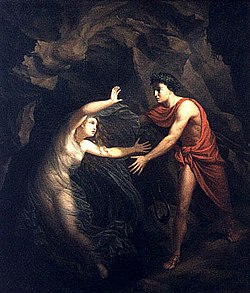
| caption = Eurydice in ”[[Hades (video game)|Hades]]”
| caption = Eurydice in ”[[Hades (video game)|Hades]]”
| series = Hades
| series = Hades
| first=””Hades (video game)|Hades” (2020)
| first=””Hades” (2020)
| creator = [[Greg Kasavin]]<br />[[Darren Korb]] (music)
| creator = [[Greg Kasavin]]<br />[[Darren Korb]] (music)
| designer = [[Jen Zee]]
| designer = [[Jen Zee]]
Hades character
Eurydice is a character in the 2020 video game Hades.
Concept and creation
[edit]

Eurydice was created by Greg Kasavin, the game’s creative director,[1] and her art was created by art director Jen Zee.[citation needed] She is a dryad, based on the Greek mythological figure of the same name.[citation needed] Her story is a retelling of the legend of Orpheus and Eurydice, where Eurydice passed away some time after marrying Orpheus. Orpheus descends to the Greek underworld to meet Hades, at which point he played his melody for him. He was moved to compassion by his performance, allowing him to take Eurydice back to the world of the living under two conditions: she must walk behind him, and he may not turn to look at her until they leave. Orpheus eventually became suspicious that he had been fooled, as he couldn’t hear her footsteps. Right before escaping, he looked back, causing her to be trapped in the underworld.[citation needed] Eurydice has tree branches on her head, which she styles into an afro.[2]
Eurydice’s song “Good Riddance” was written by Hades composer Darren Korb. Korb consulted with Kasavin about the song’s composition, asking him about details such as the subject matter, her point of view, and her feelings towards Orpheus at the time. Korb eventually conceived it as a song that was meant to both convey that she was happy with being in the underworld and happy without Orpheus, comparing it to a breakup song by an artist like Meghan Trainor. He then presented the finished lyrics to Kasavin. Between Eurydice and Orpheus, Korb intended them to have musical styles that matched their personalities; where he wrote Orpheus to have “more of a classical implication or more dramatic or operatic or melodramatic style”, Eurydice’s was made to have a “more straightforward, simplistic style” that was more accessible and less flowery.[1] This song is sung by both of them, Orpheus’ role performed by Korb.[3] The song “In the Blood” is also sung by both of them, was created to feature both of these elements.[1] Eurydice is voiced by Fransesca Hogan, while her singing is performed by Ashley Barrett.[4]
Eurydice has received generally positive reception, with author Demetrius Shahmeri stating that she was “overwhelmingly” loved by fans of the game and that she often appeared among the top-ranked Hades characters on lists. Shahmeri stated that her “strong personality, “colorful and striking design … and her music” were among the top reasons why she was so favored.[5] Inverse writer Just Lunning praised the character designs of Hades, stating that every character is “consciously trying their best to be beautiful.” They considered Eurydice’s design an embodiment of this, particularly the way she forms an afro of tree branches.[2]
Her song, “Good Riddance”, was met with positive reception. The Escapist writer Jessica Hoops stated that there was “something magical” with encountering Eurydice for the first time, believing it served as a moment of peace among the world’s typical chaos. She felt that the song served as a greater prize than the in-game rewards for meeting her, arguing that while the song’s lyrics express relief over being “freed from earthly burdens”, the use of a C minor key signature gave it a “slightly mournful air”. She described the theme as being for someone who is “resigned to her fate but wants to convince herself that she’s celebrating it”. [6] RPGFan writer Patrick Gann also praised it, stating “the melodies here are lovely, and the chord progression is deceptively simple” while calling it “beautiful.” He enjoyed Korb’s falsetto singing voice, stating that it brings depth to the song, adding that he sometimes prefers listening to the “crisp, melodic strains” Barrett provides. He hoped that they would appear in Hades II so that he could hear their singing again.[3] Fellow RPGFan writer Michael Sollosi also praised the duet between them, calling it a highlight of the game.[7]
The Mary Sue writer Briana Lawrence praised the various relationships found in Hades, in particular Eurydice and Orpheus, praising their duet upon being reunited as “beautiful”.[8] Vox writer Neel Dhanesha stated that the quest to reunite Eurydice and Orpheus was one that helped him recognize how “special” Hades was as a game. He stated that the first time meeting her broke the rhythm of the game’s gameplay loop, and that upon informing Orpheus of her location, he became intent on reuniting them. He stated that living in a pandemic at the time compelled him to “[help] these two characters regain some semblance of the life they once had”. He added that he was not surprised that developer Supergiant Games would tell such a story through music, considering it “a tale of beauty and hope found in the midst of pain and death, loss and regret” and stating that he couldn’t get t he song out of his head.[9]
The song “In the Blood” received praise from author Daniel Carpenter, who identified it as the signature song of the Hades soundtrack. He described how the acknowledgment that it is being sung by Eurydice and Orpheus inserts itself into the game’s diegesis. He argued that this song resembled a “popular music song” instead of a looping video game track due to its pacing and structure, and that it and “Good Riddance”‘s use of a semitome can “invoke its connotations of death” as well as create an in-universe musical style for Eurydice and Orpheus. He believed that Korb’s falsetto and Barrett’s “flowing, expressive vocal delivery” was vocally similar to bands such as Muse and Radiohead, including “Citizen Erased” and “No Surprises” respectively. Carpenter argued that, rather than the “timbral opposition” in Hades‘ main theme, “In the Blood” focuses on unity, citing “close vocal harmonies”, believing this to be an intentional decision to represent the reunion of Eurydice and Orpheus.[10] Author Silvia Mantilla-Wright commented that Eurydice and Orpheus represented a”pseudo-Greek chorus”, stating that they serve as observers of the narrative as it progresses, and that “In the Blood” serves as their commentary on the narrative themes of the game.[11]
Author Demetrius Shahmeri found his first encounter with Eurydice “shocking” due to the lack of a threatening presence and metal music he had become accustomed to. He stated that Zagreus’ confusion about the singing mirrored the player’s, and that it was not immediately clear whether this was being sung by a character due to there not being any vocal tracks prior to this. He found the depiction of Eurydice significant due to both the myth itself and how the myth is used in the game to “raise questions about voice and gender in video games”. Shahmeri argued that, while Eurydice was a minor figure in Greek mythology, she became significant more recently, particularly as a musical symbol, citing Hades‘ depiction.[5]
- ^ a b c Lane, Gavin (September 11, 2021). “Feature: “Metal Comes From Hell, Everyone Knows This” – Darren Korb Talks Loki, Lavtas, And Led Zeppelin”. NintendoLife. Retrieved November 4, 2025.
- ^ a b December 10, 2020. “2020’s most beautiful video game makes diversity divine”. Inverse. Retrieved November 4, 2025.
{{cite web}}: CS1 maint: numeric names: authors list (link) - ^ a b Gann, Patrick (February 24, 2023). “Hades Original Soundtrack”. RPGFan. Retrieved November 4, 2025.
- ^ Schilling, Chris (Christmas 2020). “The Making of… Hades”. Edge.
- ^ a b Shahmeri, Demitrius (January 1, 2025). [online.ucpress.edu/jsmg/article/6/1/66/205399 “Eurydice Sings: Revoicing a Musical Myth in Hades”]. Journal of Sound and Music in Games. Retrieved November 4, 2025.
- ^ Hoops, Jessica (March 21, 2023). “Six of the Most Haunting Tracks Used in Video Games”. The Escapist. Retrieved November 4, 2025.
- ^ Sollosi, Michael (February 10, 2021). “RPGFan Games of the Year 2020 ~ Editors’ Awards: Michael Sollosi”. RPGFan. Retrieved November 4, 2025.
- ^ Lawrence, Briana (August 10, 2022). “Have We Talked About How Fantastic the Ships Are in ‘Hades?’ We Have? Cool, Let’s Do It Again”. The Mary Sue. Retrieved November 4, 2025.
- ^ Dhanesha, Neel (February 12, 2022). “Hades tells a love story through song and side quest”. Vox. Retrieved November 4, 2025.
- ^ Carpenter, Daniel (January 1, 2025). “It’s ‘In the Blood’: Hades’s Signature Song and the Transcendence of Genre”. Journal of Sound and Music in Games. Retrieved November 4, 2025.
- ^ Mantilla-Wright, Silvia (January 1, 2025). ““There Is No Escape”: Hades and the Apotheosis of Death in Music”. Journal of Sound and Music in Games. Retrieved November 4, 2025.

