
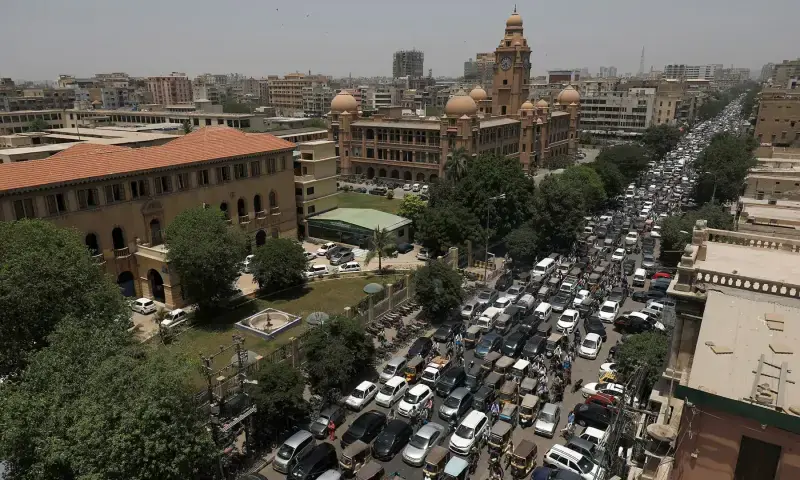
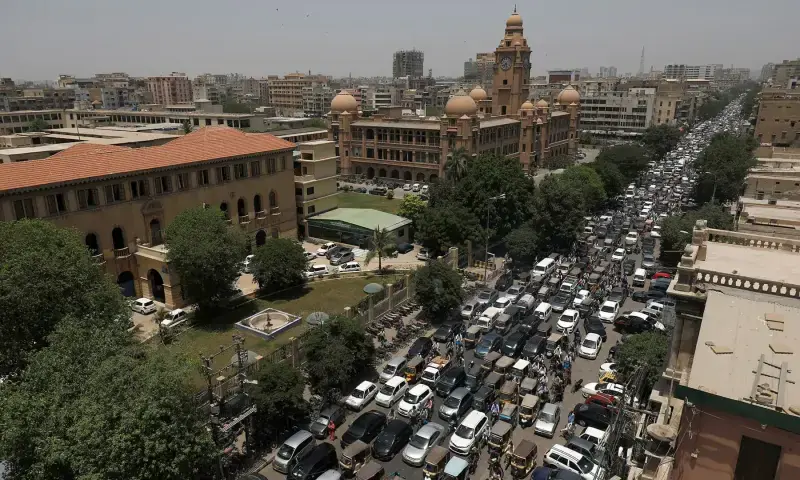
Sindh Senior Minister Sharjeel Inam Memon on Wednesday defended the recently implemented e-challan system by the provincial government, calling it a “bitter decision” that can save precious human lives.
The Sindh government in June had decided that e-challans for traffic violations would be delivered to vehicle owners’ registered home addresses. The system, officially inaugurated last month, has drawn a mix of praise and criticism from the public.
Speaking at a press conference in Karachi today, Memon defended the system, claiming that two businessmen (who he did not name) phoned him to praise the initiative.
He termed it a “bitter decision that can eventually save precious human lives,” adding that the government launched the initiative with the aim of ensuring that people abide by traffic laws. Addressing journalists, he asked if there had been an improvement since the government increased these challans.
The minister pointed out that since the implementation of the system, more than 20,000 challans had been issued, adding that many violators had appealed against the challan as first offences were pardoned.
Referring to driving the wrong way, Memon said, “If you look at the laws in other countries, the violator is imprisoned and cars are impounded for up to two to three years”.
He said traffic laws are for the betterment of people, and the intention is not to harm anyone.
In response to criticism of infrastructural problems in the metropolis, Memon reassured that the provincial chief minister had directed local governments and municipalities to improve the city, with the target of completing several projects by March.
“I believe in this entire tenure, the greatest news Karachi residents have received is that of [the construction of] Shahrah-i-Bhutto,” he said, terming it a “state-of-the-art” facility, and stating that once the road meets M9, it would be a huge convenience for Karachiites.
In response to a question on the e-challan system being challenged in the court, Memon said citizens and political parties have the right to do so, but the government is firm on its stance.
JI challenges e-challan system
Earlier today, Jamaat-i-Islami (JI) had filed a petition in the Sindh High Court (SHC) challenging the e-challan initiative, alleging that the system, based on artificial intelligence (AI), imposes “exorbitant and discriminatory fines” on Karachi residents.
A petition was submitted in the SHC by JI’s Karachi chief, Monem Zafar Khan, City Council Opposition Leader Advocate Saifuddin, and MPA Muhammad Farooq. It was filed against the Sindh government through its chief secretary, the provincial home and excise departments, Inspector General of Police (IG) Ghulam Nabi Memon, and Traffic Deputy IG Peer Muhammad Shah.
The petition, filed under Article 199 (high court’s jurisdiction) of the Constitution, stated that the petitioners are “law-abiding citizens, taxpayers and residents of Karachi” aggrieved by the “arbitrary notification” imposing a new AI-based e-challan system with exorbitant and discriminatory fines introduced by the Sindh government and the traffic department.
The petition said that the said system operates through CCTV and AI-enabled cameras which automatically detect alleged traffic violations and issue electronic challans to the registered owner of the vehicle, “regardless of the fact as to was actually driving at the time of the alleged violation and who is the actual owner”.
It stated that the “impugned notification” introducing the system has been implemented without “first ensuring the necessary road infrastructure, vehicle ownership verification mechanisms, installation of proper speed limit signboards, zebra crossings, and other essential traffic signs”.
Furthermore, according to the petition, “coercive measures such as a drastic increase in fines, in some cases up to 1,000 per cent, blocking of computerised national identity cards (CNIC), suspension of driving licenses, and impounding of vehicles upon non-payment amount to punishment without due process of law”.
Per the petition, in Karachi and other parts of Sindh, a large number of vehicles continue to operate without a formal transfer of ownership, as the registration records still reflect the name of the original owner.
“This situation persists due to the cumbersome and corrupt procedures in the Excise and Taxation Department, which discourage timely transfer of ownership,” stated the petition.
The respondents, particularly the excise department, “have failed to introduce a simple and corruption-free mechanism for transfer of ownership, thereby compelling many citizens to use vehicles not yet transferred in their names”, it said, adding that the respondents are duty-bound to ensure an efficient and transparent system for ownership transfer.
Even on Sharea Faisal, one of the city’s key arterial roads, there are no traffic and speed limit signs, no zebra crossings and no other marks available, the JI
Moreover, the petition highlighted that the roads in Karachi are in “deplorable condition” because of which “vehicles cannot be driven smoothly, forcing commuters to take alternative or even wrong routes”.
“In several areas, the traffic police themselves direct vehicles to drive on the wrong side due to ongoing construction works, for example, Numaish as well as along University Road where the [Red Line Bus Rapid Transit (BRT) project] is under construction and is not expected to be completed for another three to four years,” it stated.
“Consequently, traffic remains congested day and night. Streetlights have been removed, diversions are inadequate, and barriers have been placed haphazardly, causing further inconvenience and accidents,” the petition mentioned.
The petition requested SHC to “suspend the operation, implementation, and enforcement” of the “impugned notification” and the challans, penalties and proceedings initiated against the citizens of Sindh, and restrain the respondents from issuing, processing, or recovering any penalty until the final disposal of the petition.
It also requested the court to declare the implementation of the AI-based e-challan system without adequate infrastructure and ownership verification safeguards as “illegal, arbitrary, and unconstitutional”.

